The Tiverton hospital’s diet for the poor, children’s column · Tiverton, Devon
What Did Children Eat in the 1700s?
Bread, cheese, oatmeal and milk, with broth, pease and meat twice a week: the 1782 Tiverton workhouse diet, Hampton’s poorhouse and Samuel Bamford’s porridge.
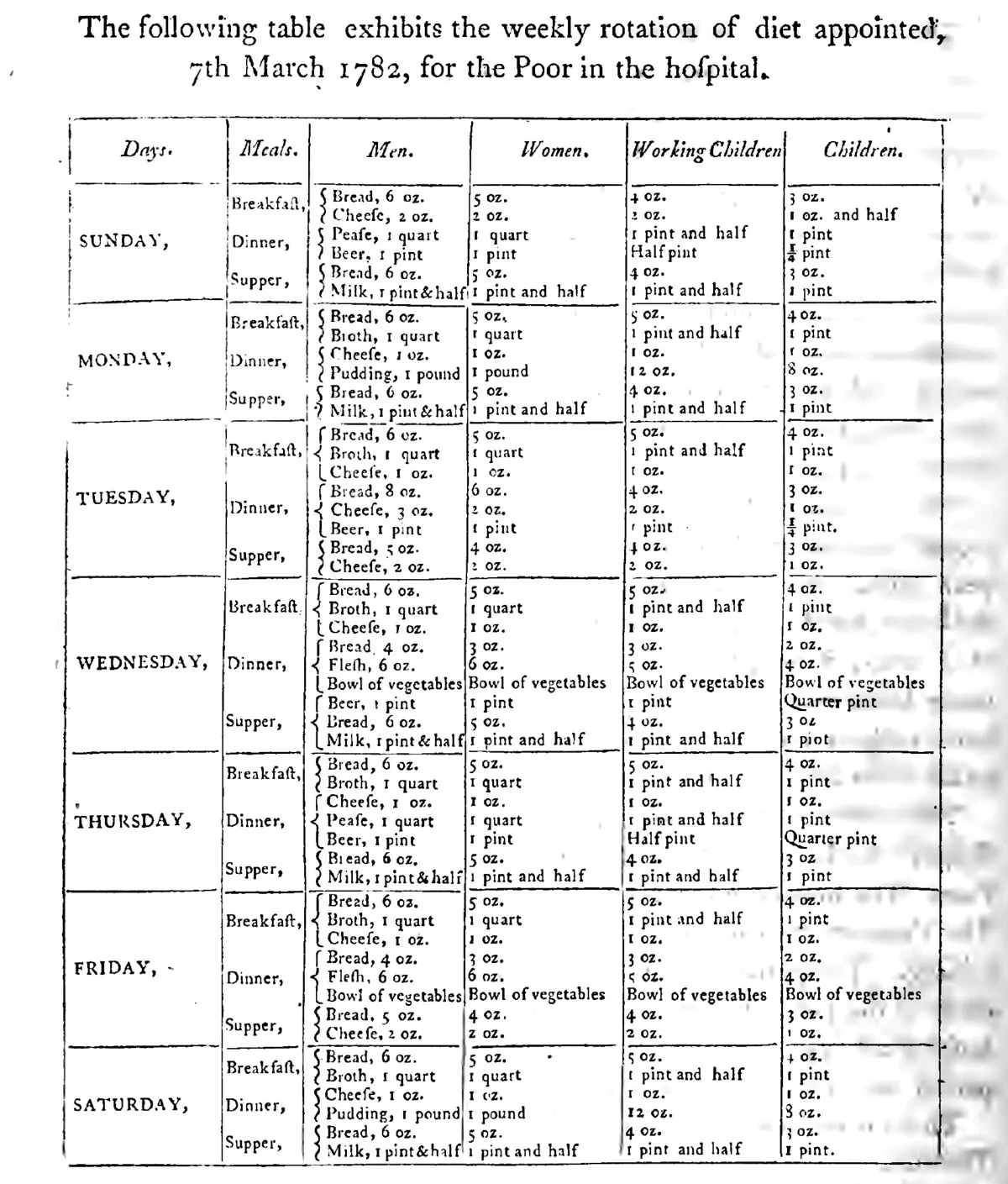
Bread, cheese, oatmeal and milk, most days and most meals, with broth, pease, a pudding and a little meat through the week. That is what poor English children ate in the late 1700s, on the evidence of the tables that set it down. The clearest is the weekly diet appointed on 7 March 1782 for the poor in the hospital at Tiverton, in Devon, which gives children a column of their own, down to a quarter pint of beer at dinner.
A week at Tiverton
Tiverton’s poor were kept in a hospital, as the town called its workhouse, built in 1704 and big enough for 300 people besides the master’s family. A large garden next to it kept the house in vegetables. The diet table survives because Frederic Morton Eden, who gathered reports on the poor from parishes across England in the mid-1790s, copied it from a local history of 1790 into the second volume of his State of the Poor (1797). It splits every meal four ways: men, women, “working children” and “children.”
The children’s column is short and regular. Breakfast from Monday to Saturday was 4 ounces of bread and a pint of broth, with an ounce of cheese on three of those days; on Sunday it was 3 ounces of bread and an ounce and a half of cheese. Supper on five nights was bread and a pint of milk, and on the other two bread and cheese. Dinner changed with the day: a pint of pease on Sunday and Thursday, 8 ounces of pudding on Monday and Saturday, bread and cheese on Tuesday, and on Wednesday and Friday 4 ounces of meat with bread and a bowl of vegetables. Added up, a young child’s bread came to 55 ounces a week, a little under 3½ pounds, against the men’s 98.
The beer is in the same column. Young children had a quarter pint of it four times a week, at dinner on Sunday, Tuesday and Thursday and at supper on Wednesday. Working children, presumably those old enough to be put to work, ate between the women and the little ones, and on Tuesday and Wednesday they were poured the full pint the adults had. The table has no tea, no sugar and no butter at all.
Breakfast in the poorhouse
Eden’s reports from other parishes fill in what a table of ounces leaves out. At Hampton, in Middlesex, the poorhouse on the common held 17 people when he wrote, and 12 of them were children, seven girls and five boys. The man and his wife who ran it were paid 2s. 8d. a week for every pauper they fed (about £13 today, by UK consumer prices from the Bank of England), and to Eden the food “seems wholsome and good.” In the previous winter, he recorded, four old people and one child had died there, “chiefly owing to the inclemency of the weather.”
Hampton’s table of diet gives the children their own lines. Breakfast was “Broth, or water-gruel: and sometimes bread and milk for the children,” while the men and women had bread and cheese. Dinner was boiled beef, half a pound each, “sometimes dumplins,” and a pint of beer, and “the children are not limited to any certain quantity,” which may mean the beer or the beef; the page doesn’t say. At supper, where the adults had bread with butter or cheese, the children had bread and cheese, “and sometimes a little treacle, in lieu of cheese.” On the same common lived nurse children sent out from the parish of St Martin-in-the-Fields in London. One woman caring for five of them told Eden “she had brought them all up by hand,” that is, without a wet nurse, and that they went back to London at eight or nine.
Further north the bowl changed. At Ashby de la Zouch in Leicestershire, a workhouse of “chiefly old women and children,” breakfast every day of the week was “Milk-pottage, water-pottage, or gruel”; the children there were taught to read and to spin jersey. At Lancaster the workhouse served milk pottage morning and night. In laborers’ homes there, Eden wrote, breakfast was milk pottage “or hasty-pudding, which is here called water pottage.” The workhouse kept four cows and sold the butter, none of which was used in the house “except for the sick, and the governor and governess.”
At home in a laborer’s cottage
Eden also wrote down what some families ate in their own homes, and there a child’s bowl could be emptier than the workhouse’s. At Monmouth, on the Welsh border, Samuel Price, a laborer of 52, had a wife and nine children, the youngest a year and a half old. His ordinary wage was 8s. a week (about £39 today), and by his own account bread alone cost him about 9s., “and that he could use more if he could get it.” The gentleman he worked for allowed him about three pints of milk a day, “which, with a little bread, serves his children for breakfast; his wife drinks tea.” Dinner was bread, potatoes and salt, with a little fat or dripping when it could be had cheap, and supper was bread or potatoes. His family, Price said, was “little more than half supplied with what they could eat.”
At Wolverhampton a spectacle-frame maker of 40, earning about 16s. a week, had boys of ten and seven and girls of two and six months. The elder boy had been put to work in his father’s shop, where, the report says, his work produced “more trouble than profit.” Breakfast in that house was divided by age and work: “bread and milk for the man and his son’s breakfasts, and tea for the wife and young children.” The Tiverton table never served tea; in a cottage it had already reached the youngest.
A pound of meat at the Foundling Hospital
London’s Foundling Hospital, which took in its first children on 25 March 1741, began more generously. Its own Account of 1799 prints the diet its General Committee resolved on 11 March 1740: roast beef on Sunday, stewed beef with turnips and carrots on Monday and Thursday, roast mutton on Tuesday and Friday, boiled beef with greens or roots on Wednesday, and on Saturday boiled beef again, or pork with pease pudding in winter and shoulders of veal in summer, all at “a pound for each head a day one with another.” The writer of 1799 put that down to “the over kindness and English feelings” of the committee and added that the meat allowance “found sufficient” by his time was “not much more than one fourth of what was then ordered.”
A doctor and a cookbook
Some of the plainest advice of the century was written for that hospital. William Cadogan, a Bristol physician, addressed his Essay upon Nursing, and the Management of Children to one of its governors, and the committee had it printed; the copy followed here is the fourth edition, of 1750, which covers children up to three. Cadogan wanted their food simple and light. The paps, panadas and gruels of the nursery came sweetened and spiced, “and sometimes a Drop of Wine,” he wrote, “neither of which they ought ever to taste.” In their place he gave broth with a little bread or rice, and bread boiled in water and mixed with milk.
A cookbook of three years earlier shows what he was up against. Hannah Glasse’s The Art of Cookery Made Plain and Easy (1747) has a chapter of “Directions for the Sick.” Its water gruel is plain oatmeal, salt and butter. On the next page comes “For a Child,” a tea of sage, balm, rue, mint and pennyroyal, two of which, rue and pennyroyal, are unsafe to drink, and then a mouthwash for a child with thrush that ends: “Give the Child over Night one Drop of Laudanum, and the next Day proper Physick.” Laudanum was a tincture of opium.
Samuel Bamford’s two tables
Samuel Bamford, born in 1788 and later the author of Passages in the Life of a Radical, set down in Early Days (1849) what he ate as a boy at two very different tables. For a time his father ran the workhouse of the township of Manchester as its governor, and the boy lived there among “these poor children and poor people.” He remembered the paupers’ diet, “according to my best recollection,” as “water porridge and milk for breakfast, and sometimes drink porridge: boiled beef and vegetables, broth, hash, peas-soup, stew, and bread, for dinner.” Supper was water porridge and milk again, except on Sunday evenings, when each adult had a pint of good ale with bread and cheese. The children’s share isn’t mentioned.
After his mother died, he was sent to his uncle and aunt in Middleton. Their food was plainer still: water porridge poured into one brown earthen dish for the whole household, with milk in a pot for each person, and for dinner meat and potatoes, potato pie, broth or barm dumplings. When there were dumplings, “a little dip was made from the water the dumplings had been boiled in; a lump of butter and a little sugar or treacle being added.”
The recipes
None of these tables comes with recipes, so the recipes here come from the books of the same years, each matched to a dish the records name. Cadogan’s own bread and milk stands for Hampton’s breakfast; Glasse gives the dumplings and the oatmeal.
- Bread and Milk (1750): bread simmered almost dry, then stirred into cold milk, as Cadogan prescribed.
- Yeast Dumplings with Dip (1747): Glasse’s boiled bread-dough dumplings, under Bamford’s dip of butter and sugar.
- Water Porridge and Milk (1747): Glasse’s oatmeal hasty pudding, served from one dish with a cup of cold milk each.
The rest of the Tiverton week is already in Glasse’s book: her Pease Soup for Sea (1747) stands in for the Sunday pease and her Suet Pudding for Sea (1747) for Monday’s pudding. For what the poor of London were sold by the quart in the same hungry decade, read What Was in London’s Penny Soup in 1799? The nursery gruel was already sweet a century before Cadogan, as Hannah Woolley’s raisins and currants show in What Did Children Eat in the 1600s?, and Beeton’s milk soup poured over bread carries the bowl on into What Did Victorian Children Eat?
Cooking it
For a classroom or a kitchen table, start with Water Porridge and Milk (1747): a quart of water, oatmeal, butter, salt and a jug of milk make breakfast for four in twenty minutes, and set out in one dish with a mug each, it is the Middleton breakfast as Bamford described it.
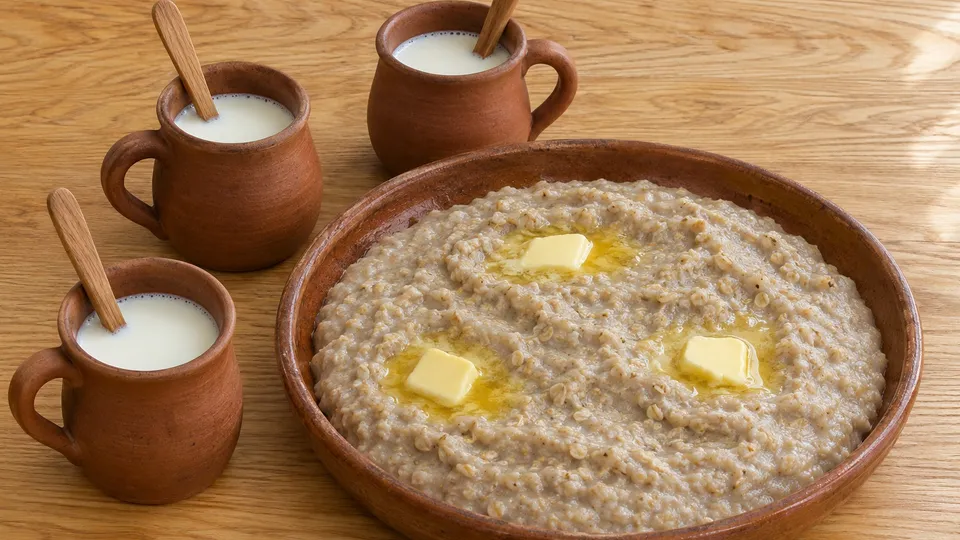 Cook it todayWater Porridge and Milk (1747)
Sources
- Frederic Morton Eden, The State of the Poor, vol. 2 (London: J. Davis, 1797): Tiverton, pp. 143–145; Lancaster, p. 309; Ashby de la Zouch, p. 375; Hampton, pp. 435–436 and 439; Monmouth, pp. 448–449; Wolverhampton, pp. 660–661.
- An Account of the Foundling Hospital in London (London, 1799), pp. 17–18.
- William Cadogan, An Essay upon Nursing, and the Management of Children, from their Birth to Three Years of Age, 4th edition (London: J. Roberts, 1750), pp. 20–22.
- Hannah Glasse, The Art of Cookery Made Plain and Easy (London, 1747), pp. 80, 112 and 120–121.
- Samuel Bamford, Early Days (London: Simpkin, Marshall, 1849), pp. 51, 73–74 and 103–105.