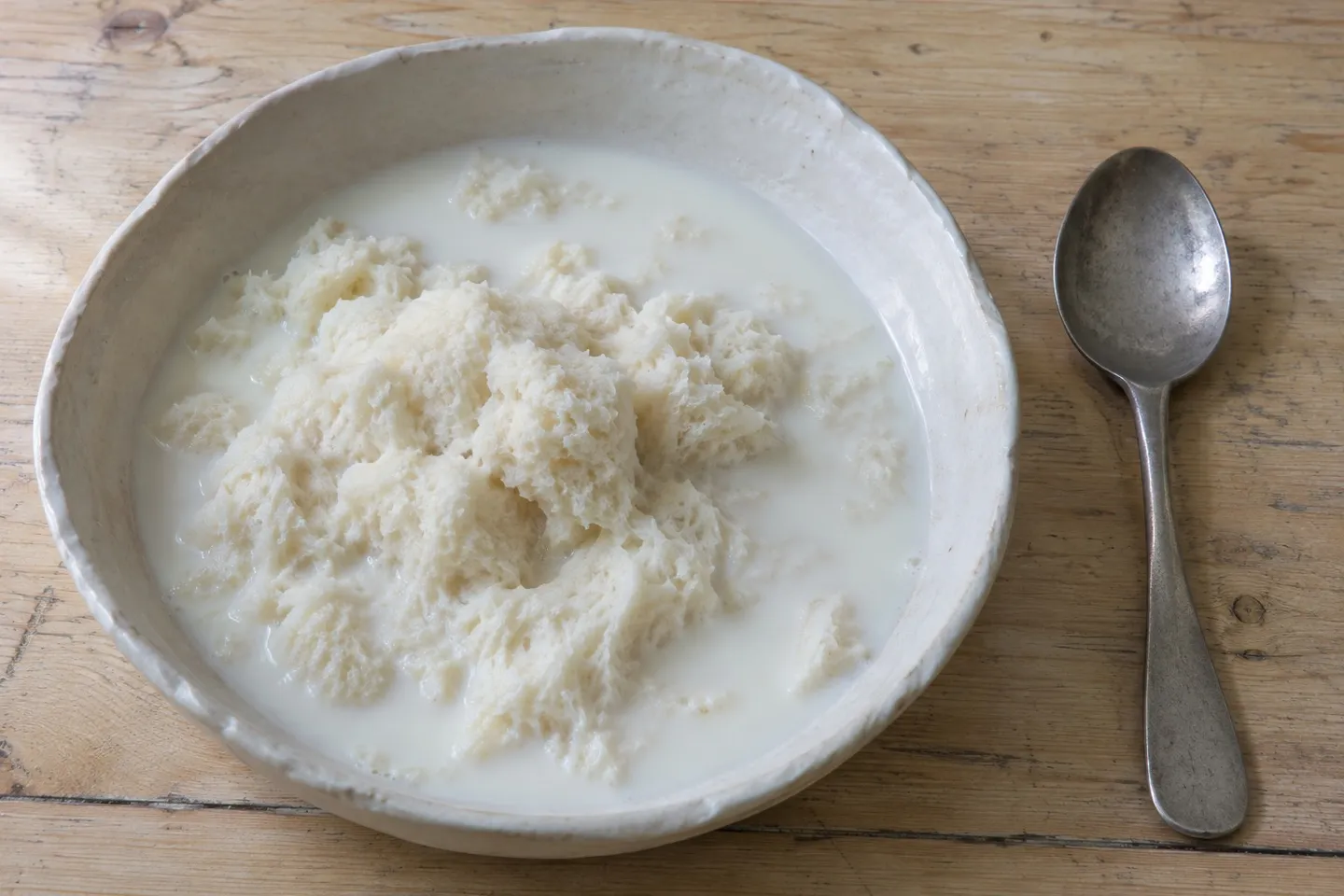
Bread and Milk (1750)
Reader ratingsBread and milk from William Cadogan’s Essay upon Nursing of 1750: bread simmered in water until almost dry, then stirred into fresh milk, with no sugar or spice.
- Recipe makes
- 2 small bowls
- Prep
- Cook
- Total
The bread takes 5 to 10 minutes to simmer down in the water. Cadogan’s milk goes in cold, so the bowl is ready as soon as it is stirred.
Soft bread pieces in cold milk in a white bowl, with a pewter spoon.
The story behind the recipe
Bread boiled in water until almost dry, then stirred into fresh milk: that is the whole of the bread and milk William Cadogan, a Bristol physician, set down for small children in 1750. What makes it his is what he left out: sugar, spice and anything else he would have called a “pretended Amendment.”
A doctor’s plain dish
Cadogan’s Essay upon Nursing, and the Management of Children was written as a letter to one of the governors of the Foundling Hospital in London, and the hospital’s General Committee had it printed. The copy followed here is the fourth edition, of 1750. It covers children from birth to three years old, and its target is the nursery of its day. The paps, panadas and gruels given to children, Cadogan wrote, were “generally enriched with Sugar, Spice, and sometimes a Drop of Wine; neither of which they ought ever to taste.”
His answer was bread, which he called “the lightest thing I know,” because its fermentation had already done part of the work. He split a small child’s diet between thin broths with a little bread or rice in them and this bread and milk, “something like Milk from the Cow, with the additional Strength and Spirit of Bread in it.” The child was to be fed at fixed times, as much as its appetite asked, “but no more.”
The same bowl turns up far from any doctor’s study. At the poorhouse on Hampton Common in the mid-1790s, breakfast was broth or water-gruel, “and sometimes bread and milk for the children,” as Frederic Eden’s survey of the poor recorded.
Read more about this recipe
Making it today
Cadogan wrote for babies, and the dish here is for older children and grown-ups; for a baby, follow current feeding advice. His milk was “fresh” and “not boiled,” which in 1750 meant milk as it came from the cow. Pasteurized whole milk, used cold, is our choice in its place. He gives no amounts, so the two slices of bread to a cup of milk are ours, and so is taking off the crusts, which keeps every piece soft. It stays unsweetened, the way he wanted it.
What Did Children Eat in the 1700s? sets Cadogan’s advice beside the poorhouse tables of the same decades. For the oatmeal side of the same table, there is Samuel Bamford’s Water Porridge and Milk (1747).
The other Part of Childrens Diet may be a little Bread and Water boil’d almost dry, and then mix’d with fresh Milk, not boiled. This, without Sugar, Spice, or any other pretended Amendment whatever, would be perfectly light and wholsome, of sufficient Nourishment, something like Milk from the Cow, with the additional Strength and Spirit of Bread in it.
Recipe makes: 2 small bowls
Ingredients
For 2 small bowls. Quantities are shown as written.
Quantities as written here, for 2 small bowls.
- Day-old white bread, crusts removed2 oz
- Water3/4 cup
- Cold whole milk, pasteurized1 cup
Measurement notes
Ingredients as written here
- 2 oz day-old white bread, crusts removed
- ¾ cup water
- 1 cup cold whole milk, pasteurized
Equipment
 Small saucepan
 Wooden spoon
 Bowl
Instructions
Tear the bread into small pieces about the size of a thumbnail.
Put the bread in the saucepan with the water and bring it to a simmer over medium heat. Simmer gently for 5 to 10 minutes, stirring and breaking up the bread with the wooden spoon, until the water is nearly all taken up and the bread is a thick, soft mass. Don’t let it catch on the bottom.
Take the pan off the heat and let it stand for a minute or two.
Spoon the bread into the bowl and stir in the cold milk a little at a time until it is as loose as you like it. Serve at once.
Nutrition
160calories per serving
- Recipe makes
- 2 small bowls
- Servings
- 2
Estimated per bowl (2) from USDA FoodData Central values for white bread and whole milk.
Recipe notes
When adjusting quantities
Cadogan gives no amounts. Two slices of bread to a cup of milk makes two small bowls.
Notes
Quantities mentioned in these notes don’t change when you adjust the servings.
Cadogan’s milk went in unheated. For a warm bowl, heat the milk gently in a clean pan until it steams, then stir it in. Contains wheat and milk. Eat it fresh, and refrigerate any that is left within 2 hours.
Scaling changes the ingredients only; pan sizes and cooking times need their own judgment. To adapt this recipe further, try the recipe tool at TuneMyRecipe (opens in a new tab), our sister site.
Sources and attribution
After William Cadogan, An Essay upon Nursing, and the Management of Children, 4th edition (London: J. Roberts, 1750)
See the original pages (scan at Internet Archive) (opens in a new tab)
Recipe details
- Course
- Breakfast
- Region
- British
- Era
- 18th century
- Main ingredient
- Milk & cream
- Difficulty
- Easy
- Occasion
- Everyday meal