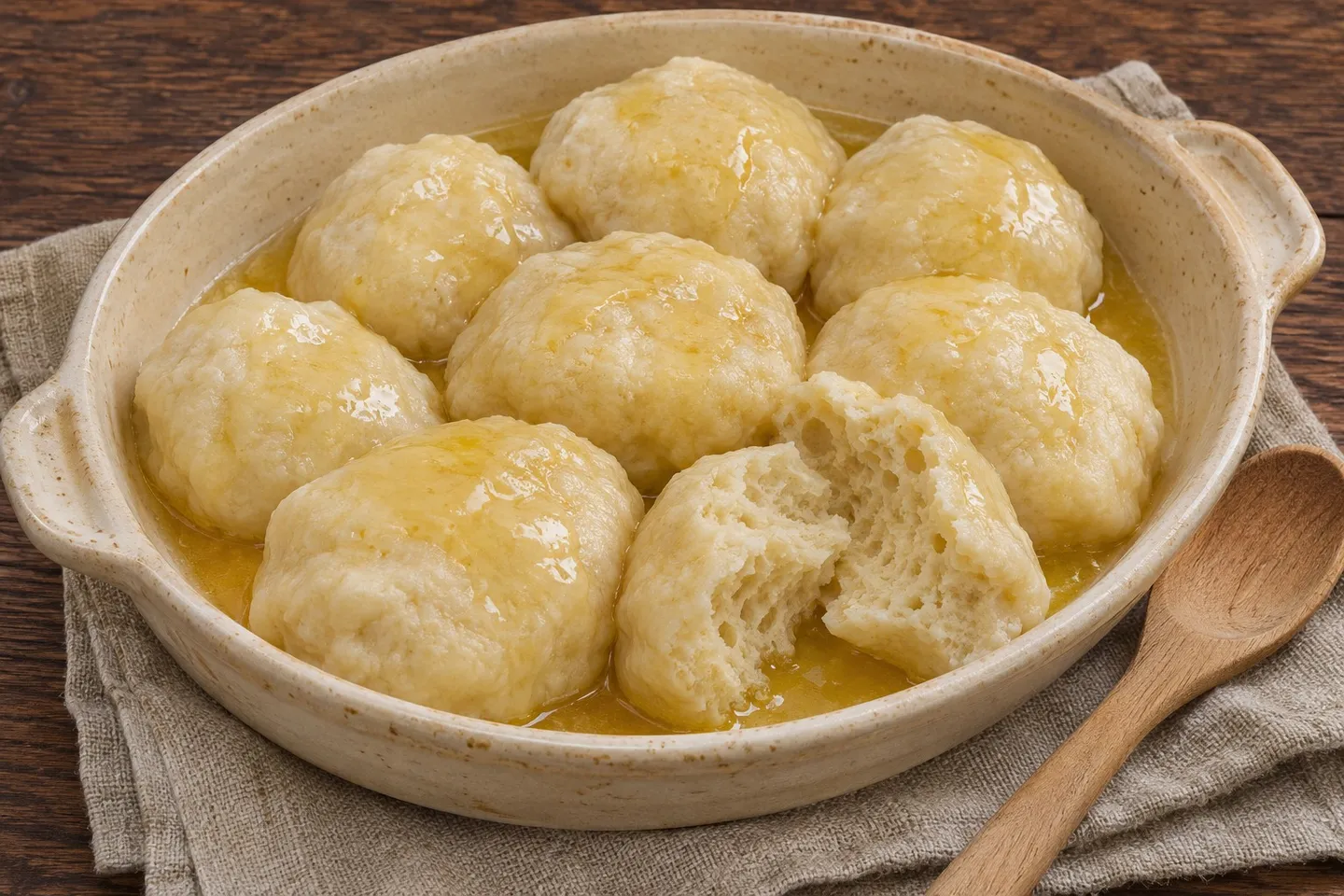
Yeast Dumplings with Dip (1747)
Reader ratingsHannah Glasse’s yeast dumplings of 1747, bread dough boiled in flat rounds, served the way Samuel Bamford remembered: with a dip of their cooking water, butter and sugar or treacle.
- Recipe makes
- About 12 dumplings
- Prep
- Cook
- Total
The dough rises for about 1 hour before shaping; that rest is the difference between total and working time. The dumplings boil in two batches of about 10 minutes each.
Boiled yeast dumplings in a cream earthenware dish with a butter and sugar dip.
The story behind the recipe
A yeast dumpling is a piece of bread dough boiled in water: Hannah Glasse’s rounds are “as big as a large Hen’s Egg,” flattened by hand and done “in ten Minutes or less.” This recipe pairs her 1747 dumplings with the way a Lancashire boy ate them half a century later, under a dip of butter and sugar.
Barm dumplings and a dip
Samuel Bamford, born in 1788, was sent as a boy to live with his uncle and aunt in Middleton, near Manchester. In Early Days, printed in 1849, he set down how they ate. Dinner might be meat and potatoes, potato pie, broth, “barm dumplings,” drink porridge or hasty pudding. Barm is the froth of yeast from brewing, and the dumplings were set out “in the same brown dish” as the morning porridge. “A little dip was made from the water the dumplings had been boiled in; a lump of butter and a little sugar or treacle being added; the dip was then poured upon the dumplings.” The household had one rule at table: “there was not to be any talking at meat.”
Bamford gives the dip but no dumpling. Glasse’s book of 1747 has one made the same way, with a light dough “as for Bread, with Flour, Water, Salt, and Yeast,” and her own sauce for it is melted butter in a cup. In the British Library copy followed here, her heading is printed “East Dumplings”; the book’s index has it right as “Yeast Dumplings.” She also points out the shortcut of a town cook: send to the baker’s “for half a quartern of Dough (which will make a great many).”
Dumplings came to the poorhouse too. At Hampton, where seven girls and five boys were among the seventeen people in the house in the mid-1790s, dinner was boiled beef and “sometimes dumplins.”
Read more about this recipe
Making it today
Glasse’s yeast came from the brewer; instant yeast stands in for it, and it needs about an hour to raise the dough where her ale-yeast had half an hour before the fire. Her warning is the one to keep: the dumplings must not sink to the bottom, “for then they will be heavy,” so the water stays at a full boil. The dip follows Bamford, with its amounts ours. Black treacle gives the darker, bitter-sweet version he also knew.
Bamford’s two tables, his uncle’s and the workhouse’s, are compared in What Did Children Eat in the 1700s? Glasse’s plainer sweet dish for the sea, boiled in a cloth, is Suet Pudding for Sea (1747).
FIRST make a light Dough as for Bread, with Flour, Water, Salt, and Yeast, cover with a Cloth, and set it before the Fire for half an Hour; then have a Sauce-pan of Water on the Fire, and when it boils, take the Dough, and make it into little round Balls, as big as a large Hen’s Egg; then flat them with your Hand, and put them into the boiling Water, a few Minutes boils them. Take great Care they don’t fall to the Bottom of the Pot or Sauce-pan; for then they will be heavy, and be sure to keep the Water boiling all the time. When they are enough, take them up (which they will be in ten Minutes or less) lay them in your Dish, and have melted Butter in a Cup.—As good a way as any to save Trouble, is to send to the Baker’s for half a quartern of Dough (which will make a great many) and then you have only the Trouble of boiling it.
Recipe makes: About 12 dumplings
Ingredients
For about 12 dumplings. Quantities are shown as written.
Quantities as written here, for about 12 dumplings.
Dumplings
- All-purpose flour, plus a little for shaping1 lb
- Salt1 1/2 tsp
- Instant yeast2 tsp
- Warm water1 1/3 cups
- Water, for boiling4 quart
Dip
- Cooking water from the dumplings1/2 cup
- Unsalted butter3 tbsp
- Granulated sugar, or black treacle2 tbsp
Measurement notes
Ingredients as written here
- 1 lb all-purpose flour, plus a little for shaping
- 1½ tsp salt
- 2 tsp instant yeast
- 1⅓ cups warm water
- 4 quarts water, for boiling
- ½ cup cooking water from the dumplings
- 3 tbsp unsalted butter
- 2 tbsp granulated sugar, or black treacle
Equipment
 Bowl
 Wooden spoon
 Clean kitchen towel
 Large pot
 Slotted spoon
 Instant-read thermometer
 Small saucepan
- Wide bowl or jug, to serve
Instructions
Mix the flour, salt and yeast in the bowl. Pour in most of the warm water and stir to a soft dough, adding the rest if it is dry. Knead on a lightly floured surface for about 8 minutes, until smooth and springy.
Return the dough to the bowl, cover it with the towel and leave it in a warm place for about 1 hour, until doubled.
Bring the water for boiling to a full rolling boil in the large pot.
Turn out the dough and divide it into pieces about the size of a large hen’s egg. Roll each into a ball between floured hands, then flatten it with your palm to a round about ¾ inch thick.
Drop in enough dumplings to float in one layer with room to swell, and keep the water boiling hard. Nudge them with the slotted spoon so none settles on the bottom. Boil for 8 to 10 minutes, turning once, until puffed and firm and the center of one reads 190°F (88°C) on the thermometer. Lift them out into the warm serving dish and boil the rest the same way.
For the dip, ladle the cooking water into the small saucepan with the butter and the sugar or treacle, and stir over low heat until the butter melts and the sugar dissolves.
Pour the dip over the dumplings and serve hot.
Nutrition
520calories per serving
- Recipe makes
- About 12 dumplings
- Servings
- 4
Estimated per serving (4) from USDA FoodData Central values for all-purpose flour, butter and sugar.
Recipe notes
When adjusting quantities
A pound of flour makes about a dozen dumplings the size of a large egg. Boil them a few at a time so they have room to swell.
Notes
Quantities mentioned in these notes don’t change when you adjust the servings.
Glasse’s own sauce was melted butter on its own, served in a cup. Bamford’s household used sugar or treacle; golden syrup is a milder stand-in for treacle. The dumplings are best straight from the pot; leftovers can be split and toasted the next day. Contains wheat and milk.
Scaling changes the ingredients only; pan sizes and cooking times need their own judgment. To adapt this recipe further, try the recipe tool at TuneMyRecipe (opens in a new tab), our sister site.
Sources and attribution
After Hannah Glasse, The Art of Cookery Made Plain and Easy (London, 1747), Yeast Dumplings; the dip as Samuel Bamford described it in Early Days (London, 1849)
See the original pages (scan at Internet Archive) (opens in a new tab)
Recipe details
- Course
- Main course
- Dish family
- Breads & Cakes
- Region
- British
- Era
- 18th century
- Difficulty
- Easy
- Occasion
- Everyday meal
- Season
- Winter