Water Porridge and Milk (1747)
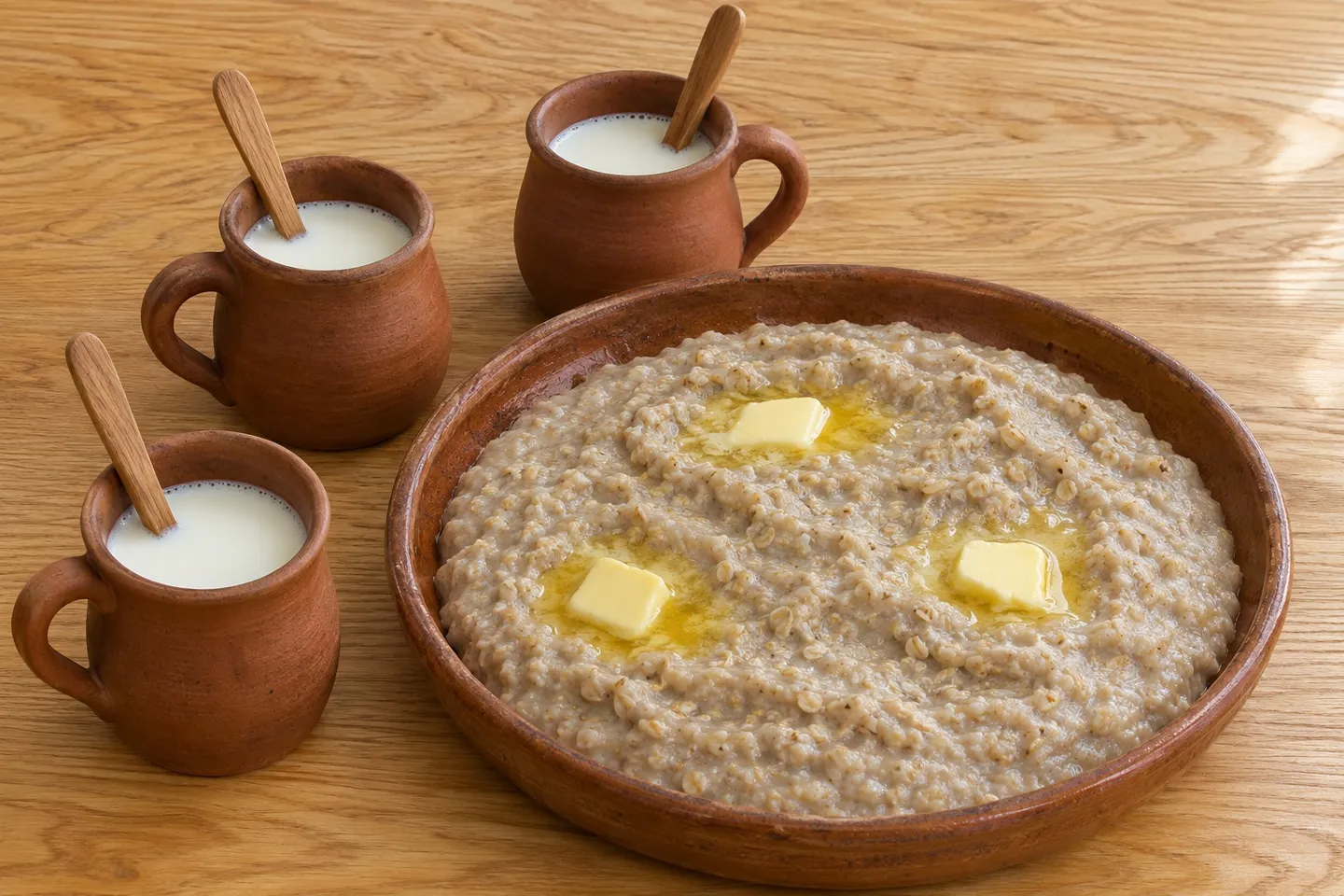
Reader ratingsWater porridge and milk: Hannah Glasse’s oatmeal hasty pudding of 1747, oatmeal stirred thick into boiling salted water with butter, eaten from one dish with a cup of cold milk each.
- Recipe makes
- 4 bowls, with milk
- Prep
- Cook
- Total
Glasse boils the porridge only a few minutes once it is thick. Medium oatmeal needs 10 to 15 minutes of stirring to turn soft, so the timing here is longer than hers.
Thick oatmeal porridge in one earthenware dish, with mugs of milk and spoons.
The story behind the recipe
Oatmeal stirred into boiling water until it is thick enough to hold a spoon went by two names. Hannah Glasse printed it in 1747 as “an Oatmeal Hasty-Pudding”; in Lancashire it was water porridge, and Frederic Eden, reporting from Lancaster in the 1790s, wrote that laborers’ breakfasts were milk pottage “or hasty-pudding, which is here called water pottage.”
One dish and a mess-pot each
The serving comes from Samuel Bamford, born in 1788, who wrote Early Days in 1849. In his uncle’s house in Middleton, near Manchester, breakfast began with “a brown earthen dish” set on a low beaufet, a kind of sideboard, near the middle of the floor, and “a boiling of water porridge was poured into the dish, hot from the pan.” Each person had a mess-pot of the same earthenware with milk and a spoon in it. His uncle asked a blessing, the children stood around, and they helped themselves “as quickly as we chose,” mixing it as they liked, “not a word being spoken all the time.” Oat cake finished the meal, and supper “was generally the same as breakfast.”
The pairing turns up in the workhouse and the cottage alike. Bamford remembered the Manchester workhouse, where his father was governor, giving “water porridge and milk for breakfast,” and the same again at supper. Eden found laborers at Cumwhitton, in Cumberland, breakfasting on hasty pudding “made with oatmeal and water, which is eat with milk.”
Glasse’s own serving was richer. Her porridge goes into the dish with pieces of butter stuck in it, to eat “with Wine and Sugar, or Ale and Sugar, or Cream, or new Milk,” and she adds that it “is best made with Scotch Oatmeal.”
Read more about this recipe
Making it today
Of Glasse’s choices, new milk is the one Bamford’s table had, and it is the one kept here; the wine and the ale are left out. She doesn’t say how fine her Scotch oatmeal was ground, and medium oatmeal is our choice; rolled oats make a softer, quicker dish. The amount of oatmeal is ours, since Glasse only says “of a good Thickness.” Serving the milk cold in a mug beside the dish, to be spooned over as you eat, is Bamford’s way.
This is breakfast and supper in What Did Children Eat in the 1700s? For the same grain soaked overnight and cooked long, the way the 1906 Mrs. Beeton preferred, compare Oatmeal Porridge (1906).
TAKE a Quart of Water, set it on to boil, put in a Piece of Butter, some Salt, when it boils, stir in the Oatmeal as you do the Flour, till it is of a good Thickness; let it boil a few Minutes, pour it in your Dish, and stick Pieces of Butter in it; or eat with Wine and Sugar, or Ale and Sugar, or Cream, or new Milk. This is best made with Scotch Oatmeal.
Recipe makes: 4 bowls, with milk
Ingredients
For 4 bowls, with milk. Quantities are shown as written.
Quantities as written here, for 4 bowls, with milk.
Porridge
- Water1 quart
- Unsalted butter, for the pot1 tbsp
- Salt1 tsp
- Medium oatmeal1 1/3 cups
- Unsalted butter, cold, in small pieces, to finish1 tbsp
To serve
- Cold whole milk2 cups
Measurement notes
Ingredients as written here
- 1 quart water
- 1 tbsp unsalted butter, for the pot
- 1 tsp salt
- 1⅓ cups medium oatmeal
- 1 tbsp unsalted butter, cold, in small pieces, to finish
- 2 cups cold whole milk
Equipment
 Medium saucepan
 Wooden spoon
 Wide bowl or jug, to serve
 Mugs
Instructions
Put the water, the butter for the pot and the salt in the saucepan and bring to a boil.
Sprinkle in the oatmeal a little at a time with one hand, stirring steadily with the wooden spoon in the other so no lumps form.
Lower the heat and let it bubble gently for 10 to 15 minutes, stirring often and scraping the bottom, until the porridge is thick enough that the spoon leaves a trail and the oatmeal is soft.
Pour it into the warm serving dish and press the pieces of cold butter into the top.
Fill a mug with milk for each person. Set the dish in the middle of the table, and let everyone eat from it with a spoon, dipping each spoonful in the milk.
Nutrition
330calories per serving
- Recipe makes
- 4 bowls, with milk
- Servings
- 4
Estimated per serving (4) from USDA FoodData Central values for oats, butter and whole milk, counting half a cup of milk each.
Recipe notes
When adjusting quantities
Glasse’s quart of water makes a dish for four. Keep one mug of milk for each person.
Notes
Quantities mentioned in these notes don’t change when you adjust the servings.
For family bowls in place of one shared dish, ladle the porridge into bowls and pour the milk around it. Leftover porridge sets firm as it cools; refrigerate it within 2 hours and slice and fry it in butter the next day. Glasse’s other serving, with cream, is the richer one. Contains milk; oats are often processed alongside wheat.
Scaling changes the ingredients only; pan sizes and cooking times need their own judgment. To adapt this recipe further, try the recipe tool at TuneMyRecipe (opens in a new tab), our sister site.
Sources and attribution
After Hannah Glasse, The Art of Cookery Made Plain and Easy (London, 1747), To make an Oatmeal Hasty-Pudding; served as Samuel Bamford described in Early Days (London, 1849)
See the original pages (scan at Internet Archive) (opens in a new tab)
Recipe details
- Course
- Breakfast
- Region
- British
- Era
- 18th century
- Main ingredient
- Grains & riceMilk & cream
- Difficulty
- Easy
- Occasion
- Everyday meal
- Season
- Winter