Children’s food in England, from Woolley’s cookbook to Locke’s advice · England
What Did Children Eat in the 1600s?
Bread, milk, gruel and small beer, the household’s own plain food. A few 1600s cookbook dishes were meant for children, among them a milk jelly for rickets.
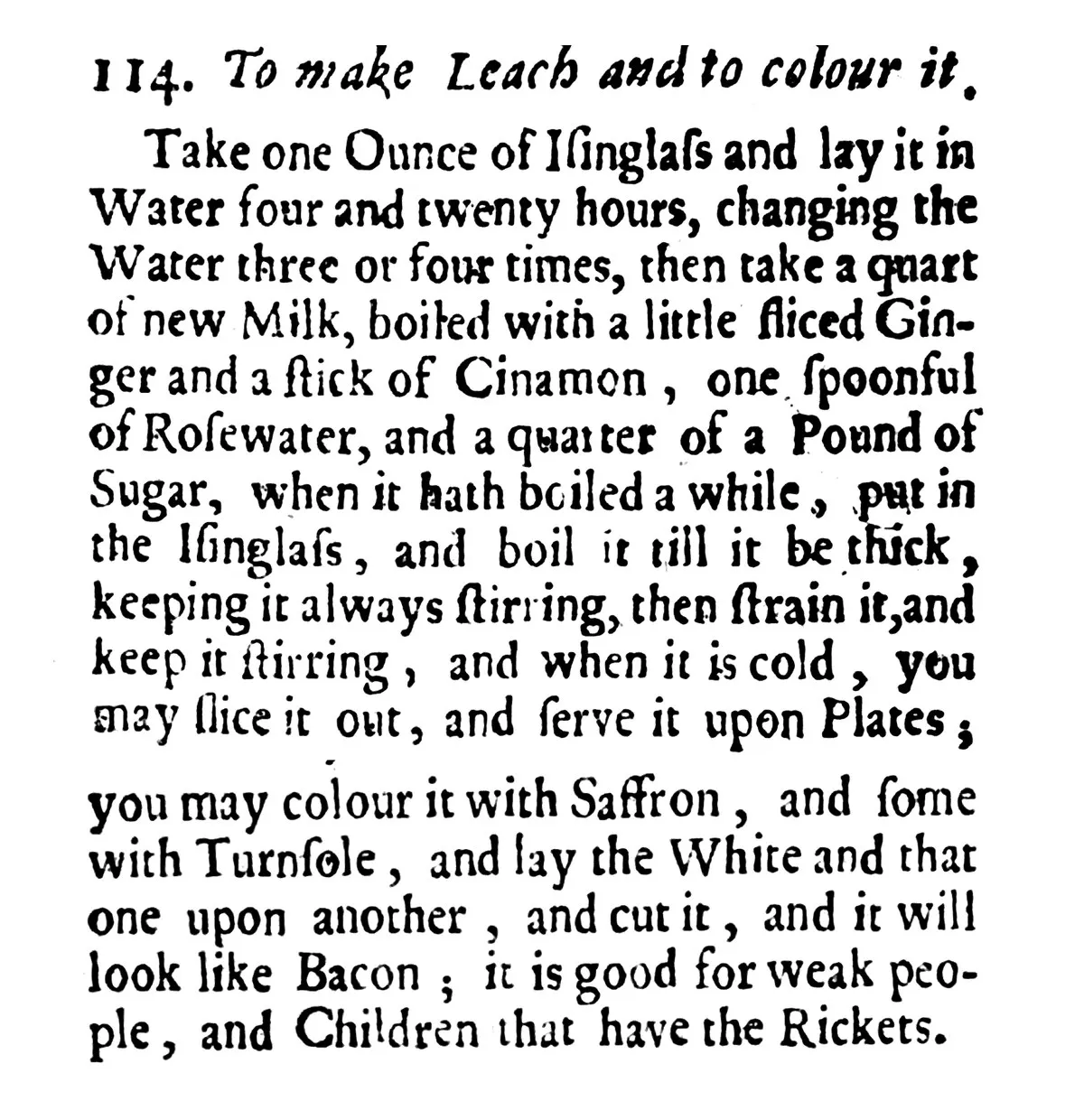
English children in the 1600s ate the plain food of the household they lived in: bread above all, milk and milk pottage, water-gruel made from oatmeal, a little meat once a day where the family could afford it, and small beer to drink. Cookbooks of the time wrote only a few dishes for them by name. Hannah Woolley’s Queen-like Closet of 1672 has a cold cup of small beer, bread and currants “for Children to eat in Afternoons in Summer,” and a sliced milk jelly she called good for “Children that have the Rickets.” The medicine books of the same years gave children boiled herb milks and worse, and the philosopher John Locke wanted the whole diet plainer still.
Before 1600: bread, beer and a nursery
Medieval and Tudor households gave children no menu of their own. The fifth Earl of Northumberland’s household book sets out who got which breakfast from Candlemas in the second year of Henry VIII’s reign, and two of his children appear as one more line in the list: “the Nurcy for my Lady Margaret and Mr. Yngram Percy.” On flesh days the nursery got “a Manchet j Quarte of Bere and iij Muton Bonys boiled,” a small loaf of fine white bread, a quart of beer and three boiled mutton bones. In Lent the bones gave way to a dish of butter, a piece of salt fish and a dish of sprats or three white herrings.
Milk had the doctors on its side. Andrew Boorde’s Dyetary of Helth of 1542 called cow’s and ewe’s milk “very good for melancoly men, & for olde men and chyldren, specyally yf it be soddyn, addynge to it a lytell sugre.” Boiled milk with a little sugar, bread, and beer: a century later the frame was much the same.
Dishes written for children
Woolley’s Queen-like Closet first appeared in 1670; its title page offers it to “Ingenious Persons of the Female Sex,” and its second edition of 1672 is the copy followed here. In the cookery part of the book, just after a pumpkin pie and fried pumpkin, comes No. 94: “To make Misers for Children to eat in Afternoons in Summer.” Half a pint of small beer, two spoonfuls of sack, the crumb of a halfpenny manchet, two handfuls of currants, nutmeg and a little sugar went together, “so give it to them cold.” The book’s table of contents files it as “Misers for Childrens Collation,” a collation being a light meal.
Children turn up in Woolley’s still-room too. Of a cordial water distilled from white wine with cinnamon, mace, rosemary flowers, cowslips and mithridate, she says to “save the first water by it self, and the small by it self, to give to Children,” a spoonful at a time sweetened with loaf sugar.
Her No. 114, “To make Leach and to colour it,” is a dish she recommends for sick children. An ounce of isinglass soaked for a day went into a quart of new milk boiled with ginger, cinnamon, rosewater and a quarter pound of sugar, and the jelly was sliced cold onto plates. Part of it could be colored with saffron and part with turnsole, and the colors laid one on another so the slices “look like Bacon.” It ends: “it is good for weak people, and Children that have the Rickets.”
Woolley’s No. 79, a fine water-gruel of oatmeal, doesn’t name children at all. Locke, twenty years later, put water-gruel among the breakfasts and suppers he thought “very fit for Children.”
Cures for rickets and teething
Rickets runs through the household books of these decades. The Queen’s Closet Opened, printed in London in 1656 as copies of the queen’s own receipt books, transcribed by “W. M. one of her late servants” and with a portrait of Henrietta Maria at the front, gives “To cure the Rickets in Children. Approved.” A quart of new milk was boiled half away with a handful of the herb sanicle for the child’s breakfast, with nothing else to eat for an hour or two after; at night a quart of milk boiled down with red mint, “let the Child eat it last at night,” for a month or longer. Woolley’s own bookseller, Richard Lowndes, filled the back pages of the 1672 Queen-like Closet with remedies he sold, starting with “A Cordial Powder, which doth infallibly Cure the Rickets in Children, and causeth an easie production of Teeth.”
Teeth had their own receipt in The Queen’s Closet, marked “proved”: “Take the head of a Hare boyled or roasted, and with the braine thereof mingle Honey and butter, & therewith anoint the childs gums as often as you please.” It is a record of what parents were told, never a remedy to try.
The NHS today describes rickets as a condition where “a child’s bones become weak and soft,” and says it is “usually caused by not getting enough vitamin D or calcium.”
John Locke’s plain table
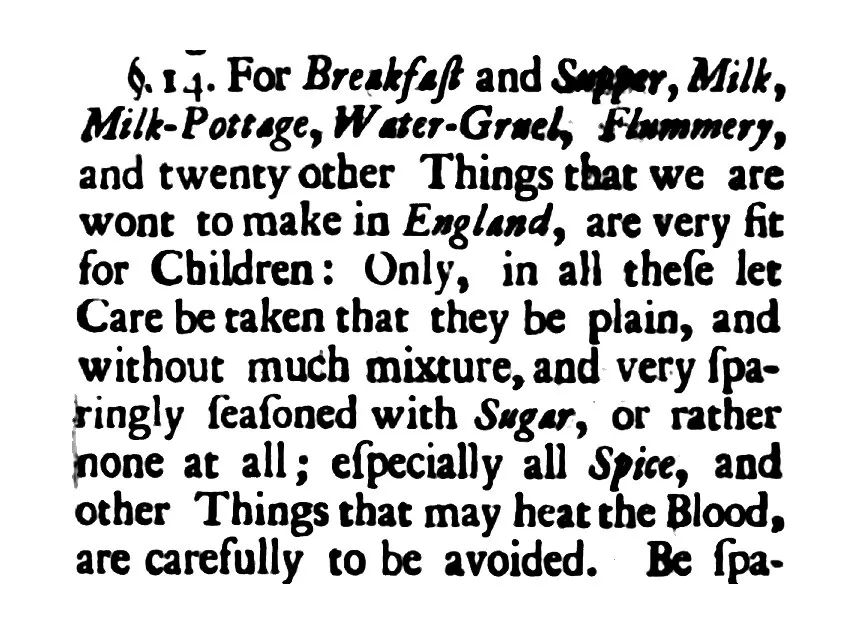 John Locke, Some Thoughts Concerning Education (London, 1693), section 14, p. 13. The lines through “Supper” and “Flummery” are ink damage in this copy, not deletions.
John Locke’s Some Thoughts Concerning Education began, his dedication says, as letters to his friend Edward Clarke, and was printed in London in 1693. A child’s diet, Locke wrote, “ought to be very plain and simple”: meat once a day, “and of one Sort at a Meal,” with no sauce but hunger, and bread eaten plentifully with everything. Breakfast and supper were the milk dishes and gruel, kept plain and “very sparingly seasoned with Sugar, or rather none at all,” with spice avoided altogether. A good piece of well-baked brown bread, “sometimes with, and sometimes without Butter or Cheese,” would often be the best breakfast, and a child who called for food between meals should get “nothing but dry Bread.”
His drink “should be only Small Beer,” and never between meals until he had eaten a piece of bread, which would “gain Time to warm the Beer Blood-hot” for a child who came in hot from play. Fruit got its own section. Melons, peaches, most plums and grapes were to be kept from children entirely. Strawberries, cherries, gooseberries and currants, when ripe through, could be allowed “with a pretty liberal Hand,” before meals or for breakfast and always with bread, and ripe apples and pears in good quantity.
Set Woolley’s leach beside that paragraph and the two books part ways. Her jelly for sickly children carries ginger, cinnamon, rosewater and a quarter pound of sugar to the quart, the very seasoning Locke wanted kept from them.
What children actually got
For what a particular child was fed on a particular day, the fullest record of the century is French. Jean Héroard, physician to the dauphin, the future Louis XIII, kept a day-by-day journal of the boy from his birth at Fontainebleau on 27 September 1601, and its first weeks are mostly about feeding. The baby sucked in such great gulps that his wet nurse was “at every hour almost dry.” On 14 October, at seventeen days old, with both breasts emptied, he was given pap, “and he takes it, and greedily.” Three days later, because he was so hungry, the women around him pressed for him to be given a piece of boiled fresh pork fat to rub on his gums; he bit off a chunk and nearly swallowed it. On the 19th his doctors, Héroard among them, gave him a second nurse. The journal was printed in French in 1868, and the translations here are ours.
English diaries give only glimpses. The diary of Ralph Josselin, vicar of Earls Colne, gives the feeding of his daughter Mary, born in April 1642, a single line: “God blessed my wife to bee a nurse, and our child thrived.” His wife weaned her the next spring. Locke reports drink in the night as “the Lullaby used by Nurses, to still crying Children,” and remembers a house where, “to appease a froward Child, they gave him Drink as often as he cried,” so that before the boy could speak he drank more in a day than Locke did.
The recipes
All three recipes come from Woolley’s 1672 book, in the order of a child’s day:
- Fine Water-Gruel (1672): oatmeal steeped overnight and strained, boiled with mace, raisins and currants; one of the breakfast and supper dishes Locke thought fit for children.
- Furmity, Wheat Boiled in Milk (1672): whole wheat boiled soft and simmered in spiced milk thickened with egg yolks, the Lent dinner a London charity school gave its children.
- Leach (1672): Woolley’s milk jelly with ginger, cinnamon and rosewater, set with gelatine in place of isinglass and striped with saffron.
The gruel leaves out Woolley’s “little Wine.” Misers, with its small beer and sack, belongs with the drinks. The same year Woolley’s second edition came out, John Josselyn printed New England’s stewed pumpkin in London, which What Did Americans Do with Pumpkin Before Pumpkin Pie? follows from the pot to the pie.
Cooking it
The Leach (1672) wants about four hours in the refrigerator once its stripes are poured, so start it after lunch for slices at supper, and keep the saffron half warm while each white layer sets. The nursery’s quart of beer is older than Woolley, and Forgotten Drink, our sister site, follows it back in What Did Medieval Children Drink? (opens in a new tab)
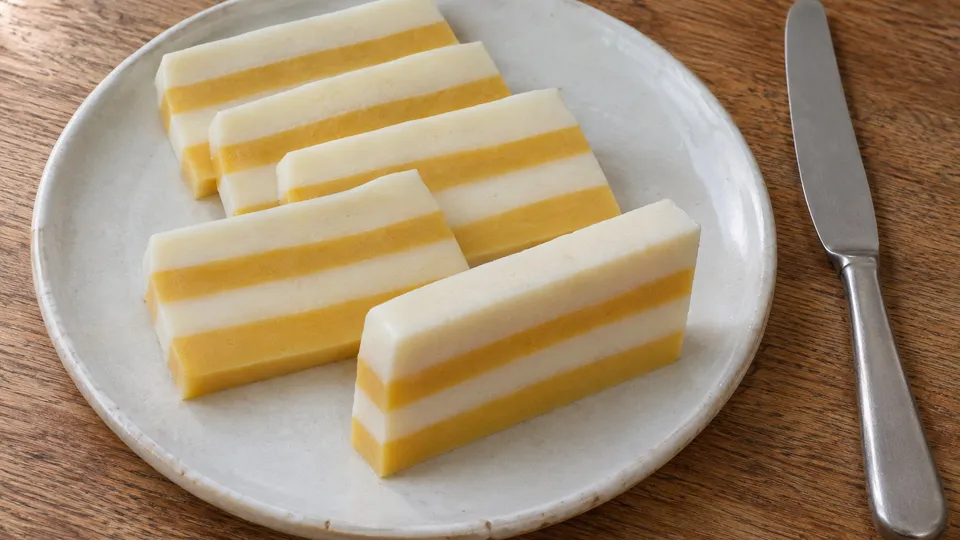 Cook it todayLeach, a Striped Milk Jelly (1672)
Sources
- Hannah Woolley, The Queen-like Closet, or Rich Cabinet, 2nd ed. (London: Richard Lowndes, 1672), pp. 14, 48, 65–66, 208, the table of contents, and the bookseller’s list at the end. Internet Archive (opens in a new tab).
- W. M., The Queen’s Closet Opened (London: Nathaniel Brook, 1656), pp. 47, 126. Internet Archive (opens in a new tab).
- John Locke, Some Thoughts Concerning Education (London: A. and J. Churchill, 1693), pp. 12–14, 16–18, 20–21. Internet Archive (opens in a new tab).
- The Regulations and Establishment of the Household of Henry Algernon Percy, the Fifth Earl of Northumberland, ed. Thomas Percy (1770; London, 1905 reprint), pp. 73, 75. Internet Archive (opens in a new tab).
- Andrew Boorde, A Compendyous Regyment or a Dyetary of Helth (1542), ed. F. J. Furnivall, Early English Text Society (London, 1870), p. 267. Internet Archive (opens in a new tab).
- Journal de Jean Héroard sur l’enfance et la jeunesse de Louis XIII, ed. Eud. Soulié and Éd. de Barthélemy, vol. 1 (Paris: Firmin Didot, 1868), pp. 2–8. Internet Archive (opens in a new tab).
- The Diary of the Rev. Ralph Josselin, 1616–1683, ed. E. Hockliffe, Camden Third Series 15 (London, 1908), pp. 12–13. Internet Archive (opens in a new tab).
- NHS, “Rickets and osteomalacia.” nhs.uk (opens in a new tab).