The Dutch herring fishery in the Second Anglo-Dutch War, 1665–67 · Holland, Zeeland and the North Sea
What Happened to the Dutch Herring Fishery in the War of 1665?
In 1665 the Dutch navy needed seamen, and the herring fleet is said to have been kept home. A painting cheered its return in 1667; the catch records tell more.
The herring fleet stayed in port, according to the account the Rijksmuseum follows, because its men were wanted on the warships. When the Second Anglo-Dutch War broke out in 1665, the Dutch navy needed many times the seamen it kept in peacetime, and by that account the herring fishery was closed along with merchant shipping and Greenland whaling so that the best sailors would sign on. After the peace of 1667 the herring came back, and a painter, probably from Zeeland, showed the admirals hauling it ashore themselves. The catch records kept for taxes tell a less cheerful story. Herring was still being landed in North Holland in the middle of the war, and in the herring towns of the Maas the war began a stretch at a lower level that lasted the rest of the century.
Admirals with a net
The picture hangs in the Rijksmuseum in Amsterdam as Allegory of the Revival of the Dutch Herring Fishery after the Second Anglo-Dutch War (1665–67). It is unsigned, about 114 by 163 centimeters, and dated about 1667 to 1670. On a beach a crowd of admirals and vice-admirals in sashes are landing a catch, and a few of them haul in a net on the left. Michiel de Ruyter sits in the middle with his son Engel beside him, several Evertsens of the Zeeland seafaring family stand among the rest, and on the right some of the company are setting off to hunt with their greyhounds. Behind them is the skyline of Vlissingen. Gerdien Wuestman, who wrote the museum’s 2024 catalogue entry, allows that some of the men look a bit comical today, but “the scene was undoubtedly intended as a tribute.”
Very little in it records a real day. The great fountain with Neptune on the right is imaginary, its lower half borrowed from an etching by the French printmaker Jean le Pautre. De Ruyter’s face was copied from Ferdinand Bol’s portrait of him painted in 1667, which is why the picture cannot be earlier. The man beside De Ruyter who is about to cut the head off a herring has been tentatively identified as Vice-Admiral Pieter Florisz, who had died some ten years before. The attribution to the Zeeland portrait painter Willem Eversdijck is kept “until a better candidate is found,” and four versions of the composition are known, in Amsterdam, Liverpool, Rotterdam and the town hall of Falaise in Normandy.
The museum’s reading goes back to R. van Luttervelt, who wrote about the painting in its Bulletin in 1957. He opened his explanation with the word waarschijnlijk, “probably,” and he also noticed that the greyhounds are drinking from water that must be salt, since herring are being caught in it. The painting can be seen on the Rijksmuseum’s collection page (opens in a new tab).
Why the fleet wanted fishermen
In peacetime the Dutch navy was a small employer. The maritime historians Victor Enthoven, Marc van Alphen and Remmelt Daalder, writing in the Nieuwe Maritieme Geschiedenis van Nederland, put it at about 3,000 seamen in an average year, no more than 7 or 8 percent of all Dutch seafarers. In wartime the admiralties suddenly needed more than 20,000, and their table of estimates gives 21,500 men on the war fleet in 1665. That figure is their estimate for the whole war fleet. It is easy to misread as a count of herring fishermen, and it isn’t one.
The Republic had no press gangs of the English kind. To fill the ships, the admiralties raised wages and bounties, closed other branches of shipping for a time and pressed them to give up men. Most crews still came aboard on their own or through private agents, lodging-house keepers known by names such as zielverkopers, soul sellers. Fishermen were not eager recruits. Coastal villagers, the same history says, usually chose fishing, whaling or merchant voyages over the navy, and in the West Frisian countryside the navy was looked down on as an employer for centuries.
That is the background to the ban Van Luttervelt described. When the war began and the fleet could not find enough men, he wrote, an order went out against all herring fishing, shipping and Greenland whaling, which between them took a large share of the best sailors, and the fleet was manned. He cited no decree on that page, and none was among the papers read for this story. The ban rests on his account and the museum’s.
Salt, barrels and fish days
What the fleet held up was a food trade with a long chain behind it. Pieter de la Court published his case for Holland’s prosperity in 1662, and a German translation appeared in 1665, the year the war began. He credited Willem Beuckelszoon of Biervliet with teaching the Dutch to salt herring and pack it in barrels some 250 years before, and called the trade one of the strongest supports of the country, the more so because many neighboring peoples were bound by their religion to abstain from meat. He listed the ships built, the ropes, nets and barrels made and the salt supplied, and reckoned that 450,000 of Holland’s 2,400,000 people lived by the sea fishery and by fitting it out. Those are his own round numbers, made to argue a case. By his reasoning, when the busses stayed in port, the coopers, net-makers and salt suppliers lost their customers too.
Cookbooks pick up the herring at the far end of that chain. François Pierre de La Varenne’s The French Cook, put into English in London in 1653, two years after the French original, has herring fresh, salted and smoked among its first courses for “leane dayes,” the fish days when meat was forbidden. Fresh herring is gutted through the gills and grilled. Salted herring, the kind packed in barrels, must be soaked to draw out the salt before it is cooked. Red herring is half salted and smoked.
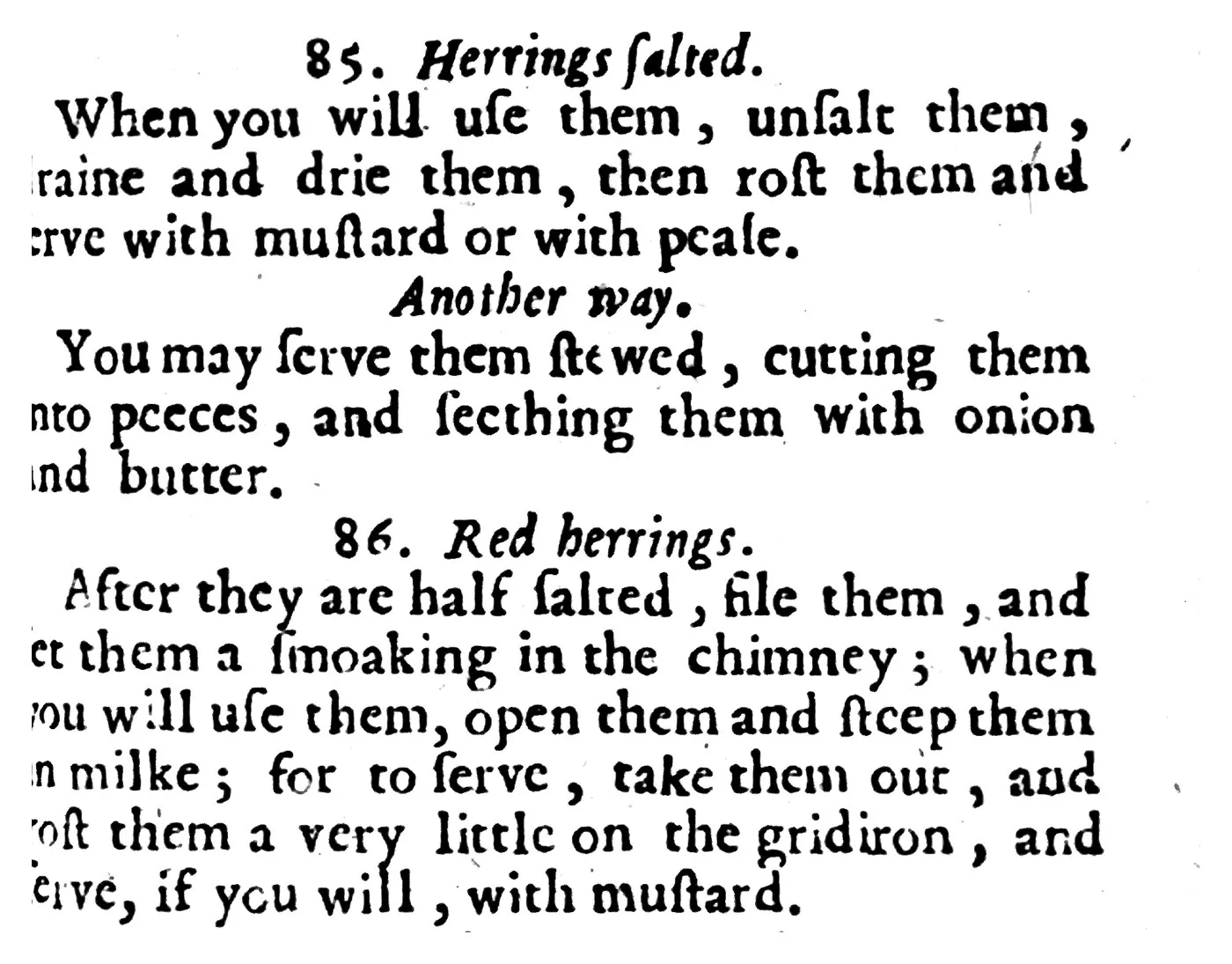 From François Pierre de La Varenne, The French Cook (London, 1653), p. 173.
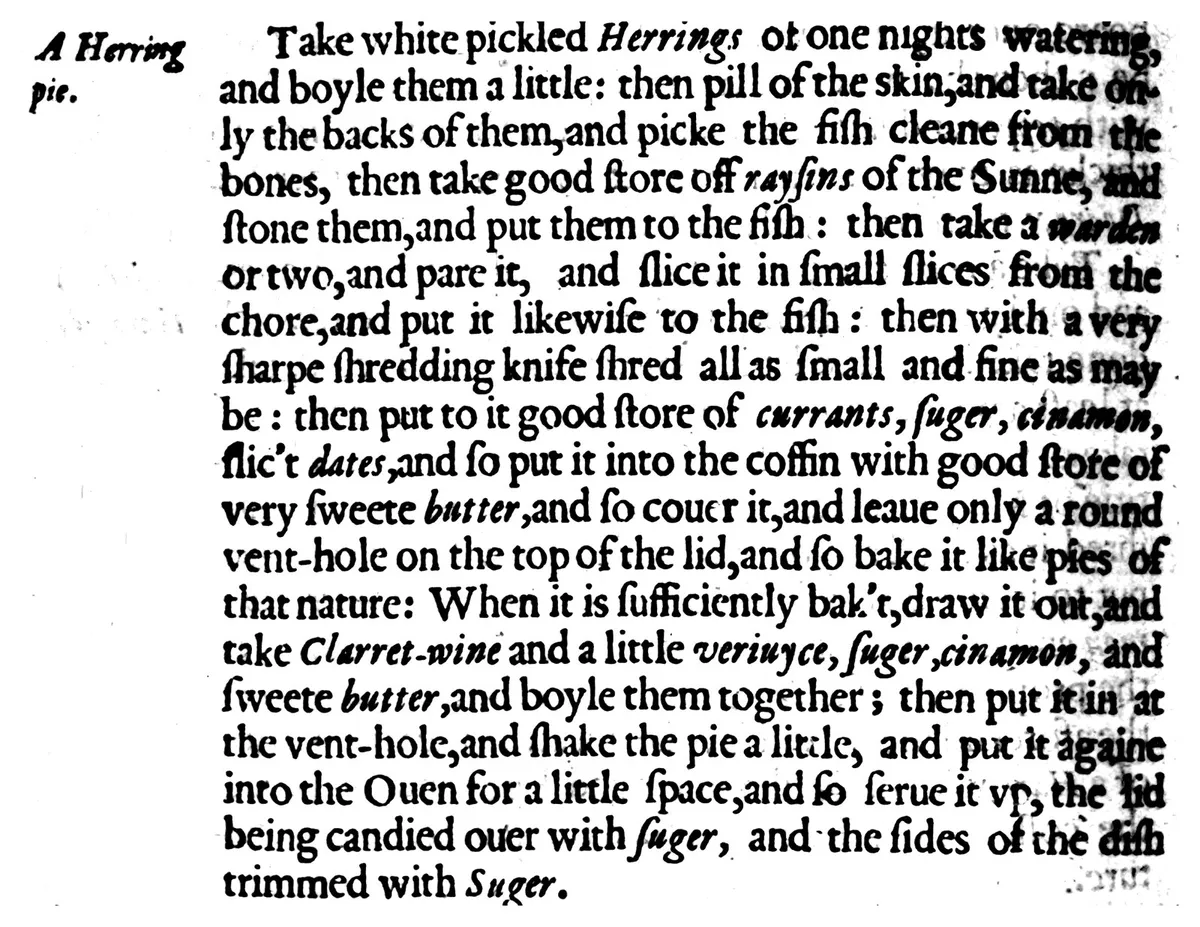
Gervase Markham’s The English Huswife, in the 1623 edition of his Countrey Contentments, starts from the same barrel. His herring pie begins with “white pickled Herrings” that have spent a night in water, keeps only the backs, and fills a pastry coffin with them, raisins, a sliced warden pear, currants, dates, sugar, cinnamon and butter. When it is baked, claret and verjuice boiled with more sugar and butter go in at a vent in the lid, and the pie comes to the table “the lid being candied ouer with suger.” On the page it sits between a pie with a pig’s head modelled in pastry on its lid and a pie of ling.
Neither book is Dutch, and neither says where its fish came from or who ate the dishes. They show what an English reader before the war could be told to do with a fresh herring, a salted one and a sweet pie, and that preserved fish could go to a well-supplied table as easily as to a poor one.
A short boom and a lower level
Van Luttervelt and the museum both describe the years after the peace of 1667 as a brief time of prosperity, when trade, shipping and fishing flourished again. Van Luttervelt wrote that there were more herring busses than ever, and that the good times did not last: the treaty England and France signed at Dover in 1670 soon became a serious threat to the Republic. The museum uses that short window to date the painting.
The catches look different. Christiaan van Bochove pieced together herring landings for Holland from three taxes and published them in 2004, and he found two herring regions with two histories. In the Maas towns of the south, catches had fallen early in the century and then held roughly steady until the mid-1660s. “Hier vormde de Tweede Engelse Oorlog echter het keerpunt,” he wrote: here the Second Anglo-Dutch War was the turning point. Production stayed fairly constant to the end of the century, “zij het op een lager niveau,” at a lower level. In the north, around Enkhuizen, the decline had begun with the first war against England in 1652 to 1654, and the effects of the second war, of the disaster year of 1672 and of later wars with France are, he wrote, clearly visible in its fishery.
One number from the north sits awkwardly beside the ban. In the old Enkhuizen town archive Van Bochove found the landings for a single year: by December 13, 1666, 5,188½ lasts of herring had come ashore. Whatever the order of 1665 said, and whenever it was lifted, herring was being caught and landed in the second year of the war.
So the painting celebrates a return that was real and short, in a fishery that had been shrinking for decades in some ports and would shrink again. What it leaves out is the work in between: the crews, the coopers and salters, the merchants, and the cooks who had to soak the salt out of the fish before anyone could eat it.
The recipes
These three dishes come from no menu of the fishery or the fleet. They follow the herring from the net to the barrel to a pie, all from cookbooks printed in London before the war. They show what the books recommended, and nothing about what any Dutch crew or admiral ate. The modern versions add amounts, heat settings and times.
- Grilled Herring with Brown Butter and Capers (1653): La Varenne’s fresh herring, grilled with butter and served with butter browned with parsley and young onions.
- Stewed Salt Herring with Onion (1653): his “another way” with the barrel herring, soaked, cut in pieces and simmered with onion and butter.
- Herring Pie with Pears and Dates (1623): Markham’s sweet pie of salt herring, dried fruit and spice, finished with claret and verjuice poured through the lid.
Herring and pease had kept company long before La Varenne paired them: a Paris household book of about 1393 sets herring beside pease pottage on its fish days, as What Did a Paris Household Eat in 1393? shows.
Cooking it
The herring pie takes two days. Markham wanted his salt herring “of one nights watering,” and a night in cold water in the refrigerator is still what it takes to soak out the salt before the fish is boiled, boned and baked with the fruit. The English had taken the Dutch colony on the Hudson the year before the war was declared, and Forgotten Drink, our sister site, reads what was drunk in New Netherland (opens in a new tab), beer first.
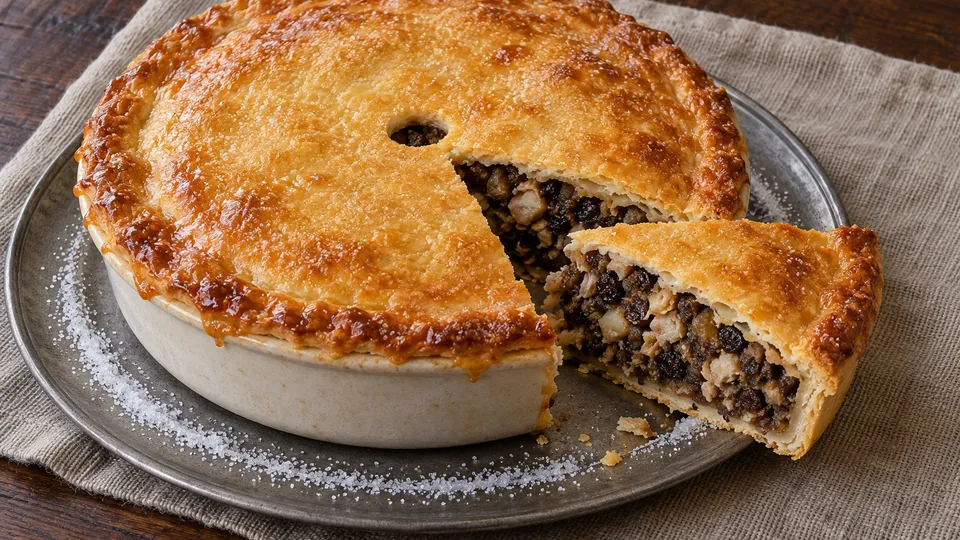 Cook it todayHerring Pie with Pears and Dates (1623)
Sources
- Gervase Markham, The English Huswife, in Countrey Contentments, or The English Huswife (London: I. B. for R. Jackson, 1623), p. 100. Early English Books microfilm, Internet Archive.
- François Pierre de La Varenne, The French Cook, translated by I. D. G. (London: Charls Adams, 1653), pp. 149, 167 and 173. Early English Books microfilm, Internet Archive.
- Gerdien Wuestman, catalogue entry for Allegory of the Revival of the Dutch Herring Fishery after the Second Anglo-Dutch War (1665–67), attributed to Willem Eversdijck, SK-A-3829 (Amsterdam: Rijksmuseum, 2024).
- R. van Luttervelt, “Herinneringen aan Michiel Adriaenszoon de Ruyter in het Rijksmuseum,” Bulletin van het Rijksmuseum 5 (1957), pp. 28–70, esp. pp. 62–63.
- Victor Enthoven, Marc van Alphen and Remmelt Daalder, “Een veelkoppig monster. De Nederlandse zeemacht, 1568–1780,” Nieuwe Maritieme Geschiedenis van Nederland, vol. 2, ch. 4, section “Arbeidsmarkt” and table 15 (Huygens Institute, online edition).
- Pieter de la Court, Interesse von Holland (1665), chapters V to VIII, in the transcription published by Themenportal Europäische Geschichte (2015).
- Christiaan van Bochove, “De Hollandse haringvisserij tijdens de vroegmoderne tijd,” Tijdschrift voor Sociale en Economische Geschiedenis 1, no. 1 (2004), pp. 3–27, esp. pp. 11 and 21–22 (CC BY 4.0).