Le Ménagier de Paris, a husband’s book for his wife · Paris · c. 1393
What Did a Paris Household Eat in 1393?
Medieval Paris recipes from Le Ménagier de Paris, about 1393: watercress porée, a herb omelette with cheese, crespes and fried cheese fingers for fish days.
Greens, eggs, cheese and fried batter. On a fish day, when the Church forbade meat, the dinners a Paris husband copied into his household book of about 1393, for his young wife to choose from when she had guests, open with pease pottage, herring and a green porée of watercress, bring a herb omelette with grated cheese in the second course, and end with crespes, lacy fried batter dusted with sugar, and pipefarces, fingers of cheese fried in batter. The same book is the source of all four recipes here.
A book for a young wife
Its name is old. Library inventories made at Bruges about 1467 and at Brussels in 1487 already list manuscripts “intitulé: C’est le Mesnagier de Paris,” titled Le Ménagier de Paris, roughly “the Paris householder.” Jérôme Pichon printed it in two volumes in 1846 for the Société des Bibliophiles François, and from the people and events it mentions, he dated it between June 1392 and September 1394.
 From Le Ménagier de Paris, ed. Jérôme Pichon (Paris, 1846), vol. 1, p. 1.
The author never gives his name. He opens by speaking to his wife as “chière seur,” dear sister, and explains why he is writing: she was fifteen in the week they were married, and she had asked him to bear with her “petit et ygnorant service,” her small and ignorant service, until she had seen and learned more. He is happy, he writes, for her to tend roses, keep violets, make garlands, dance and sing among their friends, but not to go to the feasts and dances of “trop grans seigneurs,” lords too great for her rank or his.
What follows is a whole education: prayers and conduct, the care of a husband, the garden, the servants and the horses, and then the kitchen.
Running the house
The household was large enough to need a steward. The author tells his wife to have “maistre Jehan le despensier” hire day laborers, and to settle the price before they start, because otherwise, when the work is done, they will say, “Sire, il y avoit plus à faire que je ne cuidoie”: sir, there was more to do than I thought. “Dame Agnès la béguine,” a devout laywoman, lived with her “pour vous aprendre contenance sage et meure,” to teach her a wise and grown-up bearing, and gave the maids their orders. A servant who answered “il sera fait demain bien matin,” it will be done first thing tomorrow, was to be taken as having forgotten.
The kitchen takes up a long stretch of the second volume: general terms of cookery, how to judge a fresh partridge or a good carp, a set of menus, and a long run of recipes.
Dinners to choose from
The menus come with a plain note on their purpose. They are “aucuns disners et soupers de grans seigneurs et autres,” some dinners and suppers of great lords and others, from which she could choose and learn whatever dishes she liked, according to the season and the foods of the place, “quant vous aurez à donner à disner ou à soupper,” when she had a dinner or supper to give.
The first is a meat-day dinner of thirty-one dishes in six courses, and it opens with “Garnache et tostées,” garnache, which Pichon glossed as “vin de Grenache,” with toasts. Many are fish dinners. Fish days, on Fridays, through Lent and on other days of abstinence, called for a second repertory of dishes without meat. Paris would one day eat far more meagerly than on any fish day: under the Prussian siege of 1870 the city turned to horse and the animals of its zoo, as told in What Did Paris Eat Under Siege in 1870?
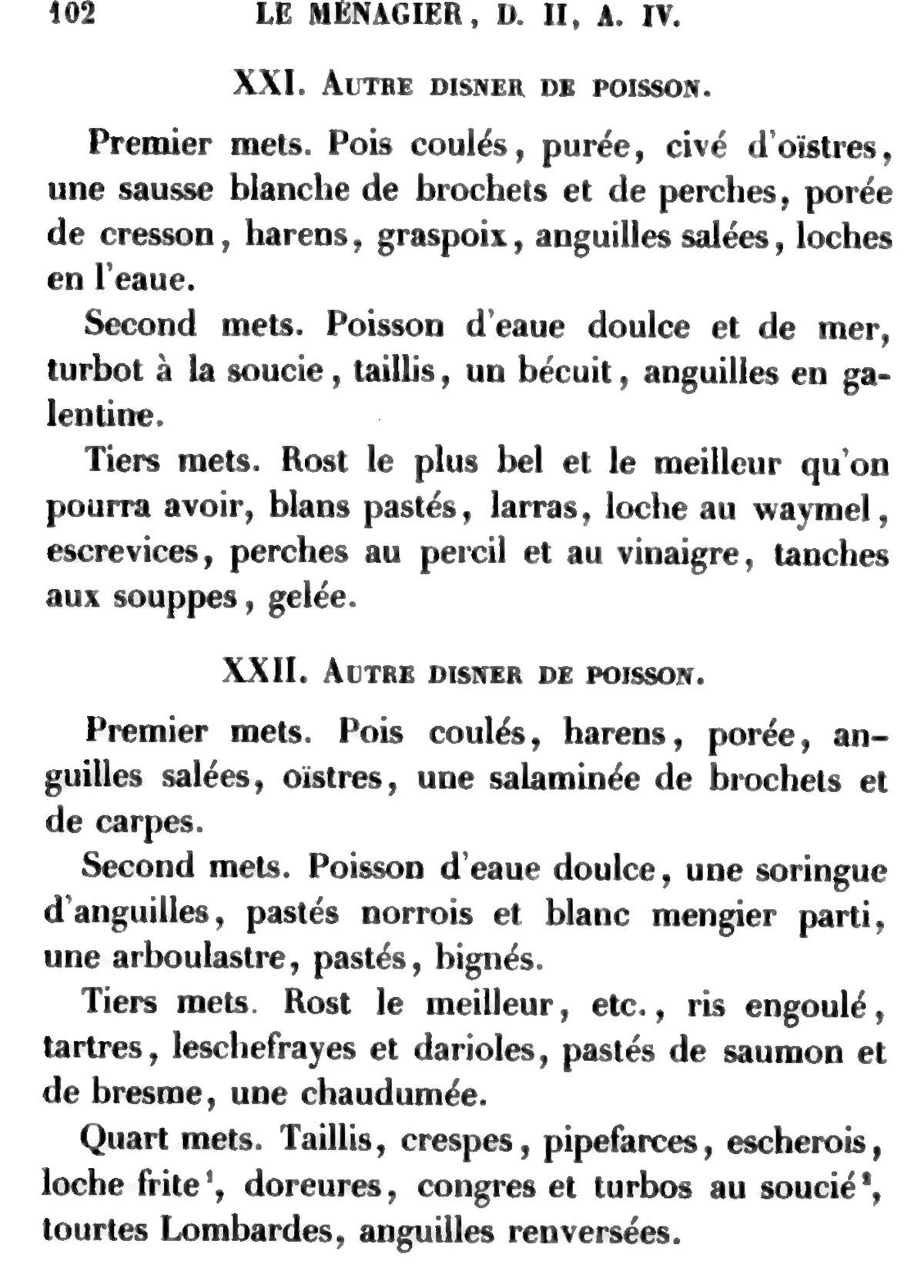
Menus XXI and XXII, printed together on one page and shown at the top of this article, are two of those. The first course of XXI sets a “porée de cresson” beside pease pottage, oysters, white sauce of pike and perch, herring and salt eels. The second course of XXII brings “une arboulastre,” and its fourth course, among fried loach, Lombard tarts and eels, sets “crespes” and “pipefarces” side by side, as several other menus in the book do.
Greens, eggs and cheese
Porée was a pottage of chopped greens, and the author, following the cooks, sorts it by color: white porée made from the white of leeks, green porée of chopped leaves, and black porée fried in bacon fat. He cares most about keeping the green ones green, and his watercress porée, made with almond milk for Lent, must be served at once, “car il roussiroit,” because it would turn brown.
The arboulastre is the most exact recipe of the four: it counts its strong herbs by the leaf and its mild greens by the handful, a dozen and more kinds in all. The herbs are pounded with ginger, beaten into sixteen eggs and fried as two thick alumelles. Pichon thought alumelle, from the Latin for a thin blade, was the word that later turned into omelette. The cheese is grated over the eggs in the pan and wrapped inside.
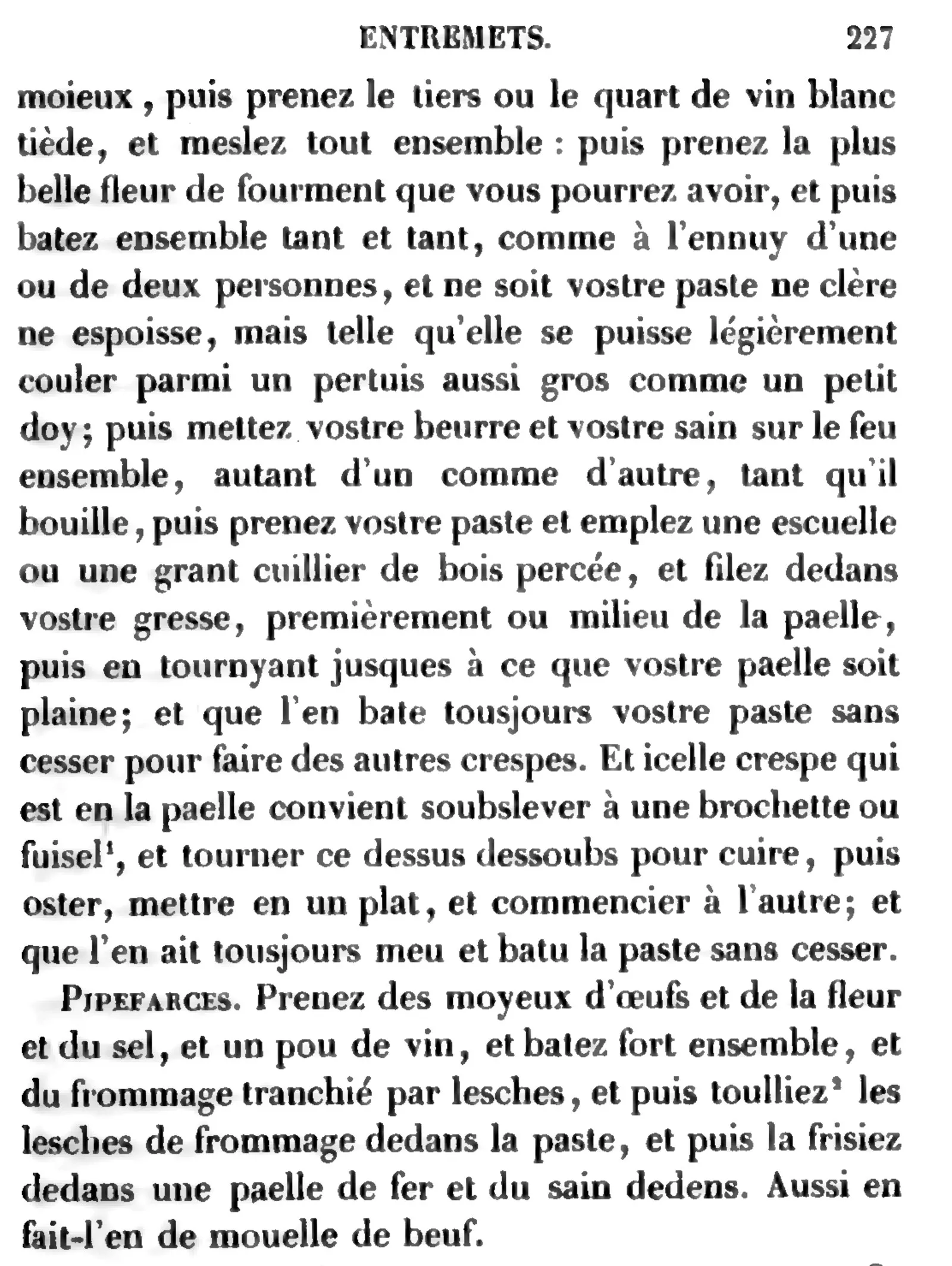 From Le Ménagier de Paris, ed. Jérôme Pichon (Paris, 1846), vol. 2, p. 227.
The crespes and pipefarces are both fried in lard. For crespes, a thin batter of flour, eggs, water, salt and wine runs from a pierced bowl in a spiral into a small iron pan of hot fat. A grander version, “à la guise de Tournay,” wants the batter beaten “comme à l’ennuy d’une ou de deux personnes,” until one or two people are tired of it. Pipefarces need only egg yolks, flour, salt and a little wine beaten hard, with slices of cheese rolled in the batter and fried.
The recipes
The four recipes are the Ménagier’s own, translated from Pichon’s edition. The modern amounts, pan sizes and temperatures are ours.
- Watercress Porée (1393): watercress and chard, parboiled, fried in oil and simmered in almond milk.
- Arboulastre, Herb Omelette (1393): eggs beaten with pounded greens, herbs and ginger, cooked thick with grated cheese folded in.
- Crespes (1393): batter poured in a spiral into hot fat, fried crisp and dusted with sugar.
- Pipefarces, Fried Cheese Fingers (1393): fingers of firm cheese in an egg-yolk and wine batter, fried in lard.
Cooking it
Start with the arboulastre. It takes half an hour, needs nothing harder to find than fresh herbs, and shows the book’s way of cooking better than any other dish here: strong herbs counted by the leaf, mild greens by the handful, and the cheese wrapped inside. Serve it as the menus do, after the porée, which takes about twenty-five minutes, and keep the crespes and pipefarces for last, fried just before they are eaten. The four dishes are among our medieval recipes, where the coronation feast of Henry IV, six years later, shows what a king’s table ate. And for what went into the cup beside a medieval dinner, Forgotten Drink, our sister site, asks Did Medieval People Really Drink Beer Instead of Water? (opens in a new tab)
 Cook it todayArboulastre, Herb Omelette (1393)
Sources
- Le Ménagier de Paris, traité de morale et d’économie domestique composé vers 1393 par un bourgeois parisien, ed. Jérôme Pichon, 2 vols. (Paris: Société des Bibliophiles François, 1846), vol. 1, pp. 1–2 and the introduction (p. liii); vol. 2, p. 61, pp. 54–55, 91, 102, 139–142, 206–208 and 226–227. Digitized by the Internet Archive.