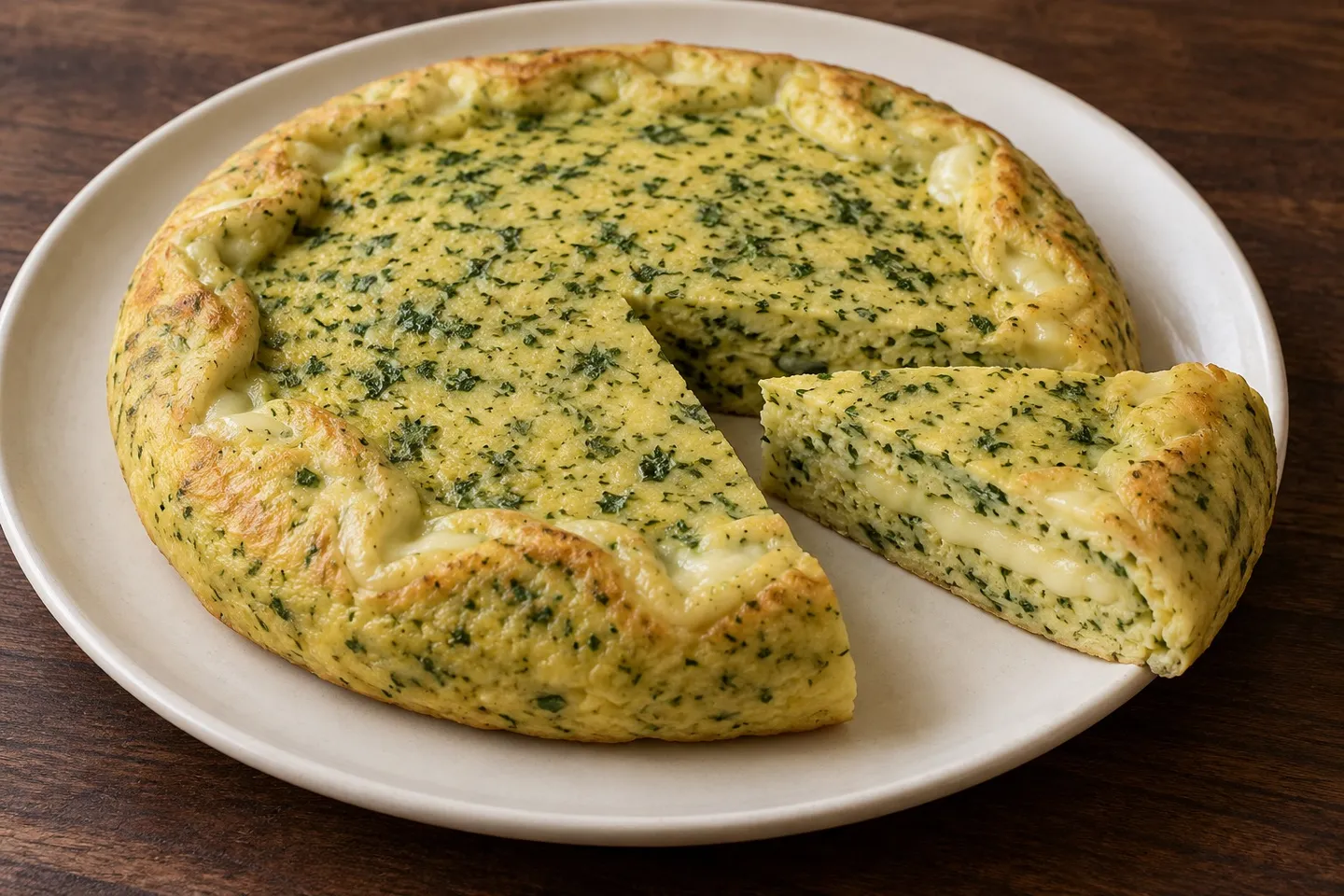
Arboulastre, Herb Omelette (1393)
Reader ratingsEggs beaten with pounded greens, garden herbs and ginger, cooked thick in butter with grated cheese folded in: the arboulastre of the Ménagier de Paris.
- Recipe makes
- One 26 cm omelette, 4 servings
- Prep
- Cook
- Total
Let the omelette stand for 5 minutes before cutting; the book says to eat it neither too hot nor too cold.
Arboulastre, a thick herb omelette with grated cheese folded in.
The story behind the recipe
An arboulastre is a thick omelette green with herbs, and the Ménagier serves it in the second course of a fish-day dinner, among pies and fritters. The recipe counts the leaves. Two of costmary only; of rue “moins la moitié ou néant,” which Pichon read as less than one leaf or none, “car sachez qu’il est fort et amer,” for know that it is strong and bitter. Four leaves each, or fewer, of smallage, tansy, mint and sage. A little more marjoram, more fennel, more parsley still. Then equal amounts of chard, beet greens, violet leaves, spinach, lettuce and clary, until there are two good handfuls in all.
What was an arboulastre?
The greens are pounded in the mortar with ginger in two or three batches, then mixed with sixteen beaten eggs and divided between two thick omelettes. Jérôme Pichon, who printed the book in 1846, took the name to come from the herbs, and compared it to an Italian herbolata in the cookbook of Bartolomeo Scappi, printed in 1570. The pan is to be hot all over, “par espécial devers la queue,” especially toward the handle, and the eggs are turned often with a spatula as they cook.
Grated cheese is scattered over the eggs once they are in the pan, and the edges are folded over it, so that it melts inside and never touches the iron. When it is done, “donnez forme quarrée ou ronde,” give it a square or round shape, and eat it “ne trop chaude ne trop froide,” neither too hot nor too cold.
Read more about this recipe
Making it today
Rue and tansy are left out: both are best avoided in pregnancy, and tansy contains thujone, which is poisonous in larger amounts. Costmary, clary and violet leaves are hard to buy, and celery leaves stand in for smallage, a wild celery. The rest of the herbs follow the book’s own order, strong ones by the leaf and mild greens by the handful. The book turns the eggs often; we stir them only for the first minute and finish the thick omelette under a lid, so the middle sets. Comté is our choice of a good cheese for grating, and we added the salt.
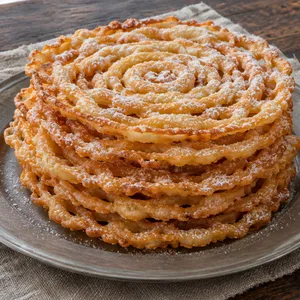
Crespes (1393) come later in the same dinner. The book, and the young wife it was written for, are in What Did a Paris Household Eat in 1393?
Une arboulastre ou deux d’œufs. Prenez du coq deux fueilles seulement, et de rue moins la moitié ou néant, car sachez qu’il est fort et amer: de l’ache, ténoisie, mente et sauge, de chascun au regart de quatre fueilles ou moins, car chascun est fort: marjolaine un petit plus, fenoul plus, et percil encores plus; mais de porée, bettes, feuilles de violettes, espinars et laitues, orvale, autant de l’un comme de l’autre, tant que de tout vous aiez deux poignées largement: eslisez et lavez en eaue froide, puis les espraignez et ostez toute l’eaue, et broyez deux cloches de gingembre; puis mettez ou mortier à deux ou à trois fois vos herbes avec le dit gingembre broyé, et broyez l’un avec l’autre. Et puis aiez seize œufs bien batus ensemble, moyeux et aubuns, et broyez et meslez ou mortier avec ce que dit est, puis partez en deux, et faites deux alumelles espesses qui seront frites par la manière qui s’ensuit ...
In our translation: “An arboulastre, or two, of eggs. Take two leaves only of costmary, and of rue less than half, or none, for know that it is strong and bitter; of smallage, tansy, mint and sage, about four leaves of each or fewer, for each is strong; marjoram a little more, fennel more, and parsley more still; but of chard, beet greens, violet leaves, spinach and lettuce, and clary, as much of one as of another, until you have two good handfuls of all: pick them over and wash them in cold water, then squeeze them and take out all the water, and pound two pieces of ginger; then put your herbs in the mortar in two or three batches with the pounded ginger, and pound one with the other. And then have sixteen eggs well beaten together, yolks and whites, and pound and mix them in the mortar with the above, then divide in two, and make two thick omelettes, fried in the manner that follows ...”
Recipe makes: One 26 cm omelette, 4 servings
Ingredients
For One 26 cm omelette, 4 servings. Quantities are shown as written.
Quantities as written here, for One 26 cm omelette, 4 servings.
- Baby spinach40 g
- Chard leaves40 g
- Butter lettuce leaves20 g
- Flat-leaf parsley leaves10 g
- Chopped fennel fronds2 tbsp
- Fresh marjoram leaves1 tsp
- Fresh mint leaves4
- Fresh sage leaves4
- Celery leaves4
- Ground ginger1/2 tsp
- Eggs8
- Salt1/2 tsp
- Butter2 tbsp
- Comté or other firm cheese, finely grated60 g
Measurement notes
Ingredients as written here
- 40 g baby spinach
- 40 g chard leaves
- 20 g butter lettuce leaves
- 10 g flat-leaf parsley leaves
- 2 tbsp chopped fennel fronds
- 1 tsp fresh marjoram leaves
- 4 fresh mint leaves
- 4 fresh sage leaves
- 4 celery leaves
- 1/2 tsp ground ginger
- 8 eggs
- 1/2 tsp salt
- 2 tbsp butter
- 60 g Comté or other firm cheese, finely grated
Equipment
- Food processor or large mortar and pestle
 Large bowl
 Whisk
- Nonstick frying pan, about 26 cm
- Wide spatula
Instructions
Wash the spinach, chard, lettuce, parsley, fennel fronds, marjoram, mint, sage and celery leaves, and squeeze or spin them as dry as you can.
Put the greens and herbs in the food processor with the ginger and pulse until finely chopped, scraping down the sides once. Or pound them in batches in the mortar.
Beat the eggs with the salt in the large bowl until yolks and whites are completely mixed. Stir in the greens.
Melt the butter in the frying pan over medium heat until it foams. Pour in the egg mixture and stir it gently with the spatula for the first minute, lifting the set egg from the bottom so the liquid runs under.
Leave it to cook undisturbed for 3 to 4 minutes, until the bottom is set and lightly browned and the top is still soft.
Scatter the cheese over the middle. With the spatula, fold the edges of the omelette in over the cheese all round, shaping it into a thick round.
Turn the heat to low, cover the pan, and cook for 2 to 3 minutes more, until the eggs are set all through and the cheese has melted.
Slide the omelette onto a plate and let it stand for 5 minutes before cutting it in wedges.
Nutrition
260calories per serving
- Recipe makes
- One 26 cm omelette, 4 servings
- Servings
- 4
Estimated per serving from USDA FoodData Central values for eggs, butter, Gruyère-type cheese, spinach, chard and lettuce.
Recipe notes
When adjusting quantities
The book makes two omelettes from sixteen eggs; make one pan at a time, with eight eggs to about 120 g of greens and herbs.
Notes
Quantities mentioned in these notes don’t change when you adjust the servings.
Eat it the same day, warm, as the book says: neither too hot nor too cold. Contains egg and milk. Rue and tansy are left out on purpose: do not add them.
Scaling changes the ingredients only; pan sizes and cooking times need their own judgment. To adapt this recipe further, try the recipe tool at TuneMyRecipe (opens in a new tab), our sister site.

Sources and attribution
After the Ménagier de Paris, Une arboulastre ou deux d’œufs, as printed by Jérôme Pichon (Paris, 1846)
Recipe details
- Course
- Main course
- Region
- French
- Era
- Medieval
- Main ingredient
- Eggs
- Difficulty
- Easy