Crespes (1393)
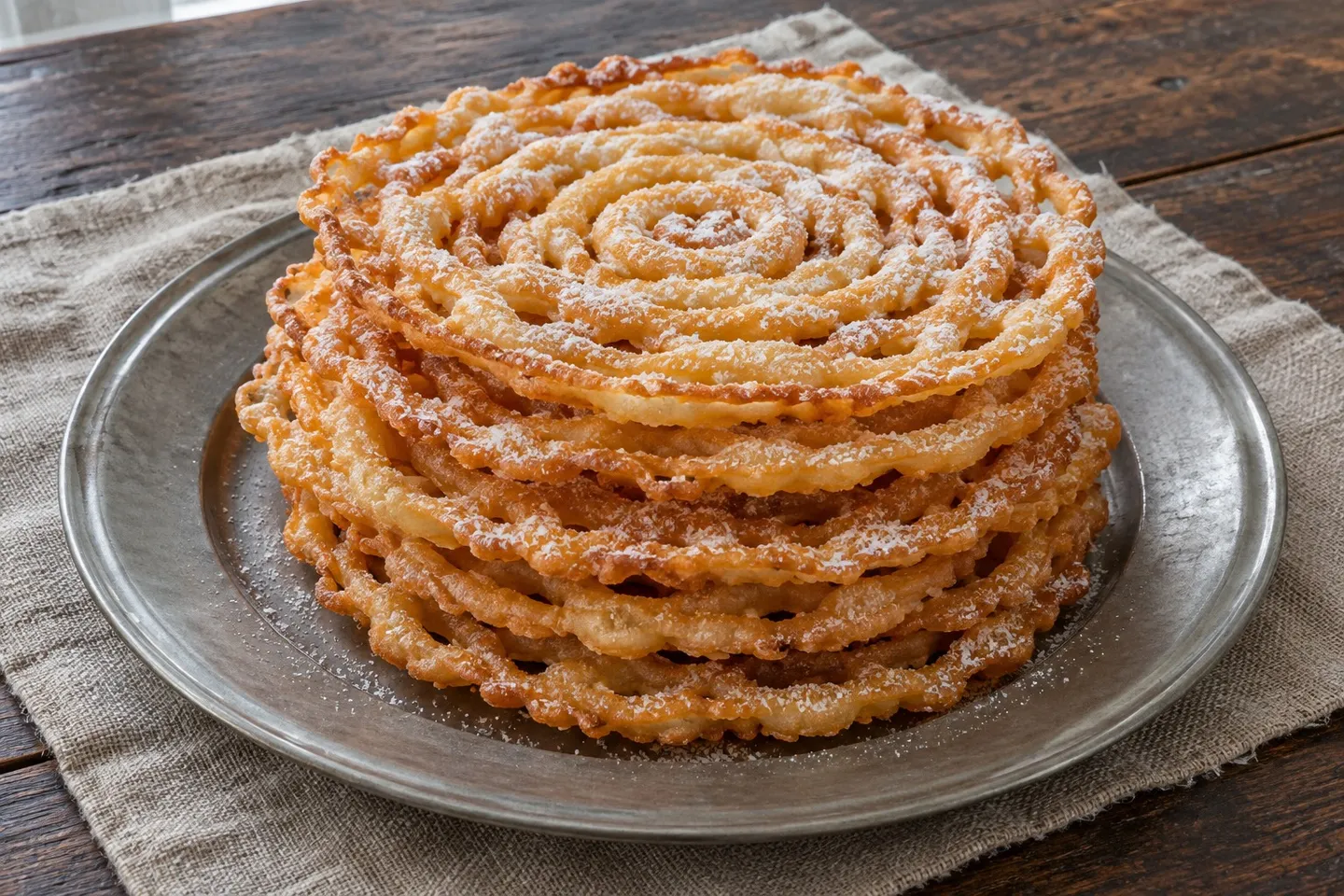
Reader ratingsA thin batter of flour, eggs, water, wine and salt poured in a spiral into hot lard and butter, fried crisp and dusted with sugar: the crespes of the Ménagier.
- Recipe makes
- About 10 crespes, 4 servings
- Prep
- Cook
- Total
Crespes, spirals of batter fried crisp and dusted with sugar.
The story behind the recipe
The batter runs through a hole “gros comme vostre petit doit,” as big as your little finger, into hot fat, where it sets in a lacy spiral. The Ménagier de Paris gives two recipes for these crespes: a plain one, and a grander one “à la guise de Tournay,” in the fashion of Tournai. On its menus they come near the end of the meal, beside fried cheese; the last course of a fish-day dinner lists “crespes, pipefarces.”
What were crespes?
The plain recipe takes flour, whole eggs, water, salt and wine, “et batez longuement ensemble,” beaten together for a long time. Fat goes into a small iron pan until it sizzles. The printed text reads “ou moitié sain ou moitié beurre frais,” and Pichon marked the second “ou” as a slip, so the fat is lard, or half lard and half fresh butter. The batter goes into the pierced bowl and runs from the middle of the pan in a spiral all the way round. The finished crespe goes on a dish “et de la pouldre de succre dessus,” with powdered sugar on top.
The author is particular about the pan: it should hold “trois choppines,” three chopines, an old Paris measure of roughly half a liter each, with a rim half a finger high, as wide at the top as at the bottom, “et pour cause,” and for good reason. The Tournai version has the salted butter melted, skimmed and cleared of its salt before it goes in with the lard, and each crespe lifted with “une brochette ou fuisel,” a skewer or spindle, and turned over to cook the other side.
The eggs are used “osté le germe,” with the germ taken out. The book doesn’t say what the germ is; we read it as the small white cords that anchor the yolk.
Read more about this recipe
Making it today
A funnel or squeeze bottle with a 1 cm opening does the job of the pierced bowl. We use half lard and half clarified butter, the butter skimmed and cleared as in the Tournai recipe. Dry white wine is our choice for the book’s unnamed wine; the Tournai recipe uses “vin blanc tiède,” warm white wine.
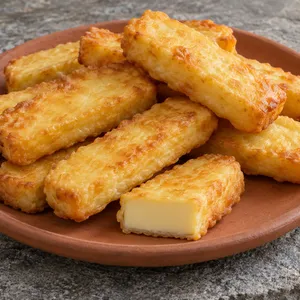
The rest of the fish-day dinner, from the green porée to these last fried things, is in What Did a Paris Household Eat in 1393? The book’s other fritter, the Pipefarces, Fried Cheese Fingers (1393), is fried in hot lard too.
Crespes. Prenez de la fleur et destrempez d’œufs tant moyeux comme aubuns, osté le germe, et le deffaites d’eaue, et y mettez du sel et du vin, et batez longuement ensemble: puis mettez du sain sur le feu en une petite paelle de fer, ou moitié sain ou moitié beurre frais, et faites fremier; et adonc aiez une escuelle percée d’un pertuis gros comme vostre petit doit, et adonc mettez de celle boulie dedans l’escuelle en commençant ou milieu, et laissiez filer tout autour de la paelle; puis mettez en un plat, et de la pouldre de succre dessus. Et que la paelle dessusdite de fer ou d’arain tiengne trois choppines, et ait le bort demy doy de hault, et soit aussi large ou dessus comme en bas, ne plus ne moins; et pour cause.
In our translation: “Crespes. Take flour and mix it with eggs, yolks as well as whites, the germ taken out, and thin it with water, and put in salt and wine, and beat together for a long time: then put lard on the fire in a small iron pan, or half lard and half fresh butter, and let it sizzle; and then have a bowl pierced with a hole as big as your little finger, and then put some of this batter in the bowl, beginning in the middle, and let it run all around the pan; then put it on a dish, with powdered sugar on top. And the pan should be of iron or brass and hold three chopines, and have a rim half a finger high, and be as wide at the top as at the bottom, no more and no less; and for good reason.”
Recipe makes: About 10 crespes, 4 servings
Ingredients
For about 10 crespes, 4 servings. Quantities are shown as written.
Quantities as written here, for about 10 crespes, 4 servings.
- All-purpose flour150 g
- Eggs2
- Water150 ml
- Dry white wine3 tbsp
- Salt1/4 tsp
- Lard, for frying150 g
- Clarified butter or ghee, for frying150 g
- Sugar, finely ground2 tbsp
Measurement notes
Ingredients as written here
- 150 g all-purpose flour
- 2 eggs
- 150 ml water
- 3 tbsp dry white wine
- 1/4 tsp salt
- 150 g lard, for frying
- 150 g clarified butter or ghee, for frying
- 2 tbsp sugar, finely ground
Equipment
- Mixing bowl
 Whisk
- Heavy straight-sided frying pan, about 20 cm, with sides at least 5 cm high
- Deep-fry or candy thermometer
- Funnel with an opening about 1 cm wide, or a squeeze bottle
- Long skewer or chopstick
- Plate lined with paper towels
Instructions
Crack the eggs into the mixing bowl; if you like, lift out the small white cords beside the yolks with the tip of a spoon. Whisk in the flour, water, wine and salt.
Beat for 3 to 4 minutes, until smooth and runny enough to pour in a steady stream. If it is too thick, beat in water a tablespoon at a time.
Heat the lard and clarified butter together in the frying pan to 350°F (175°C), about 1 cm deep. Keep the pan no more than half full.
Fill the funnel or squeeze bottle with batter, holding a finger over the funnel’s opening. Starting at the middle of the pan, let the batter run out in a spiral to about 15 cm across.
Fry for about 1 minute, until golden underneath. Lift and turn it with the skewer, and fry 30 seconds more.
Lift the crespe onto the paper towels. Beat the batter for a few seconds before each one, and bring the fat back to 350°F (175°C).
Dust the crespes with the sugar while they are hot, and serve them warm.
Nutrition
290calories per serving
- Recipe makes
- About 10 crespes, 4 servings
- Servings
- 4
Estimated per serving from USDA FoodData Central values for flour, egg, wine and sugar, with about 40 g of frying fat absorbed in all.
Recipe notes
When adjusting quantities
Keep the batter at about 150 g flour to 200 ml liquid plus 2 eggs, and the fat about 1 cm deep in the pan.
Notes
Quantities mentioned in these notes don’t change when you adjust the servings.
Best eaten within the hour, while crisp. Contains egg, milk (butter) and wheat (gluten). The wine contains sulfites. Never leave hot fat unattended, keep a lid nearby to cover the pan if it catches fire, and never use water on burning fat.
Scaling changes the ingredients only; pan sizes and cooking times need their own judgment. To adapt this recipe further, try the recipe tool at TuneMyRecipe (opens in a new tab), our sister site.
Sources and attribution
After the Ménagier de Paris, Crespes, as printed by Jérôme Pichon (Paris, 1846)
Recipe details
- Course
- Side dish
- Dish family
- Desserts & Sweets
- Region
- French
- Era
- Medieval
- Main ingredient
- Eggs
- Difficulty
- Intermediate