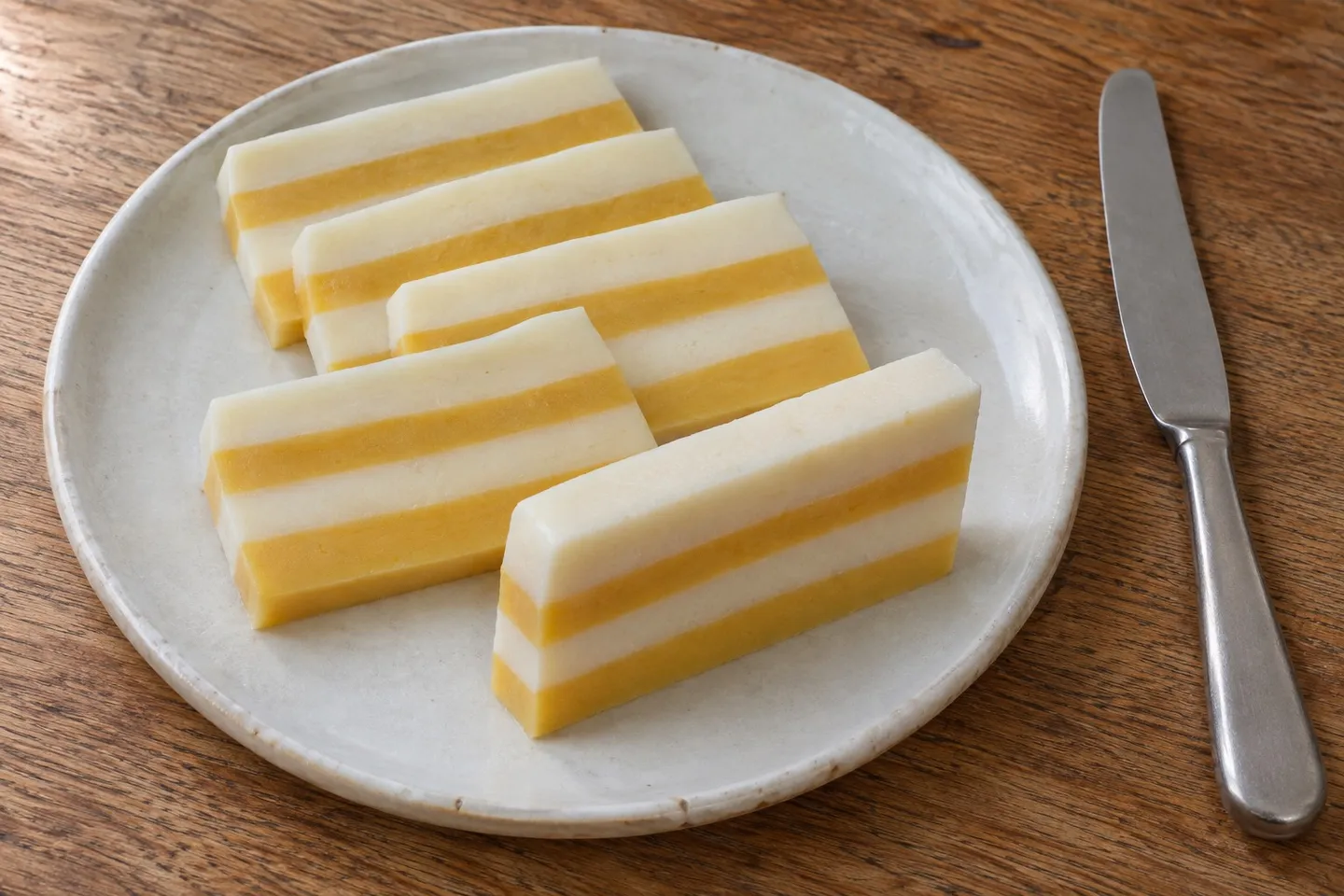
Leach, a Striped Milk Jelly (1672)
Reader ratingsHannah Woolley’s leach, 1672: new milk boiled with ginger, cinnamon, rosewater and sugar, set firm, striped white and saffron gold, and sliced onto plates.
- Recipe makes
- One loaf-pan block, about 12 slices
- Prep
- Cook
- Total
Cook time includes 10 minutes for the spices to steep. Total time adds about 1 hour for the four layers to set one on another and at least 3 hours in the refrigerator before slicing.
Slices of white and saffron-striped milk jelly on a white plate.
The story behind the recipe
Leach was a jelly firm enough to cut, and Hannah Woolley’s is made of milk. Her No. 114 in The Queen-like Closet (1672) sets a quart of new milk, boiled with ginger, a stick of cinnamon, rosewater and a quarter pound of sugar, with an ounce of isinglass that had soaked for a day in water changed three or four times. Stirred until cold, it was sliced out and served on plates.
Why did it look like bacon?
Woolley’s heading promises color as well as jelly. Part of the batch could be tinted with saffron and part with turnsole, and “the White and that one upon another” laid together and cut, so that every slice came out striped. Her own comparison is “Bacon.” Straight after the bacon, she gives the dish a use: it is “good for weak people,” and for children with rickets, the complaint her bookseller also sold a powder for in the book’s back pages. What Did Children Eat in the 1600s? follows the rickets cures of those years, and what John Locke thought of sugar and spice for children.
Read more about this recipe
Making it today
Powdered gelatine takes the place of isinglass, in about the same proportion by weight as Woolley’s ounce to her quart, so the jelly is firm enough to slice. The batch is half of hers, set in a loaf pan. Turnsole is left out, and the stripes are white and saffron gold, four layers poured one at a time, each set before the next goes on: our way of laying her colors one upon another. The milk is held at a steaming heat for a few minutes, our choice in place of her boil. For a later milk set with a different thickener, the Arrowroot Blancmange (1837) follows Eliza Leslie’s Philadelphia cups.
To make Leach and to colour it.
Take one Ounce of Isinglass and lay it in Water four and twenty hours, changing the Water three or four times, then take a quart of new Milk, boiled with a little sliced Ginger and a stick of Cinamon, one spoonful of Rosewater, and a quarter of a Pound of Sugar, when it hath boiled a while, put in the Isinglass, and boil it till it be thick, keeping it always stirring, then strain it, and keep it stirring, and when it is cold, you may slice it out, and serve it upon Plates; you may colour it with Saffron, and some with Turnsole, and lay the White and that one upon another, and cut it, and it will look like Bacon; it is good for weak people, and Children that have the Rickets.
Recipe makes: One loaf-pan block, about 12 slices
Ingredients
For One loaf-pan block, about 12 slices. Quantities are shown as written.
Quantities as written here, for One loaf-pan block, about 12 slices.
- Neutral oil, for the pan1 tsp
- Powdered gelatine14 g
- Cold water, for the gelatine60 ml
- Saffron threads1 pinch
- Hot water, for the saffron1 tbsp
- Whole milk500 ml
- Fresh ginger, thinly sliced10 g
- Cinnamon stick1
- White sugar60 g
- Rosewater1 tsp
Measurement notes
Ingredients as written here
- 1 tsp neutral oil, for the pan
- 14 g powdered gelatine
- 60 ml cold water, for the gelatine
- 1 pinch saffron threads
- 1 tbsp hot water, for the saffron
- 500 ml whole milk
- 10 g fresh ginger, thinly sliced
- 1 cinnamon stick
- 60 g white sugar
- 1 tsp rosewater
Equipment
 Loaf pan
 Saucepan
 Fine sieve
 Measuring jug
 Jug
 Small bowl
 Instant-read thermometer
 Wooden spoon
 Knife
Instructions
Brush the loaf pan very lightly with the neutral oil and wipe out the excess with a paper towel.
Sprinkle the powdered gelatine over the cold water in the small bowl and leave it for 5 minutes to swell. Crumble the saffron threads into the jug, pour on the hot water and leave them to steep.
Put the whole milk, ginger, cinnamon stick and white sugar in the saucepan and heat over medium heat, stirring, until the milk is steaming with small bubbles at the edge, 180°F (82°C). Keep it at that heat for 5 minutes without letting it boil up, then take it off the heat, cover and leave the spices to steep for 10 minutes.
Strain the milk through the fine sieve into the measuring jug and discard the spices. Add the swollen gelatine and stir until it has dissolved completely and no grains show on the spoon. Stir in the rosewater.
Pour half the milk into the jug with the saffron and stir. You now have one jug of white and one of gold. Stir both now and then as they cool, as Woolley does, so no skin forms.
When both are lukewarm, pour half the white milk into the loaf pan and refrigerate it for about 15 minutes, until it is set but still tacky to a light touch. Pour half the gold milk gently over the back of a spoon onto it and chill again until set. Repeat with the rest of the white, then the rest of the gold. If a jug starts to thicken while it waits, stand it in a bowl of warm water and stir until it is liquid again.
Cover the pan and refrigerate for at least 3 hours, at 40°F (4°C) or below, until the jelly is firm all through.
To serve, dip the pan in warm water for a few seconds, run a thin knife around the edges and turn the block out onto a board. Cut it across into slices about 1.5 cm (½ inch) thick and lay them on plates, stripes up.
Nutrition
110calories per serving
- Recipe makes
- One loaf-pan block, about 12 slices
- Servings
- 6
Estimated per serving (6) from USDA FoodData Central values for whole milk, granulated sugar and unflavored gelatin.
Recipe notes
When adjusting quantities
Woolley’s batch is a quart of new milk, about twice this one. This batch suits a 1 lb (450 g) loaf pan; a double batch needs a 2 lb (900 g) loaf pan and a little longer for each layer to set.
Notes
Quantities mentioned in these notes don’t change when you adjust the servings.
Our changes from Woolley: half her quantity; powdered gelatine for isinglass, with no day-long soak; the milk held at a steaming heat for her boiling “till it be thick”; the rosewater added after straining; saffron for one color and no turnsole; four set layers in a loaf pan for her “one upon another”; and the slicing thickness. Rosewater strengths vary, so add it sparingly and taste the milk before pouring. Keep the leach covered in the refrigerator and eat it within 3 days; don’t leave slices out for more than 2 hours. Gelatine is an animal product. Contains milk.
Scaling changes the ingredients only; pan sizes and cooking times need their own judgment. To adapt this recipe further, try the recipe tool at TuneMyRecipe (opens in a new tab), our sister site.
Sources and attribution
After Hannah Woolley, The Queen-like Closet, 2nd ed. (London, 1672), No. 114, To make Leach and to colour it
See the original pages (scan at Internet Archive) (opens in a new tab)
Recipe details
- Course
- Dessert
- Dish family
- Desserts & Sweets
- Region
- British
- Era
- 17th century
- Main ingredient
- Milk & creamSpices
- Difficulty
- Intermediate
- Occasion
- Everyday meal