Fine Water-Gruel (1672)
Reader ratingsHannah Woolley’s fine water-gruel, 1672: oatmeal steeped overnight and strained, boiled with mace, and finished with plumped raisins, currants, salt and sugar.
- Recipe makes
- About 500 ml, 2 bowls
- Prep
- Cook
- Total
Prep time includes the overnight steep of at least 8 hours in the refrigerator. The next morning the gruel takes about 15 minutes on the stove.
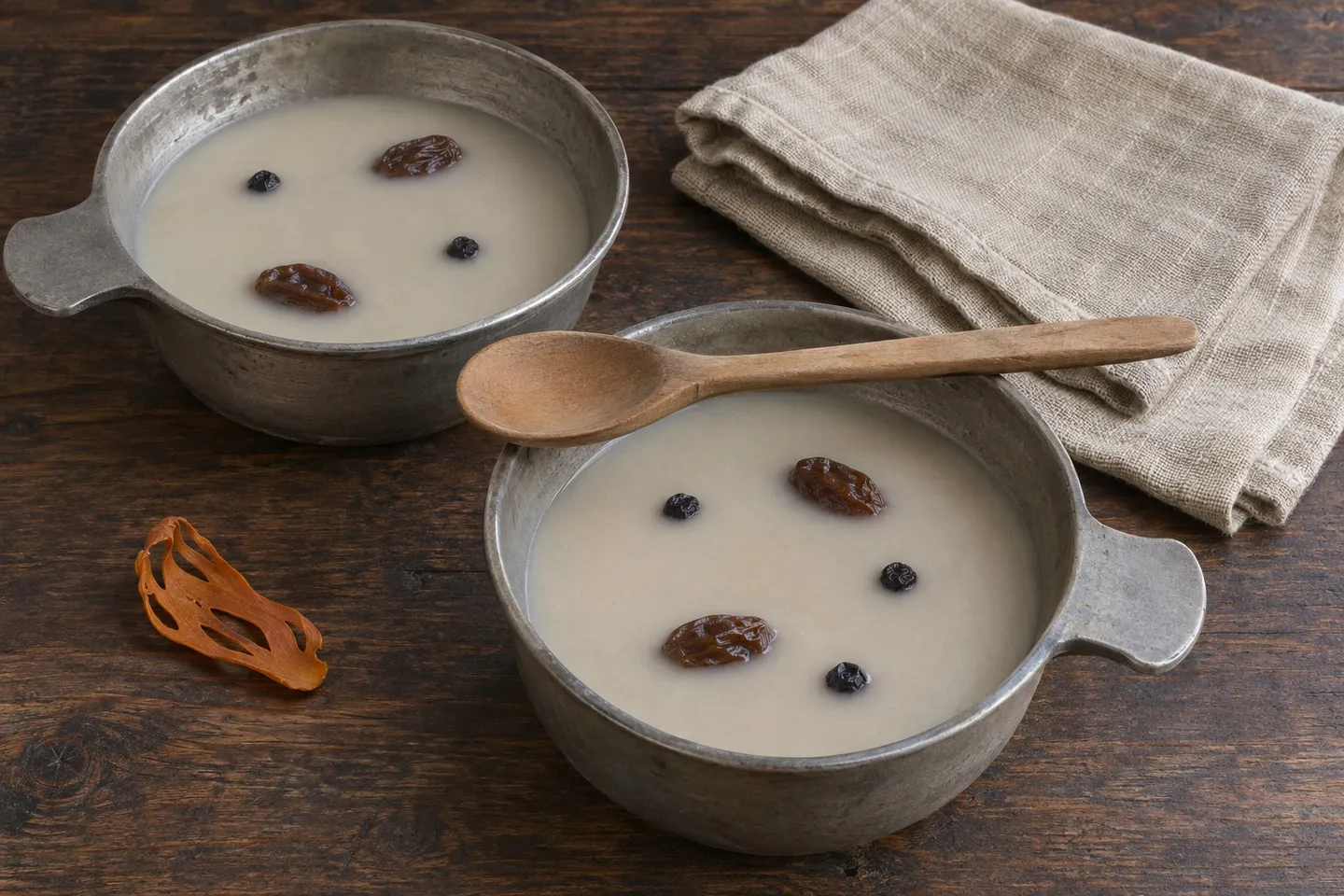
Two pewter porringers of thin oatmeal gruel with plumped raisins and currants.
The story behind the recipe
Fine water-gruel is oatmeal water, boiled until it thickens, with a little fruit stirred in. Hannah Woolley printed it as No. 79 of The Queen-like Closet in 1672, between a syllabub and a lemon cream: oatmeal steeped all night and strained, the liquor boiled with a blade of mace, then raisins and currants, salt and sugar, “and so eat it.” The solid oatmeal stays in the strainer. What reaches the bowl is the milky starch it gave up in the night.
A breakfast for children
Woolley’s recipe doesn’t mention children. John Locke supplies the link in Some Thoughts Concerning Education (1693), where water-gruel stands in his list of breakfasts and suppers “very fit for Children,” beside milk, milk pottage and flummery. He wanted all of them plain and sparingly sweetened, so his water-gruel would have had less sugar and fruit than Woolley’s. What Did Children Eat in the 1600s? sets the two books side by side.
Woolley’s fruit gets its own treatment. The raisins and currants are “infused in a Pot (in a Pot of seething Water)”: plumped in a pot that stood in simmering water, so they went into the gruel soft and swollen.
Read more about this recipe
Making it today
The overnight steep happens in the refrigerator, and a lidded jar of fruit sits in a pan of simmering water the way Woolley’s pot did. Her “little Wine” is left out, since the gruel is meant for children. Fine oatmeal, the kind ground for porridge and oatcakes, stands in for her “best Oatmeal beaten,” and all the amounts are ours, since Woolley gives none. Some 240 years later the Titanic still served gruel at third-class supper, made with milk and water in the Oatmeal Gruel (1906).
To make fine Water-Gruel.
Take the best Oatmeal beaten. and steep it in water all night, the next day strain it, and boil it with a Blade of Mace, and when it is enough, put in some Raisins and Currans which have been infused in a Pot (in a Pot of seething Water) and a little Wine, a little Salt, a little Sugar, and so eat it.
Recipe makes: About 500 ml, 2 bowls
Ingredients
For about 500 ml, 2 bowls. Quantities are shown as written.
Quantities as written here, for about 500 ml, 2 bowls.
- Fine oatmeal50 g
- Cold water600 ml
- Blade mace1
- Raisins2 tbsp
- Currants2 tbsp
- Boiling water, for the fruit100 ml
- Salt1/4 tsp
- Sugar2 tsp
Measurement notes
Ingredients as written here
- 50 g fine oatmeal
- 600 ml cold water
- 1 blade mace
- 2 tbsp raisins
- 2 tbsp currants
- 100 ml boiling water, for the fruit
- ¼ tsp salt
- 2 tsp sugar
Equipment
 Bowl
 Fine sieve
 Saucepan
 Glass jar with a lid
 Wooden spoon
Instructions
The night before, stir the fine oatmeal into the cold water in the bowl, cover it with a plate and refrigerate for at least 8 hours.
In the morning, stir the oatmeal well, then pour it through the fine sieve into the saucepan, pressing the oatmeal with the back of the spoon to push through as much of the milky liquid as you can. Discard what stays in the sieve.
Put the raisins and currants in the glass jar and pour the boiling water over them. Put the lid on and stand the jar in a pan of simmering water for about 10 minutes, until the fruit is plump.
Add the mace to the strained liquid and bring it to a boil, 212°F (100°C), stirring all the time, since the starch settles and catches on the bottom. Lower the heat and simmer, still stirring, for 8 to 10 minutes, until the gruel is smooth and thick enough to coat the spoon thinly, like single cream.
Lift out the mace. Drain the fruit and stir it into the gruel with the salt and sugar. Serve hot in bowls.
Nutrition
120calories per serving
- Recipe makes
- About 500 ml, 2 bowls
- Servings
- 2
Estimated per bowl (2) from USDA FoodData Central values for oats, raisins, Zante currants and sugar, assuming about half the oatmeal passes the sieve.
Recipe notes
When adjusting quantities
Woolley gives no amounts; these are ours, for two bowls. A double batch needs a wider pan and a few minutes more to thicken.
Notes
Quantities mentioned in these notes don’t change when you adjust the servings.
Our changes from Woolley: fine oatmeal for her “best Oatmeal beaten,” a steep in the refrigerator, amounts for two bowls, a jar in simmering water for her pot in seething water, the fruit drained before it goes in, and the “little Wine” left out for children. The gruel thickens as it cools; loosen it with a little hot water. Chill leftovers within 2 hours, keep them covered up to 3 days, and reheat until steaming hot, 165°F (74°C). Contains oats, which may carry gluten.
Scaling changes the ingredients only; pan sizes and cooking times need their own judgment. To adapt this recipe further, try the recipe tool at TuneMyRecipe (opens in a new tab), our sister site.
Sources and attribution
After Hannah Woolley, The Queen-like Closet, 2nd ed. (London, 1672), No. 79, To make fine Water-Gruel
See the original pages (scan at Internet Archive) (opens in a new tab)
Recipe details
- Course
- Breakfast
- Dish family
- Soups & Broths
- Region
- British
- Era
- 17th century
- Main ingredient
- Grains & riceFruit
- Difficulty
- Easy
- Occasion
- Everyday meal
- Season
- Winter