Furmity, Wheat Boiled in Milk (1672)
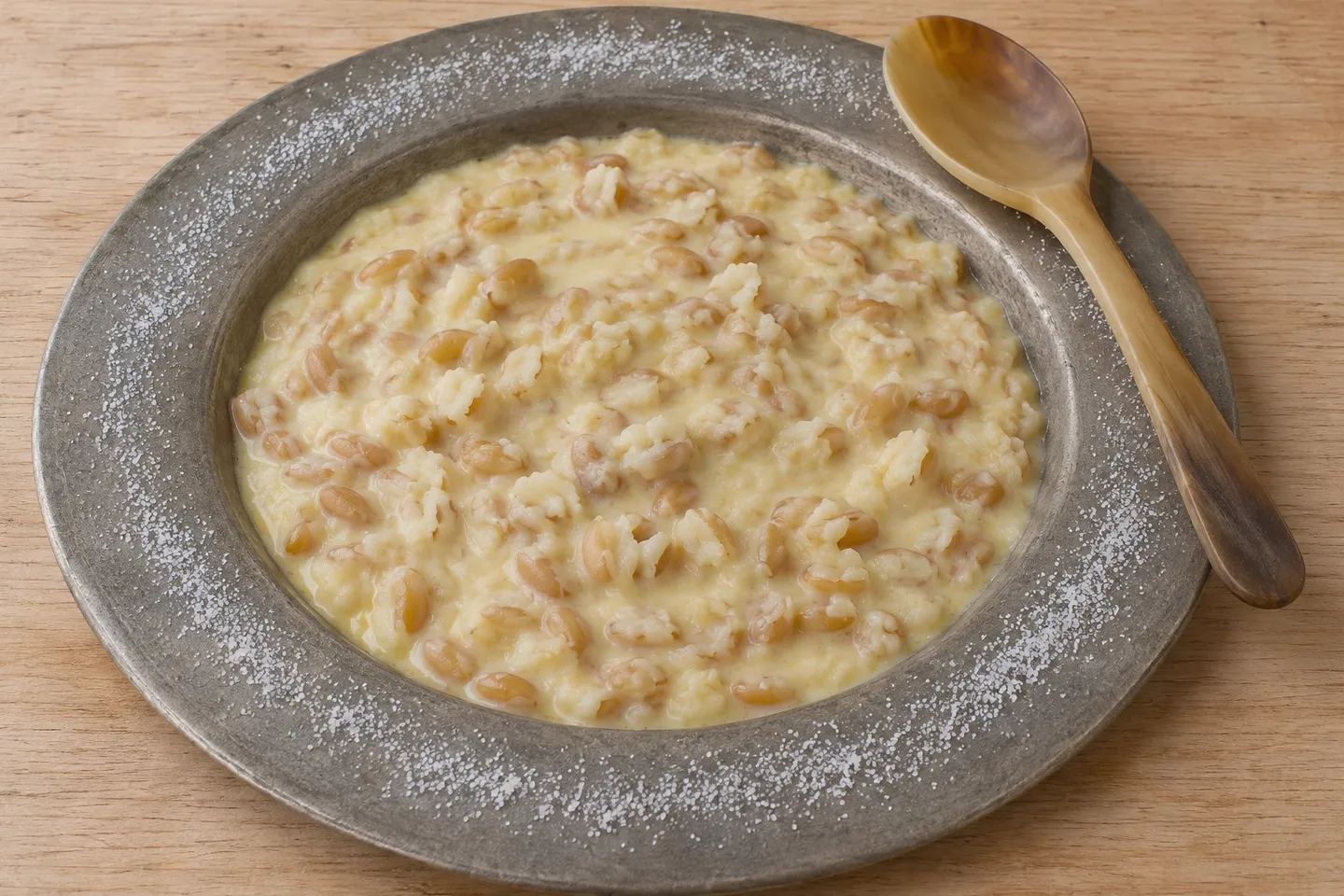
Reader ratingsHannah Woolley’s furmity of 1672: whole wheat boiled soft in two waters, simmered in spiced new milk, thickened with egg yolks and served with sugar on the rim.
- Recipe makes
- 4 bowls
- Prep
- Cook
- Total
The wheat boils in two waters for about 70 minutes in all until the grains burst and turn soft; it can be boiled a day ahead and kept in the refrigerator. The milk stage takes about 25 minutes.
Soft wheat grains in thickened milk in a pewter dish, with sugar on the rim and a horn spoon.
The story behind the recipe
Furmity is wheat boiled until the grains split and go soft, then simmered in milk. Hannah Woolley’s No. 54 in The Queen-like Closet (1672) boils new milk or cream “with whole Spice,” puts in wheat or pearl barley “boiled very tender in several Waters,” thickens it with egg yolks and sends it to table “with fine Sugar on the Brims of the Dish.” The older spelling is frumenty, from the Latin for grain.
A Lent dinner for the Blue-coat boys
Furmity was a dish for days without meat. Woolley’s own bill of fare “for Fish Days and Fasting Days in Ember week, or in Lent” opens with new butter and “A Dish of Rice Milk or Furmity,” and one London school gave it to its children on just such a day. At Christ’s Hospital, the city’s school for poor children, a benefactor named Lewis Randall left money in the late 1500s for a yearly dinner of roast meat for the children on St. Matthias’ day, in late February. If the feast fell in Lent, when meat was not eaten, “good furminty was to be substituted both at dinner and supper,” as the school’s historian William Trollope copied it in 1834.
John Locke, twenty years after Woolley, counted milk-pottages among the breakfasts and suppers “very fit for Children,” so long as they were plain and very sparingly sweetened. What Did Children Eat in the 1600s? sets his rules beside Woolley’s dishes. Her plainer pot from the same book is the Fine Water Gruel (1672), oatmeal water boiled with mace and a little fruit.
Read more about this recipe
Making it today
Whole wheat grains, sold as wheat berries, stand in for the wheat Woolley’s readers could buy “ready boiled, such as they sell in the Market,” as her next furmity puts it; pearl barley, which she allows, cooks in about half the time. Her “several Waters” become two. The spice is a stick of cinnamon and two blades of mace, our choice for her unnamed “whole Spice,” lifted out before the eggs go in. Milk rather than cream, and the amounts, are ours.
Take some new Milk or Cream, and boil it with whole Spice, then put in your Wheat or Pearl Barley boiled very tender in several Waters, when it hath boiled a while, thicken it with the yolks of Eggs well beaten, and sweeten it with Sugar, then serve it in with fine Sugar on the Brims of the Dish.
Recipe makes: 4 bowls
Ingredients
For 4 bowls. Quantities are shown as written.
Quantities as written here, for 4 bowls.
- Whole wheat grains (wheat berries)150 g
- Water, for the first boiling1.5 l
- Water, for the second boiling1.5 l
- Whole milk750 ml
- Cinnamon stick1
- Blades mace2
- Egg yolks2
- White sugar40 g
- Caster sugar, for the rim1 tbsp
Measurement notes
Ingredients as written here
- 150 g whole wheat grains (wheat berries)
- 1.5 litres water, for the first boiling
- 1.5 litres water, for the second boiling
- 750 ml whole milk
- 1 cinnamon stick
- 2 blades mace
- 2 egg yolks
- 40 g white sugar
- 1 tbsp caster sugar, for the rim
Equipment
 Large saucepan
 Colander
- Medium saucepan
 Wooden spoon
 Small bowl
 Whisk
 Instant-read thermometer
 Warm deep serving dish
Instructions
Rinse the whole wheat grains in the colander and put them in the large saucepan with the water for the first boiling. Bring to a boil and boil steadily for 30 minutes, then drain.
Return the wheat to the pan with the water for the second boiling and boil again for 30 to 40 minutes, until most of the grains have split open and are soft right through. Drain well.
Put the whole milk, cinnamon stick and mace in the medium saucepan and bring to a gentle simmer over medium heat. Stir in the drained wheat and let it bubble gently for 15 minutes, stirring often so it doesn’t catch, until the milk has thickened a little around the grains.
Take the pan off the heat and lift out the cinnamon and mace. Whisk the egg yolks with the white sugar in the small bowl, then whisk in a ladleful of the hot milk.
Pour the yolk mixture into the pan and return it to low heat. Stir without stopping for 3 to 5 minutes, without letting it boil, until it coats the back of the spoon and reads 160°F (71°C) on the thermometer.
Pour the furmity into the warm serving dish and scatter the caster sugar around the rim.
Nutrition
320calories per serving
- Recipe makes
- 4 bowls
- Servings
- 4
Estimated per serving (4) from USDA FoodData Central values for hard red wheat, whole milk, egg yolk and granulated sugar.
Recipe notes
When adjusting quantities
Woolley gives no amounts. 150 g of wheat to 750 ml of milk makes four bowls of a soft, spoonable furmity; add more milk for a thinner one.
Notes
Quantities mentioned in these notes don’t change when you adjust the servings.
Our changes from Woolley: wheat berries boiled at home for market wheat, two waters for “several,” cinnamon and mace for her unnamed spice, milk in place of the cream she also allows, and our amounts. For barley, boil 150 g pearl barley in one water for about 35 minutes. The wheat keeps in the refrigerator for 3 days once boiled. Refrigerate leftover furmity within 2 hours and eat it within 2 days; it thickens as it cools, so loosen it with a little milk when you warm it through. Contains wheat, milk and egg.
Scaling changes the ingredients only; pan sizes and cooking times need their own judgment. To adapt this recipe further, try the recipe tool at TuneMyRecipe (opens in a new tab), our sister site.
Sources and attribution
After Hannah Woolley, The Queen-like Closet, 2nd ed. (London, 1672), No. 54, To make Furmity
See the original pages (scan at Internet Archive) (opens in a new tab)
Recipe details
- Course
- Breakfast
- Region
- British
- Era
- 17th century
- Main ingredient
- Grains & riceMilk & cream
- Difficulty
- Easy
- Occasion
- Everyday meal
- Season
- Winter