Captain Swan’s buccaneers provision at Guam, May to June 1686 · Guam, Mariana Islands
What Did Buccaneers Eat When They Reached Guam in 1686?
What buccaneers ate at Guam in 1686: breadfruit baked by islanders and brought out hot each day, coconut-fed hogs and melons, then rice and salt pork for sea.
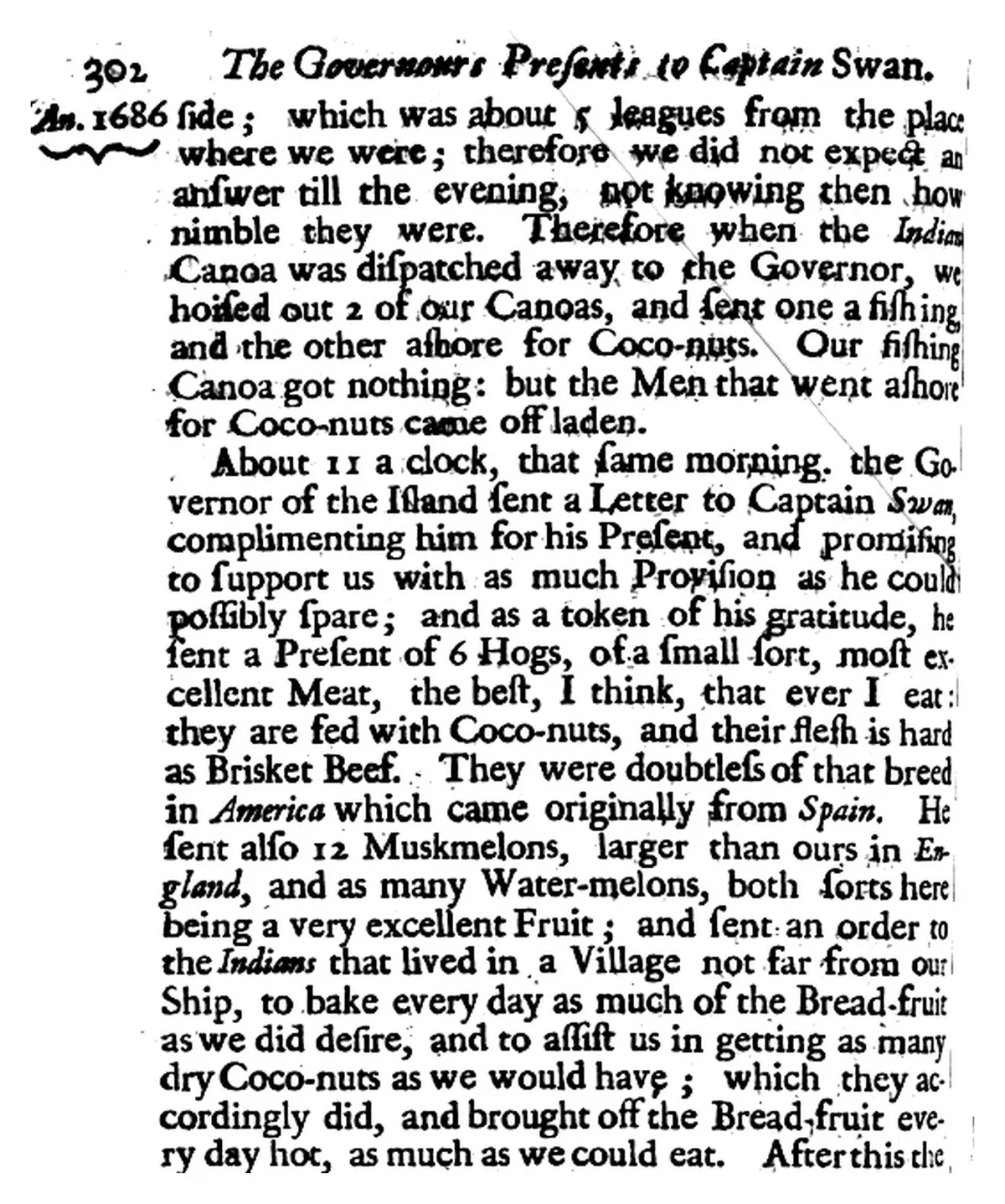
They ate breadfruit, baked in a village oven and carried out to the ship while it was still hot. When Captain Swan’s buccaneers anchored off Guam in May 1686, after seven weeks crossing the Pacific on a few spoonfuls of boiled maize a day, the Spanish governor sent them small hogs fattened on coconuts, muskmelons and watermelons, and ordered the people of a nearby village to bake breadfruit for them. William Dampier, who sailed with Swan, wrote that the islanders “brought off the Bread-fruit every day hot, as much as we could eat.” None of it came free. A priest sat in Swan’s cabin as a hostage until the food arrived, and the governor asked for powder, shot and arms in return. When the company left for Mindanao, it took what would keep: coconuts, rice and about fifty hogs in salt.
Ten spoonfuls of maize
Dampier’s A New Voyage Round the World, printed in London in 1697, tells the crossing from the deck. Swan’s ship and a smaller bark under Captain Teat sailed from Cape Corrientes, on the Pacific coast of Mexico, on March 31, 1686, with 150 men, “beside slaves.” By Dampier’s reckoning they had “not 60 days Provision, at a little more than half a pint of Maiz a day for each man,” three meals of salted jewfish, and a great many rats eating the grain. Swan had told the men they would cross “in little more than 40 days,” and what carried them, Dampier says, was the hope of cruising for Spanish ships off Manila.
The fish was eaten in the first three days. After that there was only maize, and when the men saw how fast they were sailing and grumbled at their short allowance, Swan “with much reluctance” let it rise: “now we had not above 10 spoonfuls of boil’d Maiz a man, once a day, whereas before we had 8.” Dampier thought the short commons did him good and that his dropsy wore off, “though others were weakened by it.”
They sighted Guam on May 20, with food left for three days. What came next is hearsay, and Dampier says so. “As I was afterwards informed,” he wrote, the men had planned to kill Swan and eat him when the victuals were gone, and after him everyone who had promoted the voyage, Dampier among them. Swan turned it into a joke once they were at anchor: “Ah! Dampier, you would have made them but a poor Meal,” because Dampier was as lean as the captain was “lusty and fleshy.”
A priest held for provisions
Guam had been a Spanish mission and garrison since 1668, when Jesuits arrived with a company of soldiers. The historian Francis X. Hezel describes years of intermittent warfare that ended with a final major uprising in 1684, put down by the garrison and its Chamorro allies by 1685. Dampier heard of it in his own terms: the islanders had risen not long before, failed, and destroyed the plantations and stock. Some of those still on the island offered to lead the English to the fort and help them take it. “C. Swan was not for molesting the Spaniards here.”
Before the ship had anchored, a priest came out in the night with three islanders and was told, in Spanish, that the ship was Spanish and came from Acapulco. When they saw their mistake they tried to leave, “but we held their Boat fast.” Swan received the priest “with much civility” in the great cabin, told him he came “as a friend to purchase with his Money what he wanted,” and kept him aboard as a hostage “till we had Provision.” Food was scarce on the island, the priest said, but the governor would do his utmost. In the morning his boat went off with two letters and Swan’s present: four yards of scarlet cloth and a piece of broad silver and gold lace.
The governor was Damián de Esplana, who held Guam from 1683 to 1694. His answer came by eleven o’clock. He promised as much as he could spare, and as a token sent six hogs “of a small sort, most excellent Meat, the best, I think, that ever I eat.” Dampier explains why: “they are fed with Coco-nuts, and their flesh is hard as Brisket Beef.” Twelve muskmelons came with them, larger than English ones, and as many watermelons.
Breadfruit, baked every day
The same letter carried an order. The people of a village near the ship were to bake as much breadfruit every day as the English wanted, and help them gather dry coconuts. After that the governor sent a canoe or two each day with hogs and fruit, and asked in return for powder, shot and arms, which were sent. He also asked for the ship’s large English dog, and Swan gave it to him, “though much against the grain of many of his Men.”
Dampier had never seen breadfruit anywhere but Guam, and he gives it a careful page. The tree was as big as the largest English apple trees, the fruit round, with a thick, tough rind. The islanders picked it full grown but still green and hard, and baked it until the rind was scorched black. Under the black crust they scraped away lay a thin, tender skin, and the inside was “soft, tender and white like the crumb of a Penny Loaf.” It had to be eaten fresh, since a day later it was dry and hard to swallow, and in the eight months of its season, he wrote, the islanders ate no other bread. The seedless kind he describes is called lemai in Chamorro; the seeded kind is dugdug.
Who baked it, and on what terms, Dampier leaves out. Hezel’s study of the decades after 1690 describes the labor governors demanded of the Chamorro: villages had to plant rice, corn and melons and raise pigs and poultry, nominally for the troops but in fact for the governor’s table or for sale, and women collected copra to feed the pigs. One later governor was charged with making islanders work the government’s fields for a few leaves of tobacco. That is a later account of the same colony, and it may explain how a governor could order a village to feed a shipload of strangers.
The coconut gets even more of Dampier’s attention, several pages on its water, its kernel, its oil and its rope. Rasped kernel steeped in fresh water turned “white as Milk,” and in that milk, he wrote, people boiled “a Fowl, or any sort of Flesh, and it makes very savory Broath.” English seamen put it into boiled rice in place of rice-milk, “carrying Nuts purposely to Sea with them. This they learn from the Natives.” He is writing of the coconut wherever he had met it, though the passage sits in his Guam chapter, and the company was loading coconuts by the canoe-load.
Stores for the next passage
While they lay at Guam, the Acapulco galleon came in sight of the island. The governor sent a proa to warn her, and she stood off to the south. When the islanders told the English she was nearby, the men wanted to go after her, “but Captain Swan perswaded them out of that humour.” From Manila that July, the Jesuit Antonino Tuccio passed on the news that the galleon Santa Rosa had neither anchored at the Marianas nor landed anything, warned by lookouts and canoes of two enemy ships, and that the mission had gone without the relief she carried.
On May 30 the governor sent his last present: more hogs, a jar of pickled mangoes, a jar of “excellent pickled Fish,” a jar of “fine Rusk, or Bread of fine Wheat Flower, baked like Bisket, but not so hard,” and six or seven packs of rice. He could spare no more, he said, and the west monsoon was close. Swan sent the priest ashore with a brass clock, an astrolabe and a large telescope, and the priest answered with six hogs, a roasting pig, three or four bushels of potatoes and fifty pounds of Manila tobacco.
Then the ship was loaded for the run to Mindanao. “We took aboard us as many Coco-nuts as we could well stow, and we had a good stock of Rice, and about 50 Hogs in Salt.” Salt pork, rice and whole coconuts would all keep, and from now on the cooking would be done on board. Salt meat was still at the heart of a ship’s stores when James Cook sailed in 1768, as What Did Captain Cook Feed His Crew to Keep Them Well? tells. The date they sailed is less certain. Dampier’s 1697 edition prints June 22; a 2008 history of Guam’s fisheries gives June 2, and Hezel has the English staying two weeks.
The recipes
These three dishes follow the food from shore to hold, all from Dampier’s own pages. The breadfruit is cooked as he says the islanders cooked it; the broth and the rice come from his coconut pages, which describe the nut wherever he had met it. The modern amounts, times and the choice of pork for the broth are ours.
- Baked Breadfruit (1697): a whole green breadfruit roasted until the rind blackens, then scraped and sliced like bread.
- Coconut Milk Pork Broth (1697): pork simmered in milk pressed from grated coconut.
- Rice with Coconut Milk (1697): the seamen’s rice, boiled and then finished in coconut milk.
Cooking it
Put the baked breadfruit in the oven and the coconut milk pork broth on the stove at the same time. The fruit wants 1½ to 2 hours and the pork about 1¼, so the island’s bread and a pot of pork in coconut milk reach the table hot together, as the breadfruit and the governor’s hogs reached Swan’s ship at anchor. For what the buccaneers drank, from brandy by the cask to the punch Dampier saw at the salt ponds of La Tortuga, Forgotten Drink, our sister site, tells what pirates drank (opens in a new tab).
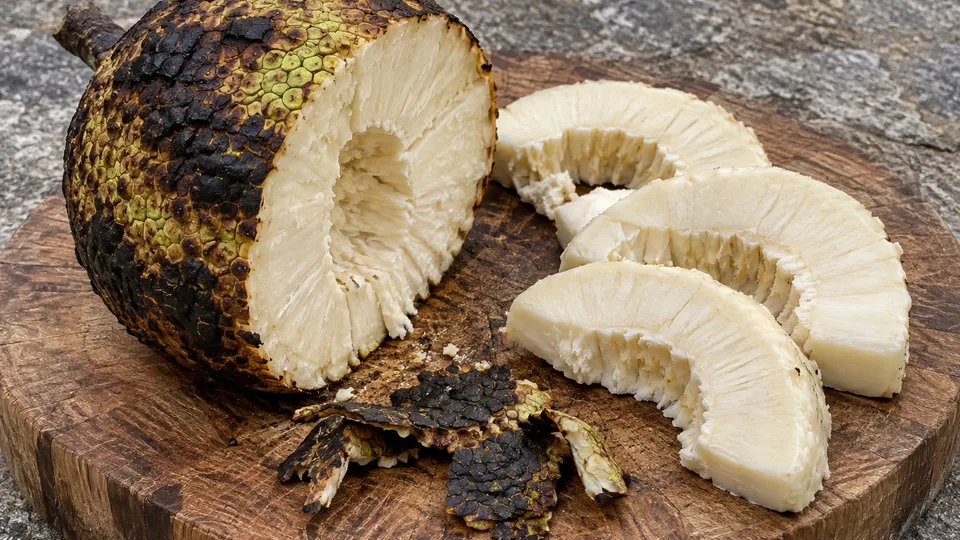 Cook it todayBaked Breadfruit (1697)
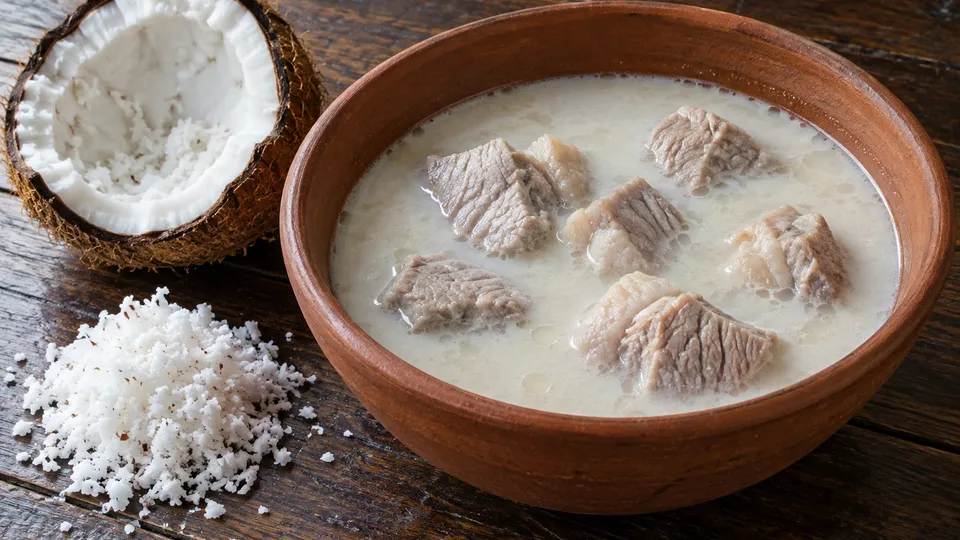 Cook it todayCoconut Milk Pork Broth (1697)
Sources
- William Dampier, A New Voyage Round the World (London: James Knapton, 1697), pp. 279–284, 292–297 and 300–306; Internet Archive, early English books microfilm copy, PDF 307–310, 315–316, 324–329 and 332–338.
- Antonino Tuccio to Pedro de Espinar, Manila, July 12, 1686, Spanish text and translation in Rodrigue Lévesque, ed., History of Micronesia, vol. 8 (Gatineau: Les Éditions Lévesque, 1996), pp. 551–554.
- Francis X. Hezel, “From Conquest to Colonization: Spain in the Marianas 1690–1740” (1988), Micronesian Seminar, https://micsem.org/article/from-conquest-to-colonization-spain-in-the-marianas-1690-1740/ (opens in a new tab).
- Judith R. Amesbury and Rosalind L. Hunter-Anderson, An Analysis of Archaeological and Historical Data on Fisheries for Pelagic Species in Guam and the Northern Mariana Islands (Pelagic Fisheries Research Program, University of Hawaii, 2008), pp. 66 and 95, https://www.soest.hawaii.edu/pfrp/pdf/MARSreport.pdf (opens in a new tab).