Coconut Milk Pork Broth (1697)
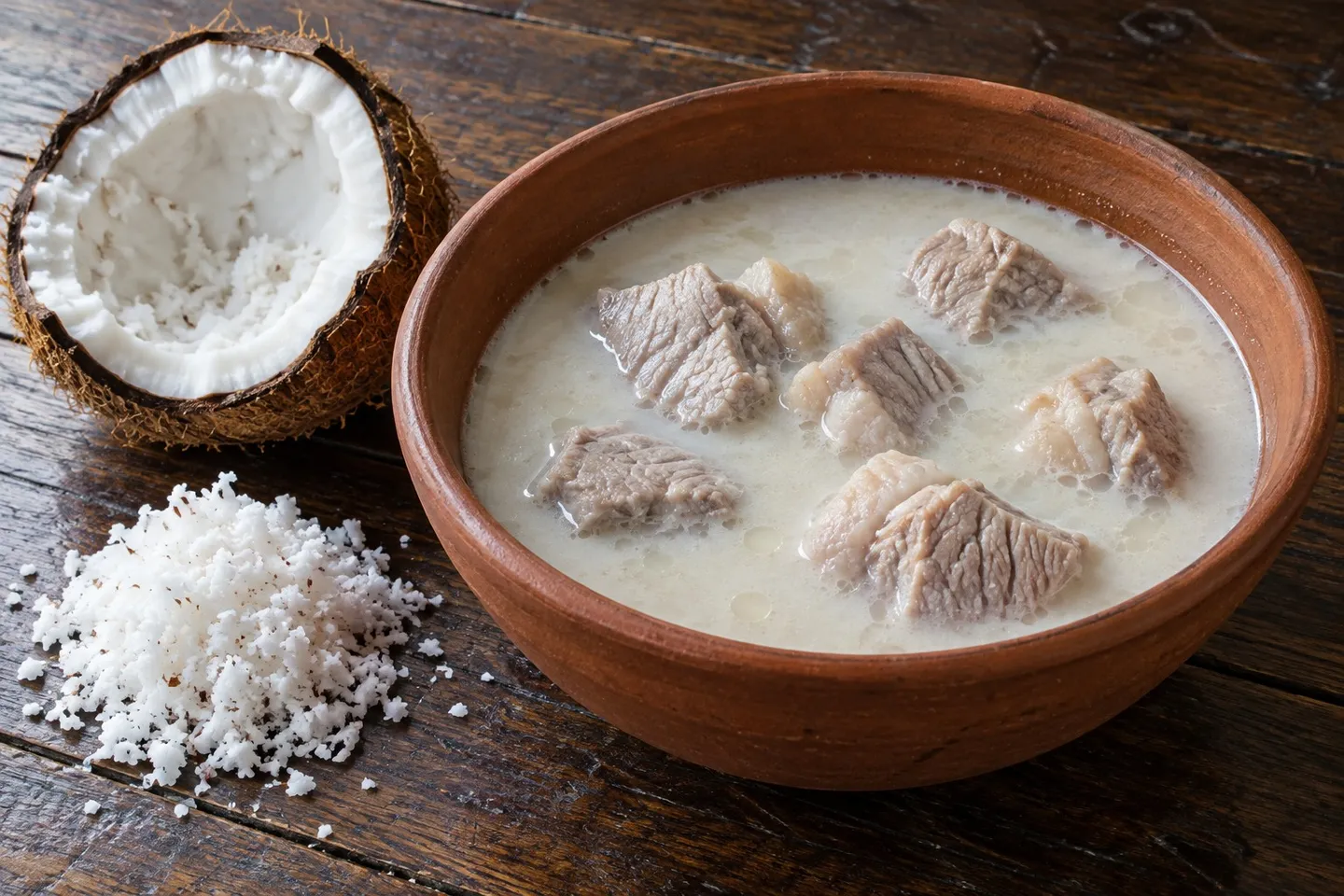
Reader ratingsA coconut milk pork broth after William Dampier’s 1697 account of meat boiled in coconut milk: pork simmered gently in milk pressed from freshly grated coconut.
- Recipe makes
- About 6 cups, 4 servings
- Prep
- Cook
- Total
Prep includes 15 minutes for the grated coconut to steep in hot water before you press out the milk.
Pork in a pale coconut milk broth, with half a coconut shell and grated coconut.
The story behind the recipe
William Dampier’s broth starts with a dry coconut and two good knocks. In A New Voyage Round the World, printed in 1697, he describes the kernel rasped out and steeped in fresh water until the water turned white, then meat boiled in it. The passage sits in his chapter on Guam, but it draws on coconuts he had known from the Maldives to Sumatra. Why Captain Swan’s buccaneers were loading them by the canoe-load in the spring of 1686 is told in What Did Buccaneers Eat When They Reached Guam in 1686?
What went into the pot?
“A Fowl, or any sort of Flesh,” Dampier says, and on Guam the flesh was pork. The Spanish governor’s first present to the hungry company was six small hogs, which Dampier rated the best meat he had ever eaten. He gave the coconut the credit: the island’s pigs were fed on it, and he found their meat as firm as brisket of beef. Feeding pigs on coconut went on long after he left. The historian Francis X. Hezel, writing of Guam in the decades after 1690, describes the island’s women required to gather copra, the dried kernel, to feed the governor’s pigs.
Dampier had the coconut down to its parts. Its water was best, he thought, when the nut was almost ripe; its kernel made oil for lamps and frying; and its husk made rope. The broth turns the kernel into something to cook in.
Read more about this recipe
Making it today
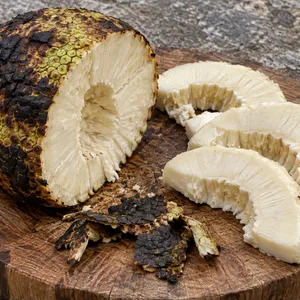
Dampier names no seasoning and no amounts. The pork is our choice, for the governor’s hogs, and so is the salt. A fresh brown coconut gives the thin, clean milk his “little fresh Water” suggests; frozen grated coconut, sold in Asian and Pacific grocers, does the same job. Keep the pot at a bare simmer, because a hard boil makes coconut milk separate. Slices of baked breadfruit, the bread Guam ate that season, go alongside.
The Kernel is much used in making Broath. When the Nut is dry they take off the husk, and giving two good blows on the middle of the Nut, it breaks in two equal parts, letting the Water fall on the ground; then with a small iron Rasp made for the purpose, the Kernel or Nut is rasped out clean, which being put into a little fresh Water, makes it become white as Milk. In this milky Water they boil a Fowl, or any sort of Flesh, and it makes very savory Broath.
Recipe makes: About 6 cups, 4 servings
Ingredients
For about 6 cups, 4 servings. Quantities are shown as written.
Quantities as written here, for about 6 cups, 4 servings.
- Freshly grated coconut, from about one brown coconut0.75 lb
- Hot water4 cups
- Boneless pork shoulder1.5 lb
- Salt1 1/2 tsp
Measurement notes
Ingredients as written here
- ¾ lb freshly grated coconut, from about one brown coconut
- 4 cups hot water
- 1½ lb boneless pork shoulder
- 1½ tsp salt
Equipment
- Box grater or food processor, if grating your own coconut
 Large heatproof bowl
- Sieve lined with a double layer of cheesecloth
- Heavy pot, about 4 quarts, with a lid
 Instant-read thermometer
Instructions
Put the grated coconut in the bowl and pour the hot water over it. Stir and leave it for 15 minutes.
Set the lined sieve over the pot. Tip in the coconut and its water, gather up the cloth and squeeze hard, twisting, until no more milk runs out. Discard the pressed coconut.
Cut the pork shoulder into 1½-inch pieces and add them to the coconut milk with the salt. Bring it slowly to a simmer over medium heat, skimming off any gray foam.
Turn the heat down, set the lid on slightly ajar and keep the pot at a bare simmer for about 1¼ hours, stirring now and then, until the pork is tender enough to break with a spoon; by then the thermometer reads well above 145°F (63°C), the safe minimum for whole cuts of pork.
Taste the broth for salt and serve the pork in wide bowls with plenty of broth.
Nutrition
560calories per serving
- Recipe makes
- About 6 cups, 4 servings
- Servings
- 4
Estimated per serving (4) from USDA FoodData Central values for pork shoulder and raw coconut meat, assuming about half the coconut’s fat passes into the milk.
Recipe notes
When adjusting quantities
Doubles in a larger pot; the simmering time stays about the same.
Notes
Quantities mentioned in these notes don’t change when you adjust the servings.
We also chose the steeping, the cheesecloth and the simmering time. To open a coconut, pierce two of its three eyes, drain the water out, then knock it hard around the middle with the back of a heavy knife or a hammer until it splits, as Dampier describes; pry out the white meat and grate it. In place of fresh coconut and the hot water, you can use a 13½ fl oz can of unsweetened coconut milk thinned with 2½ cups of water. For Dampier’s fowl, use bone-in chicken thighs and simmer about 40 minutes, until the meat reads 165°F (74°C). Chill leftovers within 2 hours, keep them up to 3 days and reheat to 165°F (74°C).
Scaling changes the ingredients only; pan sizes and cooking times need their own judgment. To adapt this recipe further, try the recipe tool at TuneMyRecipe (opens in a new tab), our sister site.
Sources and attribution
After William Dampier, A New Voyage Round the World (London, 1697), on coconut milk broth
See the original pages (scan at Internet Archive) (opens in a new tab)
Recipe details
- Course
- Soup
- Dish family
- Soups & Broths
- Region
- International
- Era
- 17th century
- Main ingredient
- Pork & ham
- Difficulty
- Easy
- Occasion
- Everyday meal