New England’s pumpkin, from Josselyn’s pot to Child’s pie · New England
What Did Americans Do with Pumpkin Before Pumpkin Pie?
They stewed it: in 1672 New England cooked diced pumpkin all day, then added butter, vinegar and ginger to eat with fish or meat. Pie came by 1658.
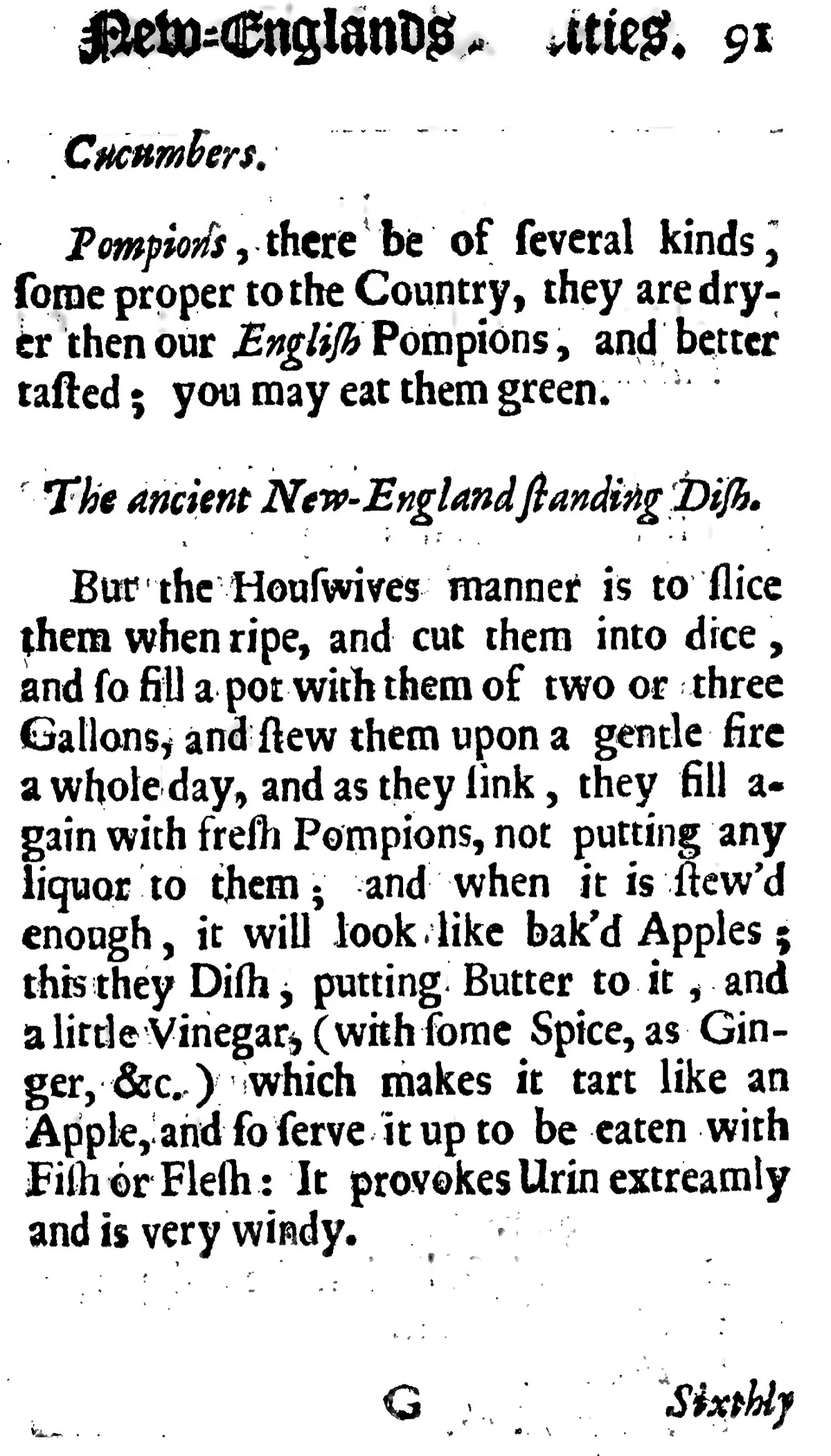
They stewed it, and ate it with dinner. In 1672 the English writer John Josselyn described how New England housewives filled a pot with diced ripe pumpkin, stewed it over a gentle fire for a whole day without adding any water, and then finished it with butter, a little vinegar and ginger, so it came out “tart like an Apple,” to be eaten “with Fish or Flesh.” Pie was not far behind. English cooks were already putting pumpkin in pastry in the 1650s, and the sweet custard in a crust that Thanksgiving knows today was in an American cookbook by 1796.
A pot that kept sinking
Josselyn published New-Englands Rarities Discovered in London in 1672, a survey of the birds, beasts, fish and plants of the country. Pompions, as the English called pumpkins, get a short entry. There were several kinds, he wrote, some “proper to the Country,” drier than English pompions and better tasted. Then comes a heading of its own, “The ancient New-England standing Dish.”
His method is all in one sentence. The housewives slice the pumpkins when ripe and cut them into dice, fill a pot of two or three gallons, and stew them all day, “and as they sink, they fill again with fresh Pompions, not putting any liquor to them.” Liquor here means any liquid. The pumpkin cooks in its own juice, and the pot keeps taking more as the first dice collapse. When it is done, “it will look like bak’d Apples.”
The vinegar is what makes it a side dish. Butter and ginger alone would point toward dessert; vinegar turns it sharp, and Josselyn’s housewives served it beside fish or meat. “Ancient” is his own word, and he puts no date on it.
He wasn’t the only one to compare pumpkin with apples. Adriaen van der Donck, describing the Dutch colony of New Netherland in 1655, wrote that its pumpkins grew with little or no tending and were so sweet and dry that people stewed them with vinegar and water “in the same manner as apples,” as the 1841 English translation puts it. On the next page he set down that the native people had a squash of their own, which the Dutch called Quaesiens after the people’s own name for it, a plant the newcomers had not known before they met the people who grew it. The squash was the native people’s, and so was its name.
Pumpkin in pastry
The same Van der Donck paragraph says that the English, who “think much of what gratifies the palate, use it also in pastry.” His Dutch original of 1655 says Pastayen. The footnote that turns those English into New Englanders and adds that “pumpkin pies still hold a prominent place among the luxuries of the land” was written by the 1841 editor, and Van der Donck gives no filling.
A London book of 1658 does. The Compleat Cook has a recipe for a “Pumpion” pie, and it is nothing like the pie of a Thanksgiving table. Sliced pumpkin goes in with thyme, rosemary, parsley and sweet marjoram, cinnamon, nutmeg, pepper and cloves, and beaten eggs; the mixture is fried and layered in a crust with thin slices of apple and currants. After baking, the cook cuts the lid and pours in a caudle of egg yolks with white wine or verjuice. That settles an old claim: pumpkin pie was in print in London well over a century before Amelia Simmons’s Hartford cookbook of 1796, often credited with the first. Anna Węgiel made the point in 2018, working from an edition of the Complete Cook she dates to 1655.
Simmons’s two Pompkins
Simmons’s American Cookery was printed “for the author,” its title page promising recipes “adapted to this country, and all grades of life.” It puts pumpkin among the puddings, under one heading, “Pompkin,” with two numbered versions.
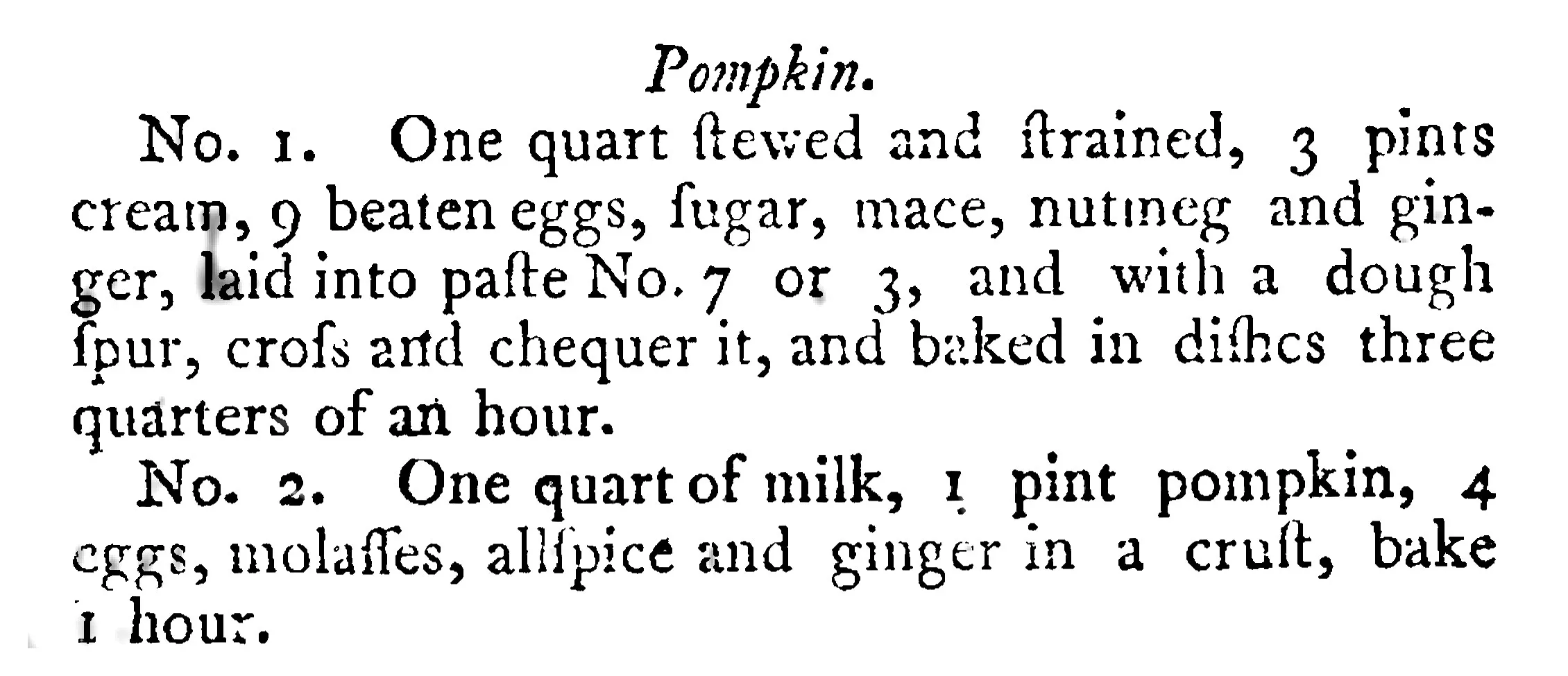
No. 1 is the rich one: a quart of stewed and strained pumpkin to three pints of cream, nine eggs, sugar, mace, nutmeg and ginger, laid into pastry and crossed with strips cut “with a dough spur.” No. 2 is the plain one: a quart of milk to a pint of pumpkin, four eggs, molasses, allspice and ginger, “in a crust.” One book offers pumpkin to dairy at two to three in the first and one to two in the second, sugar or molasses, cream or milk. Both are pies by any modern reading, and both are far closer to today’s than the 1658 layers of herbs and apple.
The short paragraph hides work on other pages. No. 1 sends the cook to “paste No. 7 or 3,” and No. 7, “A Paste for Sweet Meats,” rubs a pound of lard and a third of a pound of butter into two pounds of flour, binds it with beaten egg whites and rolls in the rest of the shortening over ten or twelve rollings. Then there is a printed notice bound into the book. It complains that the person Simmons trusted to prepare her receipts for the press had, “with a design to impose on her, and injure the sale of the book,” left out essentials and put in other things that spoiled the receipts, and follows with a list of corrections. Two touch the pumpkin pie: “In all Puddings, where cream is mentioned, milk may be used,” and “In Pastes, the white of eggs only are to be used.”
Child’s family pie
By 1832 the pie was an everyday thing. Lydia Maria Child wrote The American Frugal Housewife for “those who are not ashamed of economy,” and her “Pumpkin and Squash Pie” sits under “Common Pies,” between mince and carrot. It opens with a household rule: “For common family pumpkin pies, three eggs do very well to a quart of milk.”
What follows is a set of choices. One egg to a quart “makes very decent pies”; for a richer pie, make it thinner and add another egg; “some put an egg to a gill of milk.” The pumpkin goes in until the mixture is as thick as you can stir rapidly and easily, and the sweetening is molasses or sugar to taste, because some pumpkins need more than others. Ginger alone will do for spice if you use enough. She also tells the cook not to scrape the inside of the pumpkin, since the part nearest the seeds is the sweetest.
Her appendix adds two tricks for the pumpkin itself. Boiling the milk and letting the sifted pumpkin boil up in it once or twice, she wrote, much improves the taste of the pie. And pumpkin boiled, sifted, spread thin on tin plates and dried hard in a warm oven “will keep good all the year round,” so that a little piece boiled up in milk makes a batch of pies. That is a farm kitchen planning pies for months after the harvest. The storage claim is hers, and no guide for keeping food today.
How pie became Thanksgiving’s
Neither Simmons nor Child calls her pumpkin pie a holiday dish. A novel does. In Northwood, published in 1827, Sarah Josepha Hale sets a Thanksgiving dinner in a prosperous farmhouse, laid out before a guest from England: roast turkey at the head of the table, beef, pork and mutton at the foot, a goose and ducklings, and a chicken pie that, she wrote, “is, like the celebrated pumpkin pie, an indispensable part of a good and true Yankee Thanksgiving.” On the side table, among a plum pudding, custards and “pies of every name and description ever known in Yankee land,” the pumpkin pie “occupied the most distinguished niche.”
Hale’s table is fiction and a showpiece. What it proves is that readers in 1827 would recognize pumpkin pie as the Thanksgiving pie. Child’s “common family” pie, five years later, is the same dish from the other side: something to make often, with one egg to the quart or four, depending on what the hens and the household purse allowed.
Not on the 1621 table
The pie is often pushed back to the Plymouth harvest of 1621. The only eyewitness account, Edward Winslow’s letter of December that year, names fowl from a day’s shooting and five deer brought by Massasoit’s men, and no other food at the gathering; William Bradford’s later description of that autumn adds fish, wild turkeys, venison and Indian corn. Neither mentions pumpkin in any form. Their silence can’t prove the colonists had none, and a recipe printed decades later can’t fill it either: Josselyn’s pot of 1672 describes his own New England, fifty years on. What was on record that autumn, and who brought it, is in What Was Really Eaten at the 1621 Harvest Feast?
The recipes
One recipe from each of the three books, in the order they were printed. No single meal served them together; the grouping is ours.
- Stewed Pompions (1672): diced pumpkin cooked down in its own juice, then sharpened with butter, cider vinegar and ginger, Josselyn’s side dish for fish or meat.
- Pompkin Pudding (1796): Simmons’s rich No. 1, pumpkin with cream, eggs, mace, nutmeg and ginger, in her lard and butter paste with a crisscross of pastry strips.
- Pumpkin Pie (1832): Child’s family pie of milk, eggs and molasses, with cinnamon and ginger, the pumpkin first boiled up in the milk as her appendix advises.
Cooking it
On Thanksgiving, put the Stewed Pompions (1672) next to the turkey, where Josselyn’s housewives would have put it, beside the meat. It wants about two and a half hours over low heat and nothing from you but a stir now and then, and with Child’s pie baked the day before, the table has both of pumpkin’s old jobs. For the cider, currant wine and ginger beer that stood on Hale’s sideboard beside the pies, our sister site Forgotten Drink has A Temperance Thanksgiving (opens in a new tab).
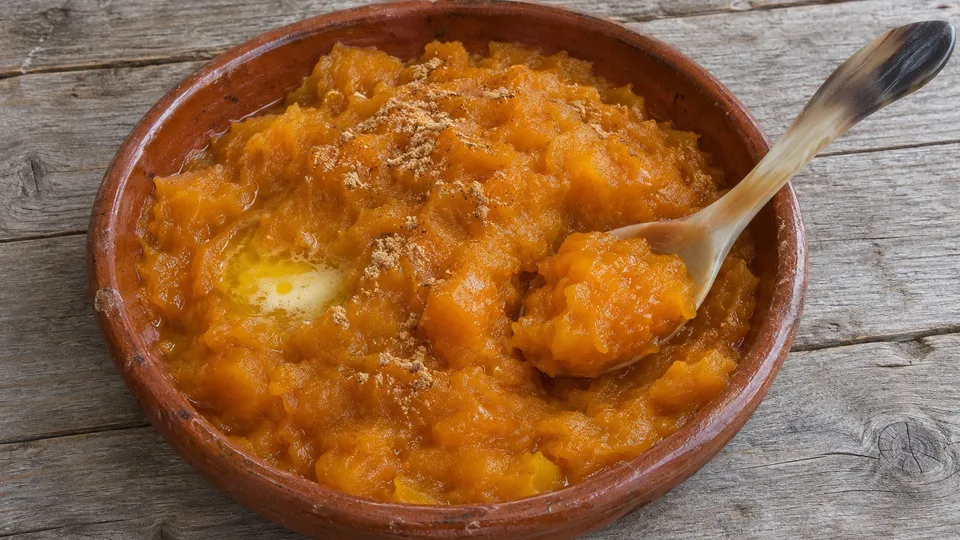 Cook it todayStewed Pompions (1672)
Sources
- John Josselyn, New-Englands Rarities Discovered (London: G. Widdowes, 1672), p. 91.
- Adriaen van der Donck, Beschryvinge van Nieuw-Nederlant (Amsterdam: Evert Nieuwenhof, 1655), pp. 21–22; English translation by Jeremiah Johnson, “Description of the New Netherlands,” Collections of the New-York Historical Society, 2nd series, vol. 1 (New York, 1841), p. 186, with the editor’s notes.
- The Compleat Cook (London, 1658), the “Pumpion” pie, pp. 14–15. Wikimedia Commons (opens in a new tab).
- Amelia Simmons, American Cookery (Hartford: Hudson & Goodwin, for the author, 1796), pp. 28–29, and the Advertisement and Errata.
- Lydia Maria Child, The American Frugal Housewife, 12th edition (Boston: Carter, Hendee, and Co., 1832; Ohio State University Libraries facsimile, 1971), pp. 66–67, 69 and 115.
- Sarah Josepha Hale, Northwood, vol. 1 (1827), pp. 108–110.
- Edward Winslow, letter of December 11, 1621, in A Relation or Iournall of the Beginning and Proceedings of the English Plantation Setled at Plimoth in New England (London, 1622), pp. 60–64.
- William Bradford, History of Plymouth Plantation, ed. Charles Deane (Boston: Massachusetts Historical Society, 1856), p. 105.
- Anna Węgiel, “The British Origins of the First American Cookbook: A Re-evaluation of Amelia Simmons’ American Cookery (1796),” New Horizons in English Studies 3 (2018), pp. 150–162. UMCS (opens in a new tab).