Stewed Pompions (1672)
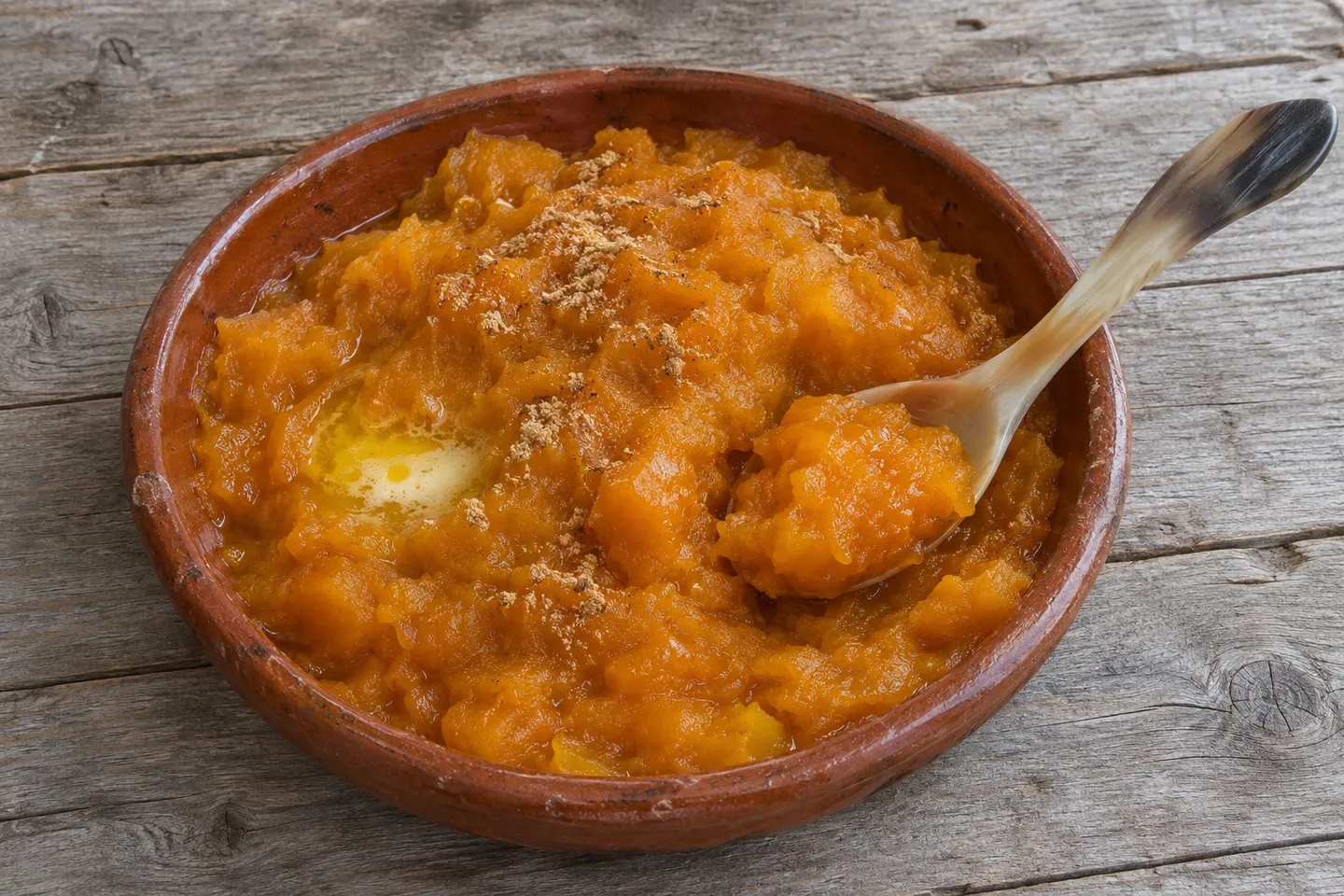
Reader ratingsNew England’s stewed pumpkin of 1672: diced pumpkin cooked down in its own juice, then finished with butter, a little vinegar and ginger to eat beside fish or meat.
- Recipe makes
- About 1 kg, 6 side servings
- Prep
- Cook
- Total
Josselyn’s housewives stewed a pot of two or three gallons for a whole day. This smaller batch cooks down in about 2½ hours over the lowest heat, with a stir every 15 to 20 minutes.
Stewed pumpkin with butter, vinegar and ginger in an earthenware dish.
The story behind the recipe
Pumpkin in Josselyn’s New England was a vegetable for the dinner plate. John Josselyn printed the method in London in 1672, in New-Englands Rarities Discovered, under a heading that names it “The ancient New-England standing Dish.” His housewives diced ripe pumpkins, stewed them a whole day with no water in the pot, topping it up as the dice sank, and then dished the soft pumpkin with butter, a little vinegar and spice such as ginger, to go beside fish or meat.
Josselyn’s pompions
Josselyn was an English visitor writing a catalog of the country’s birds, beasts, fish and plants, and the pumpkin comes among the plants. The local pompions, he wrote, were drier than English ones and better tasted, and “you may eat them green.” He ends the entry on what the dish did to the body: “It provokes Urin extreamly and is very windy.” That is his report, in the medical language of his day, and the only comment he makes on eating it.
We grouped this page’s menu card ourselves: Josselyn’s dish, Amelia Simmons’s pumpkin pudding of 1796 and Lydia Maria Child’s family pie of 1832, which What Did Americans Do with Pumpkin Before Pumpkin Pie? follows from pot to pastry.
Read more about this recipe
Making it today
The pot is the choice that matters. Josselyn’s held two or three gallons and stewed all day; ours is a heavy saucepan with a lid, and the pumpkin goes in three times instead of being topped up from a heap, so each addition can settle before the next. Josselyn praised the local pompions for being drier than English ones, so a pie or sugar pumpkin, or a butternut squash, is the nearest modern choice; a big carving pumpkin is grown for size. The cider vinegar, the salt and the amounts of butter and ginger are our choices, since Josselyn names the seasonings without measures. Serve it the way he describes, with fish or with a roast such as the Roast Venison with Vinegar Sauce (1623).
The ancient New-England standing Dish.
But the Houswives manner is to slice them when ripe, and cut them into dice, and so fill a pot with them of two or three Gallons, and stew them upon a gentle fire a whole day, and as they sink, they fill again with fresh Pompions, not putting any liquor to them; and when it is stew’d enough, it will look like bak’d Apples; this they Dish, putting Butter to it, and a little Vinegar, (with some Spice, as Ginger, &c.) which makes it tart like an Apple, and so serve it up to be eaten with Fish or Flesh: It provokes Urin extreamly and is very windy.
Recipe makes: About 1 kg, 6 side servings
Ingredients
For about 1 kg, 6 side servings. Quantities are shown as written.
Quantities as written here, for about 1 kg, 6 side servings.
- Peeled and seeded pie pumpkin, diced1.5 kg
- Unsalted butter40 g
- Cider vinegar30 ml
- Ground ginger1 tsp
- Salt1 tsp
- Water, only if the pan starts to catch60 ml
Measurement notes
Ingredients as written here
- 1.5 kg peeled and seeded pie pumpkin, diced
- 40 g unsalted butter
- 30 ml cider vinegar
- 1 tsp ground ginger
- 1 tsp salt
- 60 ml water, only if the pan starts to catch
Equipment
 Knife and board
 Kitchen scale
 Saucepan with a lid
 Wooden spoon
 Measuring spoons
Instructions
Cut the pumpkin into dice about 2 cm (¾ inch) across and divide it into three equal heaps.
Put the first heap in the saucepan, cover it and set it over the lowest heat you have. Stir it often for the first 15 minutes, until juice begins to collect in the bottom of the pan.
When the first dice have softened and sunk, after about 30 minutes, add the second heap, stir it in and cover again. Add the last heap the same way once the second has sunk.
Keep the pan covered at a bare simmer for about 1½ hours more, stirring and scraping the bottom every 15 to 20 minutes. If the bottom starts to catch before the pumpkin gives up its juice, stir in the water and turn the heat down further.
The pumpkin is done when the dice have collapsed into a thick, soft mass that holds a mound on a spoon and looks like baked apples. If it is still wet, take off the lid for the last 15 minutes.
Stir in the butter, cider vinegar, ginger and salt, heat for a minute, and taste. It should be buttery and plainly sharp. Serve hot, beside fish or meat.
Nutrition
110calories per serving
- Recipe makes
- About 1 kg, 6 side servings
- Servings
- 6
Estimated per serving (6) from USDA FoodData Central values for raw pumpkin and butter.
Recipe notes
When adjusting quantities
Use a pan that the first third of the pumpkin fills no more than halfway. A double batch needs a larger heavy pot and about an hour longer.
Notes
Quantities mentioned in these notes don’t change when you adjust the servings.
Our changes from Josselyn: a covered saucepan and about 2½ hours over the lowest heat in place of a two- or three-gallon pot on a gentle fire all day, the pumpkin added in three parts, measured butter, cider vinegar and ginger, salt, and a little water only if the pan catches. He asks only for “a little Vinegar”; cider vinegar is our choice. Chill leftovers within 2 hours, keep them covered up to 4 days, and reheat until steaming hot, 165°F (74°C). Contains milk.
Scaling changes the ingredients only; pan sizes and cooking times need their own judgment. To adapt this recipe further, try the recipe tool at TuneMyRecipe (opens in a new tab), our sister site.
Sources and attribution
After John Josselyn, New-Englands Rarities Discovered (London, 1672), “The ancient New-England standing Dish”
Recipe details
- Course
- Side dish
- Dish family
- Vegetables & Sides
- Region
- American
- Era
- 17th century
- Main ingredient
- Vegetables
- Difficulty
- Easy
- Occasion
- Thanksgiving
- Season
- Autumn