Pumpkin Pie (1832)
Reader ratingsLydia Maria Child’s family pumpkin pie of 1832: stewed pumpkin boiled up in milk, sweetened with molasses, spiced with cinnamon and ginger, set with eggs in a flaky butter crust.
- Recipe makes
- One 9-inch pie, 8 servings
- Prep
- Cook
- Total
The total includes 30 minutes of chilling the crust and 2 hours of cooling before slicing. The pumpkin can be stewed a day ahead and kept in the refrigerator.
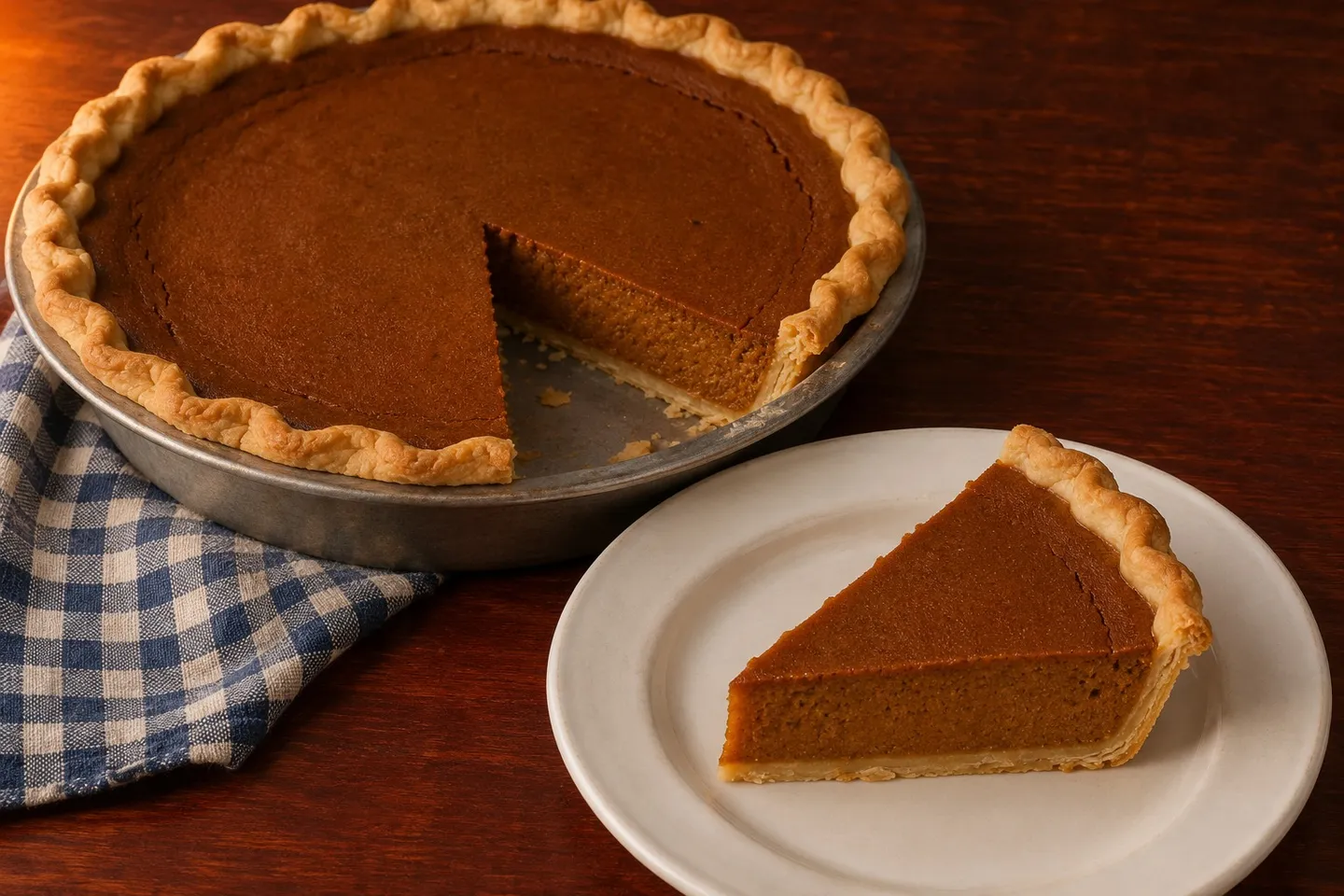
Molasses pumpkin pie with a plain crimped crust and one wedge cut.
The story behind the recipe
Among Lydia Maria Child’s “Common Pies,” the pumpkin pie is the one with a sliding scale. One egg to a quart of milk will do, three is the family standard, and a richer pie takes another; molasses or sugar sweetens it to taste, and the pumpkin goes in by feel. Her American Frugal Housewife, a Boston book of thrift for households that baked often and bought little, prints it as “Pumpkin and Squash Pie,” and squash is no afterthought: the very next recipe begins, “Carrot pies are made like squash pies,” and adds that both should be baked “without an upper crust, in deep plates.”
An American frugal housewife
The book was not always “American.” The twelfth edition of 1832 carries a note on the back of its title page explaining the change of name: there was an English work called The Frugal Housewife, “not adapted to the wants of this country.” Child’s pie fits the new title. It uses what a New England farm had in autumn, pumpkin, milk, eggs and molasses, and her appendix shows how to keep pumpkin for pies long after the harvest. How her pie relates to Josselyn’s stewed pumpkin, to Simmons’s cream pudding and to the Thanksgiving table of the 1820s is the story of What Did Americans Do with Pumpkin Before Pumpkin Pie?
Read more about this recipe
Making it today
Two eggs to 1¼ cups of milk puts this pie on Child’s richer side, between her family rule and the cooks who put “an egg to a gill”; that is our choice, and so is a fixed amount of pumpkin and molasses where she says to judge by eye and taste. Her spices and salt are scaled down from her quart, reading her “great spoonful” as a tablespoon. We follow her appendix and boil the pumpkin up in the milk before the eggs go in, and her “Pie Crust” makes the shell. The oven temperatures are ours. To taste how far the pie had moved in thirty-six years, set a slice next to Amelia Simmons’s cream-rich Pompkin Pudding (1796).
PUMPKIN AND SQUASH PIE.
For common family pumpkin pies, three eggs do very well to a quart of milk. Stew your pumpkin, and strain it through a sieve, or colander. Take out the seeds, and pare the pumpkin, or squash, before you stew it; but do not scrape the inside; the part nearest the seed is the sweetest part of the squash. Stir in the stewed pumpkin, till it is as thick as you can stir it round rapidly and easily. If you want to make your pie richer, make it thinner, and add another egg. One egg to a quart of milk makes very decent pies. Sweeten it to your taste, with molasses or sugar; some pumpkins require more sweetening than others. Two tea-spoonfuls of salt; two great spoonfuls of sifted cinnamon; one great spoonful of ginger. Ginger will answer very well alone for spice, if you use enough of it. The outside of a lemon grated in is nice. The more eggs, the better the pie; some put an egg to a gill of milk. They should bake from forty to fifty minutes, and even ten minutes longer, if very deep.
Recipe makes: One 9-inch pie, 8 servings
Ingredients
For One 9-inch pie, 8 servings. Quantities are shown as written.
Quantities as written here, for One 9-inch pie, 8 servings.
Crust
- All-purpose flour1 3/4 cups
- Cold unsalted butter, for rubbing in5 tbsp
- Cold unsalted butter, for rolling in3 tbsp
- Ice water4 tbsp
Filling
- Stewed and strained pumpkin1 1/4 cups
- Whole milk1 1/4 cups
- Unsulphured molasses (not blackstrap)1/4 cup
- Ground cinnamon2 tsp
- Ground ginger1 tsp
- Salt1/2 tsp
- Finely grated lemon zest1 tsp
- Large eggs2
Measurement notes
Ingredients as written here
- 1¾ cups all-purpose flour
- 5 tbsp cold unsalted butter, for rubbing in
- 3 tbsp cold unsalted butter, for rolling in
- 4 tbsp ice water
- 1¼ cups stewed and strained pumpkin
- 1¼ cups whole milk
- ¼ cup unsulphured molasses (not blackstrap)
- 2 tsp ground cinnamon
- 1 tsp ground ginger
- ½ tsp salt
- 1 tsp finely grated lemon zest
- 2 large eggs
Equipment
 Knife and board
 Saucepan with a lid
 Sieve
 Bowl
 Fork
 Rolling pin
 Plastic wrap
 9-inch pie plate
- Medium saucepan
 Whisk
 Small baking dish
 Rimmed baking sheet
- Aluminum foil
 Instant-read thermometer
 Wire rack
Instructions
For the stewed and strained pumpkin, cut a small pie pumpkin into wedges, scoop out the seeds without scraping the flesh beneath them, and pare off the skin. Cut it into chunks and put them in the saucepan with a splash of water. Cover and simmer gently until very soft, about 20 minutes. Drain well, press through the sieve and let cool. Measure what the list calls for and keep any extra for another use.
For the crust, set aside a quarter of the all-purpose flour for rolling. Put the rest in the bowl and rub in the butter for rubbing in with your fingertips until a handful squeezed tight holds together in a ball.
Sprinkle the ice water over the mixture and stir with the fork until it holds together as a dough.
Dust the board with some of the set-aside flour and roll the dough out. Dot half the butter for rolling in over it in small pieces, sprinkle on a little more of the set-aside flour, and roll the dough up. Roll it out again lightly and quickly, away from you, and repeat with the rest of the butter. Wrap it in plastic wrap and chill it for 30 minutes.
Heat the oven to 425°F (220°C) with a shelf in the lower third. Roll the dough out a third and last time, about ⅛ inch thick, using as little of the set-aside flour as you can. Line the pie plate, crimp the edge and chill it while you make the filling.
Bring the milk to a boil in the medium saucepan. Stir in the pumpkin and let it bubble up once or twice, stirring. Take it off the heat and stir in the molasses, cinnamon, ginger, salt and lemon zest. Let it cool for about 15 minutes, until warm.
Beat the eggs in the bowl and whisk in the warm pumpkin mixture a little at a time.
Set the lined pie plate on the baking sheet. Pour in the filling until it is ¼ inch below the rim of the crust, and pour any left over into the small baking dish.
Bake for 15 minutes, then turn the oven down to 350°F (175°C) and bake for 30 to 40 minutes more, until the edge is set, the center wobbles only slightly when you nudge the plate, and an instant-read thermometer in the center reads 160°F (71°C). If the crust edge browns too fast, cover it with strips of foil. Bake the small dish of extra filling on the same sheet and take it out when its center reads 160°F (71°C), from about 25 minutes.
Cool the pie on the wire rack for 2 hours before slicing. Serve it at room temperature or cold, and refrigerate it within 2 hours of baking.
Nutrition
270calories per serving
- Recipe makes
- One 9-inch pie, 8 servings
- Servings
- 8
Estimated per serving (8) from USDA FoodData Central values for flour, butter, whole milk, molasses, eggs and pumpkin.
Recipe notes
When adjusting quantities
Sized for one 9-inch pie plate. Child’s own rule is three eggs to a quart of milk, with the pumpkin stirred in until the mixture is as thick as you can stir quickly.
Notes
Quantities mentioned in these notes don’t change when you adjust the servings.
A pie pumpkin of about 2 lb gives enough stewed and strained pumpkin, with some to spare. Our changes from Child: a set amount of pumpkin in place of her stirring test, two eggs to 1¼ cups of milk, ¼ cup molasses for her “to your taste,” her salt, cinnamon and ginger scaled to the milk with a great spoonful read as a tablespoon (and the salt rounded down), the lemon she calls “nice” kept in, her appendix’s boil of milk and pumpkin, our split of the butter in her crust, which gives none, a 9-inch pie plate, oven temperatures she doesn’t give and a thermometer check. Her alternative is ginger alone for the spice, in a larger amount. Keep the pie covered in the refrigerator and eat it within 3 to 4 days. Contains gluten, milk and eggs.
Scaling changes the ingredients only; pan sizes and cooking times need their own judgment. To adapt this recipe further, try the recipe tool at TuneMyRecipe (opens in a new tab), our sister site.
Sources and attribution
After Lydia Maria Child, The American Frugal Housewife (Boston, 1832), “Pumpkin and Squash Pie” and “Pie Crust”
Recipe details
- Course
- Dessert
- Dish family
- Desserts & Sweets
- Region
- American
- Era
- 19th century
- Source decade
- 1830s
- Main ingredient
- VegetablesSpices
- Difficulty
- Intermediate
- Occasion
- Thanksgiving
- Season
- Autumn