Roast Venison with Vinegar Sauce (1623)
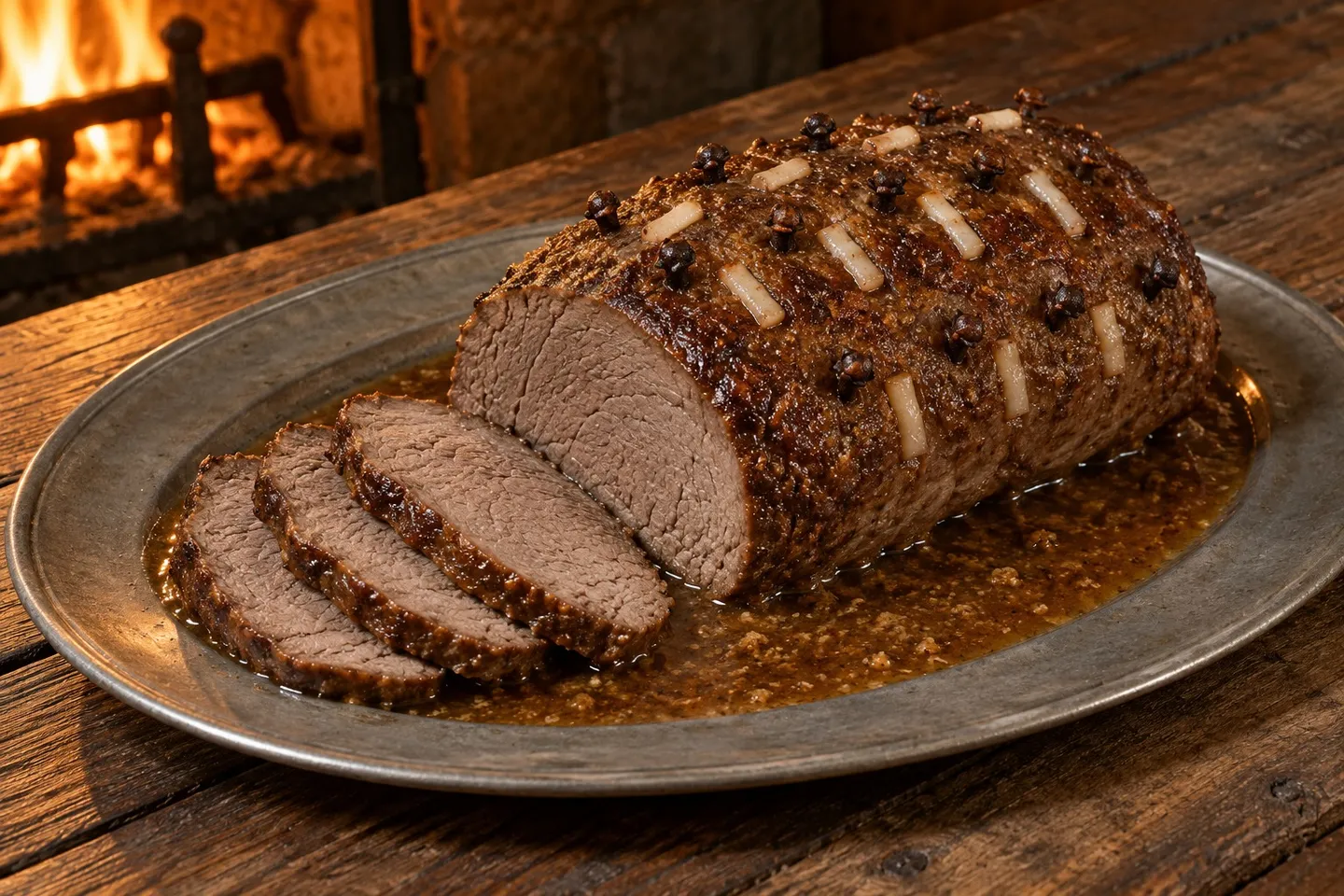
Reader ratingsRoast venison with vinegar sauce after Gervase Markham’s book of 1623: the meat studded with cloves, larded with pork fat and served on a sweet-sour sauce of vinegar, crumbs and its own juices.
- Recipe makes
- 1 roast, serving 6
- Prep
- Cook
- Total
A 3-pound roast takes 60 to 75 minutes at 325°F (165°C) and rests for 15 minutes while the sauce is made. Lard the roast and stud it with cloves up to a few hours ahead and keep it in the refrigerator.
Roast venison sliced on its sauce of vinegar, crumbs and spice.
The story behind the recipe
Venison is one of only two foods named in the one eyewitness account of the 1621 harvest feast at Plymouth. Edward Winslow wrote that Massasoit’s men “went out and killed fiue Deere,” which they brought to the settlement. How the English cooked their share isn’t recorded. This is the way an English household book of those years gave it: Gervase Markham’s Countrey Contentments, or The English Huswife, in the edition printed in London in 1623.
How did an English cook roast venison in the 1620s?
Markham’s whole recipe is one sentence. The venison is washed, the blood cleaned from it, and stuck “with cloues all ouer on the out side.” If it is lean, it is larded, with strips of fat drawn through it, “either with Mutton larde, or Porke larde, but mutton is the best.” It turns on the spit before “a good soking fire,” a steady heat that soaks through the joint.
Read more about this recipe
What went into the sauce?
Vinegar, breadcrumbs and some of the gravy that drips from the meat, boiled together and seasoned “with sugar, cinamon, ginger, and salt.” The roast is served sitting on the sauce. Markham’s sauce for a stubble goose, four pages on, mixes sweet and sharp the same way: roasted apples boiled with vinegar, barberries and crumbs, then seasoned with sugar and cinnamon.
Making it today
A boneless roast from the round or rump of farmed venison stands in for a joint of wild deer, and an oven stands in for the spit. Pork fat is easier to find than mutton fat, and Markham allows it. With no amounts from him, we chose the number of cloves, the larding and the sauce quantities, and took the oven settings from the US Department of Agriculture’s chart for venison roasts. Venison carries very little fat of its own, so the larding is what keeps it from drying out at that temperature.
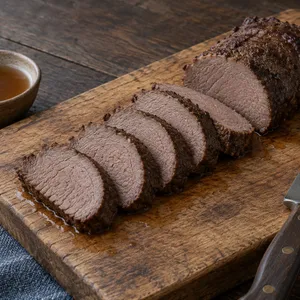
Carve the roast across the grain into thin slices and lay them back on the sauce, as Markham serves it.
The deer, the fowling and the three days of the feast are in What Was Really Eaten at the 1621 Harvest Feast? Four pages on, beside that goose sauce, Markham gives a general sauce for wild fowl, used for the Roast Wild Duck with Mustard Sauce (1623).
If you wil roast any Venison after you haue washt it, & clensed al blood from it, you shal sticke it with cloues all ouer on the out side; and if it be leane you shall larde it either with Mutton larde, or Porke larde, but mutton is the best: then spit it and roast it by a good soking fire, then take Vinegar, bread crummes, and some of the grauy, which comes from the Venison, and boile them well in a dish: then season it with sugar, cinamon, ginger, and salt, And serue the Venison foorth vpon the sauce when it is roasted enough,
Recipe makes: 1 roast, serving 6
Ingredients
For 1 roast, serving 6. Quantities are shown as written.
Quantities as written here, for 1 roast, serving 6.
- Boneless venison roast, from the round or rump3 lb
- Pork fatback, well chilled0.25 lb
- Cloves24
- Salt, for the roast1 tsp
- Melted butter2 tbsp
- Water, for the pan1/2 cup
- Red wine vinegar1/3 cup
- Fresh white breadcrumbs1/2 cup
- Sugar2 tsp
- Ground cinnamon1/2 tsp
- Ground ginger1/2 tsp
- Salt, for the sauce1 pinch
Measurement notes
Ingredients as written here
- 3 lb boneless venison roast, from the round or rump
- ¼ lb pork fatback, well chilled
- 24 whole cloves
- 1 tsp salt, for the roast
- 2 tbsp melted butter
- ½ cup water, for the pan
- ⅓ cup red wine vinegar
- ½ cup fresh white breadcrumbs
- 2 tsp sugar
- ½ tsp ground cinnamon
- ½ tsp ground ginger
- 1 pinch salt, for the sauce
Equipment
- Roasting pan with a rack
- Larding needle (or a thin, sharp knife)
 Instant-read thermometer
 Small saucepan
 Fine sieve
- Warm serving platter
Instructions
Heat the oven to 325°F (165°C).
Pat the venison dry with paper towels and trim off any silverskin.
Cut the pork fatback into strips about ¼ inch thick and 3 inches long, and keep them cold. Thread a strip into the larding needle and draw it through the meat with the grain, leaving the ends showing. Repeat at intervals of about an inch over the surface until the strips are used up. Without a needle, cut deep slits with a thin knife and push the strips in.
Press the whole cloves into the outside of the roast, spaced evenly all over. Rub it with the salt for the roast.
Set the roast on the rack in the pan, brush it with the melted butter and pour the water for the pan into the pan so the drippings don’t burn.
Roast for 60 to 75 minutes, basting two or three times with the juices in the pan, until the thickest part reads 160°F (71°C). Move it to the warm platter, cover it loosely with foil and let it rest for 15 minutes.
Pour the pan juices through the sieve into the saucepan and spoon off most of the fat. Add the red wine vinegar and the breadcrumbs and boil gently, stirring, for 3 to 4 minutes, until thick. Stir in the sugar, cinnamon, ginger and the salt for the sauce. Taste it: if it is too sharp or too stiff to spoon, stir in a little water.
Pull out the cloves you can see. Spread the sauce on the platter, carve the venison across the grain into thin slices and lay them on the sauce, with any juices from the board.
Nutrition
330calories per serving
- Recipe makes
- 1 roast, serving 6
- Servings
- 6
Estimated per serving (6) from USDA FoodData Central values for roasted venison, pork fatback, butter, breadcrumbs and sugar, counting about half the fatback as lost to the pan.
Recipe notes
When adjusting quantities
Allow 20 to 25 minutes a pound at 325°F (165°C) for a boneless roast and go by the thermometer. A larger roast needs more cloves and larding, in proportion.
Notes
Quantities mentioned in these notes don’t change when you adjust the servings.
None of the amounts, times or temperatures are Markham’s. Our changes from his recipe: an oven in place of the spit, pork fat in place of his preferred mutton fat, a boneless farmed roast trimmed of silverskin, a salt rub and melted butter on the outside, water in the pan to keep the drippings from burning, red wine vinegar and fresh white crumbs (he names only vinegar and crumbs), the pan juices sieved and skimmed before they go into the sauce, and the visible cloves pulled out before carving. Farmed venison is sold by butchers and online; ask for a boneless roast from the round, rump or sirloin tip. The cloves left in the meat are strong to bite on, so warn your guests or pick them out as you carve. Leftover venison keeps for 3 to 4 days in the refrigerator; chill it within 2 hours. Contains wheat (breadcrumbs) and milk (butter).
Scaling changes the ingredients only; pan sizes and cooking times need their own judgment. To adapt this recipe further, try the recipe tool at TuneMyRecipe (opens in a new tab), our sister site.
Sources and attribution
After Gervase Markham, Countrey Contentments, or The English Huswife (London, 1623), “To roast Venison”
Recipe details
- Course
- Main course
- Dish family
- Meat & Poultry
- Region
- British
- Era
- 17th century
- Main ingredient
- Spices
- Difficulty
- Intermediate
- Occasion
- Thanksgiving
- Season
- Autumn