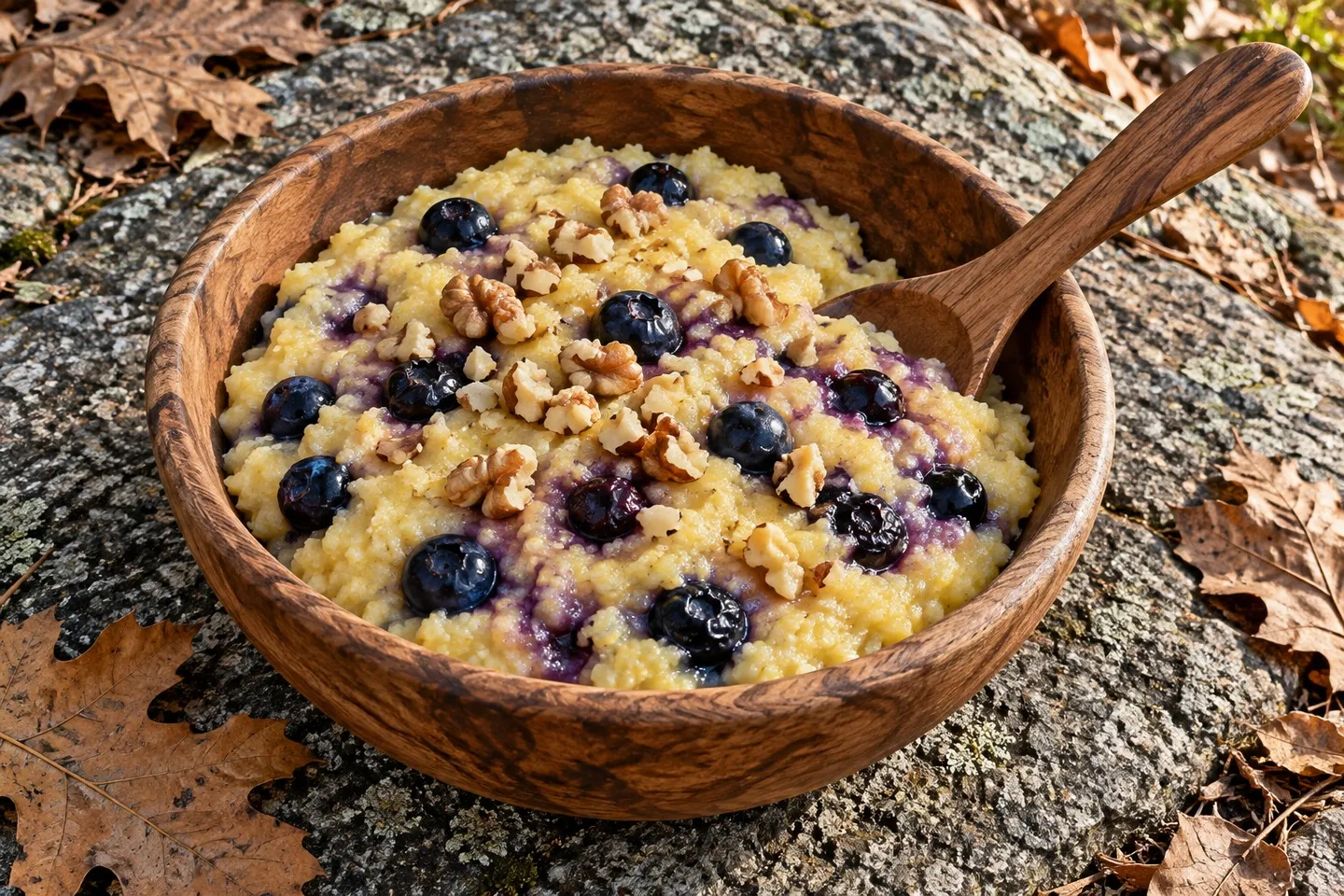
Nasaump, Cornmeal Pottage
Reader ratingsCoarse corn simmered soft with berries and crushed nuts: the corn pottage Roger Williams recorded as nasàump in 1643, after Plimoth Patuxet’s modern recipe.
- Recipe makes
- About 5 cups, 6 servings
- Prep
- Cook
- Total
Coarse stone-ground grits can take 35 to 45 minutes to soften; finer cornmeal is ready in about 15.
Nasaump, corn pottage with blueberries and walnuts.
The story behind the recipe
Nasaump is corn boiled soft into a thick pottage. Roger Williams, an English minister who lived among the Narragansett, neighbors of the Wampanoag, wrote the word down in 1643 in A Key into the Language of America, a phrasebook of their language: “Nasàump, A kind of meale pottage, unpartch’d.” Corn was the center of the Wampanoag kitchen, and corn was the harvest the colonists celebrated at Plymouth in 1621, at the feast told in What Was Really Eaten at the 1621 Harvest Feast?
What was nasaump?
Williams lists it in his chapter “Of Eating and Entertainment,” beside nókehick, parched corn meal carried on journeys and eaten “with a little water, hot or cold,” and msíckquatash, “boild corne whole.” Nasaump was the unparched kind: dried corn beaten to a coarse meal and boiled in water. “From this,” he adds, “the English call their Samp,” which they ate “with milke or butter.”
Read more about this recipe
What went in with the corn?
Williams left no recipe. Plimoth Patuxet Museums publishes a modern one “based on traditional Wampanoag foodways knowledge”: corn simmered in water with berries, fresh or dried, and crushed nuts or seeds. This page follows it with its own amounts. Williams wrote down Narragansett words; Narragansett and Wampanoag were related languages of southern New England, and the museum calls nasaump a traditional Wampanoag dish.
Making it today
The corn of the region was flint corn, hard and starchy, and the closest thing in a store is coarse stone-ground cornmeal or grits; white or yellow both work. Strawberries, raspberries and blueberries all grow wild in New England, and walnuts, hazelnuts or sunflower seeds stand in for the nuts gathered in the fall. No salt goes in. Serve it beside the Roast Venison with Vinegar Sauce (1623).
Nasàump. A kind of meale pottage, unpartch’d.
From this the English call their Samp, which is the Indian corne, beaten and boild, and eaten hot or cold with milke or butter ...
Recipe makes: About 5 cups, 6 servings
Ingredients
For about 5 cups, 6 servings. Quantities are shown as written.
Quantities as written here, for about 5 cups, 6 servings.
- Coarse stone-ground cornmeal or corn grits1 cup
- Water, plus more as needed4 cups
- Blueberries, strawberries or raspberries, fresh or frozen1 cup
- Walnuts, hazelnuts or sunflower seeds, crushed1/2 cup
Measurement notes
Ingredients as written here
- 1 cup coarse stone-ground cornmeal or corn grits
- 4 cups water, plus more as needed
- 1 cup blueberries, strawberries or raspberries, fresh or frozen
- ½ cup walnuts, hazelnuts or sunflower seeds, crushed
Equipment
- Heavy saucepan, about 3 quarts
 Whisk
 Wooden spoon
Instructions
Bring the water to a boil in the saucepan.
Whisk in the cornmeal a little at a time so it doesn’t form lumps.
Turn the heat down to low and simmer, stirring often with the wooden spoon and scraping the bottom, for 15 to 40 minutes (fine cornmeal is quickest), until the grains are tender and the pottage is thick. Add a splash of hot water if it thickens before the corn is tender.
Stir in the berries and nuts and cook for 5 minutes more, until the berries are warm and just starting to burst.
Serve hot, or let it cool and serve it at room temperature within 2 hours; refrigerate leftovers.
Nutrition
160calories per serving
- Recipe makes
- About 5 cups, 6 servings
- Servings
- 6
Estimated per serving from USDA FoodData Central values for whole-grain cornmeal, blueberries and walnuts.
Recipe notes
When adjusting quantities
One part corn to four of water, by volume. Add a little more water if the corn is coarse and the pottage gets too thick before the corn is soft.
Notes
Quantities mentioned in these notes don’t change when you adjust the servings.
This is a reconstruction. Williams recorded the dish and its name; he left no recipe. The berries and nuts follow Plimoth Patuxet Museums’ modern recipe. Our changes from it: one part corn to four of water, where the museum uses about one and a half cups to a quart; the fruit and nuts stirred in at the end, where the museum boils everything together; and no maple syrup or sugar, which the museum offers as an option. We chose the amounts and times. Modern stone-ground cornmeal replaces corn pounded by hand. Leftover nasaump firms up as it cools; loosen it with a little hot water when you reheat it. Contains tree nuts (or use sunflower seeds).
Scaling changes the ingredients only; pan sizes and cooking times need their own judgment. To adapt this recipe further, try the recipe tool at TuneMyRecipe (opens in a new tab), our sister site.
Sources and attribution
After Roger Williams, A Key into the Language of America (London, 1643), and Plimoth Patuxet Museums’ nasaump, based on Wampanoag foodways knowledge
Recipe details
- Course
- Side dish
- Dish family
- Vegetables & Sides
- Region
- American
- Era
- 17th century
- Main ingredient
- Grains & riceFruit
- Difficulty
- Easy
- Occasion
- Thanksgiving
- Season
- Autumn