Roast Wild Duck with Mustard Sauce (1623)
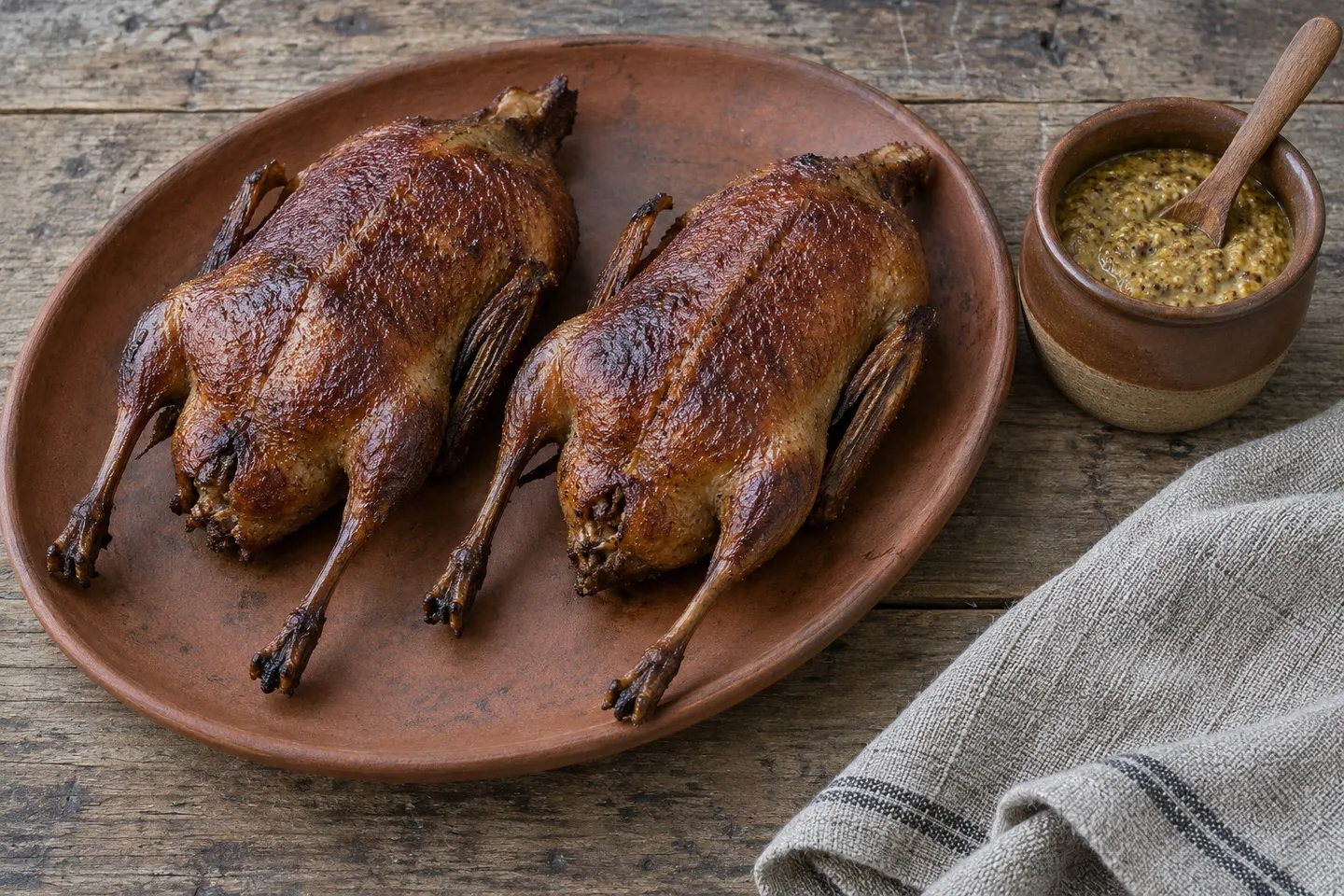
Reader ratingsRoast wild duck with mustard sauce: mallard with Gervase Markham’s “most generall sauce” for wild fowl, mustard and vinegar (1623), likely the kind of bird the Plymouth fowlers shot.
- Recipe makes
- 2 ducks, serving 4
- Prep
- Cook
- Total
Two mallards of about 2½ pounds take 45 to 55 minutes at 350°F (180°C) and rest for 10 minutes. The sauce takes a minute and can be mixed while the ducks roast.
Roast mallards with a mustard and vinegar sauce.
The story behind the recipe
Before the guests came, Plymouth’s governor “sent foure men on fowling,” Edward Winslow wrote in December 1621, and in one day they killed as much fowl as, with a little help, served the colony almost a week. He doesn’t name the birds. Waterfowl were the obvious game on that coast in autumn: William Bradford, writing years later of the same autumn, says waterfowl began to come in as winter approached, along with the wild turkeys.
How did the English sauce a wild duck?
Plainly. Gervase Markham, whose Countrey Contentments, or The English Huswife was printed in London in 1623, gives one sauce for every ordinary wild fowl roasted: ducks, mallard, wigeon, teal, snipe, plovers and the rest. It is “onely mustard and vinegar, or mustard and veriuyce mixt together,” or else an onion, water and pepper. Some, “especially in the Court,” used nothing but melted butter. A pheasant and a stubble goose got sauces of their own; the everyday birds got this.
Read more about this recipe
Making it today
Farmed mallards, sold oven-ready by game suppliers, are the nearest thing to the birds Winslow’s fowlers brought home. They are small and lean, much less fatty than a farmed Pekin duck, so they roast quickly and need butter on the breast. Markham gives no oven, no time and no amounts, so the settings follow the US Department of Agriculture’s chart for wild duck, and the sauce is equal parts mustard and cider vinegar, our choice for his “mustard and vinegar.”
Serve the sauce on the side. The same book’s roast venison, with its sweet vinegar sauce, is the Roast Venison with Vinegar Sauce (1623), and the feast that brought venison and fowl together is told in What Was Really Eaten at the 1621 Harvest Feast?
The most generall sauce for ordinarie wild fowle rosted, as Duckes, Mallard, Widgen, Tele, Snipe, Sheldrake, Plouers, Pulers, Guls, and such like, is onely mustard and vinegar, or mustard and veriuyce mixt together, or else an onion, water and Pepper, and some (especially in the Court) vse onely butter melted, and not any thing else.
Recipe makes: 2 ducks, serving 4
Ingredients
For 2 ducks, serving 4. Quantities are shown as written.
Quantities as written here, for 2 ducks, serving 4.
- Oven-ready mallard ducks (about 2 birds)5 lb
- Salt1 tsp
- Black pepper1/2 tsp
- Melted butter2 tbsp
- Prepared English mustard3 tbsp
- Cider vinegar3 tbsp
Measurement notes
Ingredients as written here
- 5 lb oven-ready mallard ducks (about 2 birds)
- 1 tsp salt
- ½ tsp black pepper
- 2 tbsp melted butter
- 3 tbsp prepared English mustard
- 3 tbsp cider vinegar
Equipment
- Roasting pan with a rack
 Instant-read thermometer
- Small bowl
- Warm serving platter
Instructions
Heat the oven to 350°F (175°C). Take the mallard ducks out of the refrigerator 20 minutes before roasting.
Pat the ducks dry inside and out with paper towels and season them all over with the salt and black pepper.
Set them breast side up on the rack in the roasting pan and brush them with the melted butter.
Roast for 45 to 55 minutes, brushing once or twice with the butter in the pan, until the innermost part of the thigh and the thickest part of the breast read 165°F (74°C).
Meanwhile, stir the prepared English mustard and the cider vinegar together in the small bowl until smooth.
Let the ducks rest on the warm platter for 10 minutes. Carve each into halves or quarters and serve with the mustard sauce.
Nutrition
420calories per serving
- Recipe makes
- 2 ducks, serving 4
- Servings
- 4
Estimated per serving (4) from USDA FoodData Central values for roasted wild duck meat with skin, butter and prepared mustard.
Recipe notes
When adjusting quantities
Allow one mallard for two people. Roasting time follows the size of each bird; more birds in the oven take no longer.
Notes
Quantities mentioned in these notes don’t change when you adjust the servings.
Markham gives the sauce only. The roasting is ours: an oven at 350°F (180°C) in place of a spit, salt, pepper and melted butter on the birds, and a 10-minute rest. Equal parts English mustard and cider vinegar are our measure for his “mustard and vinegar.” Wild-shot ducks vary in size and may carry shot; check the meat as you carve. For Markham’s other plain sauce, simmer a thinly sliced onion in a little water with black pepper until soft. Chill leftovers within 2 hours. Contains mustard and milk (butter).
Scaling changes the ingredients only; pan sizes and cooking times need their own judgment. To adapt this recipe further, try the recipe tool at TuneMyRecipe (opens in a new tab), our sister site.
Sources and attribution
After Gervase Markham, Countrey Contentments, or The English Huswife (London, 1623), “A generall sauce for wild Fowle”
Recipe details
- Course
- Main course
- Dish family
- Meat & Poultry
- Region
- British
- Era
- 17th century
- Main ingredient
- Poultry & game birds
- Difficulty
- Easy
- Occasion
- Thanksgiving
- Season
- Autumn