The harvest feast at Plymouth · Plymouth Colony, Patuxet, in present-day Massachusetts
What Was Really Eaten at the 1621 Harvest Feast?
One letter describes the 1621 feast at Plymouth: wildfowl from a day’s shooting and five deer from Massasoit’s men. Here is what it names, and what came later.
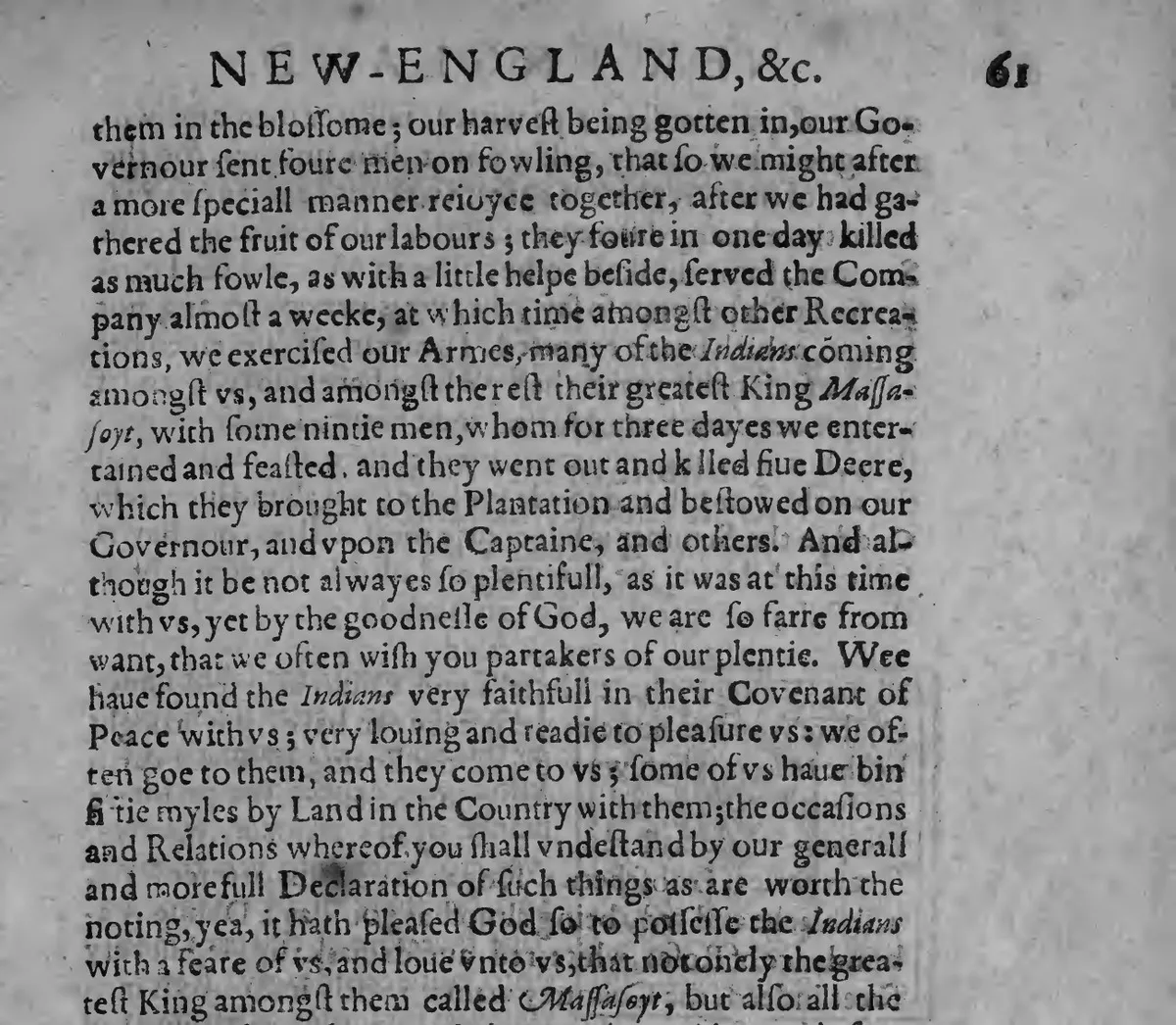
Wildfowl and venison are the only foods anyone wrote down at the feast. In a letter dated December 11, 1621, Edward Winslow told a friend in England that after the harvest the governor of Plymouth sent four men out fowling, who killed in one day as much as, with a little help beside, served the colony almost a week. During the celebration that followed, the Wampanoag leader Massasoit (Ousamequin) arrived with about ninety men, stayed three days, and his men “went out and killed fiue Deere.” Everything else on the table has to be pieced together from what each side ate in those years.
One paragraph
Winslow’s letter was printed in London in 1622, in the small book now called Mourt’s Relation. The feast takes up part of one paragraph. “Our harvest being gotten in,” he wrote, “our Governour sent foure men on fowling, that so we might after a more speciall manner reioyce together, after we had gathered the fruit of our labours.” Then came the visitors: “amongst the rest their greatest King Massasoyt, with some ninetie men, whom for three dayes we entertained and feasted.”
That is the whole record of the feast. It gives no date, no menu and no word on how anything was cooked. William Bradford, the governor, described that autumn years later in his history of the colony, but not the feast itself.
Fowl and five deer
The two named foods came from two groups of hunters. The four English fowlers brought in birds. Winslow says only “fowle,” most likely the ducks and geese that Bradford calls water fowl. Bradford, describing the same autumn, wrote that “besids water foule, ther was great store of wild Turkies, of which they tooke many,” along with venison. Turkey may have been among Winslow’s fowl, but he didn’t name it. Darius Coombs, cultural and outreach coordinator of the Mashpee Wampanoag Tribe, puts it plainly: “They never ever mention turkey at that feast.”
The deer were the Wampanoag’s contribution, given to the governor, the captain and others. They are the only gift of food in the account, and shared among the colonists and ninety guests over three days, they would have been a large part of what was eaten. Winslow adds a few lines later that the Wampanoag were often in the settlers’ houses, “friendly bestowing their Venison on vs.”
The same Bradford paragraph shows what else the colony had that autumn. Some of the men fished “aboute codd, & bass, & other fish,” and every family had its share; there was a weekly allowance of meal, “or now since harvest, Indean corne.” None of it is placed at the feast, but it was in the houses.
Who came, and why
Winslow doesn’t say whether Massasoit was invited. His sentence puts the arrival right after “we exercised our Armes, many of the Indians coming amongst vs.” Read one way, the Wampanoag came because they heard the shooting. Darius Coombs reads it the other way: “They had to be invited.” Massasoit’s home was Pokanoket, about forty miles away in present-day Rhode Island, two days’ walk, and he spoke for some seventy Wampanoag communities.
The alliance itself was a few months old. Massasoit had come to Plymouth that spring and made a peace with the colonists, each side promising to help the other if attacked. Bradford, writing in 1645, notes that it still held. The editor of the 1856 printing, quoting an earlier historian, carries it on to 1675, the year war broke out between the colonists and the Wampanoag.
The man who carried words between the two sides was Tisquantum, whom the English called Squanto. He was from Patuxet, the very place the colonists had settled. A ship’s master named Hunt had carried him away with nineteen others from Patuxet and sold them as slaves, and he had lived in England. When he came home, his village was gone. The colonists’ journal, printed in the same book as Winslow’s letter, records what they were told: all the inhabitants of Patuxet “dyed of an extraordinary plague” about four years earlier, and Squanto was its only native left.
The record leaves people out, too. Winslow names only men. Linda Coombs, a Wampanoag historian and program director at the Aquinnah Cultural Center, thinks at least the wives of some Wampanoag leaders were probably there, though no English writer mentions them.
Two kitchens
The colonists cooked as English people did. The English Huswife by Gervase Markham, first published in 1615 and reprinted in London in 1623, is the kind of book their kitchens followed: venison stuck with cloves, larded if lean, roasted before the fire and served on a sauce of vinegar, crumbs and its own juices with sugar and spice; wild duck roasted and eaten with mustard and vinegar.
The Wampanoag kitchen was built on corn. Roger Williams, who lived among the neighboring Narragansett, recorded their words for everyday food in 1643: nókehick, parched meal eaten with water on journeys; msíckquatash, corn boiled whole; and nasàump, “a kind of meale pottage, unpartch’d.” The English, he added, took their word “Samp” from it. Corn had been grown in the region for centuries, and Plimoth Patuxet Museums, drawing on Wampanoag foodways knowledge, teaches nasaump cooked with berries and nuts.
The colonists had learned to grow that corn only that spring. Bradford says Squanto showed them how to plant it, “and after how to dress & tend it,” and told them that unless they set fish with it in those old fields “it would come to nothing.” Winslow’s letter says they planted twenty acres of “Indian Corne,” manured with herring “according to the manner of the Indians,” and it did well. Their barley was “indifferent good,” and their peas were “not worth the gathering.” The harvest they were celebrating was mostly a corn harvest.
What came later
Pumpkin pie, cranberry sauce and mashed potatoes belong to later centuries; no source of 1621 names them. The word “Thanksgiving” came later too. Linda Coombs calls the gathering a harvest feast: “It was a onetime event.” Since 1970 some Native people have kept the holiday as a National Day of Mourning, with a ceremony at Plymouth.
English cooking in America kept Markham’s habits for a long time. A century and a half later, colonial kitchens still cooked from London books, as What Was on the American Tea Table Before the Boston Tea Party? shows.
The recipes
The two roasts come from Markham’s English Huswife of 1623, the English cooking of the colonists’ generation. The nasaump is a reconstruction: Williams recorded the dish but not a recipe, so ours follows the museum’s Wampanoag foodways teaching, with our own amounts.
- Roast Venison with Vinegar Sauce (1623): a venison roast studded with cloves and larded, on a sauce of vinegar, crumbs and spice.
- Roast Wild Duck with Mustard Sauce (1623): mallards roasted and served with mustard and vinegar.
- Nasaump, Cornmeal Pottage: coarse corn simmered soft with berries and nuts.
Cooking it
Start with the venison, the Wampanoag’s gift in Winslow’s letter, and make the nasaump while the roast rests; it takes about forty minutes. The duck roasts in under an hour and can share the oven. For what was in the cups that autumn, Forgotten Drink, our sister site, asks What Did the Pilgrims Drink? (opens in a new tab)
Sources
- Edward Winslow, letter of December 11, 1621, in A Relation or Iournall of the Beginning and Proceedings of the English Plantation Setled at Plimoth in New England (London: printed for John Bellamie, 1622), pp. 60–64; the journal in the same book, pp. 33 and 35.
- William Bradford, History of Plymouth Plantation (Boston: Massachusetts Historical Society, 1856), pp. 94, 100 and 105.
- Gervase Markham, Countrey Contentments, or The English Huswife (London, 1623), pp. 84 and 88.
- Roger Williams, A Key into the Language of America (London, 1643), ch. II, “Of Eating and Entertainment,” p. 11.
- David Kindy, “How to Tell the Thanksgiving Story on Its 400th Anniversary,” Smithsonian Torch, November 25, 2021, quoting Darius Coombs and Linda Coombs, https://torch.si.edu/2021/11/how-to-tell-the-thanksgiving-story-on-its-400th-anniversary (opens in a new tab).
- Plimoth Patuxet Museums, “Nasaump,” https://plimoth.org/yath/unit-3/nasaump (opens in a new tab).