Breakfast at the Waldorf · The Waldorf, Fifth Avenue and 33rd Street, New York City
What Did People Eat for Breakfast in the 1890s?
Fruit, a cereal with cream, eggs, fish or chops, hot breads, potatoes and coffee: the Waldorf’s breakfast card of April 22, 1896, priced line by line.
A well-off American breakfast of the 1890s ran in a set order, at least as a New York hotel and a Boston cookbook laid it out: fruit first, then a cooked cereal with sugar and cream, then something hot, such as eggs, fish, a chop or hash, with potatoes and hot bread or toast, and coffee alongside. The hotel printed the whole range on one card, with a price beside every line: the Waldorf’s breakfast menu for April 22, 1896, now in the Buttolph collection of menus at the New York Public Library. The same order runs through the breakfast menus Fannie Merritt Farmer printed in Boston that year in The Boston Cooking-School Cook Book, so a grand hotel and a cooking school set out the same shape of meal.
Neither source speaks for a farmhand or a mill worker, and the card lists what could be ordered, not what anyone ate. Line by line, though, it shows what a first-class breakfast was made of and how a grand hotel priced the plainest things on it.
A card dated 22-4-96
The sheet is headed “Breakfast.” in ornamental letters and signed at the foot “The Waldorf.” Beside that, in small type, is the date: “22–4–96.” Someone repeated it underneath by hand, “22. Apr. 1896.” A blue library stamp over the omelettes reads “N. Y. Public Library, Buttolph Collection, 1900–1901,” a library date years after the breakfast. On the back, in blue, someone wrote “9. Floor.”
The hotel was the first Waldorf, built by William Waldorf Astor on Fifth Avenue at 33rd Street. The library’s guide to the hotel’s records gives the dates: it opened in 1893, John Jacob Astor IV began building the Astoria on the lot next door in 1895, and the two were merged in 1897. The building was torn down in 1929 to make room for the Empire State Building, and the Waldorf-Astoria on Park Avenue opened in 1931. This breakfast belongs to the Waldorf alone, while its rival was still going up beside it.
From fruit to potatoes
The card runs through its headings in the same order as Farmer’s menus: fruit; coffee, tea and milk; breads and rolls; preserves; oatmeal and other cereals; eggs; omelettes; fish; steaks and chops; and potatoes. The prices are plain figures without a dollar sign, 25 for twenty-five cents and “1 00” for a dollar.
Under fruit, fresh strawberries with cream cost 60 cents (about $24 today, by US consumer prices, on the Minneapolis Fed’s CPI table), bananas 20, pears 40 and grapes 75. Wheatena, oatmeal, cracked wheat and hominy come “plain 25” or “with Cream 35.” Eggs are boiled, fried, poached, scrambled or shirred for 25 to 35 cents, and cost 50 in named styles such as Cocotte and Espagnole. The fish course offers brook trout at a dollar, codfish cakes, kippered herring and finnan haddie. The meat section is the longest: plain steak at 60, sirloin at a dollar, an extra porterhouse at $3, lamb chops, calf’s liver with bacon, sweetbreads, chicken hash, corned beef hash, tripe, and ham or bacon broiled at 40. Potatoes come baked, fried, sauté, lyonnaise, hashed in cream, Saratoga or “Waldorf,” for 20 to 30 cents.
The cheapest food on the card is bread. Rolls, muffins, brioche, Boston brown bread and corn bread are 10 cents each, the price of a glass of milk.
Three prices for toast
In the middle of the breads sits a small ladder. “Toast” costs 15 cents, about $6 today. “Dipped or Milk toast” costs 25, and “Cream toast” 35. Each step adds ten cents.
The same ten cents turns up elsewhere. “Coffee, with Milk 25,” then “with Cream 35.” A glass of milk is 10 cents, a glass of cream 20. The cereals are 25 plain and 35 with cream. In the coffee, the glasses and the cereals, cream costs ten cents more than milk (tea comes with milk or cream at one price, 25), and the toast follows the same pattern.
The card doesn’t break a price down, so the reason for the step has to come from elsewhere. A cookbook of the same year shows what the dearer kinds of toast could involve. In Farmer’s book, milk toast is dry toast dipped one slice at a time in a milk sauce thickened with flour and cooked for twenty minutes, with the rest of the sauce poured over. Cream toast, on the same page, is that recipe made with cream and without the butter. At the Waldorf the extra dime bought at least a sauce and someone’s time to make it.
Struck through by hand
A clean typed list of the card would hide one of its most useful features. Someone went over the printed sheet and crossed out a number of lines. Baked apples with cream and stewed rhubarb are struck through under fruit, guava jelly among the preserves, and “Breakfast Cakes 30” at the end of the breads. Two egg dishes, Chipolata and Meyerbeer, are struck through, and so are salt mackerel and smoked herring among the fish and broiled kidneys and pigs’ feet among the meats.
The marks look like corrections by an unknown hand, dishes not to be had that day. Read as printed, the card offers baked apples; read with its marks, it doesn’t. Corn bread, toast, milk toast and the plain omelette are all left clear.
A breakfast from a Boston cookbook
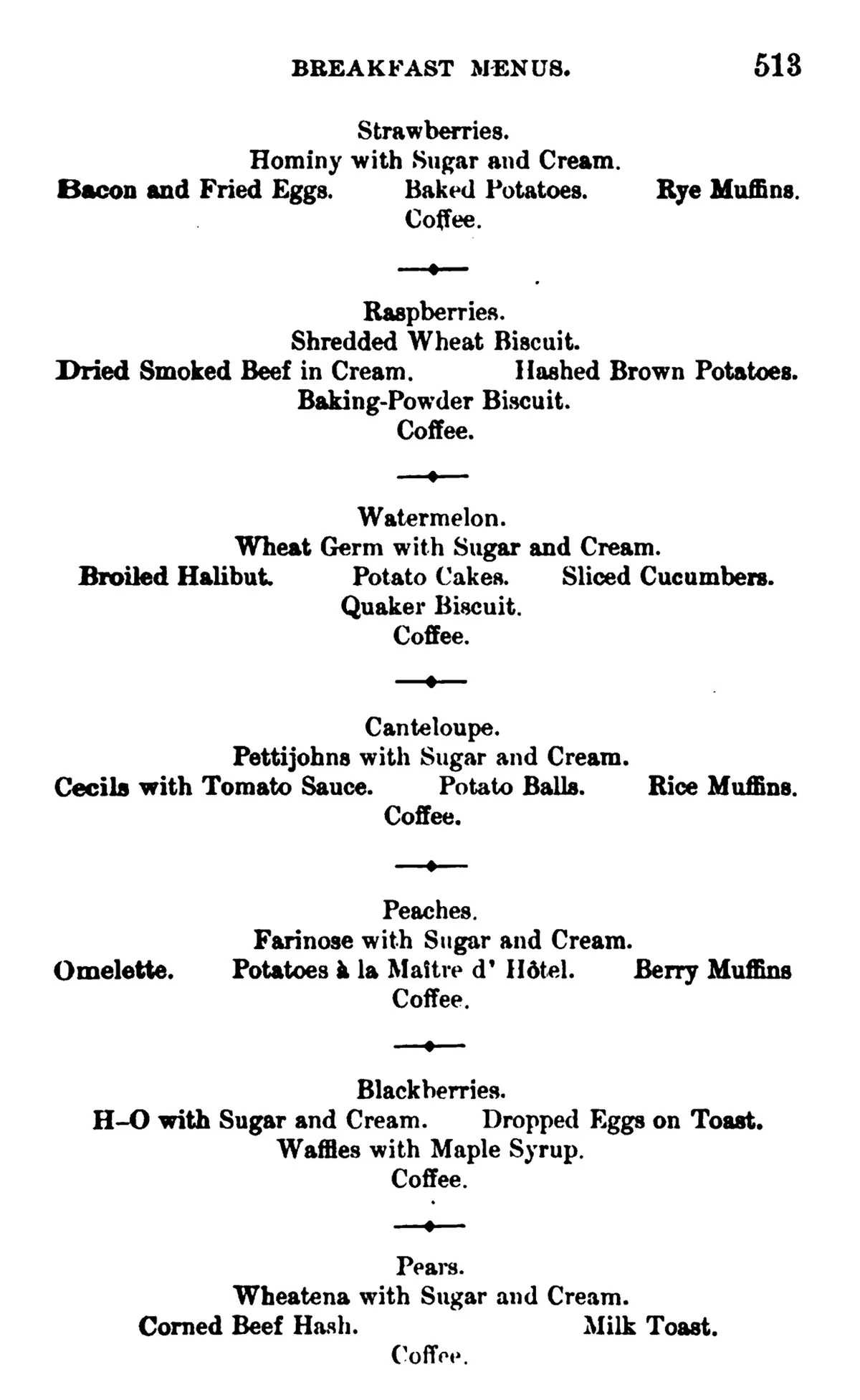
Farmer’s title page calls her “Principal of the Boston Cooking-School,” and her book ends with pages of suggested menus. The breakfasts on page 513 keep the hotel’s order. One begins with strawberries, then hominy with sugar and cream, bacon and fried eggs, baked potatoes and rye muffins, and coffee. Another serves raspberries, shredded wheat, dried smoked beef in cream, hashed brown potatoes and baking-powder biscuit. Some of the cereals go by trade names, among them Pettijohns, H-O and Wheatena.
The last menu on the page reads: “Pears. Wheatena with Sugar and Cream. Corned Beef Hash. Milk Toast. Coffee.” Every dish in it is printed on the Waldorf card. Ordered from the card, with cream on the cereal and in the coffee, it comes to pears 40, Wheatena 35, hash 40, milk toast 25 and coffee 35: $1.75, about $70 today. The sum is a way to read the prices, not anyone’s bill.
The overlap says something about breakfast in these years. The named egg dishes and the $3 porterhouse are hotel food, but much of the card is the same plain food a Boston household was taught to cook: hash, toast, hominy, muffins and an omelette. Farmer’s menus are plans, not records of what families ate, but they show that milk toast could sit beside corned beef hash on an ordinary breakfast table.
Oscar’s book
The hotel’s maître d’hôtel published a cookbook the same year. The Cook Book by “Oscar” of the Waldorf, copyright 1896 by Oscar Tschirky, gives its author’s post on the title page as “Maitre d’ Hotel, The Waldorf”: he ran the dining room. In his preface he says the book is arranged for “the caterer to large dinners or receptions, as well as the more modest entertainment furnished at the hearthside,” and that he has paid more attention to the second. It ends with a promise: “In conclusion, let me state that I enter the arena as an author with the hope that my experience may prove entertaining to my friends, as well as enable them to prepare a Waldorf Dinner at their own homes.”
The promise is about dinner, not the hotel’s breakfast. The preface does show a Waldorf man of 1896 who thought hotel food and home cooking belonged in the same book. By 1912 the merged hotel was serving French-named dinners of a grander kind, as in What Did the Pan American Society Serve at the Waldorf in 1912?
The recipes
No recipe from the Waldorf’s breakfast kitchen is known, so the three on this menu come from Farmer’s book, printed the same year as the card. They follow the card’s order, breads first, then omelettes.
- Golden Corn Cake (1896): Farmer’s sweetened cornbread of cornmeal and wheat flour, baked in a shallow pan, for the card’s 10-cent corn bread.
- Milk Toast (1896): dry toast softened in a long-cooked milk sauce, for “Dipped or Milk toast” at 25 cents.
- Plain Omelet with White Sauce (1896): a puffed omelet of separately beaten eggs, finished in the oven and served in a thin white sauce, for the card’s 30-cent plain omelette.
Cooking it
Make the toast and the milk toast side by side and the card’s first ten-cent step is on the table: Milk Toast (1896) starts from stale bread dried slowly before it browns, and its sauce cooks for twenty minutes while the toast waits. Put the corn cake in the oven at the same time and breakfast is ready in about 45 minutes. All three recipes are among our 19th-century recipes, next to the dishes of the chafing-dish suppers in Deshler Welch’s New York book of the same year. The hotel’s coffee comes back in a later story on Forgotten Drink, our sister site: a coffee row at a 1912 diplomatic dinner (opens in a new tab) at the Waldorf Astoria.
 Cook it todayMilk Toast (1896)
Sources
- The Waldorf, breakfast menu, dated 22–4–96 (April 22, 1896), front and back. New York Public Library, Rare Book Division, Buttolph Collection of Menus, shelf number 1896-0088.
- New York Public Library, Manuscripts and Archives Division, guide to the Waldorf-Astoria hotel records (opens in a new tab) (2013), historical note, for the hotel’s dates.
- Fannie Merritt Farmer, The Boston Cooking-School Cook Book (Boston: Little, Brown, and Company, 1896), title page and pp. 28, 67–68, 75, 98, 237 and 513. Harvard University copy, digitized by Google.
- Oscar Tschirky, The Cook Book by “Oscar” of the Waldorf (Chicago and New York: The Werner Company, undated; copyright 1896), title page, copyright page and preface. University of California copy, Internet Archive.