The chafing-dish supper, from The Bachelor and the Chafing Dish (1896) to Midnight Feasts (1914) · New York and San Francisco
What Did a Chafing-Dish Supper Serve?
One hot dish cooked at the table, such as cheese, oysters, shrimps or mushrooms on toast, beside a cold salad made ahead: the chafing-dish supper, 1896 to 1914.
A chafing-dish supper served one hot dish, cooked in front of the company over a small spirit lamp and spooned onto toast or crackers, with something cold that had been made beforehand. In two American books that championed it, Deshler Welch’s The Bachelor and the Chafing Dish (New York, 1896) and May E. Southworth’s Midnight Feasts (San Francisco, copyright 1914), the hot dishes include melted cheese, oysters, shrimps, sardines, eggs and mushrooms. Southworth put the rule in one line: “With a hearty chafing-dish concoction use a simple salad, and vice versa.”
Both books treat the supper as a social occasion, and both give recipes for it. Neither records a particular party with a date and a guest list. Their pages show what readers were told to cook, and how the authors pictured the people around the pan.
A pan over a spirit lamp
A chafing dish was a pan on a stand with its own burner underneath, small enough to cook on the dining table. Welch’s comic poem on Welsh rabbit gives the first two moves: “Light the spirit-lamp and place it / ’Neath the blazer brightly gleaming.” The blazer is the pan, into which the butter goes next. Eighteen years later Southworth calls the whole outfit “the blue flame and copper kettle.” She sets it on a metal tray “for safety and cleanliness” and says a second pan of hot water under the first is “almost a necessity,” for cooking and for keeping the food warm.
Welch believed the appliance was changing manners. The “new chafing-dish,” he wrote, was an important factor “in breaking formality and bringing people around a festive board.” He also noted its “very general use by both men and women,” which is worth remembering about a book with a bachelor in its title.
Welsh rabbit before an audience
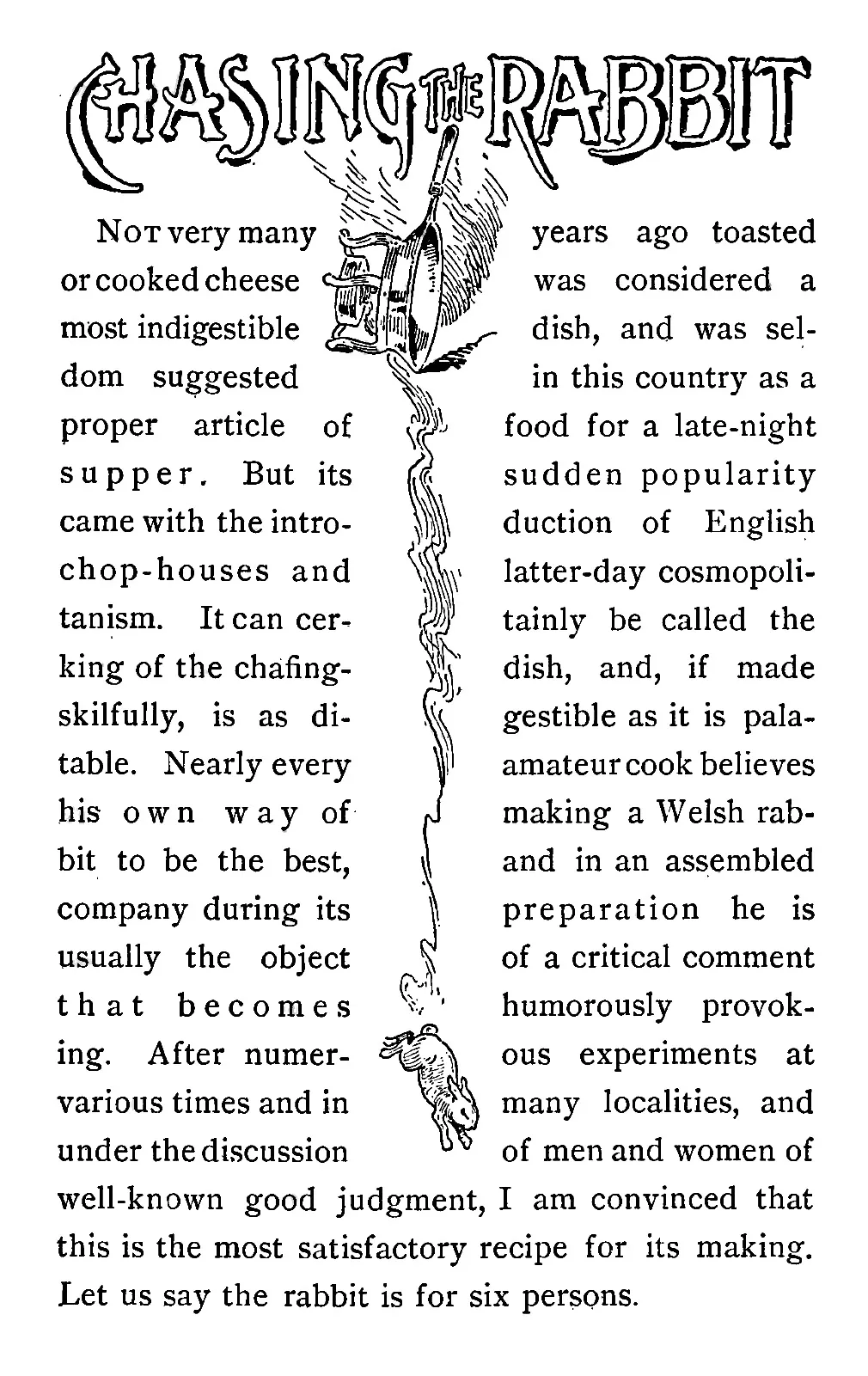
Welch’s first chapter, after a short preface, is on Welsh rabbit, and it starts with a piece of recent history as he saw it. Not many years earlier, he writes, toasted cheese was thought “a most indigestible dish” and was seldom suggested “in this country as a proper article of food for a late-night supper.” It caught on, in his account, with the arrival of English chop-houses.
Then he turns to the cook. Nearly every amateur believes his own rabbit is the best, and with company present he is “usually the object of a critical comment that becomes humorously provoking.” A few pages on he adds the advice that goes with it: “one must be Napoleonic in making Welsh rabbits before a number of interested guests; one must also be royal.”
His recipe serves six and begins with two pounds of fresh American cheese, cut up or grated in advance. It melts in butter, with mustard, paprika and salt dissolved in ale or beer, and is stirred diligently until it is as thick as batter and boiling. Bread or toast waits beside the pan, each piece is plunged into the rabbit with a fork, and it goes onto a heated plate at once. Milk, Welch allows, does as well as beer. His last word is on stirring: “It should even be beaten.” With a poached egg dropped on top, he adds, the same dish is a golden buck.
Two pounds of cheese for six people comes to about 5⅓ ounces a head as written; the book doesn’t say how much anyone ate. Welsh rabbit already has a page here, a Paris restaurateur’s version of 1814 made with Gloucester cheese, browned and served with English mustard, in Welsh Rabbit (1814). This menu leaves the rabbit to it and cooks the other things the two books put in the pan.
Mushrooms for Jim
Welch’s next chapter is a scene. The narrator is reading in his bachelor apartment when Jim, “big, bustling, hearty fellow as he is,” comes in hungry. There is nothing in the larder but mushrooms. Jim wants a broiled mushroom on toast, and when he hears where it will come from, he scoffs: “In a chafing-dish? Come off, old man!” The mushrooms brown under the lid in olive oil and paprika, and two slices of bread heat in the same pan with a little butter.
The chapter begins with a disclaimer. “I am not a maker of cook-books,” the narrator says, and what he writes will not be cold prescription indexed for “Bridget in her basement kitchen.” The joke depends on that kitchen staying downstairs and out of sight. The book’s second half nonetheless holds more than a hundred chafing-dish recipes, “the majority of them especially contributed to this book,” as the contents page puts it. Jim’s evening comes with no date, and the book gives no way to know whether it happened as told.
Many of those contributed recipes carry a name. Oysters à la George Trimble Davidson cook in butter with celery, paprika, Tabasco, lemon and sherry and go onto hot toast. Sardines under the same name are broiled and covered with “a thin milk-rabbit.” Oysters à la John Chamberlin, which Welch says were “invented by the famous viveur of Washington,” go into simmering Madeira and celery and come off the flame the moment their gills begin to curl. An oyster Newburg comes from a Mrs. Lemcke, who promised a cookery class for women that it was “an excellent thing with which to get your husbands in a good humor.”
Midnight Feasts
Southworth’s book was published in San Francisco by Paul Elder and Company. Its title page carries no date; the copyright notice on the next leaf says 1914. The introduction sells the late supper. Midnight suppers, she writes, “have always had a certain secret fascination, as of forbidden temptations.” The old idea that eating late was “the height of indiscretion” belonged, in her view, to benighted ages, and suppers after a sociable evening were “both wholesome and beneficial.”
She names her audience. “To the college boy and the college girl, these late repasts are the very soul of their good fellowship.” She also teases the men who might hang back: boys, “and even men, real manly men,” find genuine sport in the chafing dish, “if they only have the nerve to acknowledge it.”
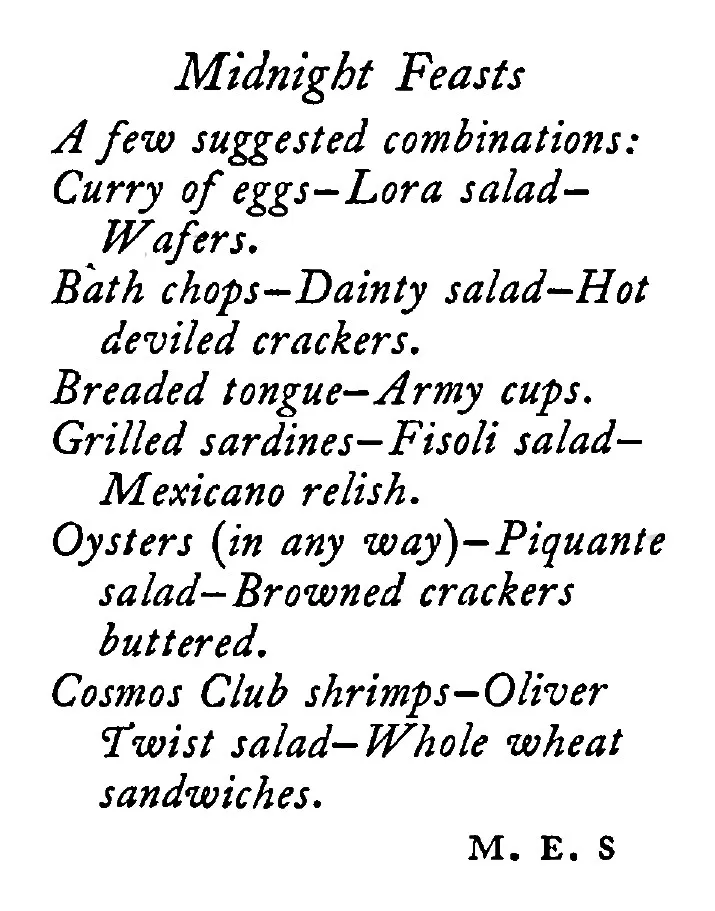
Then comes the plan. Each spread should pair two things that suit each other, a hearty hot dish with a simple salad or the reverse, and she prints a short list to show how.
 May E. Southworth, Midnight Feasts (San Francisco: Paul Elder & Company, copyright 1914), p. vi.
Three of the six hot dishes on that list are fish or shellfish. Two name a single recipe in her book, the grilled sardines and the Cosmos Club shrimps, and one is a shrug: oysters “(in any way),” of which her book gives more than a dozen.
The work before the flame
Southworth is frank about what made the show possible. “Most of the foods for the various dishes are prepared beforehand in the kitchen,” she writes at the head of her chafing-dish chapter, and placed “conveniently at hand in dishes and on trays.” Her salads ask for more of the same: beans split, tied, boiled and iced for the Fisoli, celery curled in ice water for the Oliver Twist, bakery cream-puff shells to be filled for the Mexicano relish. Each was ready before anyone sat down.
Welch’s rabbit rests on the same kind of readiness: the cheese grated before the lamp is lit, the toast made, the plates hot. Who did that work, neither book says. The company saw the last few minutes, and the cook got the credit.
The recipes
Two recipes come from Welch’s book of 1896 and two from the hot dishes on Southworth’s list of 1914. No single supper served all four; the grouping is ours, as are the modern amounts, and a skillet on the stove takes the place of the spirit lamp.
- Mushrooms on Toast (1896): Welch’s mushrooms for Jim, browned under the lid in olive oil and paprika, on bread warmed in the same pan.
- Chafing-Dish Oysters (1896): Southworth’s “oysters (in any way),” made the George Trimble Davidson way from Welch’s book, with celery, lemon and a little sherry, on hot toast.
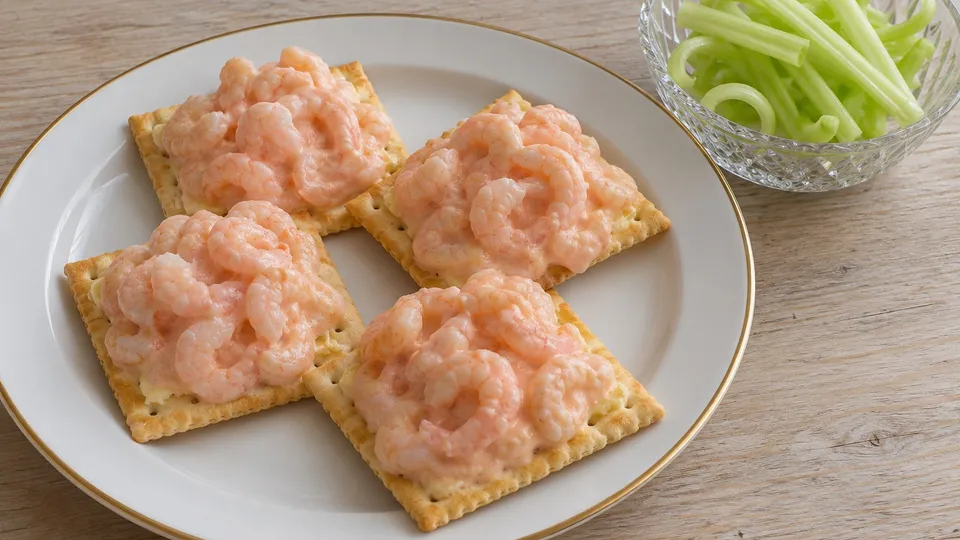
- Cosmos Club Shrimps (1914): shrimps in a cream sauce tinted with tomato, on hot buttered crackers.
- Grilled Sardines on Toast (1914): boneless sardines turned once in hot olive oil, seasoned with cayenne and lemon, each on a narrow strip of toast.
By 1920 the pan could simply keep things hot: a sundae chapter of that year, in What Did Americans Cook When the Bars Closed in 1920?, holds the fudge sauce in a double boiler or a chafing dish until serving.
Cooking it
Do it Southworth’s way round: make the salad and the toast first, set out the shrimps, cream and tomato sauce on a tray, and the Cosmos Club Shrimps (1914) take about ten minutes at the stove once everyone is sitting down. Southworth’s two dishes are among our Edwardian recipes, next to the paper-bag and fireless-cooker cooking of the same years.
 Cook it todayCosmos Club Shrimps (1914)
Sources
- Deshler Welch, The Bachelor and the Chafing Dish, with a Dissertation on Chums, drawings by Francis Day and George R. Halm (New York and Chicago: F. Tennyson Neely, 1896; copyright 1895), pp. vi, 3, 5–7, 11–13, 100–101 and 105–106. Internet Archive (opens in a new tab).
- May E. Southworth, Midnight Feasts: Two Hundred & Two Salads and Chafing-Dish Recipes (San Francisco: Paul Elder & Company, undated; copyright 1914), pp. iii–vi, 39, 47–49, the unnumbered page that opens the chafing-dish recipes, and pp. 79–83, 91 and 93–94. Internet Archive (opens in a new tab).