Welsh Rabbit (1814)
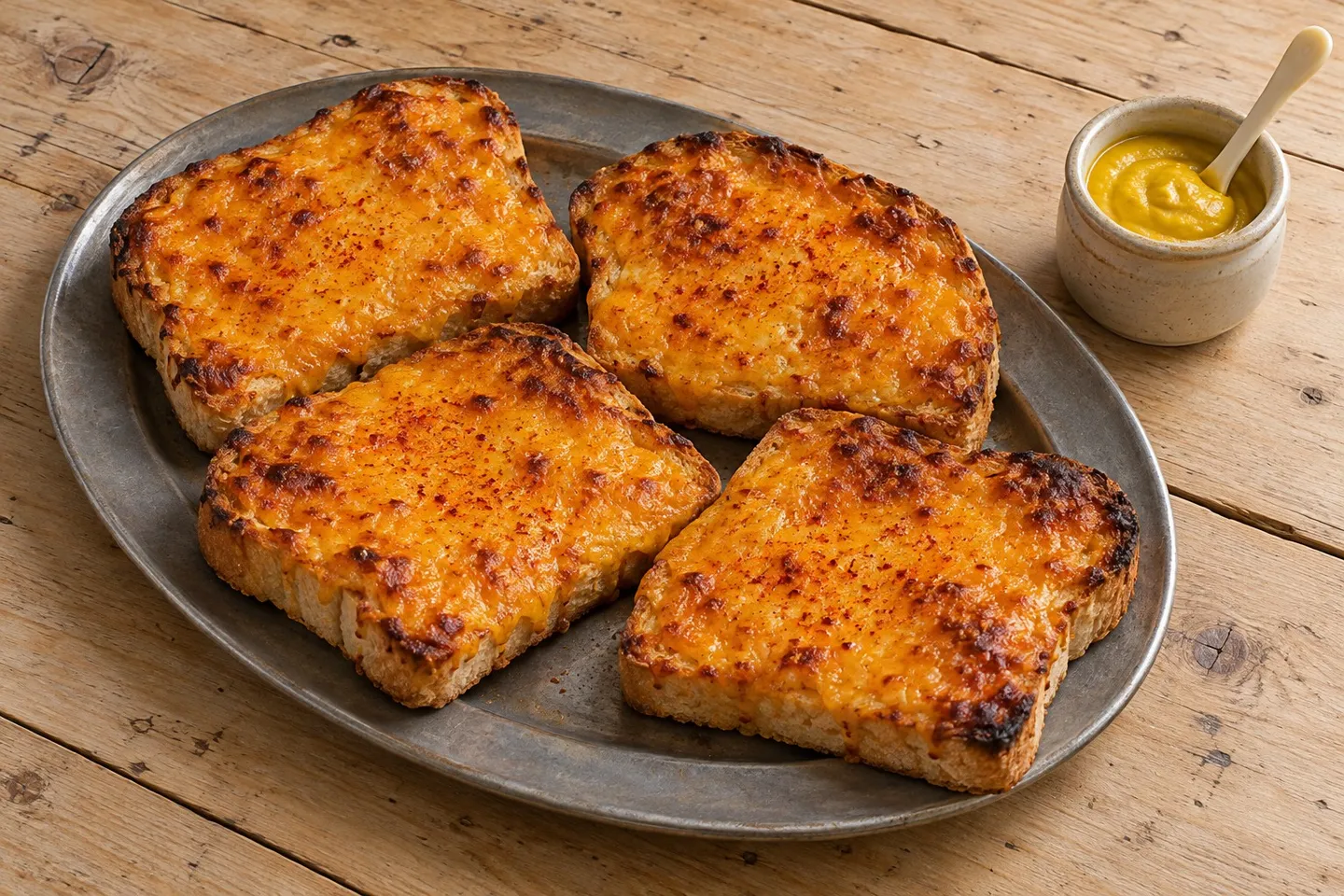
Reader ratingsGloucester cheese melted with a little water and Cayenne, spread on toast, browned and served with English mustard: a Paris restaurateur’s Welsh rabbit, 1814.
- Recipe makes
- 4 toasts, 4 servings
- Prep
- Cook
- Total
Toast spread with melted Gloucester cheese, browned, with a pot of English mustard.
The story behind the recipe
In the second course of a dinner à l’anglaise that the Paris restaurateur Antoine Beauvilliers printed in 1814, between a jam tart and a rice pudding, sits “1 de woiches rabettes.” The spelling puts Welsh rabbits into French letters. Turn to the pastry chapter of Beauvilliers’s second volume and the dish appears again, as “Wouelche rabette, ou Lapin gallois”: slices of toast spread with melted English cheese, browned, and served with English mustard.
Why is there no rabbit in it?
The rabbit was only ever in the name. Beauvilliers translated the English name word for word, so his French readers got lapin gallois, a Welsh rabbit, over a recipe of cheese and toast. What he did insist on was the cheese: “fromage anglais dit Glocester,” English cheese called Gloucester, with the rind cut off and the rest diced and melted with a little water. He seasons it with coarse pepper or “poivre rouge, dit de Caïenne,” spreads it on toast “grillées d’une belle couleur,” and browns it with a red-hot shovel held some distance above, the way a cook without a broiler finished a dish.
Beauvilliers boasted in his preface of bringing the most praised English dishes to France, and he kept the restaurant at 26 rue de Richelieu under the name of the grande Taverne de Londres. A year after the book came out, British officers were dining in the restaurants of Paris, as Where Did the Victors Dine in Paris After Waterloo? tells. Neither Hobhouse’s diary nor Gronow’s memoir, the two witnesses that article follows, names a dish an officer ordered.
Read more about this recipe
Making it today
Double Gloucester is the Gloucester most shops sell, and it goes in with Beauvilliers’s splash of water over low heat. The broiler does the shovel’s work. Of his two peppers, Cayenne is our pick. Next on the menu came the poutingue de riz, a French rice cake given an English name and a sauce: the Rice Pudding with Macaroons (1814).
Wouelche rabette, ou Lapin gallois.
Faites des rôties de pain, qui soient grillées d’une belle couleur; ayez du fromage anglais dit Glocester; ôtez-en la croûte, coupez-le en petits dés, mettez-le fondre, avec un peu d’eau, dans une casserole; ajoutez-y une pincée de gros poivre ou de poivre rouge, dit de Caïenne; étendez sur ces rôties ce fromage fondu; glacez-les avec une pelle rouge, en la tenant élevée dessus à une certaine distance, pour leur faire prendre une belle couleur : cela fait, dressez-les sur un plat, et servez à côté de la moutarde anglaise.
Recipe makes: 4 toasts, 4 servings
Ingredients
For 4 toasts, 4 servings. Quantities are shown as written.
Quantities as written here, for 4 toasts, 4 servings.
- Thick slices white bread4
- Double Gloucester cheese250 g
- Water45 ml
- Cayenne pepper1/8 tsp
- Prepared English mustard, to serve2 tsp
Measurement notes
Ingredients as written here
- 4 thick slices white bread
- 250 g Double Gloucester cheese
- 45 ml water
- 1/8 tsp cayenne pepper
- 2 tsp prepared English mustard, to serve
Equipment
- Broiler and a baking sheet
 Small heavy saucepan
 Wooden spoon
Instructions
Heat the broiler with a rack about 10 cm below the heat.
Toast the white bread on both sides under the broiler until it is a good golden brown, and lay the slices on the baking sheet.
Cut the rind off the Double Gloucester cheese and cut the cheese into small dice.
Put the cheese and the water in the saucepan over low heat and stir until the cheese has melted into a smooth, thick cream, 4 to 5 minutes, keeping the heat low so it never boils. Stir in the cayenne pepper.
Spread the cheese over the toast right to the edges.
Broil for 1 to 2 minutes, watching closely, until the cheese bubbles and browns in patches.
Set the toasts on a warm plate and serve at once, with the English mustard in a small pot beside them.
Nutrition
360calories per serving
- Recipe makes
- 4 toasts, 4 servings
- Servings
- 4
Estimated per toast (4) from USDA FoodData Central values for white bread and Double Gloucester (as Cheddar-type cheese).
Recipe notes
When adjusting quantities
Beauvilliers gives no amounts. About 60 g of cheese covers one thick slice of toast; scale by the slice.
Notes
Quantities mentioned in these notes don’t change when you adjust the servings.
Beauvilliers measures nothing, so we chose the cheese, water and pepper quantities. Double Gloucester replaces his “Glocester,” which could have been either the single or the double cheese. He allows coarse black pepper in place of Cayenne. The broiler replaces his red-hot shovel. Use a ready-made English mustard, or mix mustard powder with a little cold water 10 minutes before serving. Contains milk and wheat.
Scaling changes the ingredients only; pan sizes and cooking times need their own judgment. To adapt this recipe further, try the recipe tool at TuneMyRecipe (opens in a new tab), our sister site.
Sources and attribution
After Antoine Beauvilliers, L’Art du cuisinier (Paris, 1814), Wouelche rabette, ou Lapin gallois
See the original pages (scan at Internet Archive) (opens in a new tab)
Recipe details
- Course
- Savory
- Dish family
- Breads & Cakes
- Era
- 19th century
- Source decade
- 1810s
- Main ingredient
- Milk & cream
- Difficulty
- Easy
- Occasion
- Dinner party