Lamb Cutlets à la Soubise (1814)
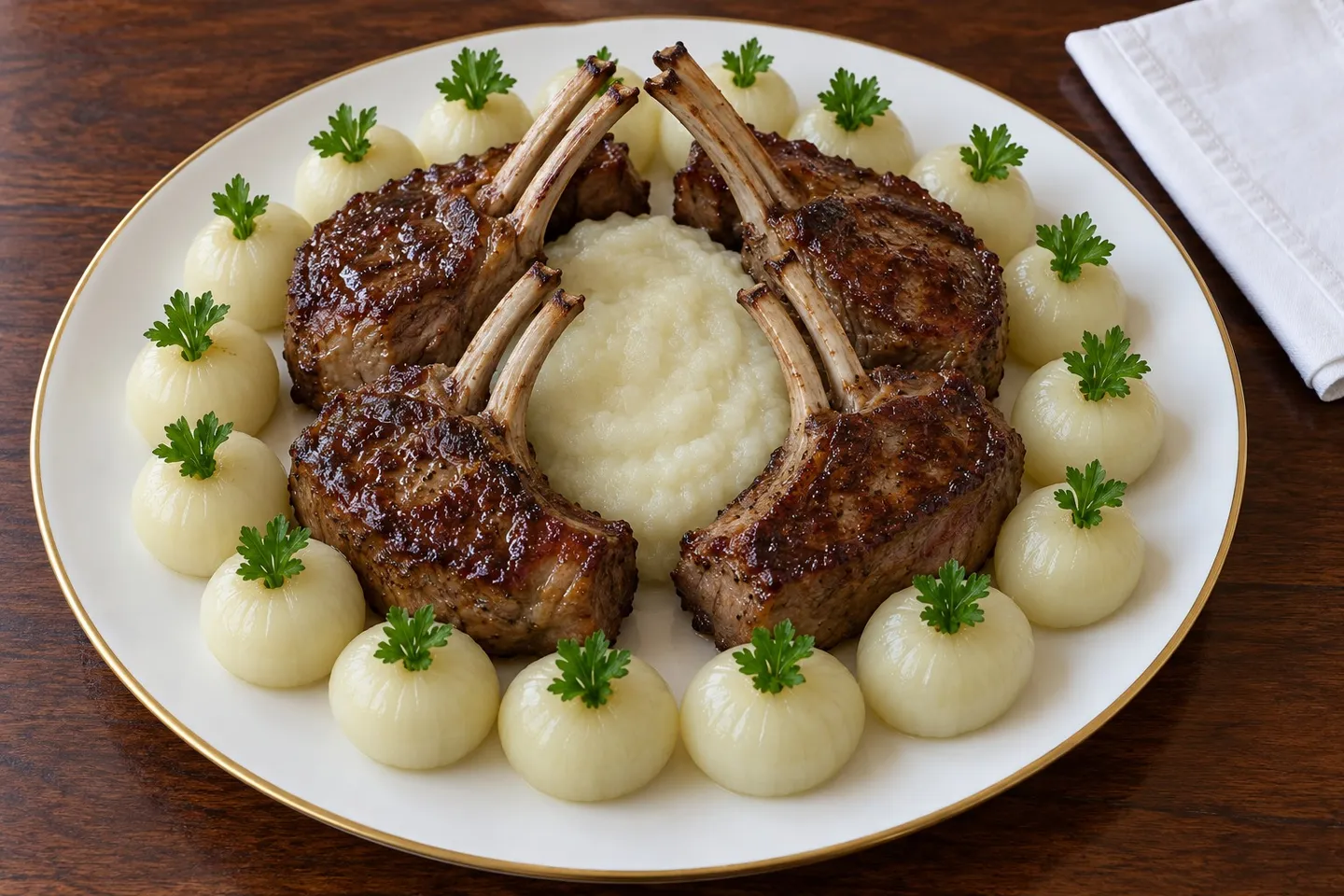
Reader ratingsLamb cutlets à la Soubise from Beauvilliers’s L’Art du cuisinier, 1814: double-rib cutlets larded with ham, braised, glazed in their own reduced liquor and ringed around a white onion purée.
- Recipe makes
- 4 double cutlets, 4 servings
- Prep
- Cook
- Total
The cutlets braise for about 1½ hours. Make the onion purée and cook the small onions while they are in the oven; the cutlets then rest 10 minutes before the liquor is reduced and they are glazed.
Glazed lamb cutlets in a ring around white onion purée, with small onions and parsley.
The story behind the recipe
Writing in 1862 about the Paris of 1815, Captain Rees Gronow gave its most celebrated restaurant two specialities: “Beauvilliers was also celebrated for his suprême de volaille, and for his côtelette à la Soubise.” The second is mutton or lamb cutlets served around a purée of white onions. Antoine Beauvilliers had already printed the dish in his own cookbook, L’Art du cuisinier, in 1814, and put it among the entrées of two of his model dinners.
Why “à la Soubise”?
Beauvilliers answers that himself, and his answer is about selling. In his preface he explains that an ingenious chef changes a known dish a little and gives it “a fanciful name, for example that of the patron to whom he is attached,” which lends an old dish “the graces of novelty.” His example is this one: the cutlets that had once been served à la purée d’oignons were now called Côtelettes à la Soubise. The name, in other words, was the new part.
His recipe is restaurant cooking, built from parts a busy kitchen kept on hand: a braise, a glaze boiled down from its own liquor, and two onion garnishes. One of them, the white purée, he does not repeat; he sends the reader to find it “à son article,” a hundred and thirty pages earlier in the same volume. The other is a border of small onions, each with a sprig of raw parsley planted in its top, so that the plate comes to the table as a ring of glazed meat around a white center, edged in green and white.
Read more about this recipe
Making it today
Mutton is hard to buy, so lamb rib cutlets stand in, two ribs to each, as Beauvilliers asks. The purée is his white onion sauce from earlier in the same volume; we thicken it with a spoonful of flour and stock in place of his velouté. The rest follows his order of work. The restaurants where it was served, and the officers who filled them that summer, are in Where Did the Victors Dine in Paris After Waterloo?; Gronow’s other dish, the Chicken Suprême (1814), comes from the same book.
Côtelettes de Mouton à la Soubise.
Coupez vos côtelettes à deux côtes le moins; parez-les, aplatissez-les légèrement; lardez-les de moyen lard et de jambon, autant de l’un que de l’autre; foncez une casserole des parures de ces côtelettes; ajoutez-y trois ou quatre oignons, un couple de carottes, un bouquet de persil et de ciboules bien assaisonné; rangez vos côtelettes dessus, mouillez-les avec du consommé, de manière qu’elles trempent presque entièrement; couvrez-les de bardes de lard, et d’un fort papier beurré par-dessus; faites-les partir; couvrez votre casserole; mettez-la sur la paillasse avec feu dessous et dessus; lorsqu’elles seront cuites, égouttez-les, laissez-les refroidir; parez-les de nouveau en égalisant la superficie des chairs et supprimant les lardons qui les outre-passent, tant de jambon que de lard; passez le fond de votre cuisson au travers d’un tamis de soie; faites-le réduire presqu’à consistance de glace; remettez vos côtelettes dans ce fond; retournez-les pour les glacer des deux côtés; ensuite dressez-les en cordon; versez dans le puits une bonne purée d’oignons au blanc (voyez Purée d’Oignons, à son article); de plus faites autour de vos côtelettes une bordure de petits oignons égaux, que vous aurez fait blanchir et cuire dans du consommé; il faut que ces oignons soient posés sur votre plat, de manière à ce que vous puissiez planter dans la queue une petite branche de persil cru, et servez.
Sauce à la purée d’Oignons blancs.
Emincez douze oignons, mettez-les dans une casserole avec un morceau de beurre; posez votre casserole sur un feu doux, afin que votre oignon ne prenne point de couleur; faites-le cuire à petit feu, ayant soin de le remuer souvent avec une cuiller de bois; quand vous voyez qu’il s’écrase facilement sur la cuiller, joignez-y une ou deux cuillerées de velouté, et laissez cuire de nouveau; quand le tout sera bien cuit et réduit, passez-le dans une étamine comme pour la purée d’oseille; remettez-le dans une casserole et sur le feu; incorporez dans cette purée d’oignon une chopine de crème que vous aurez fait bouillir; mettez-y un peu de muscade râpée, pour que votre purée soit d’un bon goût; lorsqu’elle aura atteint le degré d’une bonne bouillie, retirez-la et servez.
Recipe makes: 4 double cutlets, 4 servings
Ingredients
For 4 double cutlets, 4 servings. Quantities are shown as written.
Quantities as written here, for 4 double cutlets, 4 servings.
- Rack of lamb, cut into double cutlets of two ribs each1.2 kg
- Pork fatback for larding, cut in thin strips40 g
- Cooked ham for larding, cut in thin strips40 g
- Salt1 tsp
- Ground black pepper1/2 tsp
- Onions for the braise, sliced250 g
- Carrots, sliced150 g
- Parsley for the bundle4 sprigs
- Spring onions3
- Unsalted chicken or veal stock for the braise700 ml
- Thin slices unsmoked bacon, for covering100 g
- Butter for the paper10 g
- Onions for the purée, thinly sliced450 g
- Butter for the purée30 g
- All-purpose flour10 g
- Chicken stock for the purée150 ml
- Heavy cream120 ml
- Grated nutmeg1/8 tsp
- Salt for the purée1/4 tsp
- Small white onions, peeled and all of a size200 g
- Chicken stock for the small onions300 ml
- Small sprigs parsley for the garnish16
Measurement notes
Ingredients as written here
- 1.2 kg rack of lamb, cut into double cutlets of two ribs each
- 40 g pork fatback for larding, cut in thin strips
- 40 g cooked ham for larding, cut in thin strips
- 1 tsp salt
- 1/2 tsp ground black pepper
- 250 g onions for the braise, sliced
- 150 g carrots, sliced
- 4 sprigs parsley for the bundle
- 3 spring onions
- 700 ml unsalted chicken or veal stock for the braise
- 100 g thin slices unsmoked bacon, for covering
- 10 g butter for the paper
- 450 g onions for the purée, thinly sliced
- 30 g butter for the purée
- 10 g all-purpose flour
- 150 ml chicken stock for the purée
- 120 ml heavy cream
- 1/8 tsp grated nutmeg
- 1/4 tsp salt for the purée
- 200 g small white onions, peeled and all of a size
- 300 ml chicken stock for the small onions
- 16 small sprigs parsley for the garnish
Equipment
- Heavy ovenproof casserole with a lid, wide enough for the cutlets in one layer
- Thin sharp knife for larding
- Parchment paper
- Two saucepans
- Wide frying pan for the glaze
- Blender and fine sieve
 Instant-read thermometer
Instructions
Heat the oven to 325°F (160°C).
Trim the rack of lamb cutlets of excess fat, keeping the trimmings, and flatten the meat lightly with the flat of a heavy knife. With the thin knife, make small slits across the meat of each cutlet and push in the pork fatback for larding and the ham for larding, as much of one as of the other. Season the cutlets with the salt and black pepper.
Spread the trimmings over the bottom of the casserole with the onions for the braise and the carrots. Tie the parsley for the bundle and the spring onions together and add them. Lay the cutlets on top in one layer and pour in the stock for the braise until they are almost covered.
Lay the bacon slices over the cutlets. Rub a sheet of parchment with the butter for the paper, press it buttered side down over the bacon, and cover the casserole with its lid.
Bring the casserole to a simmer on the stove, then move it to the oven and braise for about 1½ hours, until a skewer slides easily into the thickest cutlet. By then the meat is far past the 145°F (63°C) safe minimum for lamb.
While the cutlets braise, make the purée. Melt the butter for the purée in a saucepan over low heat, add the onions for the purée, cover and cook gently for 25 to 30 minutes, stirring often, until they crush easily against the spoon without taking any color.
Stir the flour into the onions and cook for 1 minute, then stir in the stock for the purée and simmer for 10 minutes until thick. Blend until smooth and press through the fine sieve back into the pan.
Bring the heavy cream to a boil and stir it into the purée with the nutmeg and the salt for the purée. Simmer, stirring, for about 5 minutes, until it is as thick as porridge. Cover and keep warm.
Drop the small white onions into boiling water for 2 minutes and drain them. Simmer them in the stock for the small onions for 15 to 20 minutes, until tender all the way through, and keep them warm in their stock.
Lift the cutlets onto a board and let them cool for 10 minutes. Trim off any strips of ham or fat that stick out and tidy the surfaces of the meat.
Strain the braising liquid through the fine sieve into the wide frying pan and spoon off the fat. Boil it hard for about 15 minutes, until only a few spoonfuls of dark, syrupy glaze remain.
Turn the heat to low, return the cutlets to the pan and turn them in the glaze until both sides shine and they are hot through, at least 165°F (74°C) in the center.
Arrange the cutlets in a ring on a warm platter, bones pointing up. Spoon the onion purée into the middle. Drain the small onions, set them around the cutlets, and stand a parsley sprig for the garnish in the top of each one. Serve at once.
Nutrition
780calories per serving
- Recipe makes
- 4 double cutlets, 4 servings
- Servings
- 4
Estimated per serving (4) from USDA FoodData Central values for lamb rib with fat, pork fatback, ham, bacon, onions, butter, cream and flour; braising liquid not counted beyond the glaze.
Recipe notes
When adjusting quantities
Beauvilliers gives three or four onions and a couple of carrots for the braise and twelve onions for the purée, with no count of cutlets. Four double cutlets fill a casserole of about 28 cm; for eight, use two casseroles or one large roasting pan with a lid.
Notes
Quantities mentioned in these notes don’t change when you adjust the servings.
Beauvilliers names no weights, cooking time or number of cutlets, so we set every amount here, along with the oven temperature and time, the 10-minute cooling (he lets the cutlets go cold before trimming them) and the reheating temperature. Lamb replaces mutton; mutton cutlets need about 30 minutes more in the oven. Unsmoked bacon slices replace his bardes de lard, sheets of pork fat, which a butcher can cut from fatback. His white onion purée calls for twelve onions, a spoonful or two of velouté and a chopine of boiled cream, about half a liter by the old Paris measure; we use about a quarter of each, and cook a little flour and stock into the onions in place of the velouté. A blender and sieve replace his étamine, a straining cloth. The purée and the small onions can be made a day ahead, chilled within 2 hours, and reheated until steaming. Contains milk and wheat.
Scaling changes the ingredients only; pan sizes and cooking times need their own judgment. To adapt this recipe further, try the recipe tool at TuneMyRecipe (opens in a new tab), our sister site.

Sources and attribution
After Antoine Beauvilliers, L’Art du cuisinier (Paris, 1814), Côtelettes de Mouton à la Soubise
See the original pages (scan at Internet Archive) (opens in a new tab)
Recipe details
- Course
- Main course
- Dish family
- Meat & Poultry
- Region
- French
- Era
- 19th century
- Source decade
- 1810s
- Main ingredient
- Lamb & mutton
- Difficulty
- Advanced
- Occasion
- Dinner party