Paris under Allied occupation after Waterloo · Paris
Where Did the Victors Dine in Paris After Waterloo?
In the restaurants of Paris: Véry’s full of red coats in July 1815, and Beauvilliers, famous for his suprême and Soubise cutlets, who printed an English menu.
They dined in the restaurants of Paris. On 11 July 1815, three weeks after Waterloo, the English traveler John Cam Hobhouse ate at Véry’s and found it “very full of red coats.” Captain Rees Howell Gronow, a Guards officer who had fought in the battle, remembered Beauvilliers in the rue de Richelieu as the most celebrated restaurant in the city that year, and as famous for its suprême de volaille and its côtelette à la Soubise, in a memoir printed forty-seven years later. Neither man recorded what anyone at those tables ate. The food comes from Beauvilliers himself, who had printed both dishes in his cookbook the year before, along with a whole dinner à l’anglaise for English guests.
Red coats at dinner
Hobhouse, who wrote to Byron from Paris that week, was there as a civilian. His diary for the second week of July reads like a list of addresses. On 10 July he dined at Massinot’s. On 11 July came Véry’s and its red coats, in a line that runs straight on to an evening call. On 13 July he dined at Véry’s again, and on 14 July, “Dined at Very’s late.” The red coats were British uniforms. He names nobody and records no dish, so the most the entry shows is what a room looked like on one summer evening.
The city outside was tense. His entry for 9 July records Prussian demands for money, talk of blowing up the Pont d’Iéna and soldiers lodged in private houses, and notes that the English were “as much liked” as the Prussians were “hated.” The diary survives in manuscript; it is read here in Peter Cochran’s annotated transcription, The Hundred Days, and quoted only in these short lines.
Véry’s was no new discovery. Ten years earlier, Grimod de la Reynière had named “M. Véry” as his example of a restaurateur, the kind of tradesman who might send a sample to his jury of tasters, as What Did Grimod’s Tasting Jury Judge in 1805? tells.
The Guards in Paris
Gronow’s Reminiscences came out in 1862, forty-seven years after that summer: an old soldier’s memories, set down long after the events. His battalion, “the survivors of the heroic fight of the 18th of June,” reached Paris, by his date, on 25 June and bivouacked for three weeks in the Bois de Boulogne beside the Prussians. His date is early. Hobhouse heard on 3 July of the armistice under which the French army would withdraw and the Allies enter Paris, watched English troops take over the gates at the Barrière de l’Étoile on 6 July, and the next day found the Bois de Boulogne “full of our troops in tents.” He believed he was one of the first British soldiers into the heart of the city. The first house he entered was a café in the garden of the Tuileries, where a Paris-born man of English descent greeted him and “gave me some useful directions concerning restaurants and cafés.”
He describes the ordinary soldiers too. They “generally walked about Paris in parties of a dozen, and were quiet and well-behaved,” and gathered every day on the Boulevard du Temple, among jugglers, rope dancers and booths selling “cakes, gingerbread, fruit, and lemonade.” The Parisians, he thought, had one weapon left: “the only revenge which the Parisians were able to take upon the conquerors was to ridicule them.”
Beauvilliers in the rue de Richelieu
Under the heading “Parisian Cafés in 1815,” Gronow lists the places that mattered. A trip to Paris then, he says, was something only “a very limited and wealthy class of strangers” could afford.
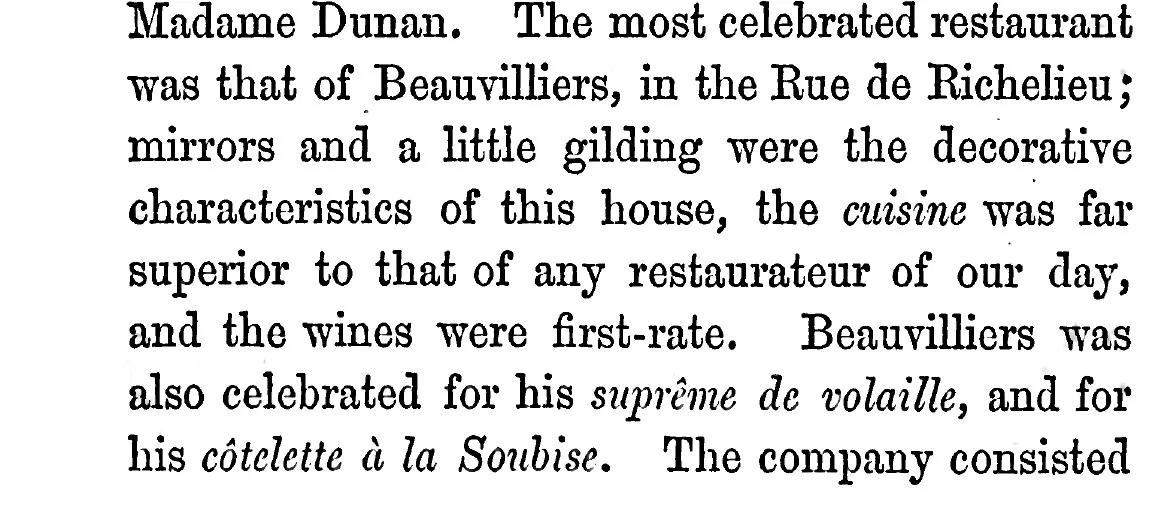 Captain Gronow on Beauvilliers’s restaurant in 1815: Reminiscences of Captain Gronow, second edition (London: Smith, Elder, 1862), p. 132.
“Mirrors and a little gilding” were the decoration, the cooking was better, he thought, than that of any restaurateur of the 1860s, when he was writing, and “the wines were first-rate.” The diners he remembered were French: Chateaubriand and the Dukes of Fitzjames, Rochefoucauld and Grammont, who went on to the theaters after dinner and then to the gaming rooms of the Salon des Étrangers. He also names the Rocher de Cancale in the rue Mandar, kept by Borel, where the cooking was so refined that people “were reported to have come over from England expressly for the purpose of enjoying it,” and the Trois Frères Provençaux in the Palais-Royal, “frequented much by the French officers,” known for its wines and its Provence dishes.
The meal Gronow does describe at Beauvilliers’s came in October 1815. A friend had asked him to dine there, and halfway through dinner an officer of the Engineers at the far end of the room, whom Gronow calls only Sir Charles S, began beating a smartly dressed Frenchman over the head with “one of the long French loaves.” The Frenchman had laughed at him for ordering three bottles of wine. The quarrel ended, Gronow writes, in a duel near Vincennes the next day, in which the Frenchman was shot. It is a good story, set down nearly half a century later, and he gives the officer only an initial.
The Taverne de Londres
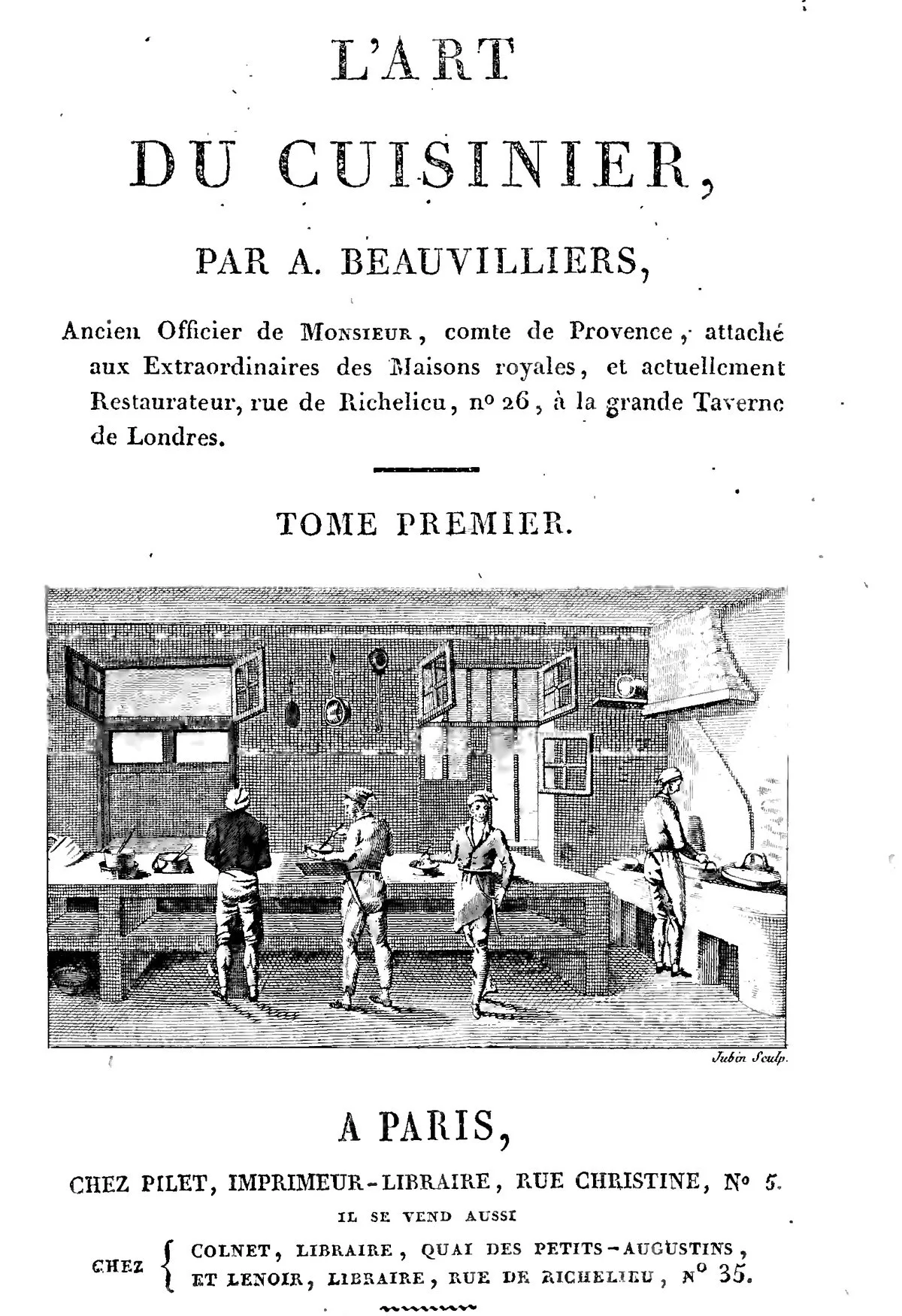
The man behind the restaurant had published his own account of it. In 1814 Antoine Beauvilliers brought out L’Art du cuisinier in two volumes, and the title page names him as a former officer of “Monsieur, comte de Provence,” the title King Louis XVIII had held before the Revolution, “and now Restaurateur, rue de Richelieu, no. 26, at the grande Taverne de Londres.” His preface claims forty-four years of experience.
The name of the house was a statement. In the preface Beauvilliers promises “the most exquisite and most praised dishes of English cooking, which I had the advantage of being the first to transplant to France.” That is his own boast. Food writers of his own day disagreed about his place among the first restaurateurs of Paris, a quarrel Leon G. Fine traced in 2021. The book also explains how a restaurant dish got its name. A clever chef, he writes, changes a known dish a little and gives it “a fanciful name, for example that of the patron to whom he is attached,” which lends it “the graces of novelty.” His example is the dish Gronow would remember: cutlets with onion purée had become Côtelettes à la Soubise.
An English menu from a French kitchen
Beauvilliers opens his first volume with bills of fare by season, for tables of eight to forty. Two dinners, one for sixteen to twenty guests and one for twenty-five to thirty, carry côtelettes à la Soubise among the entrées, and the larger one also lists a suprême de volaille aux truffes. Between them sits a dinner for twelve to sixteen “à l’anglaise.”
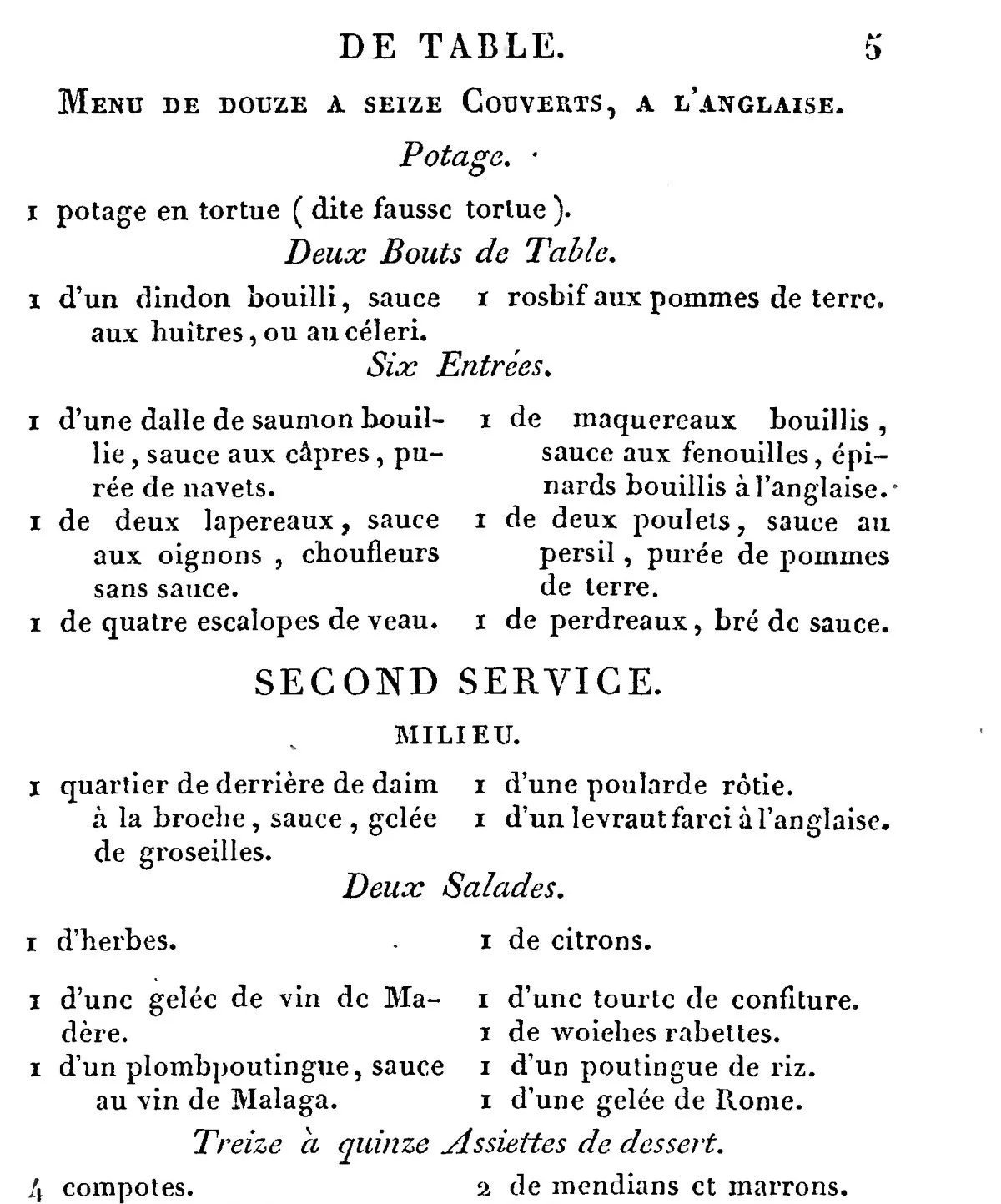 A dinner “à l’anglaise” for twelve to sixteen: Antoine Beauvilliers, L’Art du cuisinier, volume 1 (Paris, 1814), p. 5.
It reads like an English inn’s dinner seen from a French kitchen. There is mock turtle soup (“potage en tortue, dite fausse tortue”), a boiled turkey with oyster or celery sauce, roast beef with potatoes, boiled salmon with caper sauce, and a haunch of venison with currant jelly. The puddings and savories of the second course are spelled the way a Paris printer heard them: a plombpoutingue with a Malaga wine sauce, woiches rabettes and a poutingue de riz. In his second volume the Welsh rabbit becomes “Wouelche rabette, ou Lapin gallois,” made with English Gloucester cheese and served with English mustard. Fifty-five years later, plum pudding was still closing a Paris menu, on a handwritten siege menu described in What Did Paris Eat Under Siege in 1870?
None of this is a record of what the victors ate. The menus are models for a host to copy, printed before Waterloo, and nothing in Hobhouse or Gronow ties a dish to a diner. What the book does show is that a restaurateur on the rue de Richelieu was offering English dishes in print a year before the red coats filled Véry’s, and that the two dishes Gronow remembered were ones its owner thought worth printing.
The recipes
All four come from Beauvilliers’s L’Art du cuisinier of 1814. The first two are the specialities Gronow named; the last two are from the menu à l’anglaise. No single dinner served them together; the grouping is ours.
- Lamb Cutlets à la Soubise (1814): double-rib cutlets larded with ham and fat, braised, glazed in their own reduced liquor and ringed around a white onion purée.
- Chicken Suprême (1814): chicken breasts cooked white in butter and set in a crown with fried croûtons, under a sauce of reduced stock and velouté.
- Welsh Rabbit (1814): Gloucester cheese melted with a little water and pepper on toast, browned and served with English mustard.
- Rice Pudding with Macaroons (1814): a molded rice cake with bitter macaroons, baked and masked with an orange-flower cream sauce, which, Beauvilliers says, is what makes it a “pouting.”
Cooking it
For the dish Gronow named first, make the Chicken Suprême (1814): it takes about an hour, with the stock reducing while the rest is made, and Beauvilliers’s test for doneness is a finger pressed on the breast. Beauvilliers’s four dishes are among our 19th-century recipes, which run from Grimod’s Paris to the Klondike. For what fashionable London drank in the same years, Forgotten Drink, our sister site, looks at the refreshment table at Almack’s in What Did People Drink in the Regency? (opens in a new tab)
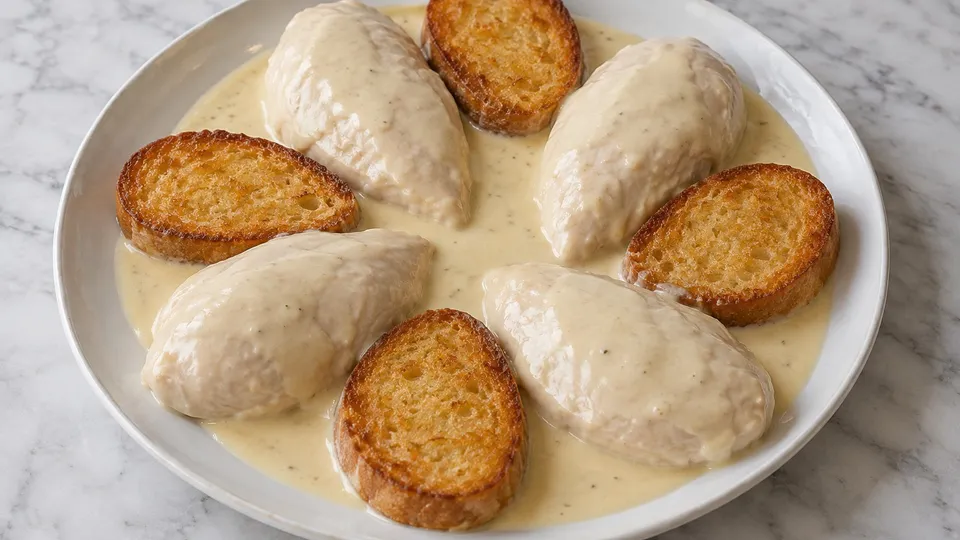 Cook it todayChicken Suprême (1814)
Sources
- John Cam Hobhouse, diary entries for 3 to 14 July 1815, in Peter Cochran (ed.), The Hundred Days, March 11th–July 24th 1815, pp. 262, 267, 272, 275–278. petercochran.wordpress.com (opens in a new tab).
- Rees Howell Gronow, Reminiscences of Captain Gronow, second edition, revised (London: Smith, Elder and Co., 1862), pp. 111–113, 128, 131–133, 147–148. Internet Archive (opens in a new tab).
- Antoine Beauvilliers, L’Art du cuisinier, volume 1 (Paris: Pilet, 1814), title page, pp. ix–xj, 3–7, 187–188, 327–328. Internet Archive (opens in a new tab).
- Antoine Beauvilliers, L’Art du cuisinier, volume 2 (Paris: Pilet, 1814), pp. 121, 125–127. Internet Archive (opens in a new tab).
- Leon G. Fine, “Gastronomy in early 19th century Paris: Divergent views of food-writers Grimod de La Reynière and Jean-Anthelme Brillat-Savarin on ‘the first restaurateur’, Antoine Beauvilliers,” International Journal of Gastronomy and Food Science 23 (2021), 100290.