The jury of tasters of the Almanach des gourmands · Paris
What Did Grimod’s Tasting Jury Judge in 1805?
Samples sent carriage paid, a weekly jury and a mention in print: how Grimod judged the food of Paris in 1805, from Champagne mustard to a giant ramequin.
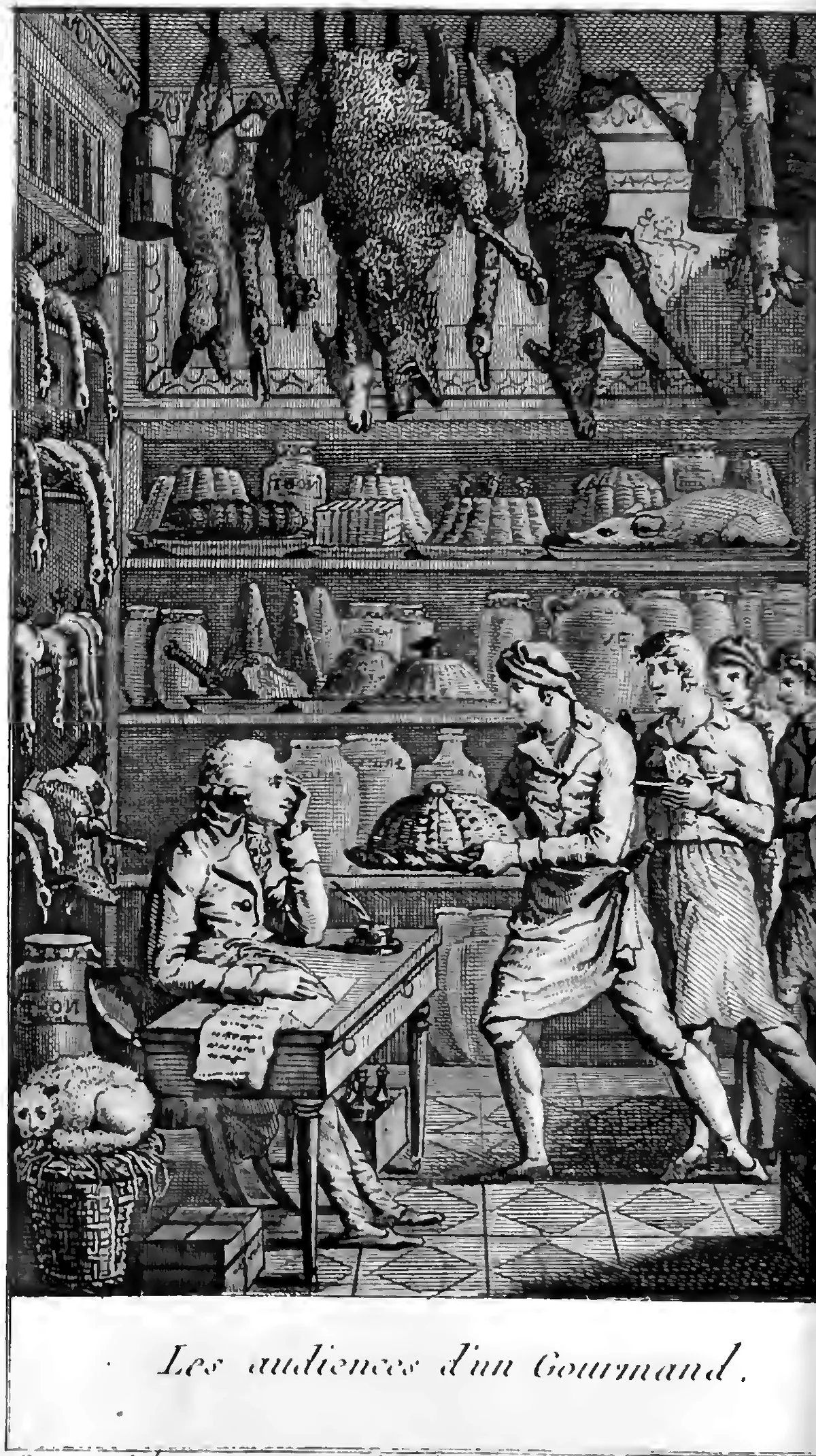
Grimod’s jury judged whatever the food trades of Paris sent to his door. In the 1805 edition of his Almanach des gourmands, Alexandre Grimod de la Reynière describes tradesmen, from pastry cooks and restaurateurs to a silversmith, sending him samples, explains that a jury of tasters met every week to judge them, and that the winners earned an honorable mention in the Almanach. He called the parcels légitimations, and he wanted them delivered carriage paid. The same volume lists the discoveries of 1803 it praised: a mustard made with Champagne, a chestnut flour, a cheese ramequin three feet round and a braised turkey stuffed with truffles.
The book even opens on the system. Its frontispiece, which Grimod designed and Dunant drew, is titled Les audiences d’un Gourmand: a gourmand at his desk in a storeroom hung with game, while people “laden with victuals” wait their turn and the one at the front “offers him an immense pâté,” all of them hoping “to obtain an honorable mention on the list of the legitimated.”
Letters of credence
This second edition, “revised, corrected and augmented” and signed on its title page only “by an old amateur,” explains the word in its preface. Légitimation had belonged to diplomacy. It now meant “the act of an artist in good cheer who submits samples of his skill or his trade to the tasting of the professors of the art of Gourmandise,” and by extension the sample itself. If a famous pastry cook like M. Rouget, a restaurateur like M. Véry, a provision merchant like M. Corcellet or “a silversmith of the first rank like M. Odiot” sent the author something they made or sold, the parcel was “a kind of letter of credence by which these diplomats make themselves known.”
They presented their credentials to a jury which, “under the presidency of the celebrated Doctor Gastaldy, pronounces every week on their respective talents.” The procedure sounds like a court’s. The samples are tasted “with very great ceremony and rigorous impartiality”; the opinions are collected “in the order of the appetites”; a formal report is drawn up; and on its result the candidates get their mention in the Almanach. The author, the preface adds, will regret “neither the trouble nor the indigestions” it costs him.
Carriage paid
The preface ends with an address: everything for the Almanach, “and even samples, légitimatoires or otherwise,” went to the author’s house at No. 8, rue des Champs-Élysées, carriage paid. The rule was strict, he says. The author “has refused even pâtés de foie gras, coming from Colmar, whose carriage had not been paid.”
Grimod prints the whole arrangement, gift, carriage and jury, as a selling point. What the preface cannot show is whether every tasting went as described, or whether a dull pâté ever got its mention anyway.
Praised in 1803
Near the end of the volume Grimod lists “the only gourmand discoveries that came to our knowledge in the course of the year 1803.” Each entry reads like a verdict.
M. Bordin’s Champagne mustard comes first, good with boiled beef and black pudding. Then a chestnut flour from M. Ragondet, dried so that it kept a year or more, with a recipe for using it: a sweet chestnut cream lightened into a kind of soufflé omelette.
The ramequin entry is the clearest account in the book of a sample sent for judgment. Paris, Grimod writes, made ramequins only in small timbales and thought any other shape a heresy. A gourmand who had eaten excellent large ones in Burgundy asked pastry cook after pastry cook in Paris to copy them and was turned away, until M. Rouget the younger listened, made trials and sent him a ramequin “more than three feet round, eight inches high.” The gourmand had gathered “a Jury of Gourmands worthy of appreciating cheese in all its forms.” They ate it to the last crumb, it caused “several indigestions,” and when the story got about, customers crowded into Rouget’s shop.
The turkey was judged by a dining club. A turkey stuffed with truffles had always been roasted, until the Société des Mercredis, seventeen gourmands who dined every Wednesday at M. Le Gacque’s restaurant, ordered one braised. Le Gacque stepped back three paces, said his honor was at stake and lost a night’s sleep. Then he obeyed. On November 16, 1803, at four o’clock by the clock of the Tuileries, the braised turkey came in. It was eaten in silence, judged “excellent” by a unanimous vote and “devoured to the bone.”
One more dish comes from the man the volume is dedicated to, M. Camerani of the Opéra-Comique. The Almanach prints his soup, “found in no dispensary”: macaroni, chopped chicken livers and Parmesan built up in layers in the tureen. Even here the macaroni, Parmesan, butter and livers each come with the name of a shop to buy them from.
The guests on trial
Twenty years later Jean Anthelme Brillat-Savarin turned the procedure around. His Physiologie du goût of 1825, quoted here from the English translation of 1884, A Handbook of Gastronomy, has a chapter of “gastronomic tests.” Grimod’s jury judged the food. Brillat-Savarin’s tests judge the guest. A test is a dish of such undoubted excellence that anyone whose face does not “beam with ecstasy” when it arrives may be “noted down as unworthy.” The rule comes from a Grand Council, written in Latin in a golden book and rendered by a “sworn translator,” all of it part of the joke.
He declines to print receipts for the test dishes and sends readers to the cookery books of Beauvilliers, Viard and Appert. Viard’s book, later retitled Le cuisinier royal, is also where a chicken Marengo appears in print by 1820, as Was Chicken Marengo Really Cooked on the Battlefield? explains. The one rule he adds is that a test should be “served up in abundance,” or the guests, afraid of a stingy portion, will not show what they feel.
Charles Monselet, who wrote the preface to that 1884 translation, saw the difference between the two men as “the difference that there is between a great eater and a delicate eater.” Grimod’s eight years of the Almanach had their “faults, compliances, injustices, and careless judgments,” he wrote, and still he counted him the historian of cookery.
The recipes
The 1805 Almanach prints no menu from a jury session, so the card shows dishes the volume names. The soup and the omelette are printed in the Almanach itself; the ramequins come from a cookbook of 1827.
- Potage à la Camerani (1805): macaroni, chicken livers and Parmesan in layers, the soup of the man the volume is dedicated to.
- Cheese Ramequins (1827): Louis Eustache Ude’s cheese choux puffs with Parmesan and Swiss cheese, a small cookbook ramequin from the years after Rouget’s giant one.
- Chestnut Soufflé Omelette (1805): the Almanach’s own use for Ragondet’s chestnut flour.
Rouget’s ramequin had to be eaten the moment it left the oven, and Ude warns that his will fall if the oven is opened before they are nearly done. Put the Cheese Ramequins (1827) in about half an hour before your guests sit down, and they will reach the table as the Almanach said Rouget’s must, straight from the oven. The ramequins and the jury’s soup and omelette are among our 19th-century recipes.
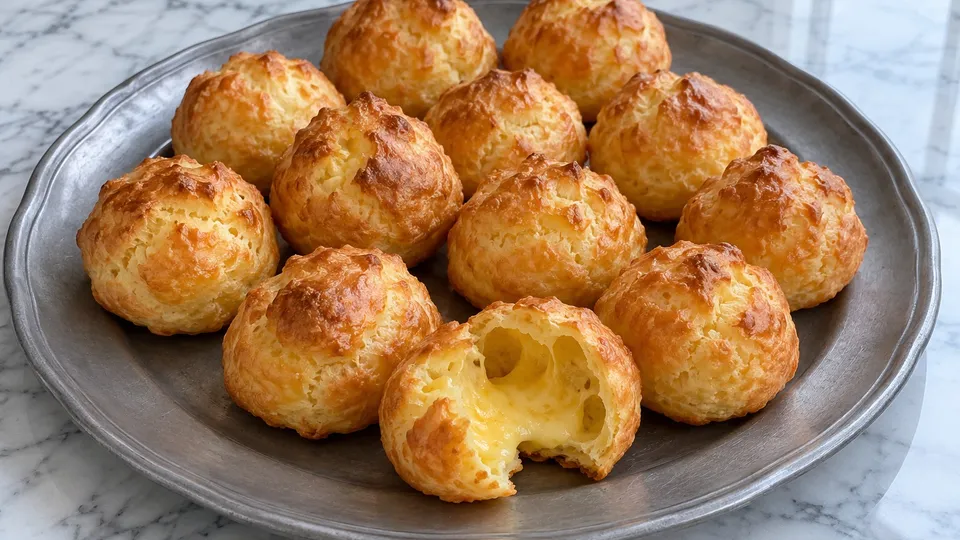 Cook it todayCheese Ramequins (1827)
Sources
- [Alexandre-Balthazar-Laurent Grimod de la Reynière], Almanach des gourmands, servant de guide dans les moyens de faire excellente chère, second year, second edition (Paris: Maradan, Year XIII, 1805), frontispiece and its explanation; preface pp. xviii–xxii; pp. 30–33 and 254–272. Translations from the French are the site’s own.
- Jean Anthelme Brillat-Savarin, A Handbook of Gastronomy, a translation of Physiologie du goût (1825) (London: J. C. Nimmo and Bain, 1884), Meditation XIII, pp. 222–225 and 228–229; preface by Charles Monselet, pp. 4–5.
- Louis Eustache Ude, The French Cook, ninth edition (London: W. H. Ainsworth, 1827), pp. 452–453 and 467–468.