Cheese Ramequins (1827)
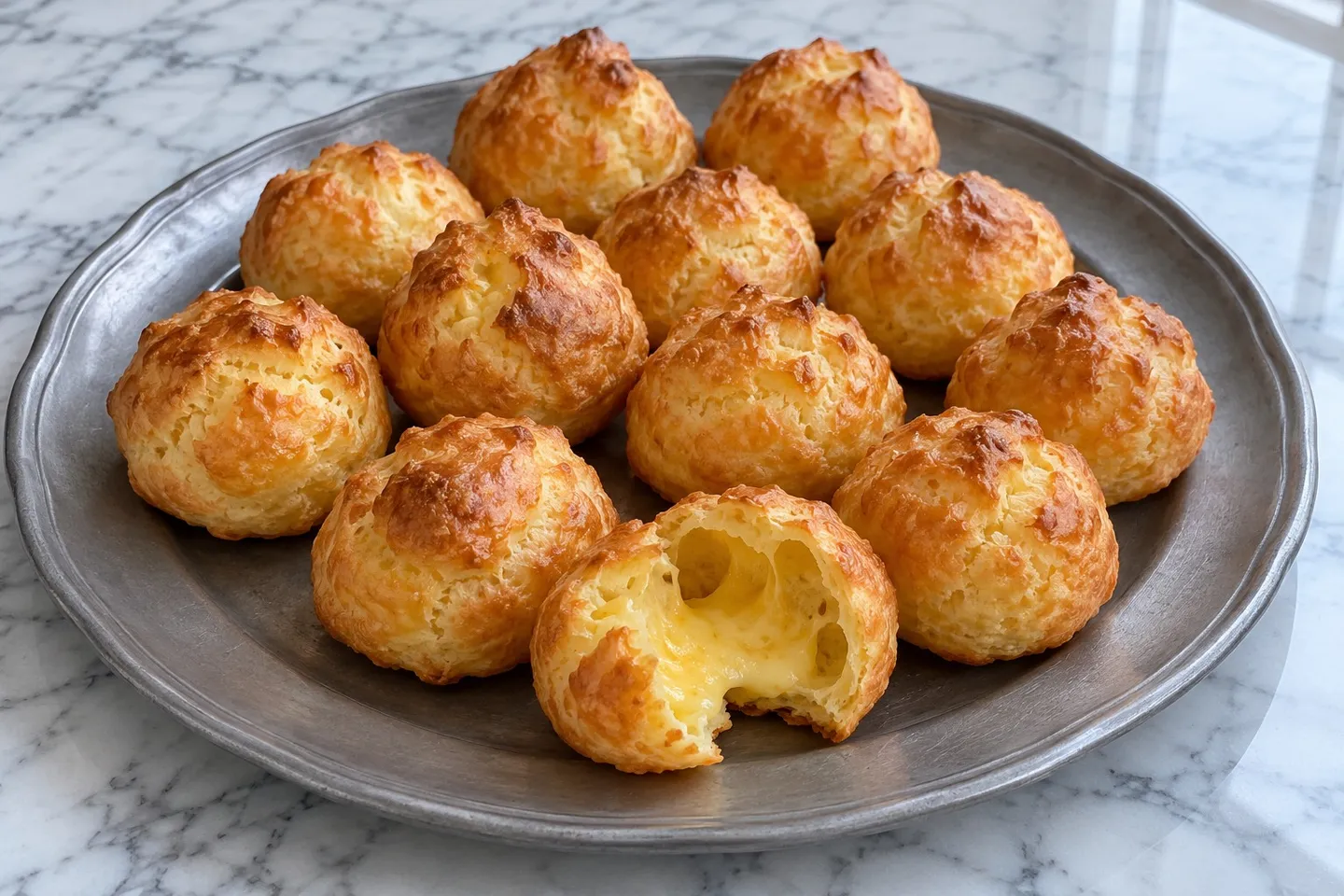
Reader ratingsLouis Eustache Ude’s cheese ramequins: choux paste beaten with eggs, a spoonful of Parmesan and diced Swiss cheese, dropped in small mounds and baked until puffed.
- Recipe makes
- About 30 small puffs, 10 servings
- Prep
- Cook
- Total
Bake them so they come out as you sit down. Like Rouget’s, they are best straight from the oven; let them stand a few minutes on the sheet so they hold their shape.
Small golden cheese puffs on a pewter plate, one broken open.
The story behind the recipe
A ramequin, in the Paris of 1803, was a small cheese pastry baked in a timbale, and Grimod de la Reynière’s Almanach des gourmands says the town’s pastry cooks thought any other shape “a sort of heresy in pastry.” Then M. Rouget the younger made a Burgundy ramequin “more than three feet round” for a gourmand back from Burgundy, who gathered a jury of his own to taste it, and buyers flocked to Rouget’s. Louis Eustache Ude’s ramequins are the small, everyday kind: puffed balls of cheese choux paste, baked free on a sheet.
What was a ramequin?
A cheese pastry for the entremets, the course of side dishes that came with the roast. The Almanach never says what went into Rouget’s; it only praises it to anyone who loves cheese, which, it adds, means every gourmand. Ude, who styled himself on his title page “ci-devant cook to Louis XVI. and the Earl of Sefton,” gives two ramequins in The French Cook. One is puff paste folded with Parmesan and cut into rounds, named for Sefton. The other, his “common” ramequin, is choux paste, the paste of cream puffs, made with water, butter and flour, beaten with eggs until it holds its shape, then mixed with a spoonful of Parmesan and a quarter pound of Swiss cheese in small dice. He dresses them “as you do the petits choux,” in small balls an inch apart, and bakes them in a moderate oven.
The copy used here is the ninth edition of 1827, more than twenty years after the Almanach; Ude’s book first appeared in 1813. Ude was also strict about the eggs: break them one at a time “and smell them, to see if they are sweet.”
Read more about this recipe
Making it today
Ude’s one warning matters most: “do not open the oven till they are nearly done, for that will make them fall, and they never rise after.” The diced cheese melts into pockets inside each puff. Gruyère or Emmental stands in for his “Swiss cheese,” and a moderate 375°F (190°C) oven for his. How Rouget’s giant ramequin fared before its jury is told in What Did Grimod’s Tasting Jury Judge in 1805? Put them in the oven as the Potage à la Camerani (1805) goes to the table, and they will follow it hot.
Put into a small stew-pan a large glass of water, a quarter of a pound of fresh butter, and a little salt; let this boil; when the butter is melted, put to it two or three spoonsful of fine dry sifted flour; stir with a wooden spoon till the paste does not stick to the stew-pan, then take it off the fire: break some eggs one after the other, and smell them, to see if they are sweet; mix them with the paste, and continue adding till you see the paste has acquired a good consistence; then put in a spoonful of rasped Parmesan cheese, and a quarter of a pound of Swiss cheese cut into small dice; mix the whole gently to avoid breaking the cheese, and dress the ramequins as you do the petits choux; doré as usual, and bake them in a moderate oven, but do not open the oven till they are nearly done, for that will make them fall, and they never rise after.
Recipe makes: About 30 small puffs, 10 servings
Ingredients
For about 30 small puffs, 10 servings. Quantities are shown as written.
Quantities as written here, for about 30 small puffs, 10 servings.
- Water1 cup
- Unsalted butter, cut in pieces8 tbsp
- Salt1/2 tsp
- All-purpose flour, sifted1 cup
- Large eggs4
- Large egg for the paste, if needed1
- Finely grated Parmesan1/4 cup
- Gruyère or Emmental, in 1/4-inch dice1 cup
- Large egg for brushing1
- Milk for brushing1 tbsp
Measurement notes
Ingredients as written here
- 1 cup water
- 8 tbsp unsalted butter, cut in pieces
- 1/2 tsp salt
- 1 cup all-purpose flour, sifted
- 4 large eggs
- 1 large egg for the paste, if needed
- 1/4 cup finely grated Parmesan
- 1 cup Gruyère or Emmental, in 1/4-inch dice
- 1 large egg for brushing
- 1 tbsp milk for brushing
Equipment
 Medium saucepan
 Wooden spoon
- Two baking sheets lined with parchment
- A pair of teaspoons or a piping bag
- Pastry brush
Instructions
Heat the oven to 375°F (190°C), with racks in the upper and lower thirds. Line the baking sheets with parchment.
Put the water, butter and salt in the saucepan over medium heat. When the butter has melted and the water comes to a full boil, take the pan off the heat and tip in all the flour at once.
Stir hard with the wooden spoon until the flour has disappeared, then set the pan back over medium heat and keep stirring for 2 to 3 minutes, until the paste comes away from the sides in one smooth ball and leaves a thin film on the bottom of the pan.
Take the pan off the heat and let the paste cool for 5 minutes, stirring now and then to let out the steam.
Break the eggs into a cup one at a time and beat them into the paste one by one, beating until each has disappeared before adding the next. When all the eggs are in, lift the spoon: the paste is ready when it falls off in a thick ribbon that leaves a V-shaped tip on the spoon. If it is too stiff to do that, beat the egg for the paste in a cup and add it a little at a time until it does.
Stir in the Parmesan, then fold in the Gruyère gently, so the dice stay whole.
With a pair of teaspoons, or a piping bag with a plain wide tip, drop the paste onto the baking sheets in mounds about 1¼ inches across, about 1½ inches apart.
Beat the egg for brushing with the milk and brush it lightly over the tops, without letting it run down onto the paper.
Bake for 25 to 30 minutes, switching the sheets between the racks only after the first 20 minutes, until the puffs are well risen, deep golden brown and firm and light when you lift one.
Let them stand on the sheet for 2 or 3 minutes, then serve hot.
Nutrition
225calories per serving
- Recipe makes
- About 30 small puffs, 10 servings
- Servings
- 10
Estimated per serving (3 puffs, 10 servings) from USDA FoodData Central values for butter, flour, eggs, Parmesan and Gruyère.
Recipe notes
When adjusting quantities
Ude’s own quantities, about a large glass of water to a quarter pound of butter and a quarter pound of Swiss cheese. Double them for a crowd, but beat the eggs into each batch of paste separately.
Notes
Quantities mentioned in these notes don’t change when you adjust the servings.
Ude gives “a large glass” of water and “two or three spoonsful” of flour; we read the glass as a cup and set the flour at the cup that a cup of water and a quarter pound of butter need to make a choux paste that holds its shape. We chose the salt amount, the 375°F (190°C) oven, the bake of 25 to 30 minutes and the size of the mounds; Ude says only “a moderate oven,” and modern recipes for gougères, the Burgundian cheese puffs, bake them at 350°F to 400°F (175°C to 200°C) for 20 to 35 minutes. His Parmesan is “a spoonful,” which we read as a quarter cup. Gruyère or Emmental stands in for his Swiss cheese. His doré is a beaten whole egg; the milk in it comes from his petits choux on p. 467. The two sheets and the switch between racks are our additions. Contains wheat, eggs and milk.
Scaling changes the ingredients only; pan sizes and cooking times need their own judgment. To adapt this recipe further, try the recipe tool at TuneMyRecipe (opens in a new tab), our sister site.
Sources and attribution
After Louis Eustache Ude, The French Cook, ninth edition (London, 1827), Common Ramequins
See the original pages (scan at Internet Archive) (opens in a new tab)
Recipe details
- Course
- StarterBread & baking
- Dish family
- Breads & Cakes
- Region
- French
- Era
- 19th century
- Main ingredient
- Eggs
- Difficulty
- Intermediate
- Occasion
- Dinner party