Chestnut Soufflé Omelette (1805)
Reader ratingsGrimod’s chestnut soufflé omelette, 1805: a sweet cream of chestnut flour, egg yolks, milk, butter and sugar, cooked thick, folded into beaten whites and baked until risen.
- Recipe makes
- One 1-liter gratin dish, 4 servings
- Prep
- Cook
- Total
Make the chestnut cream up to an hour ahead and keep it covered. Whip the whites and bake only when everyone is at the table: it falls within minutes of leaving the oven.
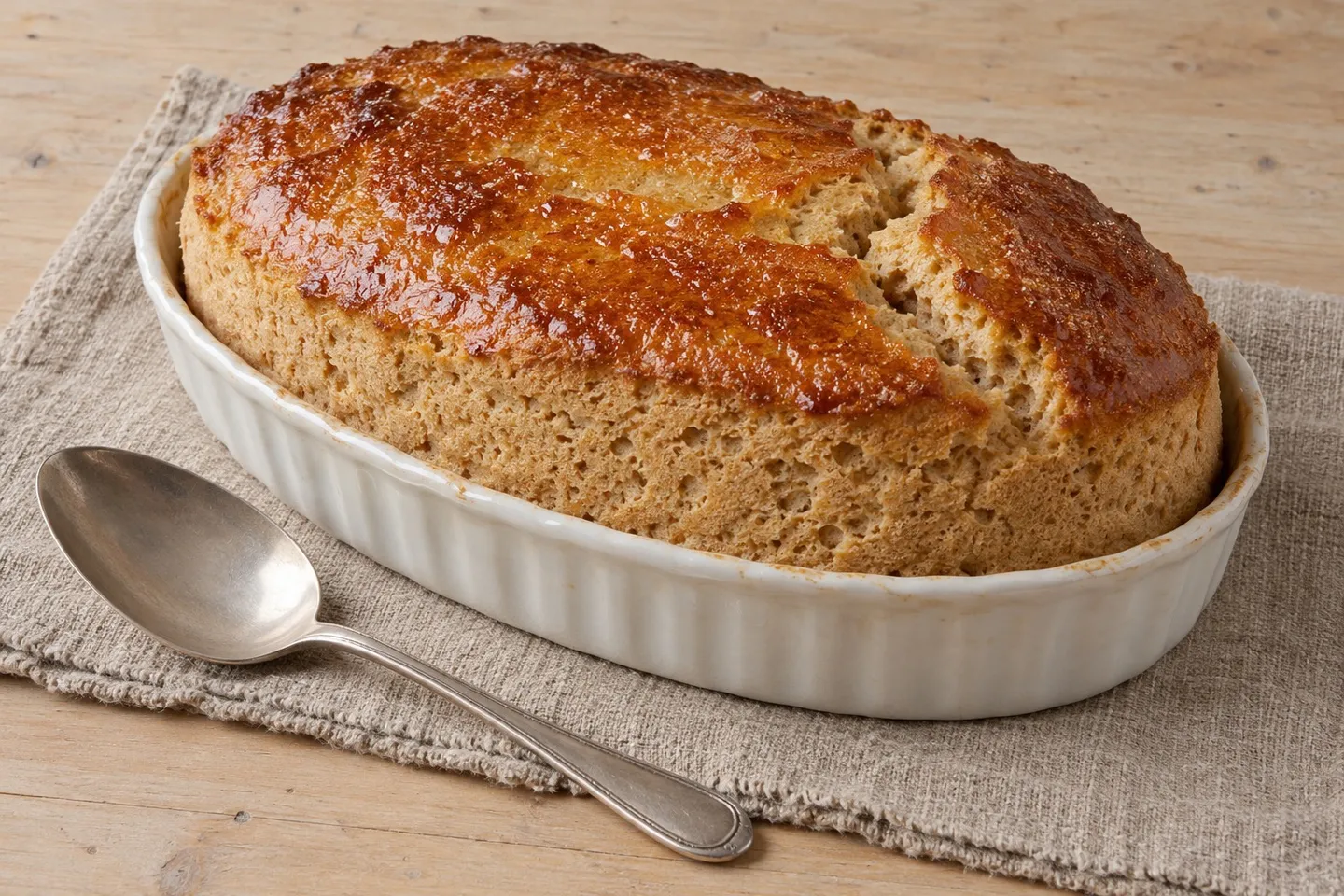
A chestnut soufflé omelette risen in a shallow gratin dish, with a sugar-glazed top.
The story behind the recipe
The Almanach des gourmands printed this recipe to sell a flour. In 1803, it says, M. Ragondet of the rue de Jouy in the Marais had succeeded where others had failed, drying the meal of Lyon chestnuts so that it kept a year or more and lost nothing of the chestnut’s taste. It could go into soups, cakes, biscuits and ices, but the best use the Almanach knew for it among the entremets was “a kind of soufflé omelette,” and gave the method step by step: two ounces of the flour, two yolks, about a demi-setier of cream, milk “or even simply river water,” butter and sugar the size of an egg each, cooked until it coats the spoon, then lightened with three whites beaten to snow.
Why chestnut flour?
Because it was new, and the Almanach’s business was the new. Its list of “gourmand discoveries” of 1803 puts this flour between a Champagne mustard and a cheese ramequin. Ragondet kept no outlet in Paris beyond his works in the Marais, and sold it there at five francs a pound, about €23 today as a rough guide (a franc of 1805 read at INSEE’s franc–euro converter for its earliest year, 1901), a price the Almanach admitted “will no doubt seem a little dear.” It had also won the support of the senator François de Neufchâteau. A similar omelette could be made with potato starch, the recipe adds, but chestnut flour “has a far more distinguished taste”; it is less light, though “very easy to digest” made this way. How the Almanach’s jury judged such samples is the story of What Did Grimod’s Tasting Jury Judge in 1805?
Read more about this recipe
Making it today
Chestnut flour is sold today in Italian and health-food shops, often as farina di castagne. Ragondet’s, the Almanach says, kept “all the taste of the chestnut.” The Almanach baked the dish under a four de campagne, a lidded pan with coals heaped on top, over a fire that had lost its first heat, and served it as soon as it had risen four inches. A hot oven does the same job, and our dish is shallow and wide so it cooks through quickly. Set the Almanach’s Potage à la Camerani (1805) before it as the savory course.
Vous mettez dans une casserole deux onces de farine de Marrons de Lyon, et vous y ajoutez deux jaunes d’œufs bien frais.
Vous délayez le tout avec environ un demi-septier de crême, de lait, ou même simplement d’eau de rivière.
Lorsque cette opération est terminée, que ce mélange est bien fait, et n’offre plus aucun grumeau, vous y ajoutez gros comme un œuf d’excellent beurre, et pareille quantité de sucre en poudre.
Vous mettez incontinent votre casserole sur le feu, en agitant sans cesse ce qu’elle contient.
Lorsque la crême est prise (et elle doit être alors assez épaisse pour s’attacher à la cuillère), vous lui laissez faire quelques bouillons, et la descendez du feu.
Alors vous ajoutez un troisième blanc d’œuf aux deux que vous avez précédemment mis à part. Vous les fouettez en neige jusqu’à ce qu’elle ait acquis une consistance bien serrée.
Vous amalgamez ces blancs ainsi fouettés avec votre crême, en remuant bien également et bien légèrement.
Vous versez le tout dans un plat un peu creux, en le saupoudrant de sucre fin et passé au tamis de soie.
Vous mettez ensuite ce plat sur un fourneau chaud, mais dont le charbon ait perdu sa grande ardeur.
Vous faites chauffer votre four de campagne, que vous mettez sur le plat, et en moins de quinze minutes cette crême est levée comme une omelette soufflée. Dès que l’élévation est de quatre pouces, il faut la servir.
Si votre four de campagne n’a pas suffi pour donner à votre crême une belle couleur, vous la glacez avec la pelle rouge.
Recipe makes: One 1-liter gratin dish, 4 servings
Ingredients
For One 1-liter gratin dish, 4 servings. Quantities are shown as written.
Quantities as written here, for One 1-liter gratin dish, 4 servings.
- Chestnut flour60 g
- Large eggs, separated2
- Whole milk240 ml
- Butter for the cream50 g
- Sugar50 g
- Large egg white1
- Butter for the dish10 g
- Superfine sugar for dusting2 tbsp
Measurement notes
Ingredients as written here
- 60 g chestnut flour
- 2 large eggs, separated
- 240 ml whole milk
- 50 g butter for the cream
- 50 g sugar
- 1 large egg white
- 10 g butter for the dish
- 2 tbsp superfine sugar for dusting
Equipment
 Small heavy saucepan
 Whisk
- Mixing bowl and electric mixer, or a large whisk
- Shallow gratin or pie dish of about 1 liter, 23 cm across
 Fine sieve
Instructions
Heat the oven to 400°F (200°C), with a rack in the lower third. Rub the gratin dish with the butter for the dish.
Put the chestnut flour in the saucepan with the egg yolks, keeping their whites in a clean mixing bowl. Whisk in a little of the milk to make a smooth paste, then whisk in the rest until there are no lumps.
Add the butter for the cream and the sugar and set the pan over medium-low heat. Whisk all the time as the butter melts and the cream warms.
When the cream thickens enough to coat the back of a spoon, let it bubble two or three times, still whisking, then take it off the heat. Let it cool for 10 minutes, whisking now and then.
Add the extra egg white to the whites in the bowl and beat them to firm, glossy peaks that stand up straight.
Stir about a quarter of the whites into the chestnut cream to loosen it, then fold in the rest lightly and evenly, until no white streaks remain.
Spread it into the buttered dish, mounding it a little in the middle. Sift the superfine sugar over the top.
Bake for 15 to 18 minutes, without opening the oven for the first 12, until it is well risen and golden brown, it barely wobbles when you nudge the dish, and the center reads 160°F (71°C).
Serve at once, spooning some of the soft middle and some of the browned top onto each plate.
Nutrition
300calories per serving
- Recipe makes
- One 1-liter gratin dish, 4 servings
- Servings
- 4
Estimated per serving (4) from USDA FoodData Central values for chestnut flour, eggs, whole milk, butter and sugar.
Recipe notes
When adjusting quantities
The Almanach’s own quantities: two ounces of chestnut flour to two yolks, three whites and about a demi-setier of milk. Double them in a dish of about 2 liters and add 5 minutes to the bake.
Notes
Quantities mentioned in these notes don’t change when you adjust the servings.
The Almanach’s ounce was the Paris ounce of about 31 grams, so its two ounces are about 60 g. Its demi-setier was about a quarter of a Paris pint, a little under 240 ml; it allows cream, milk or water, and we use milk. Butter and sugar “the size of an egg” are read as 50 g each. The Almanach separates two eggs without saying so: the yolks go in first, and the third white is added later “to the two you have set aside.” The Almanach adds that the cream rises just as well in a stove oven; we chose the 400°F (200°C) setting, the time and the 1-liter dish; modern soufflé omelettes bake at 350°F to 400°F (175°C to 200°C), or finish under a hot broiler, in 10 to 20 minutes. We also added the 10-minute rest before the whites go in, and loosening the cream with a quarter of the whites. The Almanach browns a pale top with a red-hot shovel; a hot broiler can stand in for it, watched closely. The eggs are only lightly cooked in the middle: bake until the center reaches 160°F (71°C), as USDA advises for egg dishes, or use pasteurized eggs. Contains eggs and milk; chestnut flour has no gluten, but check the packet if that matters.
Scaling changes the ingredients only; pan sizes and cooking times need their own judgment. To adapt this recipe further, try the recipe tool at TuneMyRecipe (opens in a new tab), our sister site.

Sources and attribution
After the Almanach des gourmands, second year (Paris, 1805), Farine de Marrons de Lyon
See the original pages (scan at Internet Archive) (opens in a new tab)
Recipe details
- Course
- Dessert
- Dish family
- Desserts & Sweets
- Region
- French
- Era
- 19th century
- Main ingredient
- Eggs
- Difficulty
- Easy
- Occasion
- Dinner party
- Season
- Autumn