Plain Omelet with White Sauce (1896)
Reader ratingsPlain omelet the 1896 way: Fannie Farmer’s puffed omelet of separately beaten eggs, browned slowly, finished in the oven and folded onto a thin white sauce.
- Recipe makes
- One 4-egg omelet, 4 servings
- Prep
- Cook
- Total
Make the sauce first and keep it warm; the omelet takes about 5 minutes on the stove and 8 to 10 in the oven, and should go to the table as soon as it is folded.
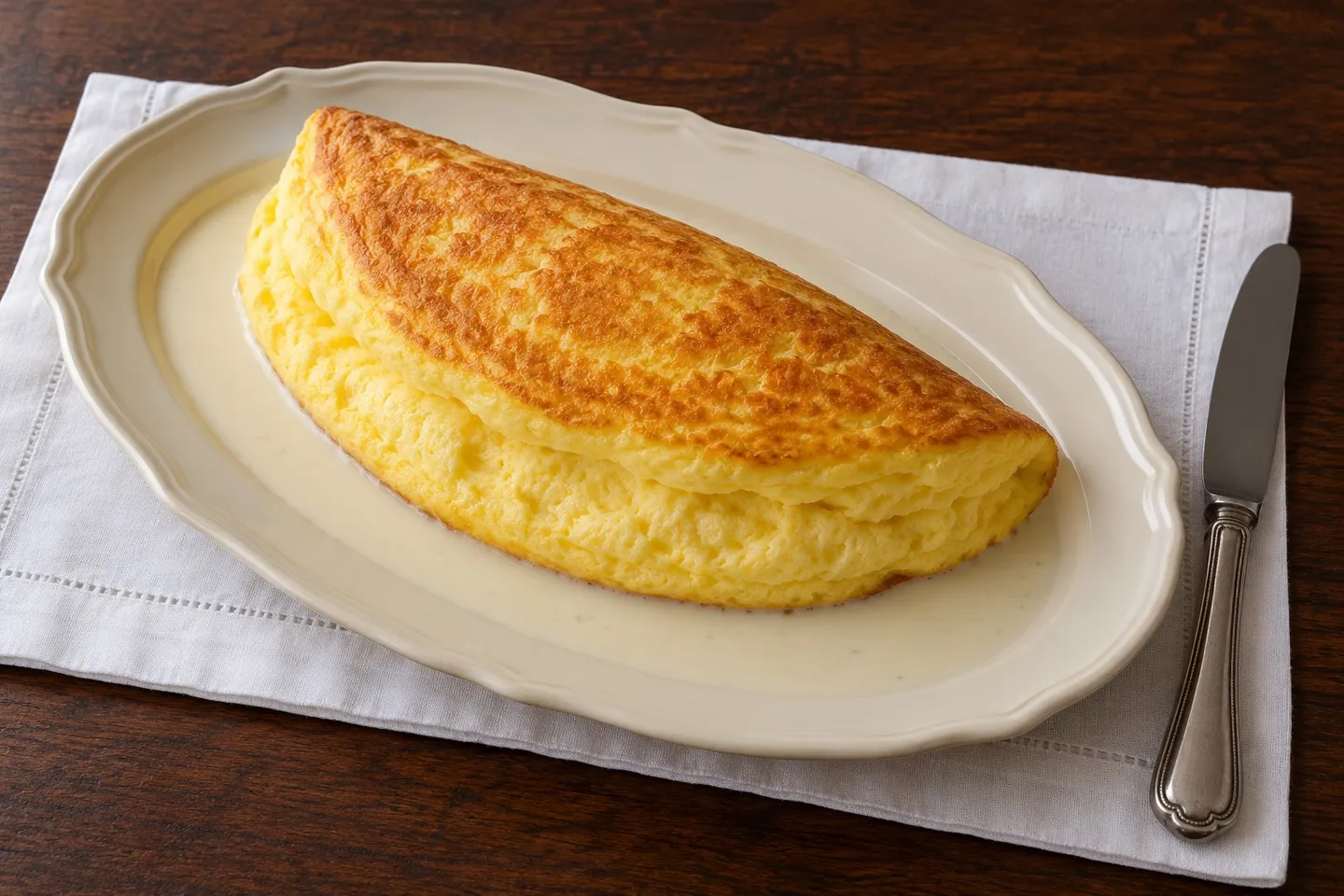
A puffed plain omelet folded on a platter, with thin white sauce poured around it.
The story behind the recipe
Fannie Farmer’s plain omelet is a puffed one. The yolks and whites are beaten apart and folded together, the omelet browns slowly in the pan and finishes in the oven, and it goes to the table folded on a hot platter with a cup and a half of thin white sauce poured around it. On the Waldorf’s breakfast card for April 22, 1896, a “Plain” omelette cost 30 cents, against 40 with tomatoes and 50 with ham or bacon. The card says nothing about how the hotel’s cooks made theirs; this recipe comes from Farmer’s Boston Cooking-School Cook Book, published in Boston the same year.
How much is a few grains of pepper?
Farmer answers that on her page about measuring: “Less than one-eighth of a teaspoonful is considered a few grains.” Her omelet is just as exact elsewhere. She allows “one egg for each person, and one tablespoon liquid for each egg,” and she prefers hot water to milk for the liquid: “Milk is sometimes used in place of hot water, but hot water makes a more tender omelet.” She keeps a pan for omelets only, smooth and clean, and explains how to fold the finished omelet with a case knife so that it turns “without breaking.”
Her test for doneness is a fingertip. The omelet is cooked “if it is firm to the touch when pressed by the finger,” and if it “clings to the finger like the beaten white of egg, it needs longer cooking.”
Read more about this recipe
Making it today
The oven Farmer finishes it in has no temperature in her book, so we use 350°F (180°C), the setting modern puffy-omelet recipes use, and a 10-inch ovenproof skillet for her omelet pan. Her finger test stays, with a thermometer beside it: US food-safety guidance puts egg dishes at 160°F (71°C). The sauce is her thin white sauce made half again as large, which gives about the cup and a half she pours around four eggs.
The omelet was one of the hot dishes on that morning’s card, and What Did People Eat for Breakfast in the 1890s? reads the card’s other choices, from fruit to potatoes. Paris had a sweet cousin ninety years earlier, the Almanach des gourmands’ Chestnut Soufflé Omelette (1805), lightened the same way with whites beaten to snow. For a breakfast from the same card, serve this one with Milk Toast (1896).
Omelets. For omelets select large eggs, allowing one egg for each person, and one tablespoon liquid for each egg. Keep an omelet pan especially for omelets, and see that it is kept clean and smooth. A frying-pan may be used in place of omelet pan.
Plain Omelet.
4 eggs. ½ teaspoon salt. Few grains pepper. 4 tablespoons hot water. 1 tablespoon butter. 1½ cups Thin White Sauce.
Separate yolks from whites. Beat yolks until thick and lemon colored; add salt, pepper, and hot water. Beat whites until stiff and dry, cutting and folding them into first mixture until they have taken up mixture. Heat omelet pan, and butter sides and bottom. Turn in mixture, spread evenly, place on range where it will cook slowly, occasionally turning the pan that omelet may brown evenly. When well “puffed” and delicately browned underneath, place pan on centre grate of oven to finish cooking the top. The omelet is cooked if it is firm to the touch when pressed by the finger. If it clings to the finger like the beaten white of egg, it needs longer cooking. Fold and turn on hot platter, and pour around one and one-half cups Thin White Sauce.
Milk is sometimes used in place of hot water, but hot water makes a more tender omelet.
To Fold and Turn an Omelet. Hold omelet pan by handle with the left hand. With a case knife make two one-half inch incisions opposite each other at right angles to handle. Place knife under the part of omelet nearest handle, tip pan to nearly a vertical position; by carefully coaxing the omelet with knife, it will fold and turn without breaking.
Thin White Sauce.
2 tablespoons butter. 1½ tablespoons flour. 1 cup scalded milk. ¼ teaspoon salt. Few grains pepper.
Put butter in saucepan, stir until melted and bubbling; add flour mixed with seasonings, and stir until thoroughly blended. Pour on gradually the milk, adding about one-third at a time, stirring until well mixed, then beating until smooth and glossy. If a wire whisk is used, all the milk may be added at once; and although more quickly made if milk is scalded, it is not necessary.
Recipe makes: One 4-egg omelet, 4 servings
Ingredients
For One 4-egg omelet, 4 servings. Quantities are shown as written.
Quantities as written here, for One 4-egg omelet, 4 servings.
Thin white sauce
- Whole milk1 1/2 cups
- Butter for the sauce3 tbsp
- All-purpose flour2 1/4 tbsp
- Salt for the sauce1/4 tsp
- Pepper for the sauce1 pinch
Omelet
- Large eggs4
- Salt for the eggs1/2 tsp
- Pepper for the eggs1 pinch
- Hot water1/4 cup
- Butter for the pan1 tbsp
Measurement notes
Ingredients as written here
- 1½ cups whole milk
- 3 tbsp butter for the sauce
- 2¼ tbsp all-purpose flour
- ¼ tsp salt for the sauce
- 1 pinch pepper for the sauce
- 4 large eggs
- ½ tsp salt for the eggs
- 1 pinch pepper for the eggs
- ¼ cup hot water
- 1 tbsp butter for the pan
Equipment
- Small saucepan and a second pan for the milk
 Whisk
- Two mixing bowls and an electric or rotary beater
- 10-inch ovenproof skillet
- Table knife or thin spatula
- Warm serving platter
 Instant-read thermometer
Instructions
Heat the oven to 350°F (180°C) and put the serving platter in a warm place.
For the sauce, heat the whole milk until it steams. In the small saucepan, melt the butter for the sauce until it bubbles. Mix the all-purpose flour with the salt for the sauce and the pepper for the sauce, and stir it into the butter until blended.
Pour in the hot milk a third at a time, stirring until smooth after each addition, then beat until the sauce is smooth and glossy. Let it bubble gently for 2 minutes, stirring, and keep it warm over the lowest heat.
Separate the eggs, putting the whites in a clean, dry bowl. Beat the yolks until thick and lemon colored, then beat in the salt for the eggs, the pepper for the eggs and the hot water.
Beat the whites until stiff and dry. Cut and fold them into the yolk mixture until no streaks of white remain.
Heat the skillet over medium-low heat and coat the bottom and sides with the butter for the pan.
Turn in the egg mixture and spread it evenly. Cook slowly for about 5 minutes, turning the pan now and then so it browns evenly, until well puffed and delicately browned underneath.
Set the pan on the middle rack of the oven and bake for 8 to 10 minutes, until the top is firm when pressed lightly with a fingertip, doesn’t cling, and the center reads 160°F (71°C).
With the knife, make two ½-inch cuts in the edge of the omelet, opposite each other and at right angles to the handle. Slide the knife under the half nearest the handle, tip the pan and coax the omelet to fold over onto the warm platter.
Pour the sauce around the omelet and serve at once.
Nutrition
245calories per serving
- Recipe makes
- One 4-egg omelet, 4 servings
- Servings
- 4
Estimated per serving (4) from USDA FoodData Central (SR Legacy) values for whole eggs, butter, all-purpose flour and whole milk, counting all the sauce as eaten.
Recipe notes
When adjusting quantities
One omelet of four eggs, Farmer’s own size. For more people make a second omelet; a larger one is hard to fold.
Notes
Quantities mentioned in these notes don’t change when you adjust the servings.
The eggs, salt, water and pan butter are Farmer’s amounts. The 350°F (180°C) oven, the 10-inch skillet, the times and the 2-minute simmer for the sauce are our choices. Her thin white sauce is made at one and a half times her printed recipe, with ¼ teaspoon of salt where strict arithmetic would give a little more. A frying pan with an ovenproof handle does the work of her omelet pan, as she allows. Milk in place of the hot water gives a firmer omelet, by her account. Serve it as soon as it is folded, as Farmer’s hot platter suggests.
Scaling changes the ingredients only; pan sizes and cooking times need their own judgment. To adapt this recipe further, try the recipe tool at TuneMyRecipe (opens in a new tab), our sister site.

Sources and attribution
After Fannie Merritt Farmer, The Boston Cooking-School Cook Book (Boston, 1896), Plain Omelet and Thin White Sauce
Recipe details
- Course
- Main courseBreakfast
- Region
- American
- Era
- 19th century
- Source decade
- 1890s
- Main ingredient
- Eggs
- Difficulty
- Intermediate