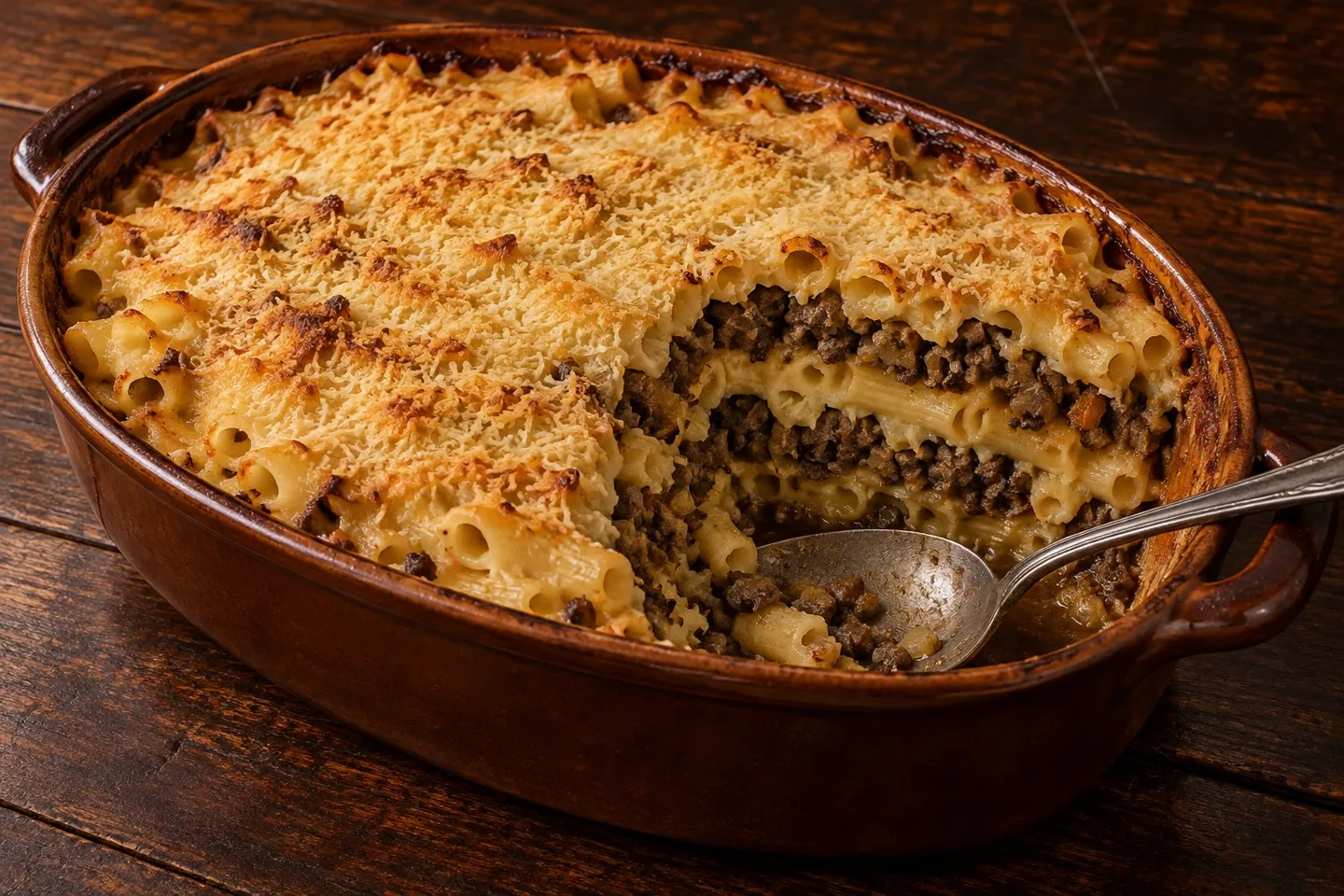
Potage à la Camerani (1805)
Reader ratingsPotage à la Camerani, 1805: macaroni, chopped chicken livers cooked in butter with celery and pot vegetables, and grated Parmesan, layered in the dish and simmered.
- Recipe makes
- One 2-liter dish, 6 servings
- Prep
- Cook
- Total
Chop and cook the livers while the pasta water heats. The layered dish bakes covered for 20 minutes and uncovered for 10, then rests for 5 before serving.
Macaroni layered with chopped chicken livers, vegetables and Parmesan in an earthenware dish.
The story behind the recipe
Grimod de la Reynière printed this soup in 1805 as a favor to his readers, who had begged him for it, and as a compliment to its inventor, M. Camerani of the Opéra-Comique, to whom that volume of the Almanach des gourmands is dedicated. It is a soup only by name: Naples macaroni, chopped chicken livers and grated Parmesan, laid in the tureen in rows like the courses of a wall and left to simmer “over a gentle fire.” Camerani, the Almanach says, “often treats his friends to it.” It was “a delicious dish, and the cause of a very great number of indigestions.”
What was in Camerani’s soup?
Nearly everything in it came from a named shop. The Almanach sends the reader for macaroni and Parmesan to La Truie qui file or M. Corazza, for butter from Gournay or Isigny to M. Theurlot at the market, and for “about two dozen” fattened chicken livers “of a reasonable size” to M. Corcellet, M. Chevet or the poultry market. Celery and pot vegetables (cabbage, carrots, parsnips, turnips, leeks) are chopped fine with the livers and cooked together in butter. Corcellet is also one of the tradesmen the Almanach’s preface gives as an example of a sender of samples, so the soup reads like a shopping list from the jury’s own world. It was dear, and getting dearer: the Almanach reckoned it cost half as much again as two years before, its ingredients having nearly doubled in price, and blamed a monopoly on everything people ate. The parcels such shops sent, and the jury that sat over them, are the subject of What Did Grimod’s Tasting Jury Judge in 1805?
Read more about this recipe
Making it today
The Almanach gives no amounts, so ours are scaled to a family dish with about a dozen livers. The one real choice is the liquid. The recipe names none, yet it asks for the layers to mitonner, to simmer gently, which needs some; we pour a little chicken broth down the side of the dish so the macaroni simmers as it bakes. A modern oven stands in for the gentle fire under the tureen. For a next course, the Cheese Ramequins (1827) bring a cookbook ramequin to the table beside the Almanach’s story of Rouget’s.
Il faut d’abord se procurer de véritables macaronis de Naples, et d’excellent fromage de Parmesan ... D’excellent beurre de Gournai ou d’Isigny, selon la saison ... Environ deux douzaines de foies de poulets gras, d’une raisonnable grosseur ... Du céleri et de toutes sortes de légumes potagers; tels que choux, carotes, panais, navets, poireaux, etc.
On commence par hacher bien menus les foies de poulets, le céleri et les légumes.
On fait cuire le tout ensemble dans une casserole avec du beurre.
Pendant ce temps on a fait blanchir les macaronis, on les assaisonne de poivre et d’épices fines, et on les laisse bien égoutter.
On prend ensuite la soupière qu’on doit mettre sur table, et qui doit pouvoir aller sur le feu.
On dresse au fond un lit de macaronis;
Par-dessus un lit du hachis précité;
Enfin un lit de fromage de Parmesan râpé.
On recommence ensuite dans le même ordre, et l’on élève les assises de ce bâtiment jusques vers les bords de la soupière.
On la met ensuite sur un feu doux, et on laisse mitonner le tout pendant un temps convenable.
Recipe makes: One 2-liter dish, 6 servings
Ingredients
For One 2-liter dish, 6 servings. Quantities are shown as written.
Quantities as written here, for One 2-liter dish, 6 servings.
- Ziti or other long macaroni250 g
- Salt for the pasta water1 tbsp
- Chicken livers450 g
- Celery100 g
- Carrot80 g
- Parsnip80 g
- Turnip80 g
- Leek, white part80 g
- Green cabbage60 g
- Butter60 g
- Salt for the livers1/2 tsp
- Ground black pepper1/2 tsp
- Quatre épices or ground nutmeg1/4 tsp
- Parmesan, finely grated120 g
- Chicken broth400 ml
Measurement notes
Ingredients as written here
- 250 g ziti or other long macaroni
- 1 tbsp salt for the pasta water
- 450 g chicken livers
- 100 g celery
- 80 g carrot
- 80 g parsnip
- 80 g turnip
- 80 g leek, white part
- 60 g green cabbage
- 60 g butter
- 1/2 tsp salt for the livers
- 1/2 tsp ground black pepper
- 1/4 tsp quatre épices or ground nutmeg
- 120 g Parmesan, finely grated
- 400 ml chicken broth
Equipment
- Large pot for the pasta, and a colander
- Food processor or a large knife and board
- Large frying pan
- Ovenproof dish of about 2 liters, with a lid or foil
 Instant-read thermometer
Instructions
Heat the oven to 375°F (190°C). Bring a large pot of water to a boil with the salt for the pasta water.
Trim the chicken livers of any green spots and stringy bits. Trim and roughly cut the celery, carrot, parsnip, turnip, leek and cabbage.
Chop the livers and vegetables very fine, together, by pulsing them in the food processor or with a large knife. Stop while it still has some texture, like a coarse hash.
Melt the butter in the frying pan over medium heat. Add the hash and the salt for the livers and cook, stirring often, for 10 to 12 minutes, until the vegetables are soft, no pink remains in the liver and it reads 165°F (74°C) on the thermometer.
Meanwhile, boil the ziti for 3 minutes less than the packet says, so it is still firm. Drain well and toss it with the black pepper and quatre épices.
Butter the baking dish with a little of the fat from the pan. Lay a third of the macaroni in the bottom, then a third of the liver hash, then a third of the Parmesan. Repeat twice, ending with Parmesan.
Pour the chicken broth down the side of the dish so it runs in under the layers. Cover with the lid or foil.
Bake for 20 minutes, then uncover and bake for 10 minutes more, until the broth is bubbling at the edges, most of it has been absorbed and the cheese on top is melted and lightly browned.
Let it stand for 5 minutes, then serve from the dish with a large spoon, a little of every layer to each plate.
Nutrition
430calories per serving
- Recipe makes
- One 2-liter dish, 6 servings
- Servings
- 6
Estimated per serving (6) from USDA FoodData Central values for dry pasta, chicken livers, butter, Parmesan, celery and root vegetables; broth not counted.
Recipe notes
When adjusting quantities
The Almanach names about two dozen chicken livers and no other amounts; this dish uses about a dozen livers and fills a 2-liter baking dish. Double it in a 4-liter dish and add 10 minutes to the covered bake.
Notes
Quantities mentioned in these notes don’t change when you adjust the servings.
Beyond the ingredients and the order of the layers, the Almanach leaves everything to the cook, so we set every quantity, starting from about a dozen livers, half the two dozen it names. The chicken broth (see above), the 375°F (190°C) oven, the 30-minute bake and the covered start are also our choices, in line with modern baked pasta dishes of the same size. Ziti stands in for long Naples macaroni; break long pasta in half if you use it. Quatre épices, a French blend of pepper, nutmeg, clove and ginger, stands in for the “épices fines”; nutmeg alone is close. If one of the five pot vegetables is hard to find, use more of the others. Chicken livers must be cooked through, to 165°F (74°C), before they go into the dish. Leftovers keep, covered and chilled within 2 hours, for up to 3 days; reheat until hot through. Contains wheat, milk and celery.
Scaling changes the ingredients only; pan sizes and cooking times need their own judgment. To adapt this recipe further, try the recipe tool at TuneMyRecipe (opens in a new tab), our sister site.
Sources and attribution
After the Almanach des gourmands, second year (Paris, 1805), Potage à la Camerani
See the original pages (scan at Internet Archive) (opens in a new tab)
Recipe details
- Course
- Soup
- Dish family
- Soups & Broths
- Region
- French
- Era
- 19th century
- Main ingredient
- Poultry & game birdsGrains & rice
- Difficulty
- Intermediate
- Occasion
- Dinner party