Baking-Powder Biscuits (1896)
Reader ratingsPlain baking-powder biscuits of flour, salt and a little lard, rolled thick and baked close together, from the War Department’s Manual for Army Cooks, 1896.
- Recipe makes
- About 10 biscuits, 2 inches across
- Prep
- Cook
- Total
Heat the oven before you mix, since the dough goes in as soon as it is cut. The manual bakes them five or six minutes in a quick oven; modern recipes give 10 to 15 minutes at 425°F to 450°F (220°C to 230°C).
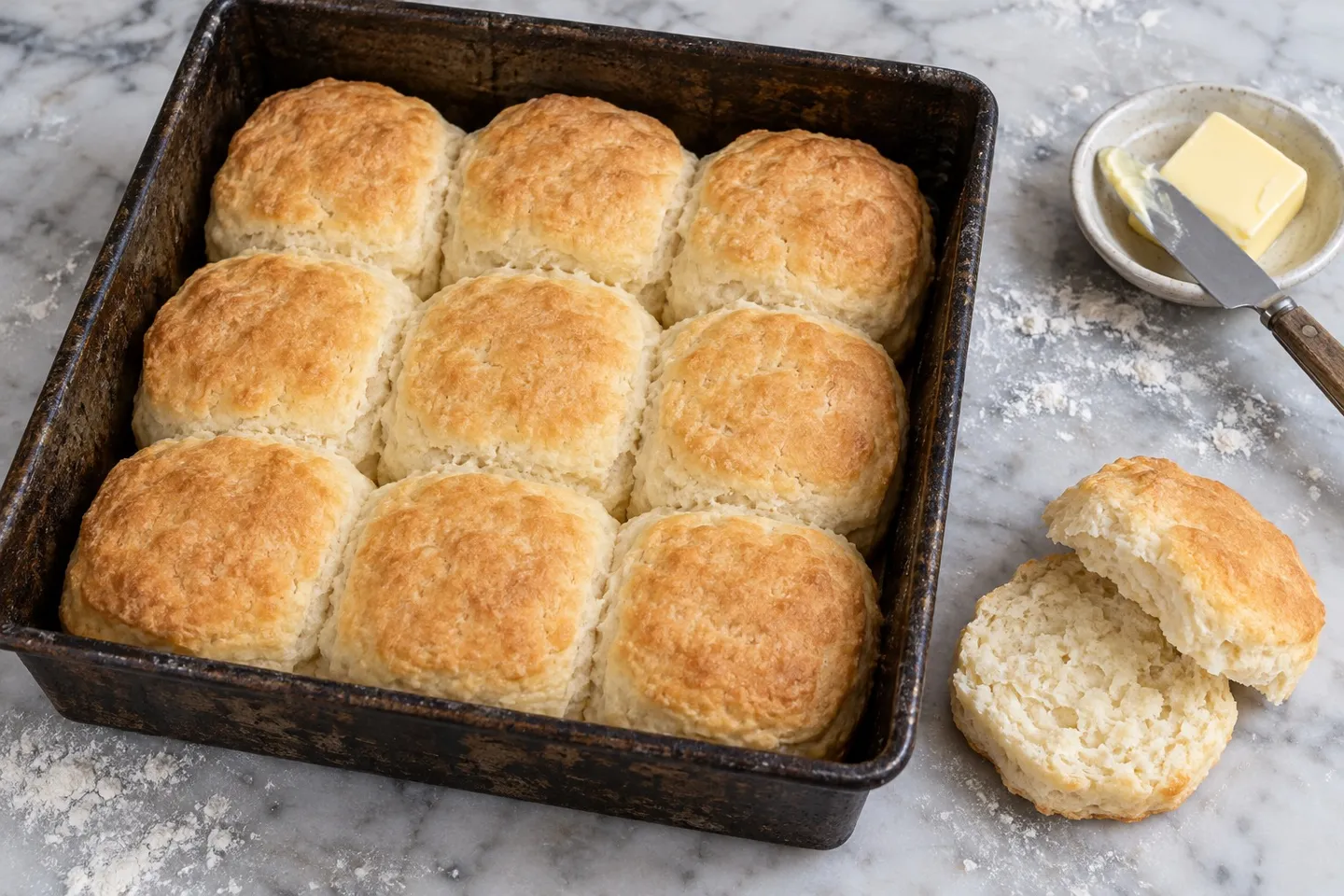
Plain baking-powder biscuits in a baking pan, one split, with butter.
The story behind the recipe
Bread is the vaguest word in Tappan Adney’s note on the hotel meal at Finnegan’s Point in 1897. He writes only “bread and butter,” and the outfitters’ lists show what such bread could rise on. The Klondyke and Yukon Guide from Seattle sent each man north with 400 pounds of flour, 8 pounds of baking powder and 2 of soda, and just six packages of yeast cakes.
Why did soda matter on the Klondike?
Sourdough had to be corrected with it. That Christmas in Dawson, Adney and his partner forgot to “sweeten” eighteen loaves of sourdough bread with soda, and lost the lot. The army taught the same fix for any dough left too long: “If the dough has stood so long as to sour, dissolve a level teaspoonful of soda in sufficient warm water,” knead it in and bake at once. Baking powder came with the soda and its acid already measured together. The War Department’s Manual for Army Cooks of 1896 even prints a home formula, eight ounces of bicarbonate of soda to four of cream of tartar and four of cornstarch, and warns in a footnote that “one teaspoonful of some powders is as strong as two teaspoonfuls of others.”
Read more about this recipe
Making it today
Adney does not say what kind of bread the hotel served, so this recipe takes the 1896 manual’s quick bread. Its biscuits are lean, a tablespoon of fat to two quarts of flour, where modern biscuit recipes often use that much for every half cup of flour, and they bake crowded together in the pan, sides touching. Milk is the manual’s own preference over water. The oven is our choice: the manual’s “quick oven” becomes 450°F (230°C), the heat modern lard-biscuit recipes use, and the baking time grows to match. The manual allows an empty can in place of a biscuit cutter. Split and butter them to go with the Baked Pork and Beans (1896), the dish that heads the meal in What Did Klondike Stampeders Eat on the Trail?.
2 quarts sifted flour. 1 large teaspoonful salt. 4 large teaspoonfuls baking powder. 1 tablespoonful dripping or lard. Cold water (sweet milk is preferable) enough to make a soft dough.
Put flour into a deep dish; mix into this the baking powder and salt; then rub in the dripping or lard. Put in enough cold water or milk to make a soft dough. Handle as little as possible. Roll quickly into a sheet three-quarters of an inch thick. Cut into circular cakes, with a floured biscuit cutter, or an empty can; roll the dough that is left into a sheet, and recut. Lay the biscuits thus cut into a well-greased baking pan close together and bake five or six minutes in a quick oven until they are browned.
In using baking powder the directions printed on the packages should be strictly followed, as one teaspoonful of some powders is as strong as two teaspoonfuls of others.
Recipe makes: About 10 biscuits, 2 inches across
Ingredients
For about 10 biscuits, 2 inches across. Quantities are shown as written.
Quantities as written here, for about 10 biscuits, 2 inches across.
- All-purpose flour, plus more for rolling2 cups
- Baking powder1 tbsp
- Salt1/2 tsp
- Lard or beef dripping1 tsp
- Cold milk3/4 cup
- Lard, for greasing the pan
- Butter, to serve
Measurement notes
Ingredients as written here
- 2 cups all-purpose flour, plus more for rolling
- 1 tbsp baking powder
- ½ tsp salt
- 1 tsp lard or beef dripping
- ¾ cup cold milk
- Lard, for greasing the pan
- Butter, to serve
Equipment
 Sieve
- Mixing bowl
- Rolling pin
- 2-inch biscuit cutter, or a clean can of that size
- 8-inch square baking pan or small baking sheet
 Instant-read thermometer
Instructions
Heat the oven to 450°F (230°C) and grease the baking pan with lard for greasing.
Sift the flour, baking powder and salt together into the mixing bowl.
Rub the lard or beef dripping into the flour with your fingertips until no lumps remain.
Stir in the cold milk a little at a time, using just enough to make a soft dough that holds together. Handle it as little as possible.
Turn the dough onto a floured board and roll it quickly into a sheet ¾ inch thick.
Cut out rounds with the floured cutter or can. Press the scraps together, roll them out again and cut more.
Set the biscuits in the pan close together, sides touching.
Bake for 12 to 14 minutes, until the tops are browned and the center of a middle biscuit reads about 200°F (93°C).
Serve warm, split, with butter.
Nutrition
105calories per serving
- Recipe makes
- About 10 biscuits, 2 inches across
- Servings
- 10
Estimated per biscuit (10) from USDA FoodData Central values for all-purpose flour, whole milk and lard; butter to serve not included.
Recipe notes
When adjusting quantities
A quarter of the manual’s batch of 2 quarts of flour. Bake larger batches in more pans of the same size.
Notes
Quantities mentioned in these notes don’t change when you adjust the servings.
The manual’s 2 quarts of flour, 4 large teaspoons of baking powder, 1 large teaspoon of salt and 1 tablespoon of dripping or lard become a quarter batch. The baking powder is a full tablespoon, following the manual’s footnote to go by the strength of the powder in hand, and is about what modern biscuit recipes use for 2 cups of flour. The amount of milk, the 2-inch cutter, the 450°F (230°C) oven and the 12 to 14 minutes in place of the manual’s five or six are our choices. Don’t taste the raw dough: uncooked flour can carry bacteria. The biscuits are best the day they are baked.
Scaling changes the ingredients only; pan sizes and cooking times need their own judgment. To adapt this recipe further, try the recipe tool at TuneMyRecipe (opens in a new tab), our sister site.
Sources and attribution
After War Department, Manual for Army Cooks (Washington: Government Printing Office, 1896), Baking-Powder Biscuits
See the original pages (scan at Internet Archive) (opens in a new tab)
Recipe details
- Course
- Bread & baking
- Dish family
- Breads & Cakes
- Region
- American
- Era
- 19th century
- Source decade
- 1890s
- Difficulty
- Easy
- Occasion
- Everyday meal