A trail hotel’s full meal at Finnegan’s Point, reported by Tappan Adney · Finnegan’s Point, Dyea Trail, Alaska
What Did Klondike Stampeders Eat on the Trail?
Beans and bacon, bread and butter, dried peaches and coffee: the 75-cent trail meal of 1897, and why much the same plate cost $3.50 once it reached Dawson.
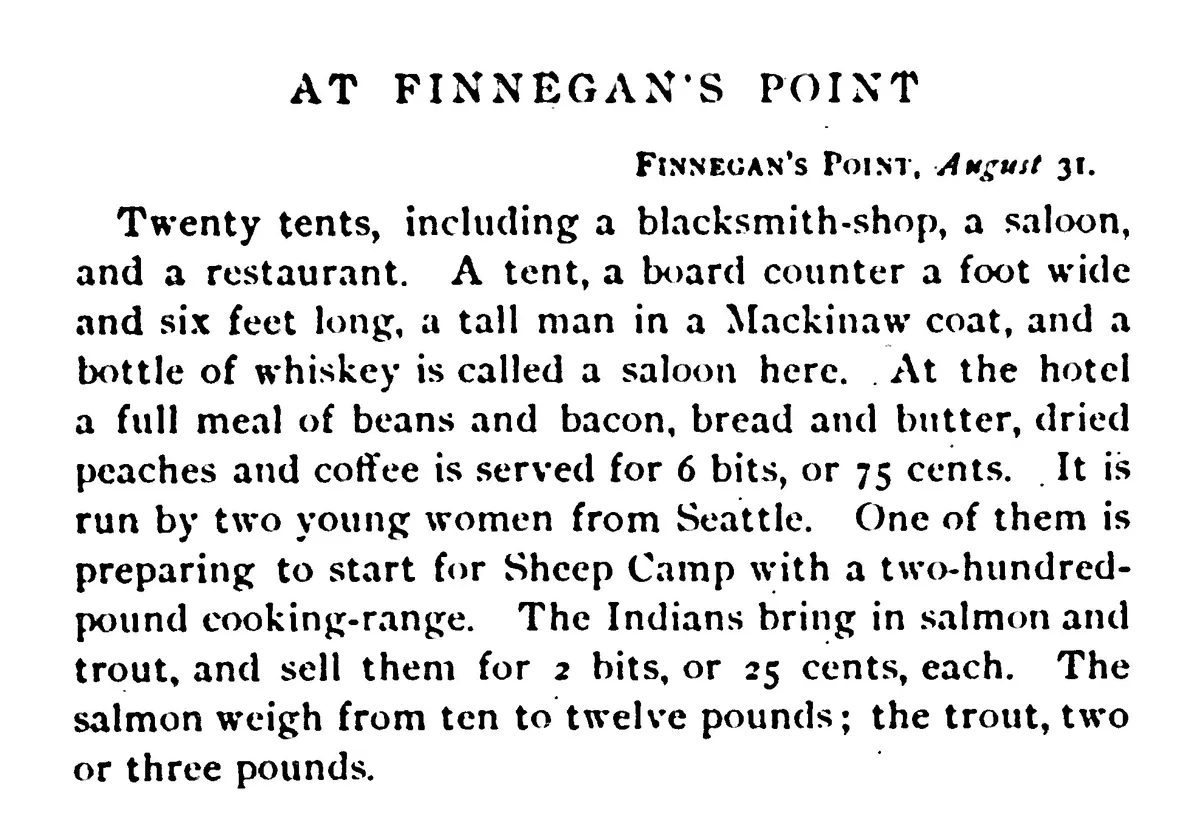
Klondike stampeders ate beans and bacon, bread and butter, dried fruit and coffee or tea, and they ate it all the way from the beach at Dyea to the restaurants of Dawson. The plate hardly changed on the road north, but its price climbed with every mile. On August 31, 1897, the correspondent Tappan Adney found a tent hotel at Finnegan’s Point on the Dyea Trail serving “a full meal of beans and bacon, bread and butter, dried peaches and coffee” for “6 bits, or 75 cents,” roughly $30 in today’s money (a rough guide by US consumer prices, from the Minneapolis Fed and BLS CPI-U tables, used for every conversion on this page). That winter in Dawson, much the same meal with a bit of moose meat cost $3.50, roughly $140. Everything on both plates had been hauled in by pack train, on men’s backs or by riverboat, and the bill said so.
Six bits at Finnegan’s Point
Adney went north in 1897 as a correspondent, and his book The Klondike Stampede (New York, 1900) keeps the trip as dated entries from the trail. Finnegan’s Point, between the landing at Dyea and Sheep Camp, gets a short one. “Twenty tents, including a blacksmith-shop, a saloon, and a restaurant,” it begins, and the saloon turns out to be a tent, a board counter, a tall man in a Mackinaw coat and a bottle of whiskey. The hotel, he writes, “is run by two young women from Seattle,” and one of them was getting ready to move up to Sheep Camp with a cooking range that weighed two hundred pounds.
He lists the meal and leaves the cooking out. The same paragraph turns to another trade: “The Indians bring in salmon and trout, and sell them for 2 bits, or 25 cents, each,” roughly $10 apiece, the salmon weighing ten to twelve pounds. The fishers worked in pairs from small canoes, he noted, one paddling while the other felt along the pools with an iron gaff, in glacial water too milky to see a foot into.
The three B’s
Adney knew this food by its northern nickname. Writing of Christmas in Dawson, he complained that his cabin couldn’t even manage “the usual ‘three B’s,’ bread, beans, and bacon, of Alaska fare.” While he was still buying his outfit, he meant to stick to the merest essentials: “Lumbermen know what a man can live and grow fat on out-of-doors, and so does the United States army. There is something about pork, flour, beans, and tea that makes it easy to add the rest.”
The outfitters’ guides agreed. The Klondyke and Yukon Guide published by Alaska Illustrators in Seattle, undated but catalogued as 1898, heads its list “Your Food Supply” and calls it “The Most Important of All.” One man’s groceries for a year begin with 400 pounds of flour and run to 100 pounds of beans, 150 of bacon, 8 of baking powder, 20 of evaporated peaches, 25 of coffee and butter in sealed cans. Every part of the Finnegan’s Point meal is on it.
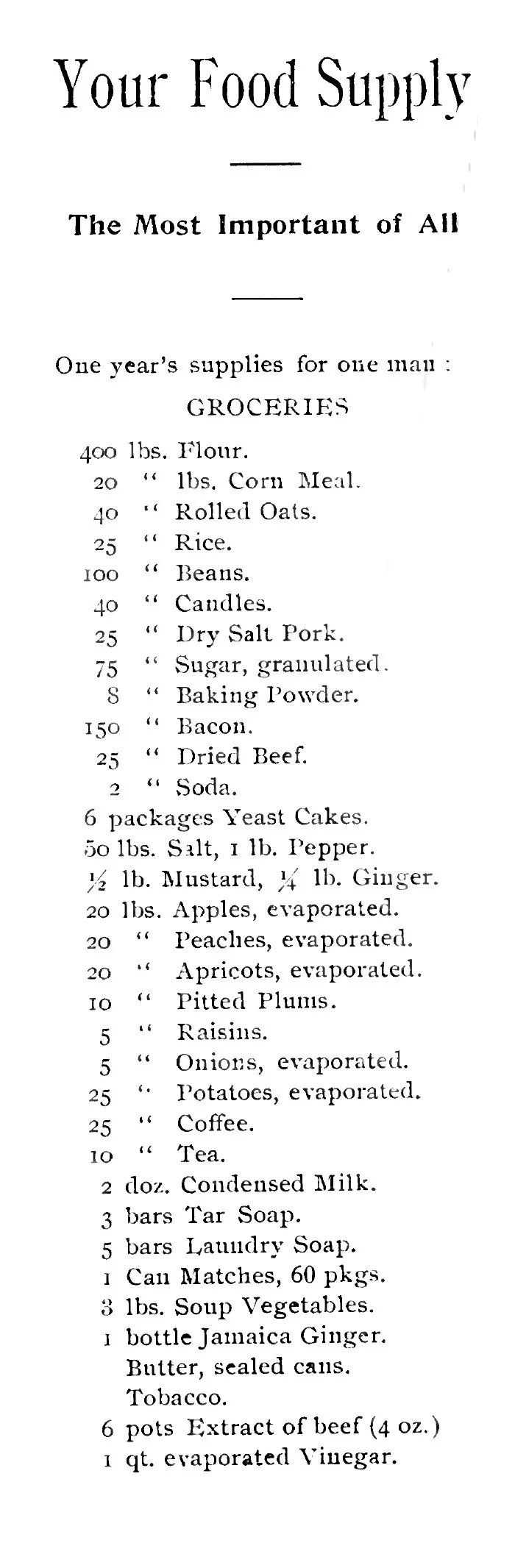 One man’s year of groceries in the Klondyke and Yukon Guide (Seattle, undated; catalogued as 1898), p. 12.
Paid by the pound
All of it had to be carried, and carrying was priced by weight. The Seattle guide warned that getting provisions from Dyea or Skagway to the lakes was hard work, and that “Indian packers may be hired to carry your outfit, their charge being twenty-five cents per pound,” roughly $10 a pound today. Those packers were working an old road. Parks Canada counts the Chilkoot as one of five trails the coastal Tlingit used to trade into the interior, carrying “eulachon grease, dried fish and other marine products,” and says the Tlingit used their control of it to build “a profitable packing monopoly.” As the packing trade grew it took in Tagish packers from the interior, and Tlingit and Tagish packers profited early in the rush.
Adney reached Sheep Camp, thirteen miles from Dyea, that September. The pack trains charged 14 cents a pound to get goods that far, which he said made “oats $16 a sack.” Sheep Camp had a hotel too, Hotel Palmer, a single room of rough boards where the landlord’s family lived behind a calico curtain and meals were cooked for several hundred packers three times a day. There, Adney wrote, “the beans, tea, and bacon are thrown into them at 75 cents each, payable strictly in advance,” and the fare “depends greatly on what the pack-train has been able to pick up at Dyea.” Palmer had heard the complaints. “Why, the price they pay hardly pays the packing on what some of them eat.”
He had a point. The National Park Service reckons a stampeder’s food at three pounds a day. At 14 cents a pound, one day’s food cost 42 cents, roughly $17, to carry as far as Sheep Camp, more than half the price of Palmer’s meal. By 1898, the Park Service says, the Mounties at the summit would let no one into Canada without a year’s supplies, which it reckons at 1,095 pounds of food or more.
Three-fifty in Dawson
Adney was in Dawson by early October 1897, when snow already lay ankle-deep. Over the winter that followed, a restaurant there was “a profitable undertaking to a person with a well-filled cache.” He describes one called the Eldorado, barely ten feet wide, its walls plastered with signs: “Meal, $3.50”; “Porterhouse Steak, $8.” The meal, he wrote, “consisted of a bit of moose meat, or beef, beans, a small dish of stewed apples or peaches, one ‘helping’ of bread and butter, and one cup of tea or coffee.” It was the Finnegan’s Point plate with moose or beef added, at nearly five times the price.
At Jake’s, a bill of fare drawn in black letters on Bristol-board hung all winter. Stewed fruits were 50 cents a dish, tea or coffee 50 cents a cup, a sandwich 75 cents. The card and its printing cost $15, roughly $600 today, “probably one of the most expensive menu cards in the world,” while Jake’s visible stock “seldom consisted, at any one time, of more than a bottle of Worcestershire sauce, a pie, a few tins of sardines, some tins of milk, a pan of beans, and a loaf of bread.” When oysters came in by dog team in April, an oyster stew at Jake’s cost $15 as well.
Cooking for yourself was no guarantee either. That Christmas, Adney’s cabin had plenty of flour and bacon and no one who could bake bread. He and his partner had lately lost eighteen loaves of sourdough by forgetting to sweeten them with soda, loaves “not even passing dogs would eat.” Dinner was saved by a friend, Pelletier, who came back one night with condensed cream, two cans of French peas and a can of turkey.
The fish weirs at the Klondike’s mouth
Dawson was built on ground that already fed people. Across the Klondike River from the town, at its mouth, stood what Adney calls Klondike City, which, he wrote, had been “the seat of the local Indians, or Trochutin, as they call themselves,” until “the miners bringing rafts of logs down the Klondike destroyed their fish-weirs.” The Tr’ondëk Hwëch’in, whose government tells the place’s history today, describe Tr’ochëk as a fishing and hunting camp “for many centuries,” with fish traps built across the mouth of the river. “During the Klondike gold rush years, a horde of newcomers displaced our people from Tr’ochëk,” their account says, and the people moved downriver to Moosehide. Tr’ochëk is a seasonal fish camp again today.
The recipes
Adney recorded no recipe from the hotel at Finnegan’s Point or from Palmer’s kitchen. The three recipes here come from the War Department’s Manual for Army Cooks (Washington, 1896), printed a year before Adney’s walk and written for the army whose food he held up as the model. They follow the order of his sentence.
- Baked Pork and Beans (1896): navy beans soaked overnight, boiled, layered with parboiled salt pork and baked slowly for hours.
- Baking-Powder Biscuits (1896): a plain flour, lard and baking-powder dough, cut with a biscuit cutter or “an empty can.”
- Stewed Dried Peaches (1896): dried peaches soaked overnight, simmered covered, sweetened only at the end and served cold.
The same manual supplies the salt pork and hardtack stew in How Was Bread Baked at a Frontier Fort?, cooked for soldiers who never went near a gold field.
Cooking it
Coffee closed the meal at Finnegan’s Point. For how the West drank it away from the bar, black and often boiled, Forgotten Drink, our sister site, asks what people drank in a Wild West saloon (opens in a new tab). For the plate itself, put the beans to soak the night before: the Baked Pork and Beans (1896) want about an hour on the stove and six in a slow oven, so a morning start gives you Palmer’s supper by evening. The beans, biscuits and peaches sit with the canned-beef stew of the 1898 scandal in our 19th-century recipes.
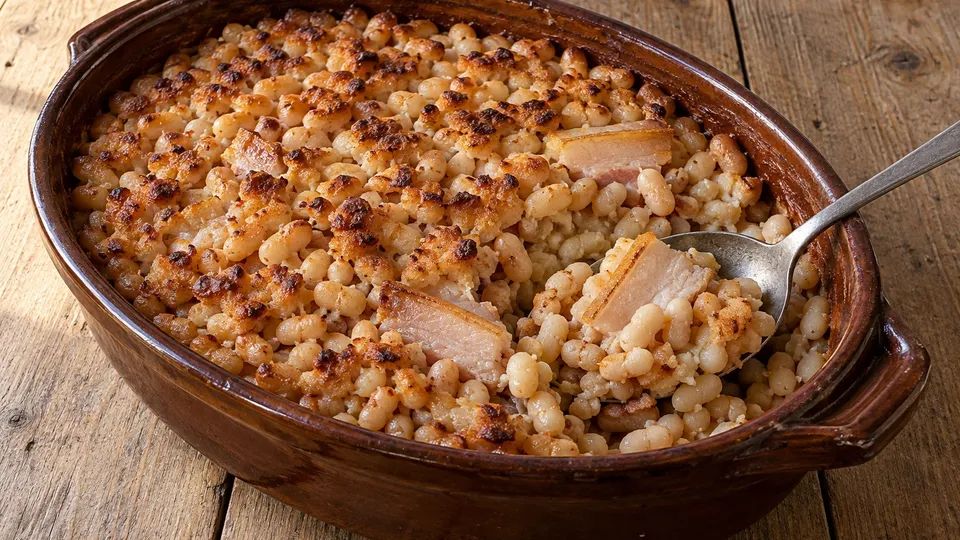 Cook it todayBaked Pork and Beans (1896)
Sources
- Tappan Adney, The Klondike Stampede (New York and London: Harper & Brothers, 1900; copyright 1899), pp. 20, 99, 104–107, 176–177, 181, 335–336, 346–347. Read in a modern on-demand reprint of the 1900 edition, Internet Archive (opens in a new tab).
- Klondyke and Yukon Guide: Alaska and Northwest Territory Gold Fields (Seattle: Alaska Illustrators, undated; catalogued as 1898), pp. 4, 12. Internet Archive (opens in a new tab).
- War Department, Manual for Army Cooks (Washington: Government Printing Office, 1896). Internet Archive (opens in a new tab).
- National Park Service, Klondike Gold Rush National Historical Park, “Ton of Goods” (opens in a new tab) and “Historic Chilkoot Trail” (opens in a new tab).
- Parks Canada, Chilkoot Trail National Historic Site, “History” (opens in a new tab).
- Tr’ondëk Hwëch’in Government, “Tr’ochëk” (opens in a new tab).
- Smithsonian National Postal Museum, “Trails to the Klondike” (opens in a new tab), for Adney’s journey.