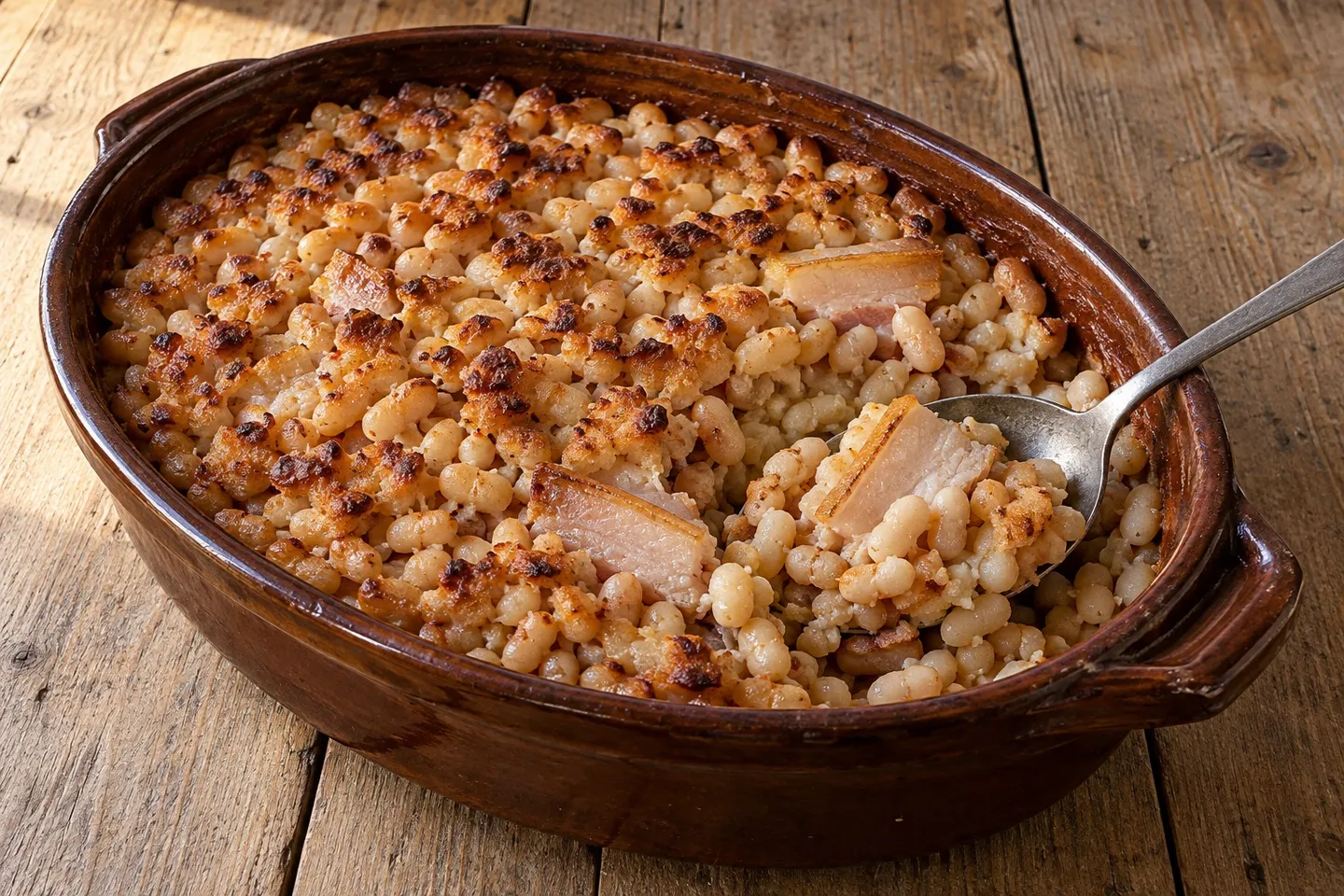
Baked Pork and Beans (1896)
Reader ratingsBaked pork and beans after the War Department’s Manual for Army Cooks, 1896: navy beans soaked overnight, boiled, layered with parboiled salt pork and baked slowly until nearly dry.
- Recipe makes
- About 6 cups, 6 servings
- Prep
- Cook
- Total
Prep includes an overnight soak of about 12 hours. Then about an hour of boiling on the stove and 6 hours in a slow oven, the last hour uncovered.
Baked navy beans with thin slices of salt pork in an earthenware dish.
The story behind the recipe
Beans and bacon headed the 75-cent meal Tappan Adney saw served at Finnegan’s Point on the Dyea Trail on August 31, 1897, and Adney was already looking past them. A few days later, accepting an invitation to a Christmas dinner still months away, he wrote that the turkey, cranberry sauce, plum pudding and champagne promised for it would be “a change from pork and beans.”
What were army baked beans like?
They were slow to make, and drier than anything from a modern can. The War Department’s Manual for Army Cooks, printed in 1896, gives “Time to bake, six to eight hours,” and says that when cooked “the beans should be comparatively dry,” with the top left to brown. Its pork is salt pork, cut thin and buried between two layers of beans, and a spoonful of molasses to the quart is allowed but never required. It even has a plan for what’s left over: “Cold beans may be made into a salad.”
Adney’s page doesn’t say how the hotel cooked the dish, so this recipe comes from the army manual, a year older than his walk, and from the army he himself held up as knowing what a man could live on out of doors, as What Did Klondike Stampeders Eat on the Trail? tells.
Read more about this recipe
Making it today
This is a quarter of the army’s batch. The soda, the parboiled pork, the layering and the boiling water added through the bake all stay. The oven setting is our choice, since the manual asks only for “a uniform heat”: 300°F (150°C), the setting modern New England bean-pot recipes use. Navy beans are our choice too, where the manual says only “beans.” The full soak and at least half an hour of hard boiling before the oven follow the US Food and Drug Administration’s advice for dried kidney beans, which we apply to navy beans too. Look for salt pork near the bacon; it is cured and unsmoked, so slab bacon gives a smokier pan than the manual’s. Adney’s list puts bread and butter next, and the army’s quickest answer to that is its Baking-Powder Biscuits (1896).
2 quarts beans. 3 pounds salt pork. 1 teaspoonful bicarbonate of soda.
Time to bake, six to eight hours.
Pick over the beans, wash, and soak them over night in cold water; soft water is preferable. Parboil the pork and cut it into thin slices. Drain the soaked beans; put them into a pot with enough fresh cold water to cover them plentifully; put in the soda. Cover; boil for fifteen or twenty minutes; remove the scum as it rises; pour off the water; replace with boiling water; cover; boil steadily until tender; drain and season with pepper. If the pork is freshly cured, add salt. Put one-half of the beans in a deep baking pan; lay over them the sliced pork, then cover the pork with the other half of the beans. Pour over from a half pint to a pint of boiling water, and bake with a uniform heat. Every hour add from a half to a cupful of boiling water. If the beans show signs of burning, cover them with a tin pan and remove it in time to allow the top to brown. Serve hot or cold. Cold beans may be made into a salad. If preferred, the beans and pork may be put into the dish in layers, finishing with a layer of pork.
A tablespoonful of molasses, or an equivalent of sugar, to the quart of beans may be added when the beans are put into the baking pan.
When cooked the beans should be comparatively dry.
Recipe makes: About 6 cups, 6 servings
Ingredients
For about 6 cups, 6 servings. Quantities are shown as written.
Quantities as written here, for about 6 cups, 6 servings.
- Dried navy beans2 cups
- Salt pork0.75 lb
- Baking soda1/4 tsp
- Ground black pepper1/2 tsp
- Molasses (optional)1 1/2 tsp
- Boiling water, to start the bake1/2 cup
- Boiling water, for topping up1 1/2 cups
- Water, for soaking and boiling
Measurement notes
Ingredients as written here
- 2 cups dried navy beans
- ¾ lb salt pork
- ¼ tsp baking soda
- ½ tsp ground black pepper
- 1½ tsp molasses (optional)
- ½ cup boiling water, to start the bake
- 1½ cups boiling water, for topping up
- Water, for soaking and boiling
Equipment
- Large bowl for soaking
- Large pot with a lid
 Small saucepan
- Deep 2-quart baking dish or bean pot with a lid, or foil
 Kettle
 Instant-read thermometer
Instructions
Pick over the navy beans, rinse them and cover them with plenty of cold water. Cover the bowl and soak the beans in the refrigerator overnight, at least 8 hours.
Rinse the salt pork, put it in the small saucepan with cold water to cover, bring it to a boil and simmer for 10 minutes. Drain it, let it cool enough to handle and cut it into thin slices, rind and all.
Drain the beans, put them in the large pot with fresh cold water to cover them by about 2 inches, and stir in the baking soda. Cover, bring to a boil and boil for 15 minutes, skimming off the foam as it rises.
Drain the beans in a colander, return them to the pot and cover them again with boiling water from the kettle. Cover and boil steadily until the beans are tender but still whole, at least 30 minutes and up to an hour. Drain them and stir in the black pepper.
Heat the oven to 300°F (150°C).
Spread half the beans in the baking dish, lay the pork slices over them and cover the pork with the rest of the beans. Stir the molasses, if using, into the boiling water to start the bake and pour it over the beans.
Cover the dish and bake for 5 hours. Every hour, pour in a little of the boiling water for topping up, just enough to keep the beans from drying out on the bottom.
Uncover the dish and bake for 1 hour more, until the top is browned and the liquid is nearly all absorbed. The beans are done when they are soft through and the center of the dish reads at least 165°F (74°C).
Serve hot, or let the beans cool and serve them cold, as the manual allows. Chill leftovers in a shallow container within 2 hours and reheat them to 165°F (74°C).
Nutrition
650calories per serving
- Recipe makes
- About 6 cups, 6 servings
- Servings
- 6
Estimated per serving (6) from USDA FoodData Central values for dried navy beans and salt pork; some pork fat is lost in parboiling, so the figure is high.
Recipe notes
When adjusting quantities
A quarter of the manual’s batch of 2 quarts of beans and 3 pounds of salt pork. A larger batch needs a deeper pot and more baking time; judge by tenderness and the 165°F (74°C) reading.
Notes
Quantities mentioned in these notes don’t change when you adjust the servings.
The quantities are a quarter of the manual’s: its 2 quarts of beans and 3 pounds of salt pork become 2 cups and ¾ pound, its teaspoon of soda becomes ¼ teaspoon, and its tablespoon of molasses to the quart of beans becomes 1½ teaspoons. Its half pint to a pint of boiling water to start becomes ½ cup, and its half to a whole cup each hour becomes a little at each check. The manual adds salt only when the pork is freshly cured; modern salt pork is salty, so no salt is listed. Navy beans, the overnight soak in the refrigerator, the timed parboil of the pork, the 300°F (150°C) oven, the lid or foil in place of its tin pan and the 6 hours (the manual says six to eight) are our choices. The manual also allows the layers to finish with pork on top.
Scaling changes the ingredients only; pan sizes and cooking times need their own judgment. To adapt this recipe further, try the recipe tool at TuneMyRecipe (opens in a new tab), our sister site.
Sources and attribution
After War Department, Manual for Army Cooks (Washington: Government Printing Office, 1896), Baked Pork and Beans
See the original pages (scan at Internet Archive) (opens in a new tab)
Recipe details
- Course
- Main course
- Dish family
- Meat & Poultry
- Region
- American
- Era
- 19th century
- Source decade
- 1890s
- Main ingredient
- Pork & ham
- Difficulty
- Easy
- Occasion
- Everyday meal
- Season
- Winter