Waterhouse Hawkins’s dinner in the Iguanodon mould · Crystal Palace, Sydenham
What Was Served at the Dinner Inside the Iguanodon?
Mock turtle soup, cod with oyster sauce, roast turkey, game, a Bavaroise and five wines: the bill for Hawkins’s 1853 dinner in the Iguanodon mould.
Mock turtle, julienne and hare soups; cod with oyster sauce, fillets of whiting and turbot with Hollandaise; roast turkey, ham and a raised pigeon pie; then game, jellies, a Bavaroise, a Charlotte Russe, French pastry and dessert fruit, with sherry, Madeira, port, Moselle and claret. That is the bill of fare for the dinner the artist Benjamin Waterhouse Hawkins gave on December 31, 1853, in the mould of his giant Iguanodon model at the Crystal Palace in Sydenham, south London. The setting was a dinosaur. The food was a grand London dinner of its day, and a cookbook of 1846 shows how three of its dishes were made.
Dinner in the Iguanodon
Hawkins was building models of extinct animals for the Crystal Palace Company at Sydenham, which the Illustrated London News called his “gigantic restorations of the Extinct Inhabitants of the Ancient World.” On Saturday evening, “the last day of the year 1853,” the paper reported a week later, he invited “a number of his scientific friends and supporters to dine with him in the body of one of his largest models, called the Iguanodon,” with the concurrence of the Crystal Palace Company’s directors.
The cards went out only that week, and the paper copied their wording, with a blank for each guest’s name: “Mr. B. Waterhouse Hawkins solicits the honour of” the professor’s “company at dinner, in the Iguanodon, on the 31st of December, 1853, at four p.m.” The request was “written on the wing of a Pterodactyle,” spread before an etching of the Iguanodon “with his socially-loaded stomach.” A card made out to the geologist Joseph Prestwich also survives, worded a little differently and inviting him to dinner in the Iguanodon at four o’clock that Saturday; the historian Joe Cain publishes a reproduction credited to the Geological Society of London. It records the plan for one guest to come. The newspaper is the witness that the dinner took place.
At the head of the table, “most appropriately, and in the head of the gigantic animal, sat Professor Owen,” the anatomist Richard Owen, who had advised on the models. The report names Professor Edward Forbes, “Mr. Prestwick, the geologist” (Prestwich, misspelled), the ornithologist John Gould, and the directors and officers of the company.
How many sat down is less certain than it looks. The bill of fare is addressed to Professor Owen and twenty gentlemen. The Illustrated London News says Hawkins had “one-and-twenty guests around him.” Joe Cain has gathered other reports and Hawkins’s later drawings, which count and seat the party differently, and the tiny heads in the engraving are no census. The plain description is a dinner for scientific men and the company’s supporters, about twenty of them.
The bill of fare
The printed bill is headed “Bill of Fare of a Dinner given at the Crystal Palace, by Mr. Waterhouse Hawkins to Professor Owen and twenty gentlemen,” on Saturday, December 31st, 1853, “in the mould of the Iguanodon.” Its headings run Soups, Fish, Removes, Entrées, Game, Sweets, Dessert and Wines.
Under Soups come Mock Turtle, Julien and Hare. The fish are Cod and Oyster Sauce, Fillets of Whiting, and Turbot with Hollandaise. The removes, the big joints, are roast turkey, ham, a raised pigeon pie, and boiled chicken with celery sauce. The entrées are mutton cutlets with tomato, a rabbit curry with rice, a salmi of partridge and a mayonnaise of fillets of sole, and the game is pheasants, woodcocks and snipes. The sweets include an orange jelly, a Bavaroise, a Charlotte Russe, French pastry and a nougat, and the dessert is fruit and nuts, grapes, apples, pears, almonds and raisins among them. The published reproduction is small and its finest lettering hard to read, so a few names are left out here.
Several dishes stand under each heading, and eight headings need not mean eight plated courses, or that any one guest ate all of them.
Nothing on the card is prehistoric. Mock turtle, which imitated turtle with calf’s head, was an English dinner soup well before 1853: the Paris restaurateur Antoine Beauvilliers put it at the head of his dinner “à l’anglaise” in 1814, as Where Did the Victors Dine in Paris After Waterloo? shows. Charlottes and molded creams were party sweets on both sides of the Atlantic, and eleven years later they stood on the sweets table in What Was on the Sweets Table at Lincoln’s Inaugural Ball? The extraordinary part of the evening was the room.
What the engraving shows
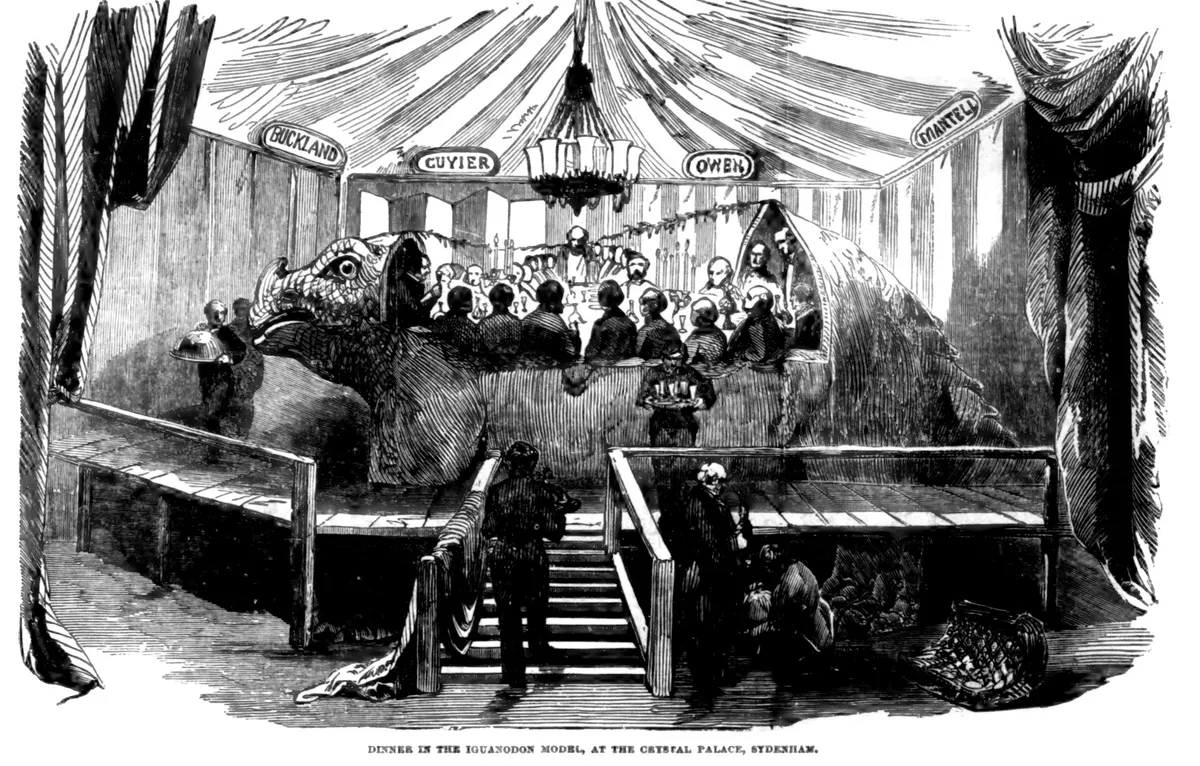
The Illustrated London News printed the scene above its report, captioned “Dinner in the Iguanodon Model, at the Crystal Palace, Sydenham.” The table runs down the open back of the model, and the diners in dark coats sit shoulder to shoulder inside it. A tent ceiling with a chandelier hangs over them, and banners on the walls carry the names Buckland, Cuvier, Owen and Mantell. Waiters bring a covered dish and a loaded tray up to the platform, and a staircase leads up to it from the floor below.
It is an engraving made for the paper, and it shows the dinner as the paper’s readers were meant to see it: elegant, well served and full of famous names.
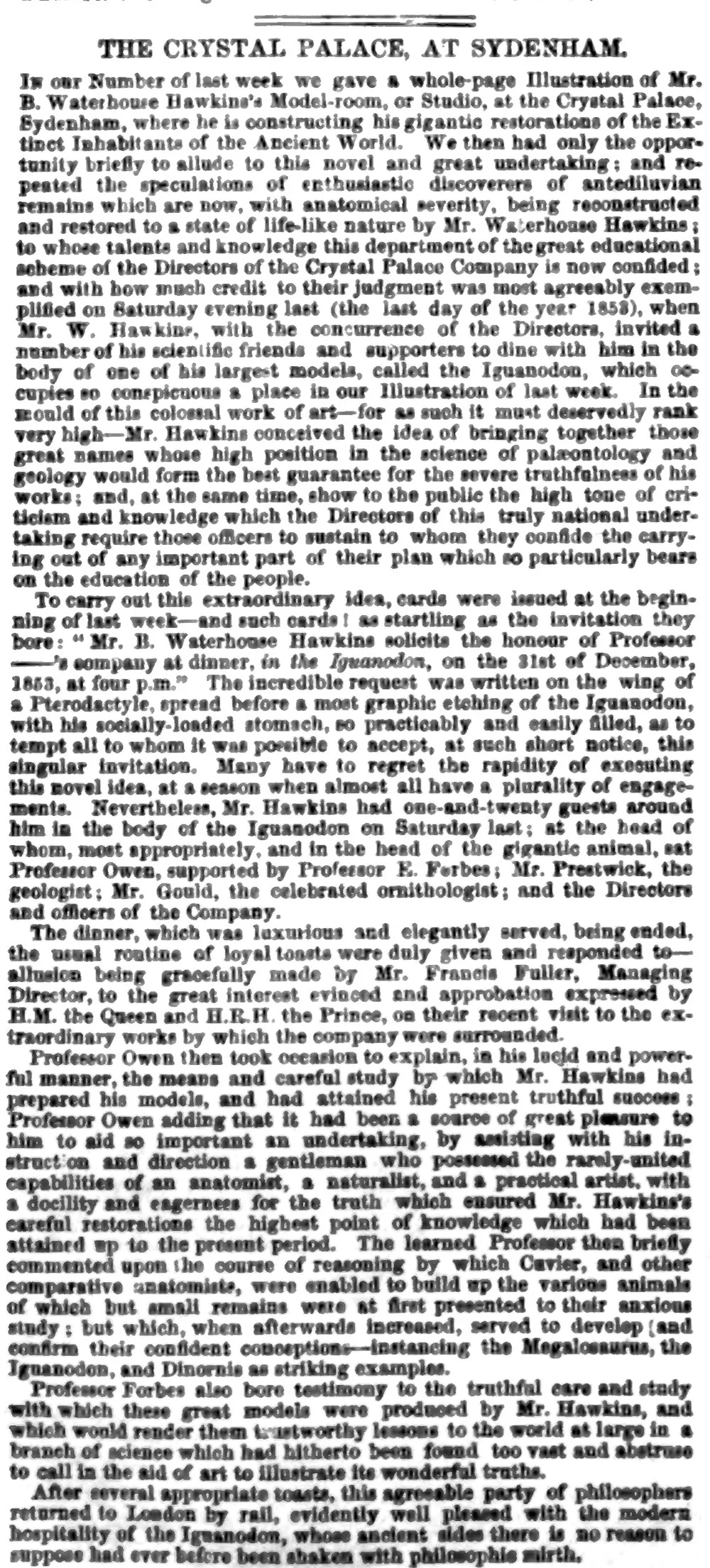 The report beneath the engraving: Illustrated London News, January 7, 1854, p. 22.
That issue, dated Saturday, January 7, 1854, cost sixpence with its supplement, about £2.40 today by UK consumer prices (Bank of England). No price survives for the dinner itself.
Toasts in the mould
The paper says plainly why Hawkins wanted these guests. Their “high position in the science of palæontology and geology would form the best guarantee for the severe truthfulness of his works,” and would show the public the standards the directors demanded of anyone working on “the education of the people.”
The food gets one sentence. “The dinner, which was luxurious and elegantly served, being ended, the usual routine of loyal toasts were duly given and responded to,” with the managing director, Francis Fuller, recalling the interest that the Queen and Prince Albert had shown “on their recent visit to the extraordinary works by which the company were surrounded.” The royal couple had seen the models already. They were not at the dinner.
Then came the science. Owen explained “the means and careful study” by which Hawkins had prepared his models, and the reasoning by which Cuvier and other anatomists had built up animals “of which but small remains were at first presented to their anxious study,” naming the Megalosaurus, the Iguanodon and the Dinornis. Forbes praised the “truthful care and study” that would make the models “trustworthy lessons to the world at large.” After more toasts, “this agreeable party of philosophers returned to London by rail, evidently well pleased with the modern hospitality of the Iguanodon, whose ancient sides there is no reason to suppose had ever before been shaken with philosophic mirth.”
Put together, the menu and the report show a familiar kind of hospitality staging an unfamiliar kind of occasion: a professional banquet, toasts to the Crown, and then Owen and Forbes vouching in public for the models around them. What the guests made of the soup, and whether the dinner changed anyone’s mind about the models, the paper doesn’t say.
The recipes
The bill names its dishes and gives no recipes. Seven years before the dinner, Alexis Soyer, the chef of London’s Reform Club, had printed his own for three of them in The Gastronomic Regenerator. There is no sign the kitchen at Sydenham used it, but his pages measure the stock-making, straining and molding that a two-word line on a bill could stand for. In the order of the bill:
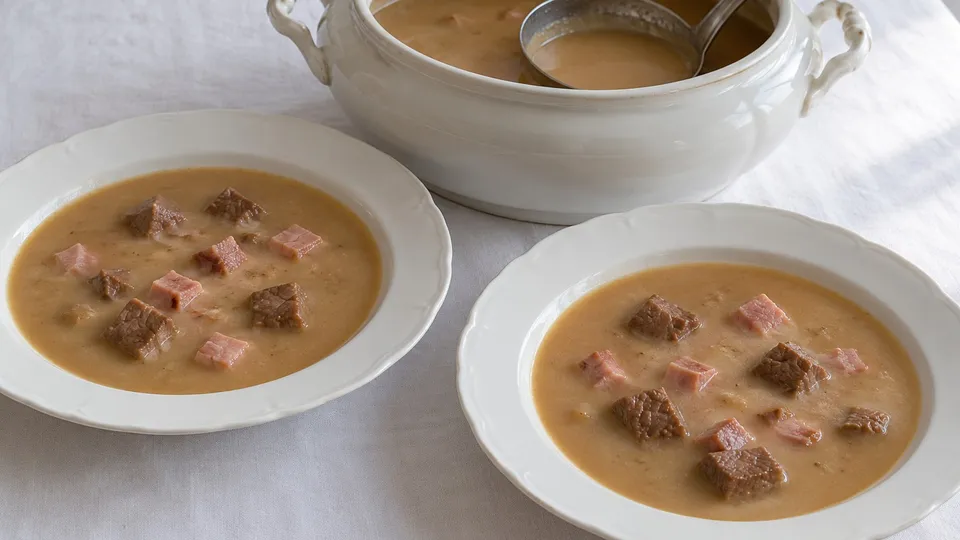
- Mock Turtle Soup (1846): the first soup on the bill. Soyer’s is a brown soup thickened with a roux, scented with savory, thyme, marjoram, basil and bay, and finished with sherry and pieces of calf’s head.
- Cod with Oyster Sauce (1846): the first fish. Soyer’s cod is boiled in salted water and sent up on a napkin, with the oyster sauce apart in a boat.
- Strawberry Bavaroise (1846): one of the sweets. The bill gives no flavor, so this is one of Soyer’s fruit Bavaroises, a strawberry purée set with isinglass and whipped cream and turned out of a mold.
Each recipe page says what it changes from Soyer, and why.
Back in the kitchen
The guests began with the Mock Turtle Soup (1846). Beef takes the calf’s head’s place in our pot, but Soyer’s roux fried with savory, thyme, marjoram, basil and bay comes through unchanged, and so does his check on a soup that “must adhere lightly to the back of the spoon.” All three dishes are among our Victorian recipes, with the soups Soyer later cooked for Dublin and the hospital food in What Did Soyer Cook for the Soldiers at Scutari? The bill ends with five wines: sherry, Madeira, port, Moselle and claret. The dinner fell in the week after Christmas, and for what Victorians poured through that season, Forgotten Drink, our sister site, asks What Did Victorians Drink at Christmas? (opens in a new tab)
 Cook it todayMock Turtle Soup (1846)
Sources
- “The Crystal Palace, at Sydenham,” with the engraving “Dinner in the Iguanodon Model, at the Crystal Palace, Sydenham,” Illustrated London News, vol. 24, no. 662, January 7, 1854, p. 22; cover price on p. 1. Digitized by the Internet Archive.
- Bill of fare, “Dinner given at the Crystal Palace, by Mr. Waterhouse Hawkins to Professor Owen and twenty gentlemen,” December 31, 1853, read in the reproduction published by The Feast, episode 5.
- Invitation to Joseph Prestwich, December 31, 1853, credited to the Geological Society of London, read in the reproduction in Joe Cain, “Top questions about the New Year’s Eve dinner in the Iguanodon” (opens in a new tab).
- Alison Laurence, “Animals of Crystal Palace,” (opens in a new tab) Science Museum Group Journal (2019), on the models and the dinner in their wider setting.
- Alexis Soyer, The Gastronomic Regenerator (London: Simpkin, Marshall & Co., 1846), nos. 69, 202, 271, 272, 342 and 1255, pp. 30–31, 88–89, 119, 139 and 529.
- Present-day equivalent: Bank of England inflation calculator basis (composite price index to 1948, then consumer prices).