Cod with Oyster Sauce (1846)
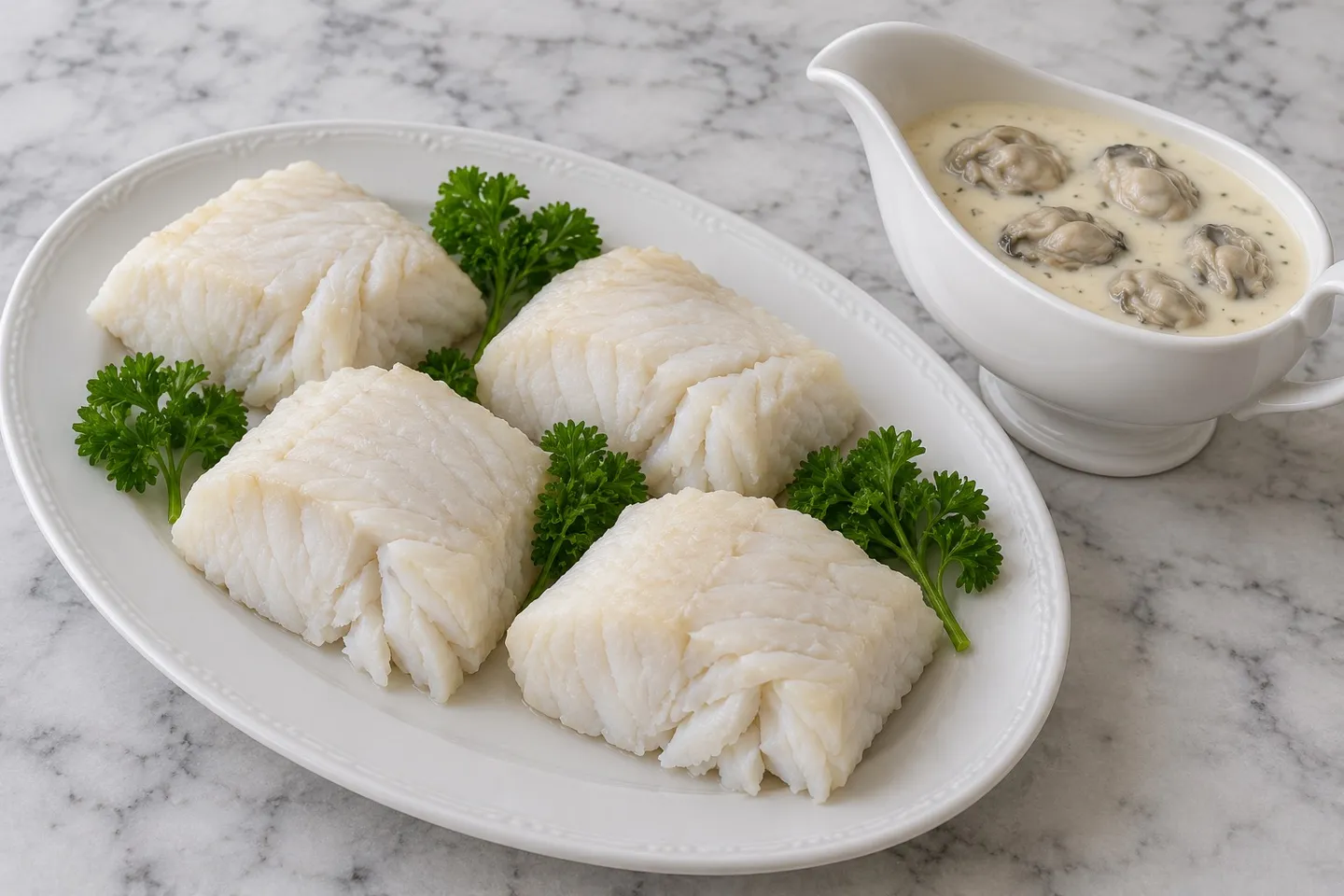
Reader ratingsCod with oyster sauce after Alexis Soyer’s 1846 Cabillaud aux Huîtres: poached cod with parsley and a milk sauce of oysters, anchovy and mace in a boat.
- Recipe makes
- 4 portions of cod with about 2 cups of sauce
- Prep
- Cook
- Total
Start the sauce first: it simmers for 10 minutes while the poaching water heats. The cod poaches for 6 to 10 minutes while the oysters cook in the strained sauce.
Poached cod with curly parsley and a boat of oyster sauce.
The story behind the recipe
Cod with oyster sauce headed the fish on the bill of fare for Waterhouse Hawkins’s dinner in the Iguanodon at Sydenham on the last night of 1853, ahead of the whiting and the turbot. The bill gives the dish in four words. Alexis Soyer’s The Gastronomic Regenerator of 1846, the source of this recipe, needs four numbered recipes to make it, spread over three parts of the book.
Why does a plain fish need four recipes?
Soyer’s Cabillaud aux Huîtres is two lines long: boil the fish “as above,” dress it on a napkin with “some nice sprigs of double parsley,” and send the oyster sauce up in a boat. “As above” is his plain boiled cod, the oyster sauce is in his chapter of sauces, and that sauce sends the cook on to the fish chapter to learn how the oysters are blanched.
The plain cod is all about salt and timing. Soyer preferred crimped cod, cut in slices, and boiled in water salted at “one pound of salt to every six quarts,” more if the cod was not crimped, because “it will make the fish eat firmer.” He warned against boiling it too long, “for it would cause the fish to eat tough and stringy.”
The sauce is milk thickened with butter and flour, spiced with cloves, mace, cayenne and peppercorns, and sharpened with essence of anchovies and Harvey sauce, a bottled sauce of the day. The oysters go in only at the end. He liked “English green oysters” best, the small ones for the table and the large for cooking, and said “the latter end of August is about the time an epicure would begin to eat them.” By his calendar, an epicure would have been eating them for four months by New Year’s Eve.
Read more about this recipe
Making it today
Thick fillets take the place of Soyer’s crimped slices, and they poach in water salted far more lightly than his. The sauce keeps his milk, spices, anchovy and separate boat. The big change is ours and concerns the oysters. Soyer only warmed them, letting them “set” in their own liquor without boiling, and then kept the finished sauce hot “without boiling.” Here they simmer in the sauce for 3 minutes, following FDA advice for cooking shellfish. Worcestershire sauce stands in for Harvey sauce.
The Mock Turtle Soup (1846) came before it on the same bill. Half a century later, in New York, Deshler Welch warmed oysters in butter and their own liquor at the supper table, in Chafing-Dish Oysters (1896). The rest of Hawkins’s bill, and the speeches after it, are in What Was Served at the Dinner Inside the Iguanodon?
No. 271. Cod-fish au naturel.
Crimped cod, like crimped salmon, is preferable to the plain, and is better cut in slices and cooked, than to cook the whole fish; to boil it well you should have the water boiling (with one pound of salt to every six quarts of water); when you put in the fish, then draw it to the corner of the stove, and let it simmer twenty minutes or half an hour; when it is done, the bone in the centre will leave with facility; be careful you do not boil it too much, for it would cause the fish to eat tough and stringy, and observe in boiling cod that is not crimped, to put more salt in the water, it will make the fish eat firmer.
No. 272. Cabillaud aux Huîtres.
Boil your fish as above, dress it on a napkin, and garnish with some nice sprigs of double parsley, and serve the oyster sauce (No. 69) in a boat.
No. 69. Oyster Sauce.
Mix three ounces of butter in a stewpan with two ounces of flour; then blanch and beard three dozen oysters, as directed (No. 342); put the oysters into another stewpan, and the beards and liquor to the other ingredients, with a pint and a half of milk, a teaspoonful of salt, half a saltspoonful of cayenne pepper, two cloves, half a blade of mace, and six peppercorns; place it over the fire, keep stirring, and boil it ten minutes; then add a tablespoonful of essence of anchovies, and one of Harvey sauce; then pass it through a tammie over the oysters; make the whole very hot, without boiling, when ready to serve.
No. 342. Oysters.
The English green oysters are the best that are known; the latter end of August is about the time an epicure would begin to eat them; the small ones are the best for table, and the large ones for culinary purposes; to blanch them open them with care, and put them in a stewpan with their own liquor; let them set, but they must not boil; beard them, strain their own liquor over them in a basin, put them by and use where described.
Recipe makes: 4 portions of cod with about 2 cups of sauce
Ingredients
For 4 portions of cod with about 2 cups of sauce. Quantities are shown as written.
Quantities as written here, for 4 portions of cod with about 2 cups of sauce.
Oyster sauce
- Shucked oysters6 oz
- Strained oyster liquor1/4 cup
- Unsalted butter2 tbsp
- All-purpose flour3 tbsp
- Whole milk2 cups
- Clove1
- Black peppercorns3
- Ground mace1 pinch
- Cayenne pepper1 pinch
- Anchovy paste1/2 tsp
- Worcestershire sauce1 tsp
- Salt, for the sauce, if needed1 pinch
Cod
- Thick skinless cod fillet, cut in 4 portions1.5 lb
- Water, for poaching2 quart
- Salt, for the poaching water2 tsp
- Curly parsley4 sprigs
Measurement notes
Ingredients as written here
- 6 oz shucked oysters
- 1/4 cup strained oyster liquor
- 2 tbsp unsalted butter
- 3 tbsp all-purpose flour
- 2 cups whole milk
- 1 whole clove
- 3 black peppercorns
- 1 pinch ground mace
- 1 pinch cayenne pepper
- 1/2 tsp anchovy paste
- 1 tsp Worcestershire sauce
- 1 pinch salt, for the sauce, if needed
- 1 1/2 lb thick skinless cod fillet, cut in 4 portions
- 2 quarts water, for poaching
- 2 tsp salt, for the poaching water
- 4 sprigs curly parsley
Equipment
- Wide, deep pan for poaching
- Two saucepans
 Fine sieve
 Whisk
- Slotted fish spatula
 Instant-read thermometer
- Warm platter
- Warm sauce boat
Instructions
Pick over the oysters for bits of shell and keep them cold. Measure the oyster liquor, making it up with water if there isn’t enough.
Melt the butter in a saucepan over medium-low heat, stir in the flour and cook, stirring, for 1 minute without letting it color. Whisk in the milk a little at a time, then the oyster liquor. Add the clove, peppercorns, mace and cayenne pepper. Bring to a gentle simmer, stirring, and cook for 10 minutes, adding a little water if it gets too thick to pour.
While the sauce simmers, bring the water for poaching and the salt for the poaching water to a simmer in the wide pan.
Stir the anchovy paste and Worcestershire sauce into the sauce, then pour it through the fine sieve into a clean saucepan and throw away the spices.
Lower the cod into the simmering water and poach it gently, without letting the water boil hard, for 6 to 10 minutes depending on thickness, until the center reaches 145°F (63°C) and the flesh flakes.
At the same time, add the oysters to the strained sauce and bring it back to a gentle boil, 212°F (100°C), stirring. Keep it bubbling for 3 minutes, until the oysters are plump and their edges curl. Taste, and add the salt for the sauce only if it needs it.
Lift the cod out with the slotted spatula, let it drain for a moment and arrange it on a warm platter with the parsley. Pour the sauce into the warm sauce boat and serve it beside the fish.
Nutrition
310calories per serving
- Recipe makes
- 4 portions of cod with about 2 cups of sauce
- Servings
- 4
Estimated per serving (4) from USDA FoodData Central values for raw cod, eastern oysters, whole milk, butter, flour and Worcestershire sauce, with the poaching water discarded.
Recipe notes
When adjusting quantities
Scales by the portion. A larger batch poaches in two pans or in turns, so the water stays at a simmer.
Notes
Quantities mentioned in these notes don’t change when you adjust the servings.
Soyer’s sauce is a large batch, with three ounces of butter, two of flour, a pint and a half of milk and three dozen oysters; this one is newly sized for four, with the oysters by weight, since their size varies. Our changes: thick fillets for crimped slices of cod; much less salt in the poaching water, about a tenth of his strength; the thermometer in place of his sign of doneness, that “the bone in the centre will leave with facility”; one clove in place of two; anchovy paste for essence of anchovies and Worcestershire sauce for Harvey sauce; the oysters simmered in the sauce, where Soyer warmed them only until they set; no beards boiled in the sauce; and a platter in place of his napkin.
Raw and lightly cooked oysters can carry Vibrio bacteria and norovirus. Cook the oysters as described and serve the sauce hot. Cool leftovers within 2 hours and eat them within 3 to 4 days, following USDA guidance on leftovers. Contains fish, shellfish, milk and wheat; Worcestershire sauce usually contains anchovies.
Scaling changes the ingredients only; pan sizes and cooking times need their own judgment. To adapt this recipe further, try the recipe tool at TuneMyRecipe (opens in a new tab), our sister site.
Sources and attribution
After Alexis Soyer, The Gastronomic Regenerator (London, 1846), no. 272, Cabillaud aux Huîtres, with no. 271, Cod-fish au naturel, no. 69, Oyster Sauce, and no. 342, Oysters
See the original pages (scan at Internet Archive) (opens in a new tab)
Recipe details
- Course
- Fish course
- Dish family
- Fish & Seafood
- Region
- British
- Era
- 19th century
- Source decade
- 1840s
- Difficulty
- Intermediate
- Occasion
- Dinner party
- Season
- Winter