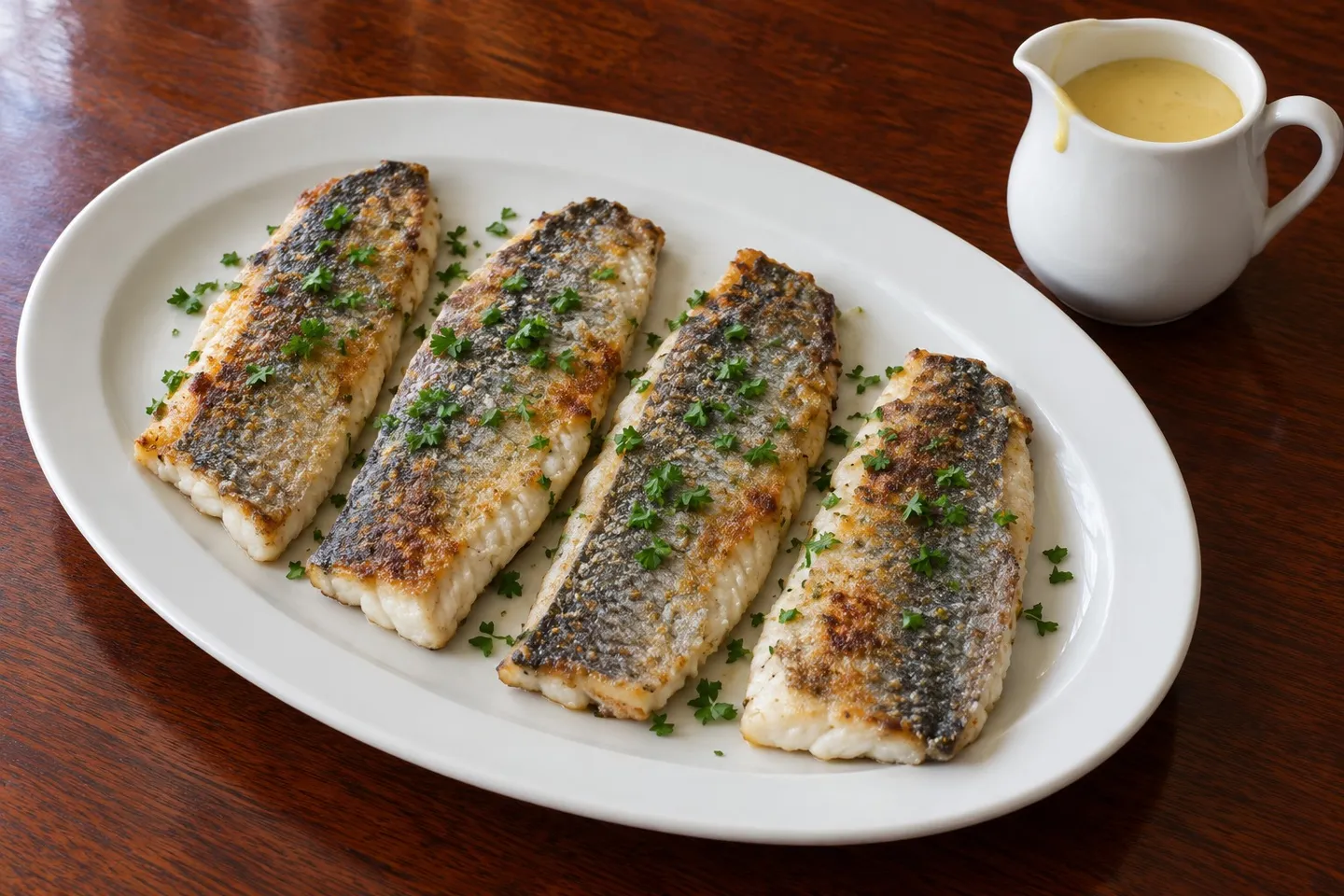
Broiled Herrings with Mustard Sauce (1846)
Reader ratingsBroiled herring with mustard sauce from Alexis Soyer’s 1846 cookbook: floured fillets under the broiler, with a butter and Dijon mustard sauce in a jug.
- Recipe makes
- 4 servings
- Prep
- Cook
- Total
The sauce takes about 10 minutes and is made first, so it is ready when the fish comes out. The fillets need 6 to 10 minutes under the broiler, depending on their thickness.
Broiled herring fillets with parsley and a jug of mustard sauce.
The story behind the recipe
Bright eyes, red gills and glossy scales: Alexis Soyer begins his broiled herrings of 1846 by telling the cook how to know the fish is fresh, which matters on a bill of fare that asks for “Fresh Herrings” and nothing more. Catherine Dickens’s winter dinner for six or seven, printed in 1852, opens with them, and the menu leaves the method open. The Gastronomic Regenerator, Soyer’s big London cookbook of six years earlier, gives one answer.
Why does the sauce start with melted butter?
Soyer’s sauce for the herrings begins with “melted butter,” and in his kitchen that was a sauce in its own right, made a hundred pages earlier as No. 71: butter and flour worked together in the pan before any heat, then a pint and a half of cold water, stirred until “upon the point of boiling, but do not let it boil,” seasoned with vinegar, salt and pepper and finished with more butter. Eight spoonfuls of it, two of French mustard and two pats of butter make the herring sauce. His heading prints it “sauce Digon.”
He thought little of the alternatives. Herrings, he wrote, are too delicate for anything but broiling or boiling; “they may certainly be bread-crumbed and fried, but very few persons like them.” Mustard and herring were old partners by then. La Varenne’s The French Cook of 1653 mixes “some mustard” into the butter sauce for his grilled fresh herring, and his other sauce, browned butter with parsley, is in Grilled Herring with Brown Butter and Capers (1653).
The bill names the fish and no cookbook, so this is Soyer’s way with fresh herrings, and no record ties it to Catherine’s table.
Read more about this recipe
Making it today
We broil fillets in place of whole fish, so the three cuts Soyer makes in each side are left out, and a thermometer replaces his “when done.” The sauce is a small batch on his pattern, sized for four servings: the same butter, flour, water and vinegar base, with the mustard and the last of the butter whisked in at the end. Dijon mustard is our choice for his French mustard. Serve it in a jug on the side, as he did in a boat.
The rest of the winter bill, from the oyster-stuffed mutton to the greengage tart, is in What Did Catherine Dickens Plan for a Winter Dinner Party?
No. 320. Herrings broiled, sauce Digon.
These fish are fresh when the eyes look bright, the gills red, and the scales glossy; the delicacy of these fish prevent them being dressed in any other way than broiled or boiled, they may certainly be bread-crumbed and fried, but very few persons like them; they are best in the following way: wipe them well and cut three incisions on each side, dip them in flour, and broil them over a moderate fire; when done, sprinkle a little salt over them, dish them on a napkin, garnish with parsley, and serve the following sauce in a boat: put eight tablespoonfuls of melted butter in a stewpan, with two ditto of French mustard, two pats of butter, and a little pepper and salt, when boiling and the pats are melted, pour the sauce into the boat and serve.
No. 71. Melted Butter.
Mix a quarter of a pound of butter in a stewpan, with two tablespoonfuls of flour, without putting it upon the fire; then add a pint and a half of cold water, place it upon the fire, keep stirring until upon the point of boiling, but do not let it boil; season with a tablespoonful of vinegar, and a teaspoonful of salt, and the eighth of one of pepper; pass it through a tammie into a basin, then add two ounces more of fresh butter; keep stirring till the butter is melted; it is then ready for use where required.
Recipe makes: 4 servings
Ingredients
For 4 servings. Quantities are shown as written.
Quantities as written here, for 4 servings.
Herrings
- Fresh herring fillets, pin bones removed600 g
- Flour for dusting2 tbsp
- Fine salt1/4 tsp
- Chopped parsley1 tbsp
Mustard sauce
- Unsalted butter for the sauce30 g
- Flour for the sauce1 tbsp
- Cold water120 ml
- White vinegar1 tsp
- Ground black pepper1/8 tsp
- Dijon mustard2 tbsp
- Cold butter to finish15 g
- Warm water, to thin the sauce if needed2 tbsp
Measurement notes
Ingredients as written here
- 600 g fresh herring fillets, pin bones removed
- 2 tbsp flour for dusting
- ¼ tsp fine salt
- 1 tbsp chopped parsley
- 30 g unsalted butter for the sauce
- 1 tbsp flour for the sauce
- 120 ml cold water
- 1 tsp white vinegar
- ⅛ tsp ground black pepper
- 2 tbsp Dijon mustard
- 15 g cold butter to finish
- 2 tbsp warm water, to thin the sauce if needed
Equipment
- Broiler pan lined with foil
 Small saucepan
 Whisk
 Fine sieve
 Instant-read thermometer
- Warm sauceboat or small jug
Instructions
Heat the broiler to medium with the rack about 15 cm (6 inches) below the element, and line the broiler pan with foil.
Pat the fresh herring fillets dry with paper towels and run a finger along each one to find any pin bones left behind. Dust both sides lightly with the flour for dusting, season with half the fine salt, and lay them skin side up on the pan.
Make the sauce before the fish goes under the heat. In the saucepan, off the heat, mash the unsalted butter for the sauce with the flour for the sauce until smooth, as Soyer does, then whisk in the cold water a little at a time.
Set the pan over medium-low heat and whisk until the sauce thickens and comes just to the point of boiling. Turn the heat down and keep it at a bare simmer for 4 to 5 minutes, whisking now and then, so the flour cooks. Stir in the white vinegar, the ground black pepper and the rest of the salt. If there are lumps, pass the sauce through the sieve into a clean pan.
Whisk in the Dijon mustard and warm the sauce for 1 minute. Take it off the heat and whisk in the cold butter to finish until it melts. If the sauce is too thick to pour, whisk in the warm water a spoonful at a time. Keep it warm over the lowest heat while the fish cooks.
Broil the fillets skin side up, without turning, for 6 to 10 minutes, until the skin is lightly browned and the flesh is opaque and flakes, and the thickest part reads 145°F (63°C). If the coating starts to scorch, lower the pan a rung.
Lift the fillets onto a warm platter, scatter the chopped parsley over them and serve at once, with the sauce in the warm sauceboat or jug.
Nutrition
340calories per serving
- Recipe makes
- 4 servings
- Servings
- 4
Estimated per serving (4) from USDA FoodData Central (SR Legacy) values for raw Atlantic herring, butter, flour and prepared mustard, counting all of the sauce.
Recipe notes
When adjusting quantities
Soyer gives no number of fish. Broil no more fillets at a time than fit in one layer with space between them.
Notes
Quantities mentioned in these notes don’t change when you adjust the servings.
Our changes from Soyer: fillets in place of whole fish, without his three incisions on each side; the number of fish, the broiler and the thermometer; a small batch of his melted butter, scaled by us to suit the herring sauce, with his final boil after the pats melt replaced by whisking the butter in off the heat; the sieve used only if the sauce is lumpy; and no napkin under the fish. His sauce has no measured salt beyond “a little,” and the salt here is shared between fish and sauce. For whole fresh herring of about 200 g, slash them as Soyer does and broil 3 to 4 minutes a side until the thickest part reads 145°F (63°C), as the US Food and Drug Administration advises for fish. Refrigerate leftover fish and sauce within 2 hours and eat within a day. Contains fish, milk (butter), wheat (flour) and mustard.
Scaling changes the ingredients only; pan sizes and cooking times need their own judgment. To adapt this recipe further, try the recipe tool at TuneMyRecipe (opens in a new tab), our sister site.
Sources and attribution
After Alexis Soyer, The Gastronomic Regenerator (London, 1846), No. 320, Herrings broiled, sauce Digon, and No. 71, Melted Butter
See the original pages (scan at Internet Archive) (opens in a new tab)
Recipe details
- Course
- Fish course
- Dish family
- Fish & Seafood
- Region
- British
- Era
- 19th century
- Source decade
- 1840s
- Main ingredient
- Fish
- Difficulty
- Easy
- Occasion
- Dinner party
- Season
- Winter