Greengage Tart (1846)
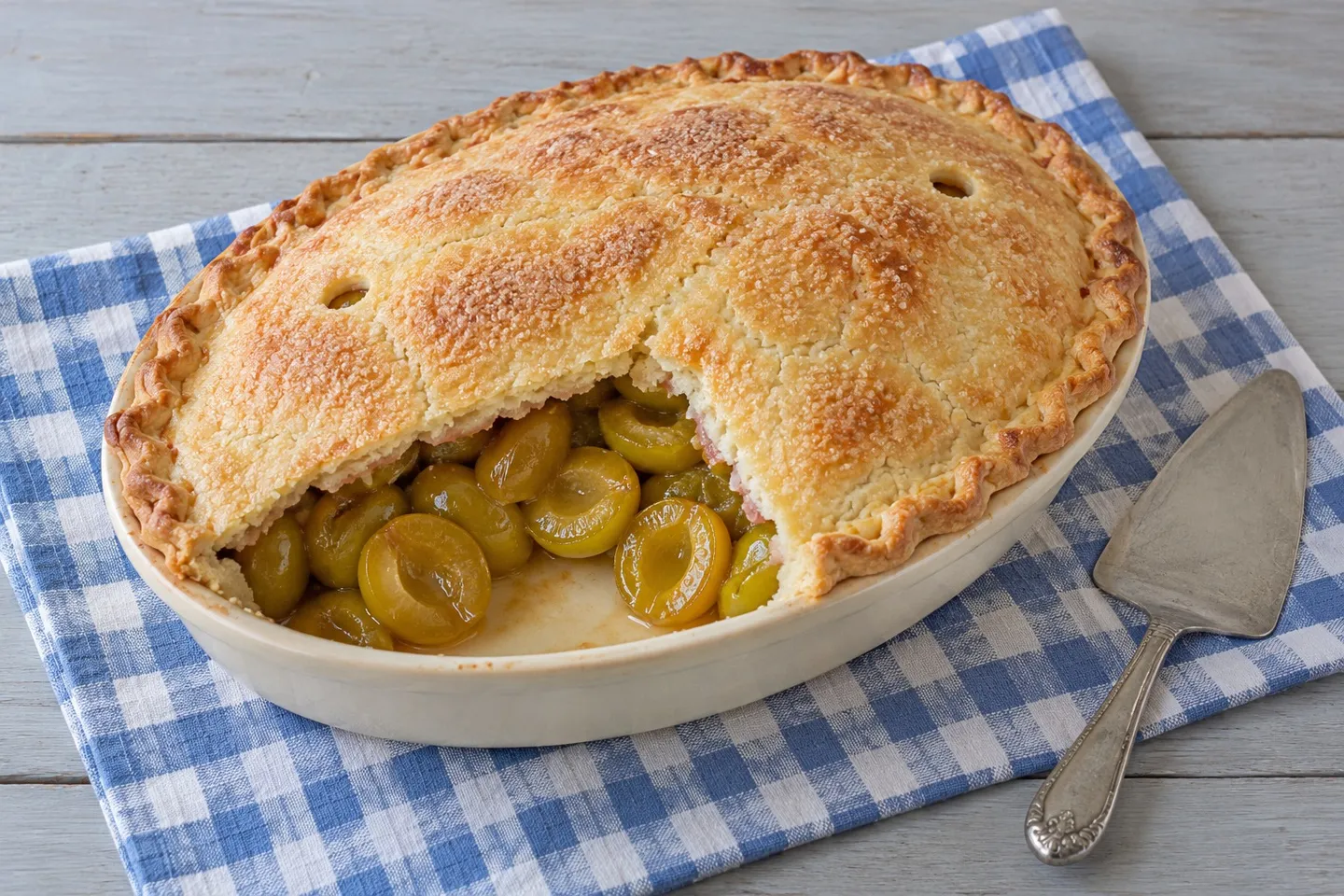
Reader ratingsGreengage tart from Alexis Soyer’s 1846 cookbook: green plums domed in a pie dish under a sweet short-pastry lid, glazed with egg white and sugar, served cold.
- Recipe makes
- One 23 cm tart, 6 servings
- Prep
- Cook
- Total
Total time includes 30 minutes chilling the pastry and 90 minutes cooling, since Soyer serves the tart cold. The bake runs 45 to 60 minutes, depending on the depth of the dish and the juice in the fruit.
Greengage tart under a sugar-glazed pastry lid, one slice cut.
The story behind the recipe
There is no pastry under the fruit in Alexis Soyer’s greengage tart. The greengages go straight into the dish, piled into a dome, and the pastry makes only a band around the rim and a lid on top, glazed with frothed egg white and sugar and baked “a very light brown colour.” On Catherine Dickens’s winter bill of 1852 the tart shares a line with macaroni and bacon, at the end of a dinner for six or seven. Her book prints only the name; Soyer’s Gastronomic Regenerator of 1846 fills in the rest.
What was a fruit tart in 1846?
In Soyer’s Kitchen at Home, a fruit tart is a covered dish. His apricot tart, which the greengage recipe follows step by step, builds the fruit above the level of the dish and lays the lid over it, with “a hole in each side between the fruit and the edge of the dish, forming a well all round.” Plum, gooseberry, cherry, currant, raspberry and cranberry tarts, he adds, are all made the same way. On the same page he prints the other kind as a “French Fruit Tart,” an open crust filled with “about twenty greengages, or any other description of plums, split each one into two,” baked half an hour in a hot oven.
His sugar is white on purpose. Brown sugar was “commonly used,” he wrote, but it “frequently destroys the delicious flavour of some descriptions of fruit.” For the pastry he gives a half-puff paste or a short sweet paste of flour, butter, sugar, eggs and water; this recipe takes the short one.
Read more about this recipe
Making it today
Soyer puts the greengages in whole. We halve and stone them, our choice, so the tart can be cut and served without stones, and we weigh the fruit, since his “about two dozen” depends on their size. We sweeten it with less sugar than his, and read his “powdered sugar” as superfine (caster) sugar. If greengages are not to be had, Soyer’s note that any plum tart is made the same way covers another ripe plum, and frozen stoned greengages, thawed and drained, are a modern convenience; use the same weight. The tart is served cold, as he served it, which suits a dinner of several dishes.
The herrings and kidneys from the same bill are in What Did Catherine Dickens Plan for a Winter Dinner Party?, and the pudding Soyer wrote for the army hospitals at Scutari nine years later is the Rich Rice Pudding (1857).
No. 262. Greengage Tart. Procure a sufficient number of ripe greengages, which put into your dish whole, giving them the form of a dome at the top, and if about two dozen covering them with six ounces of powdered sugar; cover with paste, and proceed exactly as described in the last.
Any description of plum tart is made precisely in the same manner, as also are gooseberry, cherry, currant and raspberry, cranberry, &c., and all requiring about the same time and same description of oven.
No. 261. Apricot Tarts. For tarts the apricots do not require to be too ripe. Procure about two dozen, or according to the size of your dish, split each one in halves, break their stones and take out their kernels, which blanch and skin, lay the apricots in your dish, building them in the form of a dome above the level of your dish, and interspersing the kernels here and there, cover them over with half a pound of lump sugar broken very small; have ready sufficient half-puff-paste (page 480), or the tart-paste just described, a band of which, the eighth of an inch in thickness, lay round the rim of your dish, previously wetting it, then roll out a sheet of the paste large enough to cover the fruit, and a quarter of an inch in thickness, wet the band of paste upon your dish, and lay the cover over, in which prick a hole in each side between the fruit and the edge of the dish, forming a well all round, and closing the paste well at the edges, trim round with a knife, with which also decorate the edges, wet the top well with white of egg beat to a light froth, over which sprinkle two ounces of finely-powdered sugar, sprinkle with water until the sugar is well dissolved (but not to run off), place in a moderate oven, and bake about an hour, keeping it a very light brown colour, serve when cold.
No. 260. Short Paste for Fruit Tarts. Although I have above stated that the half-puff is very excellent for the covering of fruit tarts, I am also aware that very many persons prefer a short sweet paste, as such I have given the following receipt, leaving my readers to choose between the two, the process being the same for either.
Put a pound of flour upon your pastry slab, with six ounces of butter, and rub them well together with your hands, then make a hole in the centre, in which put two ounces of powdered sugar, two whole eggs, and rather more than a wineglassful of water: mix the eggs, sugar, and water well together, then draw in the flour and butter, shaking the whole well, and when dry work it together lightly with the hands.
Recipe makes: One 23 cm tart, 6 servings
Ingredients
For One 23 cm tart, 6 servings. Quantities are shown as written.
Quantities as written here, for One 23 cm tart, 6 servings.
Short sweet pastry
- All-purpose flour225 g
- Cold unsalted butter, diced85 g
- Superfine sugar for the pastry15 g
- Egg, beaten1
- Cold water30 ml
- Extra cold water, if needed15 ml
- Flour for rolling1 tbsp
Fruit
- Greengages, halved and stoned weight600 g
- Superfine sugar for the fruit120 g
Glaze
- Egg white1
- Superfine sugar for the glaze15 g
- Water for the glaze1 tsp
Measurement notes
Ingredients as written here
- 225 g all-purpose flour
- 85 g cold unsalted butter, diced
- 15 g superfine sugar for the pastry
- 1 egg, beaten
- 30 ml cold water
- 15 ml extra cold water, if needed
- 1 tbsp flour for rolling
- 600 g greengages, halved and stoned weight
- 120 g superfine sugar for the fruit
- 1 egg white
- 15 g superfine sugar for the glaze
- 1 tsp water for the glaze
Equipment
 Kitchen scale
- Mixing bowl
- Rolling pin
- Pie dish about 23 cm (9 inches) across, holding about 1 liter, with a wide rim
- Baking sheet
- Pastry brush
- Wire rack
Instructions
Rub the cold unsalted butter into the all-purpose flour with your fingertips until it looks like fine crumbs, and stir in the superfine sugar for the pastry. Make a well, add the egg and the cold water, and draw the flour in until the dough comes together, adding the extra cold water only if it stays dry. Work it lightly into a flat disc, wrap it and refrigerate for 30 minutes.
Heat the oven to 375°F (190°C). Put the greengages in the pie dish, turn them with the superfine sugar for the fruit, and pile them into a gentle dome that rises above the rim. Set the dish on the baking sheet.
Dust the work surface with the flour for rolling and roll out the pastry about 6 mm (¼ inch) thick. Cut a few strips about 1.5 cm (½ inch) wide from the edge and roll them thinner, to about 3 mm (⅛ inch).
Brush the rim of the dish with cold water and press the strips onto it to make a band. Brush the band with water, lay the sheet of pastry over the fruit and press it onto the band to seal. Trim the edge with a knife and crimp it. Cut a small hole on each side of the lid, between the fruit and the rim.
Whisk the egg white until lightly frothy and brush it over the lid. Sprinkle over the superfine sugar for the glaze and dab the water for the glaze over it with the brush, just enough to moisten the sugar without washing it off.
Bake for 45 to 60 minutes, until the pastry is cooked through and pale golden and juice bubbles up through the holes. If the edges brown before the fruit is done, cover them loosely with foil.
Cool the tart completely on the wire rack, about 1½ hours, and serve it cold.
Nutrition
400calories per serving
- Recipe makes
- One 23 cm tart, 6 servings
- Servings
- 6
Estimated per serving (6) from USDA FoodData Central (SR Legacy) values for raw plums, sugar, flour, butter, whole egg and egg white, counting all the pastry and glaze.
Recipe notes
When adjusting quantities
The pastry makes one lid and rim band for a dish of about 1 liter. Soyer’s own batch, a pound of flour, is about twice this.
Notes
Quantities mentioned in these notes don’t change when you adjust the servings.
Our changes from Soyer: greengages halved and stoned, weighed in place of counted; 120 g of sugar on the fruit in place of his six ounces (about 170 g) for two dozen; a pastry batch of about half his, with less sugar in it; 15 g of sugar on the glaze in place of the apricot tart’s two ounces; a measured dish, a 30-minute chill and an oven of 375°F (190°C) for his “moderate oven” and “about an hour.” The apricot kernels belong to the apricot tart and are left out. Soyer allows half-puff paste in place of the short paste. For a plum tart, use the same weight of another ripe plum. Refrigerate the cooled tart, covered, and eat it within 2 days. Contains wheat, egg and milk (butter).
Scaling changes the ingredients only; pan sizes and cooking times need their own judgment. To adapt this recipe further, try the recipe tool at TuneMyRecipe (opens in a new tab), our sister site.
Sources and attribution
After Alexis Soyer, The Gastronomic Regenerator (London, 1846), Kitchen at Home Nos. 260–262, Short Paste for Fruit Tarts, Apricot Tarts and Greengage Tart
See the original pages (scan at Internet Archive) (opens in a new tab)
Recipe details
- Course
- Dessert
- Dish family
- Desserts & Sweets
- Region
- British
- Era
- 19th century
- Source decade
- 1840s
- Main ingredient
- Fruit
- Difficulty
- Intermediate
- Occasion
- Dinner party
- Season
- Winter