A winter dinner for six or seven, planned in What Shall We Have for Dinner? · London
What Did Catherine Dickens Plan for a Winter Dinner Party?
Fresh herrings, mutton stuffed with oysters, stewed kidneys and a greengage tart: a winter dinner for six or seven from Catherine Dickens’s 1852 menu book.
Fresh herrings, a roast leg of mutton stuffed with oysters, stewed kidneys, mashed turnips, mashed and brown potatoes, a greengage tart and macaroni with bacon: that is the first winter dinner “for six or seven persons” in Catherine Dickens’s menu book, What Shall We Have for Dinner?, in its edition of 1852. It is a plan, offered to any household for the months from October to February, and nothing shows that Catherine served it on a particular evening. What it does show is how a London menu book of those years laid out a dinner for company, and how much a short bill of fare left for the cook to decide.
A book of bills of fare
The book came out under the name of Lady Maria Clutterbuck, and it is attributed to Catherine Dickens, the novelist’s wife. The Charles Dickens Museum in London holds a copy published by Bradbury and Evans in 1852, and the Grolier Club in New York dates the first edition to 1851. Its bills of fare run from dinners for two people to dinners for eighteen.
Page 33 carries four winter bills under one heading, “For six or seven persons.” The second begins with oyster soup, hare soup, a cod’s head and smelts and goes on to two roast fowls, boiled bacon, a saddle of Welsh mutton and two pheasants; the third has mock turtle and a roast turkey; the fourth a turbot with lobster sauce and a roast pig. Macaroni turns up in three of the four. The first bill is the shortest on the page, seven dishes against eleven to fourteen in the others, and the only one dated more narrowly than “All the Winter.”
The first bill on page 33
The bill reads, line by line, as printed:
Fresh Herrings.
Roast Leg of Mutton, stuffed with Oysters.
Stewed Kidneys.
Mashed Turnips. Mashed and Brown Potatoes.
Greengage Tart. Macaroni, with Bacon.
[Oct. to Feb.]
Fish comes first, then the roast and a made dish of kidneys, then the vegetables, then a sweet beside a savory. The curators of Sydney Living Museums, who published this page in 2017 on their blog Cook and Curator, read the book’s bills as plans for laying the table in the French style, with dishes set out together. Read that way, the greengage tart and the macaroni share a line because they shared the table, and the page says nothing about the order in which anyone ate them, or whether every guest took every dish.
The bill does settle a good deal. It fixes the company, six or seven, and the season. It says the mutton is roasted and stuffed with oysters, and it asks for potatoes two ways, mashed and browned. For the mashed ones, Alexis Soyer’s Mashed Potatoes (1854), beaten light with two forks, come from his Shilling Cookery for the People, printed two years after this edition.
What the names leave to the cook
Other entries stop at a name. For what could lie behind three of them, one book to open is The Gastronomic Regenerator, printed in London in 1846 by Alexis Soyer, chef “of the Reform Club,” six years before this edition of Catherine’s book. Whether she or her cook owned it is unknown; it shows what a London cook of the 1840s could find under the same names.
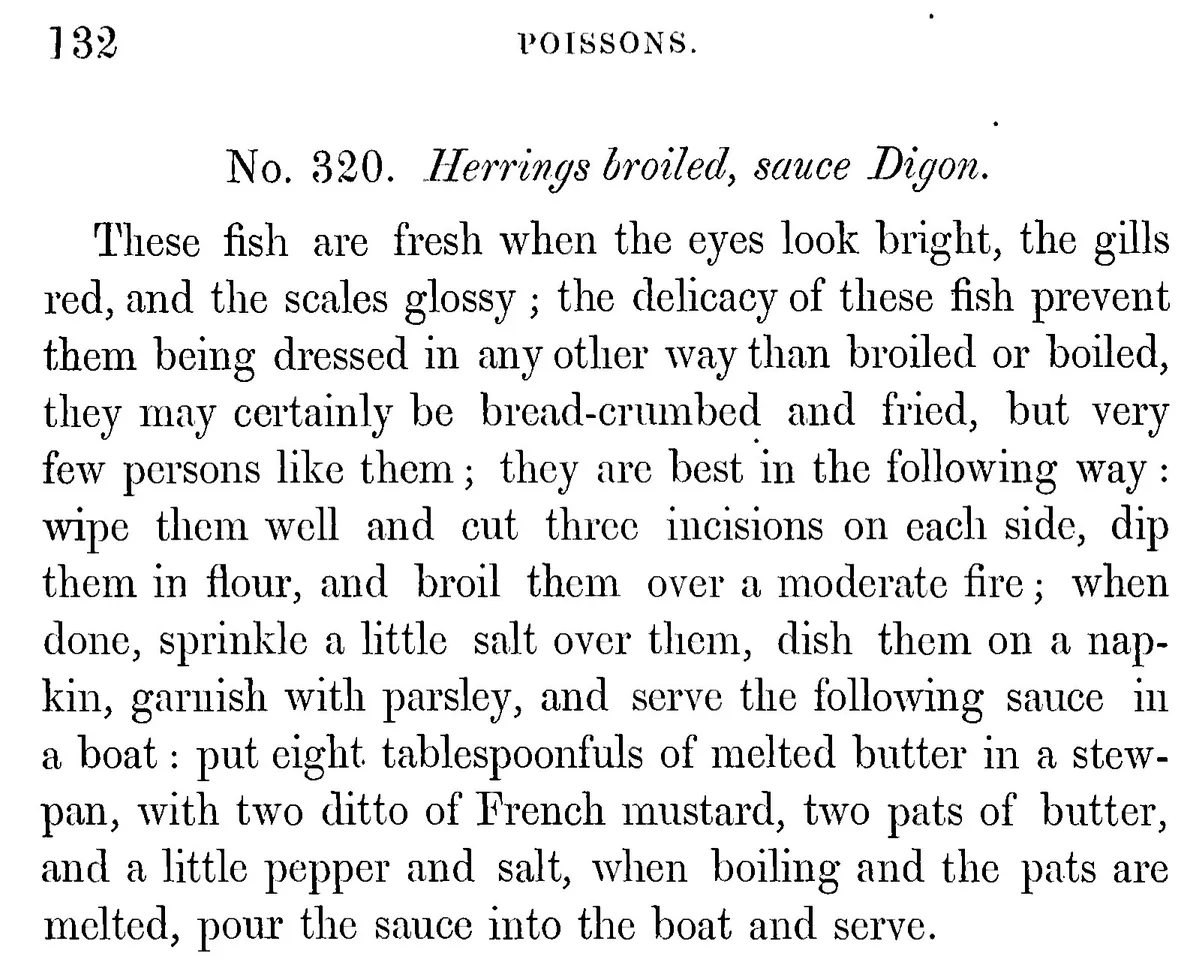
“Fresh Herrings” chooses no method. Soyer gives three for herrings on a single page, broiled, boiled and boiled with cream, and says they can be bread-crumbed and fried too. His broiled herrings come with a sauce that starts from “eight tablespoonfuls of melted butter,” and in his book melted butter is a sauce of its own, butter and flour cooked with water, a spoonful of vinegar and more butter, so the mustard sauce for the fish depends on another recipe a hundred pages earlier.
“Stewed Kidneys” names no animal. Soyer’s ox kidneys are sliced thin, browned with shallots and finished in a few minutes with sherry and water, and he recommends them for breakfast or luncheon. On Catherine’s bill, kidneys belong to dinner.
“Greengage Tart” at least names its fruit. In Soyer, the greengage recipe is four lines long and ends “proceed exactly as described in the last,” which sends the cook back to his apricot tart for the pastry band on the rim of the dish, the lid, the egg-white glaze, about an hour in a moderate oven and service cold. The apricot recipe in turn offers two pastries. Soyer chooses neither for the reader, “leaving my readers to choose between the two, the process being the same for either.”
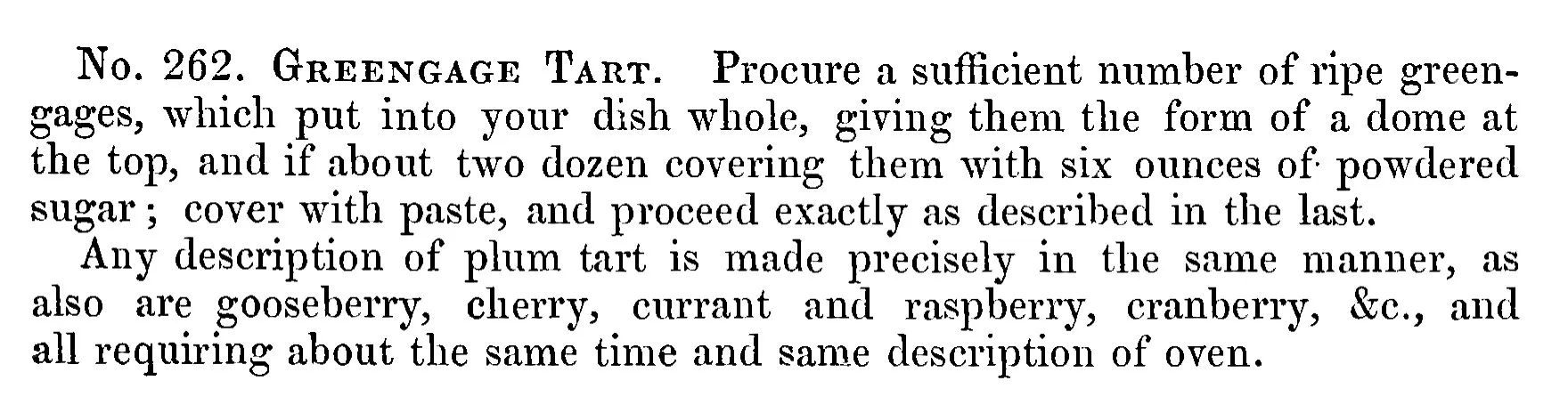 Soyer’s greengage tart, from The Gastronomic Regenerator (London, 1846), p. 707.
The season raises a question the bill leaves open. Soyer asks for ripe greengages, and the bill places its tart between October and February. Where a cook found the fruit in those months, neither the menu nor Soyer says.
What the bill cannot tell us
The page gives no date beyond its months, no guests, no cost and no cook. A Christmas Eve invitation in the Charles Dickens Museum’s collection names no food and could belong to any of four years. The Dickens dinner most readers know, the Cratchits’ goose in What Did the Cratchits Eat for Christmas Dinner?, is fiction, and it cannot fill the gap either.
The likeliest reading is the modest one. This is a conventional dinner for comfortable London company, written down so that another household could copy it. Menus of that kind have a long history: in about 1393 the Paris husband who wrote the Ménagier de Paris copied out dinners for his young wife to choose from when she had guests. What Catherine’s book adds is a dinner of the 1850s laid out whole, with its fish, its joint, its made dish and its tart, and with room left on every line for the cook.
The recipes
Three dishes from the bill, in the order they stand on the page, each from Soyer’s book of 1846:
- Broiled Herrings with Mustard Sauce (1846): floured fillets under the broiler, with a mustard sauce built on Soyer’s melted butter and served in a jug.
- Stewed Kidneys with Sherry (1846): sliced beef kidneys browned with shallot and finished gently in sherry, water, parsley and bay.
- Greengage Tart (1846): greengages domed in a pie dish under a lid of sweet short pastry, glazed with egg white and sugar and served cold.
The mutton stuffed with oysters, the turnips and the macaroni with bacon stay on the bill. Each recipe page says how Soyer’s version relates to the menu’s short name.
Making the cook’s choices
Of the three, the bill leaves most open on its kidneys, so start there. Stewed Kidneys with Sherry (1846) settles the animal as beef and the sauce as Soyer’s sherry and water, and once the kidney is trimmed it needs only a quarter of an hour at the stove, kept below the boil as his warning asks. All three dishes are among our Victorian recipes, next to Mrs. Beeton’s Christmas plum pudding of 1861. For the bowl her husband had Scrooge promise Bob Cratchit, Forgotten Drink, our sister site, explains smoking bishop (opens in a new tab).
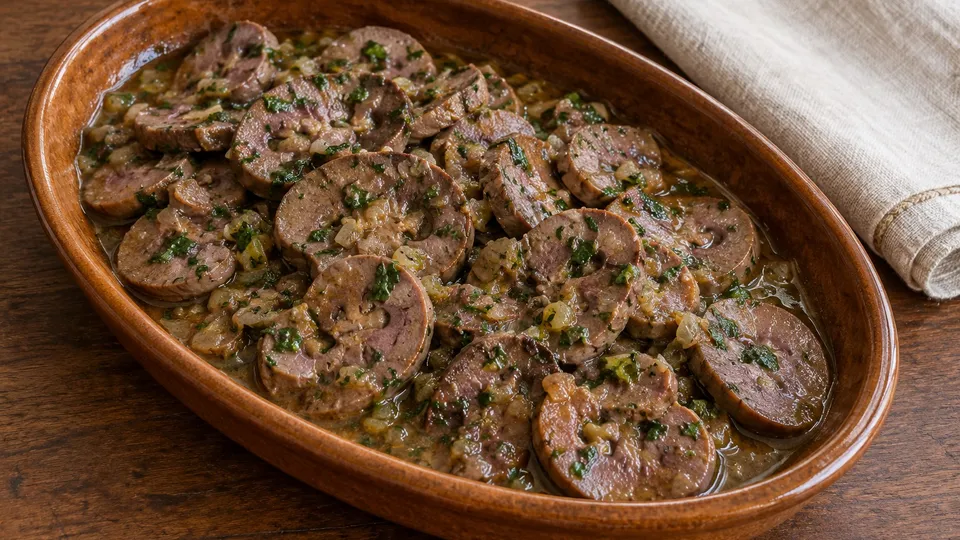 Cook it todayStewed Kidneys with Sherry (1846)
Sources
- Lady Maria Clutterbuck [Catherine Dickens], What Shall We Have for Dinner?, new edition (London: Bradbury and Evans, 1852), p. 33, read in the page reproduction published by Sydney Living Museums (Cook and Curator, “What shall we have for dinner?” (opens in a new tab), 2017), digitized by Google.
- Charles Dickens Museum, London: catalogue entry for the 1852 edition (opens in a new tab), object 2016.B7.1, and its account of the book (opens in a new tab).
- Grolier Club, catalogue entry for the 1856 fourth edition (opens in a new tab), on the 1851 first edition.
- Alexis Soyer, The Gastronomic Regenerator: A Simplified and Entirely New System of Cookery (London: Simpkin, Marshall & Co.; sold by John Ollivier, 1846), nos. 71 and 320, pp. 31–32 and 132, and Kitchen at Home nos. 159 and 260–262, pp. 679–680 and 706–707. Digitized by the Internet Archive (opens in a new tab).