Mock Turtle Soup (1846)
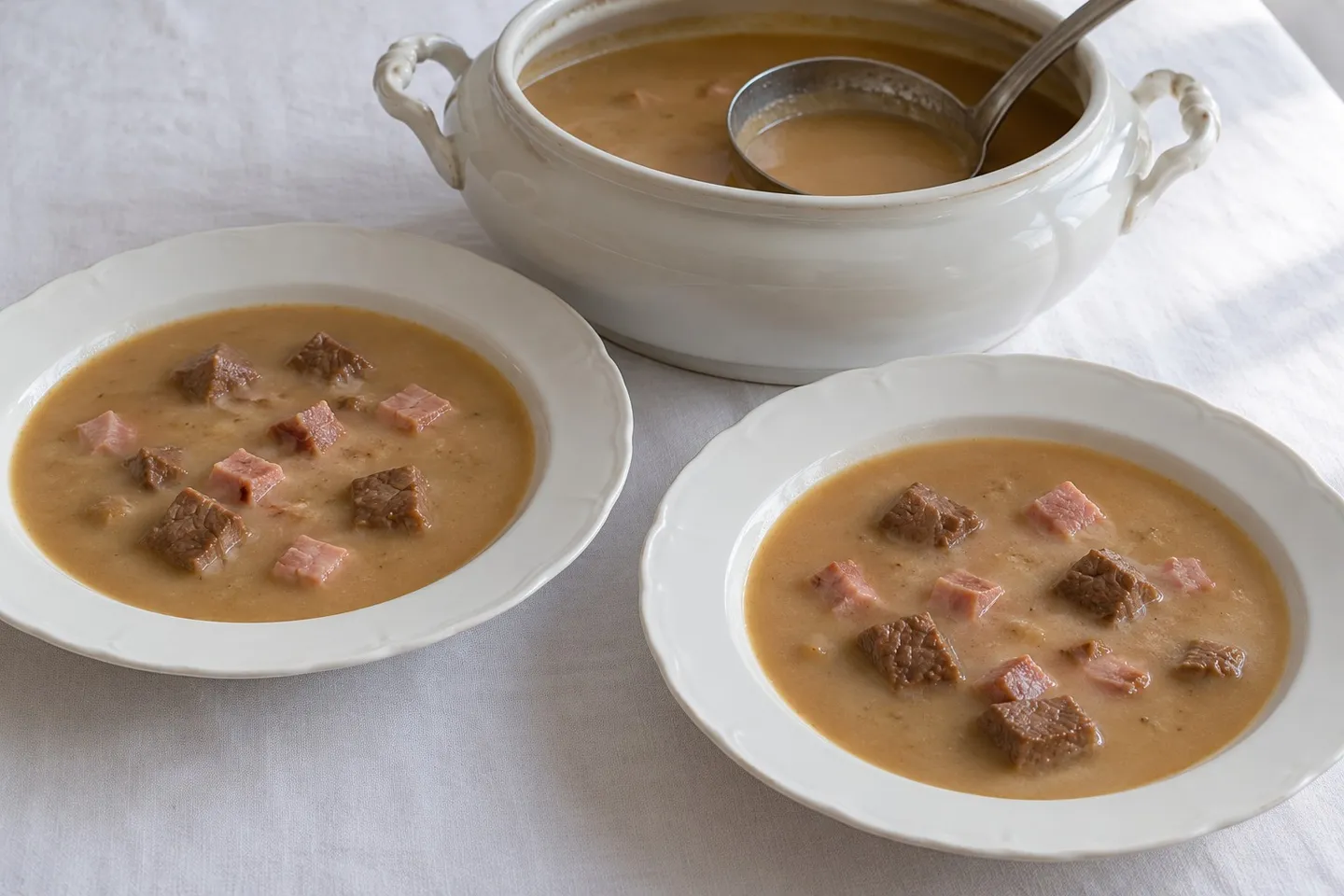
Reader ratingsMock turtle soup after Alexis Soyer’s 1846 recipe: a light brown soup thickened with a roux, scented with savory, thyme, marjoram, basil and bay, with sherry.
- Recipe makes
- About 8 cups, 6 servings
- Prep
- Cook
- Total
The beef simmers for about 2 1/2 hours until tender. The roux, a second straining and the final 15 minutes with the sherry take about 45 minutes more. The soup can be made the day before up to the sherry and finished on the day.
Mock turtle soup with cubes of beef and ham, served from a white tureen.
The story behind the recipe
The name promised turtle; the pot held calf’s head, cut so that its soft, gelatinous pieces stood in for the turtle meat. Mock turtle was the first soup on the bill when Waterhouse Hawkins gave his New Year’s Eve dinner in the mould of the Iguanodon at Sydenham in 1853, and the bill names it and nothing more. This recipe comes from Alexis Soyer’s The Gastronomic Regenerator, printed in London seven years before the dinner.
What was mock turtle soup?
In Soyer’s book it is a big kitchen’s soup, made by the tureen. The meat that makes the stock, veal knuckle and raw ham, is strained out and never goes back into the soup. The calf’s head is the part that reaches the table, and only a little of it: Soyer keeps “nothing but the glutinous part,” once the meat and fat are taken off, cut in pieces an inch square. The rest of the flavor comes from a roux fried with winter savory, thyme, marjoram, basil and bay, and from a glass of sherry at the end.
The page before gives his real turtle soup, which “ought to be quite clear and of a greenish hue.” The mock turtle is the other way round. It “requires to be a light brown colour, and for thickness it must adhere lightly to the back of the spoon.”
Older cooks floated forcemeat balls and egg balls in it, the egg balls made to look like turtles’ eggs. Soyer threw them out: they were “better imitations of bullets, and almost as indigestible,” and no stomach, strong or delicate, “will bear loading with ammunition of that description.” That was his advice in 1846. Whether the Iguanodon’s soup had egg balls, nobody wrote down.
Read more about this recipe
Making it today
Calf’s head is seldom sold today, so this version is built differently, and it is our choice: diced beef chuck stays in the soup in place of the head, and a spoonful of gelatin gives back some of the body the head would have lent, though none of its texture. Ready-made beef broth replaces the veal stock. Soyer’s roux, his five herbs, both strainings and the sherry stay, and so does the color and thickness he asked for.
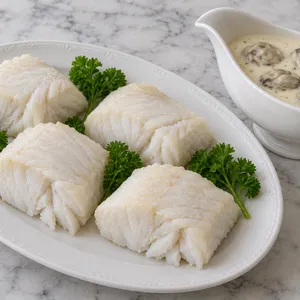
Serve it ahead of the Cod with Oyster Sauce (1846), in the bill’s order. Soyer’s soups for the poor, a year later in Dublin, began with a very different pot, in Soyer’s Soup No. 1 (1857). What Was Served at the Dinner Inside the Iguanodon? reads the whole bill.
No. 202. Mock Turtle Soup.
Put a quarter of a pound of butter at the bottom of a large stewpan, then cut up twenty pounds of knuckles of veal in large dice, with two pounds of uncooked ham; put them into a stewpan with six onions, two carrots, two heads of celery, twenty peppercorns, two blades of mace, two ounces of salt, and a pint of water; set it over a sharp fire, stirring it round occasionally until the bottom of the stewpan is covered with a light brown glaze, then lay in the half of a scalded calf’s head, the cheek downwards, and fill up the stewpan with fourteen quarts of water; when boiling, place it at the corner of the fire, where let it simmer two hours and a half, keeping it well skimmed, but taking out the half head as soon as it becomes flexible to the touch, (which will take about the time the stock requires to simmer), remove all the bone and press the head flat between two dishes until cold, then pass the stock through a cloth into a basin, put a pound of butter into another stewpan, with four sprigs of winter savory, four of thyme, four of marjoram, four of basil, and four bay-leaves, fry them a few minutes in the butter, but do not let it change colour, then mix in a pound and a half of flour, stir it a few minutes over the fire until becoming slightly tinged, take it from the fire, stirring it round occasionally until partly cold, when pour in the stock, place it again upon the fire, keeping it stirred until it boils, then place it at the corner and let it simmer for half an hour, keeping it well skimmed, season with a little cayenne pepper, and more salt if required, and pass it through a tammie into a basin until wanted. When the calf’s head is cold take off all the meat and fat, leaving nothing but the glutinous part, which cut into pieces an inch square; when ready to serve the soup put about three quarts (to each tureen), into a stewpan with twenty of the pieces of head and a glass of sherry, boil altogether fifteen minutes, when skim and serve very hot. This soup may likewise be thickened without a roux, as directed for brown sauce (No. 4). Forcemeat and egg-balls were formerly served in this soup, the latter in imitation of turtles’ eggs, but better imitations of bullets, and almost as indigestible; the omission of them will, I am certain, prove beneficial, for whether the stomach be strong or delicate it will not bear loading with ammunition of that description. The above soup requires to be a light brown colour, and for thickness it must adhere lightly to the back of the spoon.
Recipe makes: About 8 cups, 6 servings
Ingredients
For about 8 cups, 6 servings. Quantities are shown as written.
Quantities as written here, for about 8 cups, 6 servings.
Stock and meat
- Boneless beef chuck, cut in 3/4-inch pieces1 lb
- Cooked ham, diced2 oz
- Unsalted butter, for browning1 tbsp
- Medium onion, chopped1
- Small carrot, chopped1
- Celery, chopped1 stalk
- Reduced-sodium beef broth8 cups
- Black peppercorns6
- Ground mace1/8 tsp
Roux and finish
- Unsalted butter, for the roux4 tbsp
- Bay leaf1
- Fresh thyme2 sprigs
- Fresh marjoram1 sprig
- Fresh basil1 sprig
- Fresh winter savory1 sprig
- All-purpose flour6 tbsp
- Unflavored powdered gelatin1 1/2 tsp
- Cold water, for the gelatin2 tbsp
- Dry sherry1/4 cup
- Cayenne pepper1 pinch
- Salt, plus more to taste1/2 tsp
Measurement notes
Ingredients as written here
- 1 lb boneless beef chuck, cut in 3/4-inch pieces
- 2 oz cooked ham, diced
- 1 tbsp unsalted butter, for browning
- 1 medium onion, chopped
- 1 small carrot, chopped
- 1 celery stalk, chopped
- 8 cups reduced-sodium beef broth
- 6 black peppercorns
- 1/8 tsp ground mace
- 4 tbsp unsalted butter, for the roux
- 1 bay leaf
- 2 sprigs fresh thyme
- 1 sprig fresh marjoram
- 1 sprig fresh basil
- 1 sprig fresh winter savory
- 6 tbsp all-purpose flour
- 1 1/2 tsp unflavored powdered gelatin
- 2 tbsp cold water, for the gelatin
- 1/4 cup dry sherry
- 1 pinch cayenne pepper
- 1/2 tsp salt, plus more to taste
Equipment
- Heavy pot of about 5 quarts
- Second large saucepan
 Fine sieve
 Large bowl
 Whisk
- Liquid measuring cup
- Small cup for the gelatin
- Soup tureen and ladle
Instructions
Pat the beef chuck dry. Melt the butter for browning in the heavy pot over medium-high heat and brown the beef in two batches, about 5 minutes a batch, turning the pieces until they are brown on several sides. Lift them out onto a plate.
Lower the heat to medium and add the ham, onion, carrot and celery. Cook, stirring, for 5 minutes, until the vegetables soften. Pour in a splash of the beef broth and scrape up the brown glaze from the bottom of the pot.
Return the beef with its juices and add three-quarters of the broth, the peppercorns and the mace. Keep the rest of the broth for later. Bring to the boil, skim off the foam, then lower the heat, partly cover and simmer gently for about 2 1/2 hours, skimming now and then, until the beef is tender enough to break with a fork, far past the USDA minimum of 145°F (63°C) for beef. Add a little of the kept broth if the meat starts to show above the liquid.
Lift the beef and ham out into a bowl. Pour the stock through the fine sieve into the large bowl, pressing lightly on the vegetables, and throw the vegetables and spices away.
Melt the butter for the roux in the second saucepan over medium-low heat. Add the bay leaf, thyme, marjoram, basil and winter savory and stir for 1 minute without letting the butter color. Stir in the flour and cook, stirring, for 3 to 4 minutes, until the roux is just tinged pale gold.
Take the pan off the heat and stir for 2 minutes to let the roux cool a little. Whisk in the hot stock a little at a time, then return the pan to medium heat and whisk until it boils. Lower the heat and simmer for 20 minutes, skimming off any foam.
Meanwhile, sprinkle the gelatin over the cold water for the gelatin in the small cup and leave it for 5 minutes to soften.
Pour the soup through the sieve again to take out the herbs, and return it to the pan. Add the beef and ham, the softened gelatin and the sherry. Simmer for 15 minutes, stirring until the gelatin has melted.
Check the thickness: the soup should coat the back of a spoon lightly. Thin it with some of the kept broth if it is too thick, or simmer it a few minutes more if it is too thin. Season with the cayenne pepper, then the salt, tasting as you go, since the broth and ham are already salted. Serve very hot.
Nutrition
275calories per serving
- Recipe makes
- About 8 cups, 6 servings
- Servings
- 6
Estimated per serving (6) from USDA FoodData Central values for beef chuck, ham, butter, flour, reduced-sodium beef broth, the vegetables and dry sherry, counting the strained-out vegetables.
Recipe notes
When adjusting quantities
Scales by the batch. For a double batch, brown the beef in four batches and allow a little longer for the stock to come to the boil.
Notes
Quantities mentioned in these notes don’t change when you adjust the servings.
Soyer’s soup is a professional batch of about fourteen quarts from twenty pounds of veal, two pounds of raw ham and half a calf’s head, with a pound of butter and a pound and a half of flour in the roux. This version is newly sized for six. Our changes: diced beef chuck kept in the soup in place of the veal, which Soyer strains out, and of the calf’s head; ready-made beef broth for his veal stock; gelatin for some of the head’s body; cooked ham; dried herbs allowed in place of fresh, about 1/4 teaspoon each; a quarter cup of sherry for his “glass”; and a single pot of soup in place of his tureens. His egg balls and forcemeat balls are left out, as he advised.
For an alcohol-free soup, use a quarter cup more broth and a teaspoon of lemon juice in place of the sherry. Fifteen minutes of simmering doesn’t drive off all the alcohol.
The soup keeps, covered, in the refrigerator for 3 to 4 days, following USDA guidance on leftovers; cool it within 2 hours and reheat it to a boil, at least 165°F (74°C). Contains wheat and milk.
Scaling changes the ingredients only; pan sizes and cooking times need their own judgment. To adapt this recipe further, try the recipe tool at TuneMyRecipe (opens in a new tab), our sister site.
Sources and attribution
After Alexis Soyer, The Gastronomic Regenerator (London, 1846), no. 202, Mock Turtle Soup
See the original pages (scan at Internet Archive) (opens in a new tab)
Recipe details
- Course
- Soup
- Dish family
- Soups & Broths
- Region
- British
- Era
- 19th century
- Source decade
- 1840s
- Main ingredient
- Beef
- Difficulty
- Intermediate
- Occasion
- Dinner party
- Season
- Winter