Bacon, ham, butter and sugar go on the ration in Britain · Great Britain
What Was a Week’s Food Ration in Britain, 1940 to 1954?
An adult’s weekly ration from January 1940 to July 1954, from Hansard and the Ministry of Food, and four dishes from its wartime cookery leaflets.
On Monday 8 January 1940 an adult in Britain was allowed 4 oz of bacon or ham, 4 oz of butter and 12 oz of sugar a week, and that was the whole ration. By September 1941 it covered most of the larder: 1s 2d worth of meat, 4 oz of bacon, 6 oz of butter and margarine with no more than 2 oz of it butter, 2 oz of cooking fat, 3 oz of cheese, 8 oz of sugar, 2 oz of tea and a pound of jam every four weeks. It outlasted the war by nine years. Meat and bacon were the last foods to come off, in the first half of July 1954.
An adult’s week, in three columns
Bacon and ham, butter and sugar were rationed together from 8 January 1940, as the Ministry of Food’s own record of its work, How Britain Was Fed in War Time (HMSO, 1946), dates the start. Two answers in the House of Commons give the ration at later moments. In September 1941 Major Gwilym Lloyd George, the Ministry’s parliamentary secretary, set out the civilian allowance as it stood on the 15th of that month. In February 1954 Dr Charles Hill, answering for the Minister of Food, printed what one ration book bought on 1 October 1951.
| Per adult, per week | 8 January 1940 | 15 September 1941 | 1 October 1951 |
|---|---|---|---|
| Bacon and ham | 4 oz | 4 oz | 3 oz |
| Butter | 4 oz | 2 oz at most, within the 6 oz below | 3 oz |
| Margarine | not rationed | 6 oz of butter and margarine together | 4 oz |
| Cooking fat | not rationed | 2 oz | 2 oz |
| Sugar | 12 oz | 8 oz | 10 oz |
| Tea | not rationed | 2 oz | 2 oz |
| Cheese | not rationed | 3 oz | 1½ oz |
| Meat, by price | not yet rationed | 1s 2d worth | costing 2s 0d |
| Jam and other preserves | not rationed | 1 lb every four weeks | not in the table |
The figures moved all the time. By the Ministry’s account, bacon rose to 8 oz before January was out, more than people had eaten on average before the war, and fell back to 4 oz in June. Sugar came down to 8 oz in May 1940. Tea went on the ration in July 1940 at 2 oz, and in the same month margarine joined butter in one allowance and cooking fat was rationed at 2 oz. Cheese, which the Ministry found the most changeable ration of all, started at 1 oz in May 1941, reached 8 oz in July 1942 and was down to 2 oz by April 1944.
Meat was rationed by what it cost, so the butcher’s prices decided the weight. It began on 11 March 1940 at 1s 10d a week for everyone over six (about £4.45 today, on the Bank of England’s consumer price basis) and 11d for younger children. It rose to 2s 2d in September 1940, sank to 1s by the end of March 1941, and from July 1941 held at 1s 2d, about £2.55 today, for the rest of the war. A child under six had 7d. Pooled by three small families, those coupons bought the Christmas joint in What Was on a Wartime Christmas Menu in 1941?
Meals eaten out came on top of the ration, and the Ministry supplied the caterers by arithmetic. It assumed meat went into two main meals a day, fourteen a week, so a restaurant received one fourteenth of the 1s 2d ration, a pennyworth of meat, for every main meal it served. It could put twopence of meat into half its meals and none into the rest. Only about 3 percent of the rationed food was eaten in ordinary cafés and restaurants in December 1944, the Ministry found, which for anyone outside the works canteens and other “special” catering places came to roughly one day’s meals a month.
Points, packets and dried eggs
The weekly weights were only part of it. From 1 December 1941 each person also had 16 “points” every four weeks to spend on tinned meat, fish and vegetables, at any shop, with each food given a points value set by how short it was. Dried fruit, rice and pulses joined the scheme in January 1942, tinned fruit in February, condensed milk and breakfast cereals in April, syrup and treacle in July, biscuits in August and rolled oats in December. Sweets and chocolate had points of their own from July 1942, settling at 12 oz every four weeks by the middle of October.
Eggs were never a fixed ration. The Ministry shared shell eggs out one a head whenever there were enough, and anyone who kept hens gave up the allocation to get feed for them. Dried egg came in packets, each equal to twelve eggs, from June 1942: usually one packet for an adult’s ration book every eight weeks, one every four weeks for a spell from late 1943, and two every four weeks from October 1944 until September 1945. The Ministry’s Dried Eggs leaflet of February 1945 belongs to that best spell. “1 level tablespoon dried eggs, 2 [level tablespoons] water equals 1 egg,” it says, and of the powder, “They are just as good as fresh eggs and can be used in the same ways.”
Milk was guaranteed only to those the Ministry counted as priority. Everyone else got what was left, usually 2 pints a week in winter and up to 3 in summer. From July 1940 the National Milk Scheme gave every expectant mother and every child under five a pint a day for 2d, against the 4½d usual in most districts, or free where the family income was low.
Off the ration, and on again
Some foods stayed free all through the war. The Ministry’s account lists bread, flour, oatmeal, potatoes, other fresh vegetables, fruit apart from oranges, and fish as the important foods never rationed. The Ministry’s 1944 leaflet on carrots offered the unrationed root to make up for short butter and cheese, as told in Did Carrots Really Help Britons See in the Blackout? Peace turned that round. A written answer of November 1947 lists every change since July 1945: bread rationed from 21 July 1946, the bacon ration cut from 3 oz to 2 oz in January 1947 and to 2 oz a fortnight that October, and the meat ration down to 1s worth in September 1947. Within weeks potatoes went on the ration too, at 3 lb a head, in the November of Princess Elizabeth’s wedding breakfast, whose sole and partridge needed no coupons.
The October 1951 table puts a price on the whole week. The meat, bacon, fats, cheese, sugar and tea in one ration book cost 4s 3½d, about £5.85 today.
The end came one food at a time. Tea was off the ration by October 1952, when a member asked the Minister of Food about prices “since tea has been de-rationed.” In June 1953 Lloyd George, by then the Minister, said of sugar, “If all goes well I hope to end rationing in September.” In February 1954 Hill gave the last date: “meat and bacon rationing will end during the first half of July. This will be the final step in the dismantling of the war-time food rationing system.” On 5 July 1954, answering questions on meat supplies, he spoke of “the first day of freedom.”
The United States had rationed sugar first and released it last, as the National Park Service tells it, from the spring of 1942 to June 1947, at about half a pound a week to begin with. Britain’s ration had seven years still to run.
Cooking to the Ministry’s leaflets
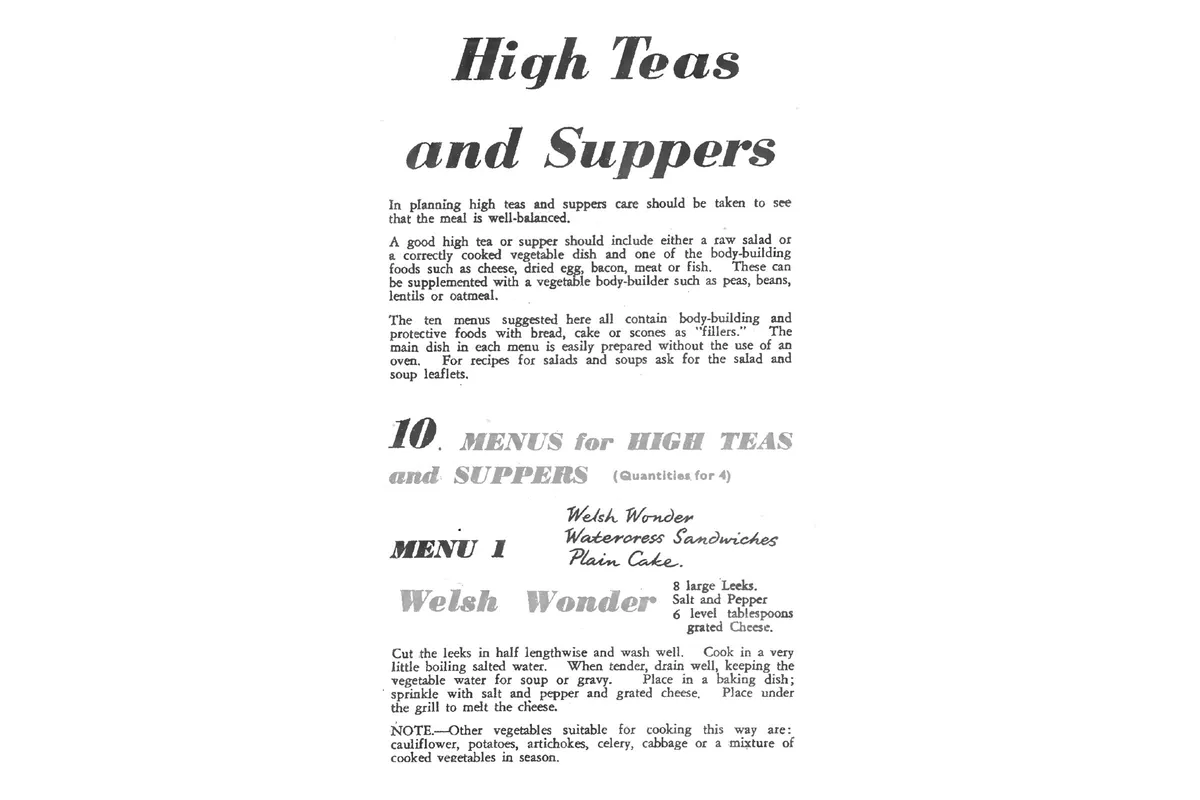
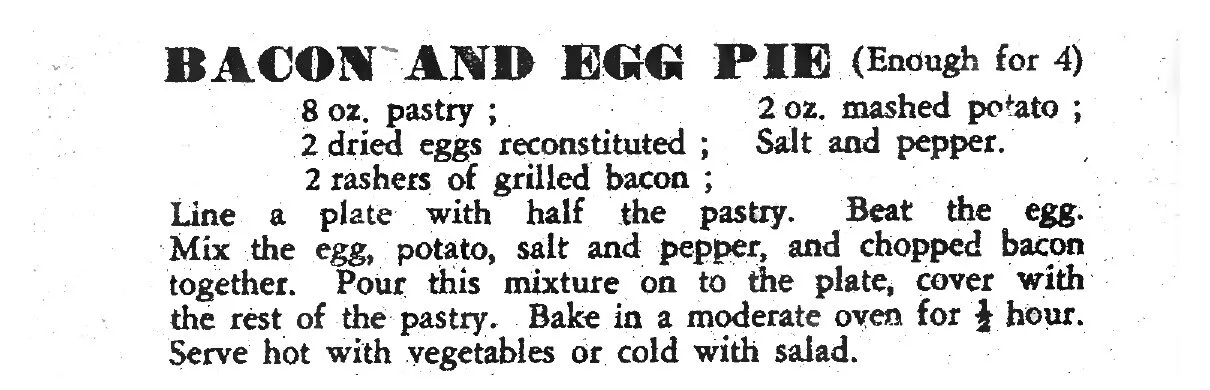
The Ministry printed its advice as numbered War Cookery Leaflets. High Teas and Suppers, No. 18, dated November 1944, gives ten menus with quantities for four. Each one pairs a salad or “a correctly cooked vegetable dish” with “one of the body-building foods such as cheese, dried egg, bacon, meat or fish,” and the main dish of every menu is made “without the use of an oven.” Dried Eggs, No. 11, followed in February 1945. Read beside the ration book, both are lessons in stretching a coupon: two rashers of bacon in a pie for four, six level spoonfuls of grated cheese over a dish of leeks for four in the year cheese stood at 2 oz a head, two pilchards in a supper for four.
The leaflets record what the Ministry advised, and nothing in them says which households cooked it. The same goes for the best-known Ministry dish of all, the vegetable pie named for the Minister, Lord Woolton, which TuneMyRecipe gives as Woolton Pie with a Pastry Lid (1941) (opens in a new tab). A ministry voice is on record in a booklet of recipes collected by the Women’s Voluntary Services in Mirfield, Yorkshire, too: William Mabane, the parliamentary secretary from 1942 to 1945, gives a supper dish of eight reconstituted eggs scrambled on National Bread toast under a cheese and mushroom sauce, the toast spread with margarine “if sufficient available.” The same booklet is the source of the Parkin (1940s).
Others ate on different terms. On 1 July 1945, with the British meat ration at 1s 2d, a French railway menu offered the Sultan of Morocco rolled sole and apricot ice on his way to Paris, as told in What Was on the Royal Train’s Menu in 1945?
The recipes
The four dishes follow a day, a midday dinner, a high tea and a supper, all from the two leaflets.
- Bacon and Egg Pie (1945): two rashers, two dried eggs and a little mashed potato between two rounds of pastry, for dinner hot with vegetables or cold with salad.
- Welsh Wonder (1944): whole leeks under grated cheese, browned under the grill, the main dish of Menu 1.
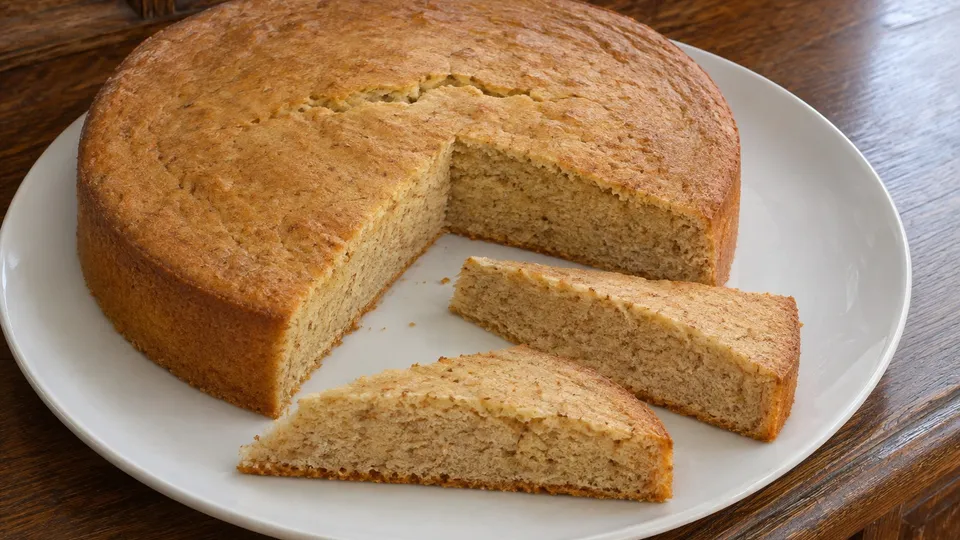
- Dried Egg Madeira Cake (1945): the leaflet’s cake of margarine, sugar and national flour with the egg powder beaten in dry, our pick for the “plain cake” on the same high tea.
- Pilchard Pancakes (1944): mashed potato and pilchards with leek and parsley, fried by the spoonful, from Menu 2.
Cooking it
The Madeira cake asks for 2½ oz of margarine and 3 oz of sugar, more than a third of one adult’s weekly sugar in 1945 and two-fifths of their butter and margarine, so weigh out the Dried Egg Madeira Cake (1945) with the table above beside the scale and see what one cake cost in coupons.
 Cook it todayDried Egg Madeira Cake (1945)
Sources
- Ministry of Food, How Britain Was Fed in War Time: Food Control 1939–1945 (London: HMSO, 1946), paras. 135 to 143 and Appendix D, paras. 1 to 29, pp. 42 to 45 and 56 to 61. Wellcome Collection copy.
- Ministry of Food, High Teas and Suppers, War Cookery Leaflet No. 18 (November 1944). National Library of Scotland (opens in a new tab).
- Ministry of Food, Dried Eggs, War Cookery Leaflet No. 11 (February 1945). National Library of Scotland (opens in a new tab).
- The Housewives’ Book of Recipes & Hints, collected by members of the W.V.S., Mirfield (Mirfield: A. Chadwick, printer, 1942 to 1945), p. 2.
- House of Commons debates, Hansard: 30 September 1941, “Rationed Foodstuffs (opens in a new tab),” cols. 473W to 475W; 3 November 1947, “Basic Rations (opens in a new tab),” cols. 142W to 144W; 22 October 1952, “Tea (opens in a new tab),” col. 1013; 24 June 1953, “Sugar Derationing (opens in a new tab),” col. 1884; 17 February 1954, “Meat and Bacon Derationing (opens in a new tab),” col. 1974, and “Rationed Foods (opens in a new tab),” cols. 203W to 204W; 5 July 1954, “Meat Supplies, East Scotland (opens in a new tab),” col. 1786.
- Megan E. Springate, “Sugar: The First and Last Food Rationed on the World War II Home Front (opens in a new tab),” National Park Service.