Ministry of Food, War Cookery Leaflet No. 4: Carrots · Great Britain
Did Carrots Really Help Britons See in the Blackout?
Only eyes short of vitamin A. The Ministry of Food said carrots helped people see in the blackout; the radar cover-up story has no wartime paper.
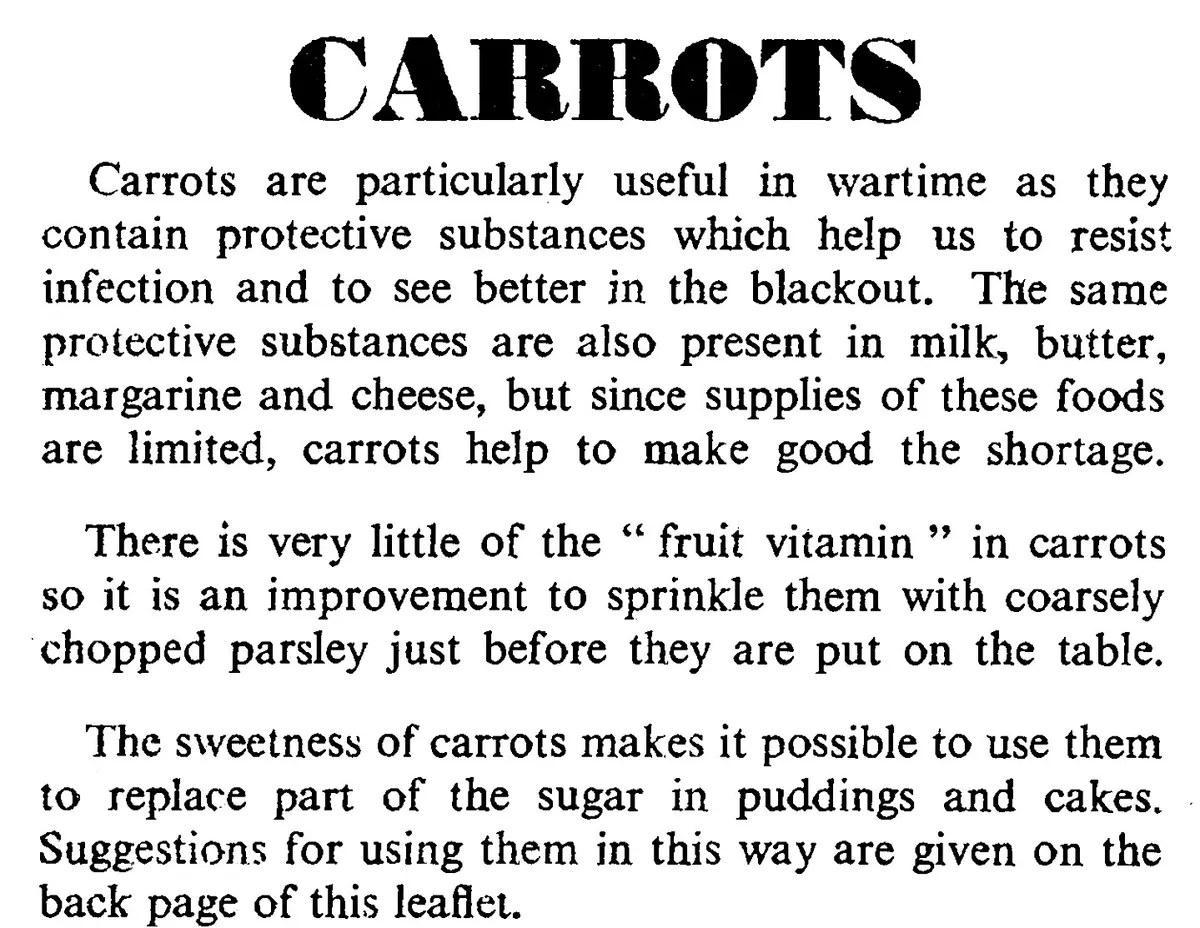
Carrots helped some Britons see in the blackout, but only those whose eyes were short of vitamin A, and they gave nobody better sight than normal. The Ministry of Food said as much in print. Its June 1944 leaflet on carrots opens by telling the housewife that they “contain protective substances which help us to resist infection and to see better in the blackout.” That much is documented. The story usually told beside it, that the whole idea was a ruse to hide Britain’s airborne radar from the Germans, is the part with no wartime paper behind it.
The leaflet
Carrots is No. 4 in the Ministry of Food’s War Cookery Leaflets: four pages in orange and grey, the Ministry’s crowned MF seal on the cover, and “June ’44” printed at the foot of the last page. The copy read here belongs to the National Library of Scotland. The opening paragraph explains why the carrot mattered. The same protective substances “are also present in milk, butter, margarine and cheese, but since supplies of these foods are limited, carrots help to make good the shortage.” By 1944 every one of those foods but milk had been on the ration for years: butter from January 1940, margarine from that July, cheese from May 1941, according to the Ministry’s own account published after the war, How Britain Was Fed in War Time. What the whole weekly ration came to, and how it changed until rationing ended in 1954, is set out in What Was a Week’s Food Ration in Britain, 1940 to 1954? The same account says the growing of carrots and green vegetables was pushed from early in the war to make up vitamins A and C while fruit was short.
The second paragraph owns up to a weakness. There is “very little of the ‘fruit vitamin’ in carrots,” the leaflet’s homely name for vitamin C, “so it is an improvement to sprinkle them with coarsely chopped parsley just before they are put on the table.” The third turns the carrot into a sugar-saver: “The sweetness of carrots makes it possible to use them to replace part of the sugar in puddings and cakes.” Sugar had been rationed since January 1940, and syrup and treacle joined the preserves ration in March 1941.
Then come the recipes, “All quantities for 4 persons”: two salads, a soup, a flan with oatmeal pastry, a savoury bake, croquettes, a carrot scramble made with dried egg and a cheese spread, and on the back page the sweet things the opening promised, an Ohio pudding, a carrot cake and a carrot charlotte. The leaflet ends with advice for the allotment: lift carrots in dry weather “not later than the middle of October,” reject the forked and blemished ones, and store the rest crown to tail in sand under straw.
Doctor Carrot
The blackout claim was three years old by then. A press advertisement in the collection of the History of Advertising Trust, catalogued under 1941, is headed “EYES IN THE BLACKOUT” and introduces “Doctor Carrot.” It credits him with “odd, unexpected little talents,” among them “giving savour to your sweets and sweetness to your savouries,” and adds that he “can actually … help you to see better in the blackout.” Its printed schedule shows how widely it was meant to run: the national Sundays, dailies and evenings, the provincial papers, and the English, Scottish and Welsh weeklies. The recipe under it was an American one, a Boston bake of white beans.
The idea travelled beyond Britain. On 30 May 1941 the New Zealand Listener printed a radio talk from station 4YA under the heading “Eat Carrots And See Well.” It explained that the body turns the carotene in carrots into vitamin A, which the eye needs to make visual purple, the pigment in the retina that lets it see in dim light.
Cat’s Eyes
The pilot whose name is tied to the carrot is John Cunningham of No. 604 Squadron. He claimed his first victory, a Junkers Ju 88, on 19 November 1940, and he finished with twenty, nearly all of them at night. The British press called him “Cat’s Eyes.” What found him his targets in the dark was airborne interception radar, secret at the time, worked from the end of 1940 in his Bristol Beaufighter by his operator, Jimmy Rawnsley.
Later accounts, Smithsonian magazine’s in 2013 among them, say the newspapers put his success down to carrots. None of those accounts cites a dated newspaper story of 1940 or 1941 that makes the link, so the Cunningham carrots stay a reported story.
The radar story
The fuller version runs like this: the Air Ministry, wanting to hide airborne radar, put it about that its night fighter crews ate carrots, and the Germans believed it. No wartime document setting out such a plan has turned up. Bryan Legate, an assistant curator at the RAF Museum, told Scientific American in 2014, as Smithsonian magazine reports, that the British “never set out to use it to fool the Germans,” and that “the German intelligence service were well aware of our ground-based radar installation.”
The leaflet itself points elsewhere. Its blackout line is written for households, and the reason it gives is the shortage of butter and cheese. Whatever the Air Ministry did or didn’t say about Cunningham, the Ministry of Food had its own reasons to praise the carrot, and they were in the larder: a country short of fats, cheese and sugar, with carrots it could grow at home.
What carrots can do for the eye
The Ministry’s science was sound as far as it went. Vitamin A is “an essential component of rhodopsin, the light-sensitive protein in the retina,” in the words of the US Office of Dietary Supplements, whose fact sheet names night blindness as the first sign of a deficiency and lists carrots among the richest plant sources of provitamin A. An eye short of vitamin A sees badly in low light, and carrots can put that right. Smithsonian’s 2013 account marks where the promise ends: vitamin A mends sight that a deficiency has damaged and does nothing for the sight of people who are healthy. A well-fed warden gained nothing in the dark from an extra plateful.
The recipes
The leaflet prints recipes and no menu, so the order here is ours: a soup, a savoury main course and a pudding from the leaflet, then a teatime gingerbread from a booklet of the same years. The leaflet’s ovens are “moderate” or “top of oven,” and the temperatures on the recipe pages are our reading of them.
- Carrot and Potato Soup (1944): carrots and potatoes simmered with onion and cloves, sieved, and thickened with a little flour and milk.
- Cheese and Carrot Flan (1944): oatmeal pastry with chopped carrots under a cheese sauce, browned at the top of the oven.
- Carrot Charlotte (1944): carrots cooked with syrup, sultanas and orange essence, layered with suet crumbs and turned out with custard.
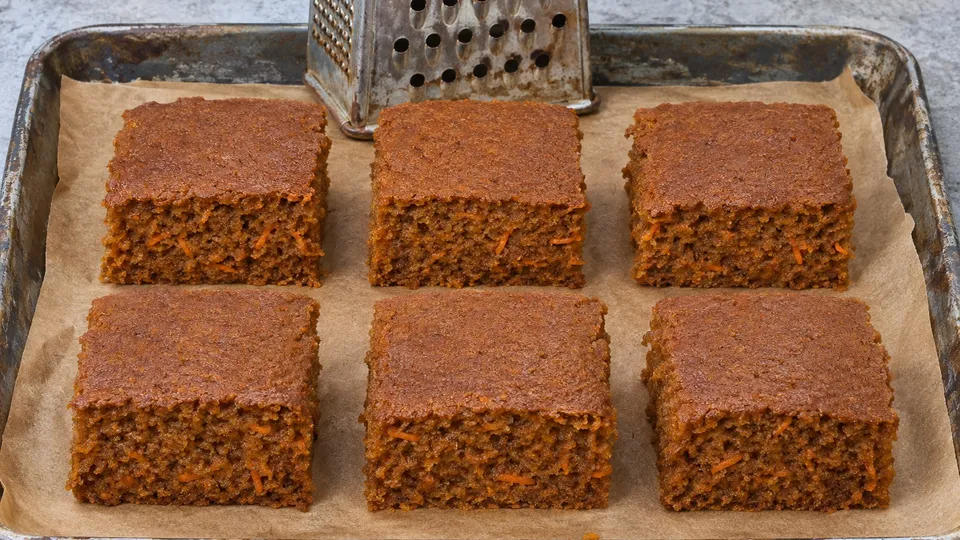
- Carrot Gingerbread (1940s): a pound of grated carrot to half a pound of flour and an ounce of sugar, from the Mirfield W.V.S. booklet.
The gingerbread leans on the carrot harder than anything in the leaflet. Its contributor, D. M. Brooke, put a pound of it into the tin with a single ounce of sugar and let the carrot and two spoonfuls of syrup do the sweetening. Carrots had been drafted in the First World War too: American lunch rooms baked a carrot and green pea loaf on their wheatless days, as How Did You Feed a Hundred People Without Wheat in 1918? tells. Nearer home, a Christmas leaflet of 1941 had already bound its eggless pudding with grated raw carrot and potato, in What Was on a Wartime Christmas Menu in 1941? By 1944 the British carrot was asked to stand in for butter, cheese and sugar at once.
Cooking it
Grate the pound of carrot for the Carrot Gingerbread (1940s) on the finest holes of the grater, because in D. M. Brooke’s tin it is the carrot, far more than the ounce of sugar, that sweetens an hour in a moderate oven.
 Cook it todayCarrot Gingerbread (1940s)
Sources
- Ministry of Food, Carrots, War Cookery Leaflet No. 4 (London: Ministry of Food, June 1944), pp. 1–4. National Library of Scotland. digital.nls.uk (opens in a new tab).
- Ministry of Food, How Britain Was Fed in War Time: Food Control 1939–1945 (London: HMSO, 1946), pp. 47, 56–57. Wellcome Collection.
- The Housewives’ Book of Recipes & Hints, collected by members of the W.V.S., Mirfield (Mirfield: A. Chadwick, printer, between 1942 and 1945), Carrot Gingerbread, D. M. Brooke, p. 14. Wellcome Collection. Internet Archive (opens in a new tab).
- “Eyes in the blackout (Dr Carrot),” press advertisement, 1941, History of Advertising Trust, HATOM/8/10. history-commons.net (opens in a new tab).
- “Eat Carrots And See Well,” New Zealand Listener, 30 May 1941, p. 5. Papers Past (opens in a new tab).
- Annabelle Smith, “A WWII Propaganda Campaign Popularized the Myth That Carrots Help You See in the Dark,” Smithsonian Magazine, 13 August 2013. smithsonianmag.com (opens in a new tab).
- Battle of Britain London Monument, “The Airmen’s Stories: F/O J. Cunningham,” for his squadron, first victory, Beaufighter, operator, nickname and the radar cover story. bbm.org.uk (opens in a new tab).
- Office of Dietary Supplements, US National Institutes of Health, “Vitamin A and Carotenoids: Fact Sheet for Health Professionals” (updated 15 June 2022). ods.od.nih.gov (opens in a new tab).