Carrot Gingerbread (1940s)
Reader ratingsA wartime carrot gingerbread from the Mirfield W.V.S. booklet: a pound of grated carrot to half a pound of flour, ginger, mixed spice and an ounce of sugar.
- Recipe makes
- One 8-inch square tin, 12 pieces
- Prep
- Cook
- Total
Grating the carrot takes most of the preparation. The gingerbread bakes for about an hour and cools in the tin for 30 minutes before it is cut.
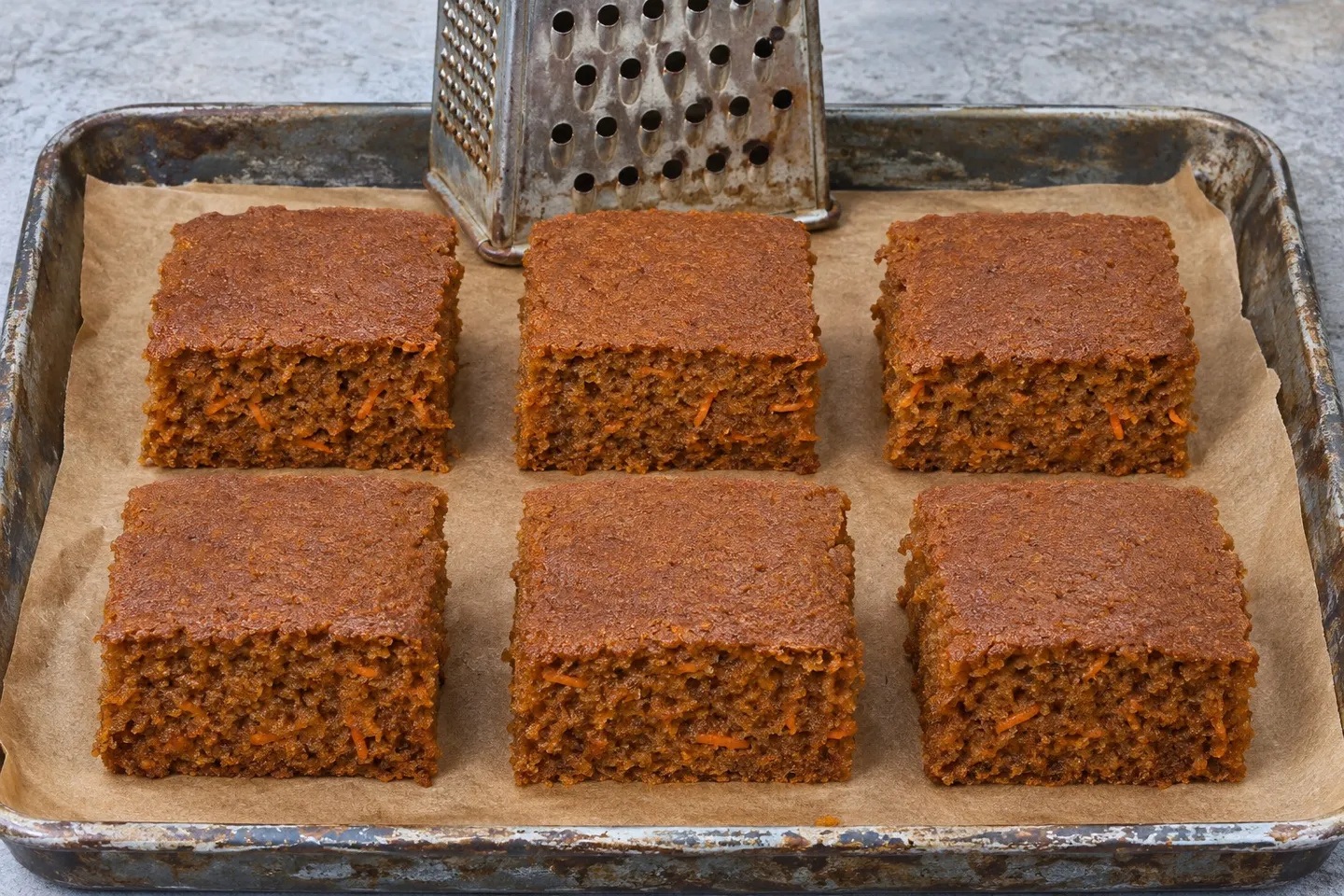
Carrot gingerbread cut into squares on brown paper, beside a grater.
The story behind the recipe
Carrot gingerbread is a gingerbread that the carrot sweetens, and in this one from a Yorkshire wartime booklet the carrot outweighs the flour two to one. The recipe is signed by D. M. Brooke in The Housewives’ Book of Recipes & Hints, a small collection printed at Mirfield, in the West Riding, by members of the Women’s Voluntary Services. Against a pound of grated carrot and half a pound of flour it sets a single ounce of sugar and two tablespoons of syrup, with ginger and mixed spice for the gingerbread part. It closes the meal, at tea.
An ounce of sugar for the tin
The Ministry of Food told cooks in its 1944 leaflet Carrots that their sweetness could take the place of part of the sugar in cakes and puddings. D. M. Brooke took that further than the leaflet itself: its carrot cake takes three tablespoons of grated carrot to six ounces of flour. The weekly sugar ration came down to eight ounces a head in May 1940, the Ministry’s postwar history How Britain Was Fed in War Time records, and a Ministry advertisement of January 1944 still gives it as eight. A whole tin of this gingerbread took one-eighth of one person’s week of sugar. The syrup was rationed too, with the jam, from March 1941.
The booklet carries no date, but its first recipe is signed by William Mabane as parliamentary secretary to the Ministry of Food, a post he held from 1942 to 1945, and others call for dried egg and National Bread. That places Brooke’s gingerbread in the same years as the Ministry’s leaflet. It takes no egg at all; shell eggs had been under Ministry control since June 1941, the same history notes. Its whole method fits in six short sentences and leaves the tin and the heat to the cook, who is told only to add a little milk “if too dry.”
Read more about this recipe
Making it today
The booklet’s “Fat” is unnamed; margarine or butter will do, and we read “Syrup” as golden syrup, as the booklet’s toffee recipes name it when they mean it. Its “Baking Soda” is bicarbonate of soda. We supply the tin size, the 350°F (175°C) oven and the doneness test, and we grate the carrot finely, since the booklet leaves the grater to the cook and the carrot has to cook through in an hour.
How the carrot came to stand in for sugar, and why the Ministry said it helped people see in the blackout, is told in Did Carrots Really Help Britons See in the Blackout? From the same booklet comes the Parkin (1940s) of a West Riding Bonfire Night, sweetened the old way, with syrup and sugar both.
Sift flour, soda and spices into a basin. Add carrot. ...
Recipe makes: One 8-inch square tin, 12 pieces
Ingredients
For One 8-inch square tin, 12 pieces. Quantities are shown as written.
Quantities as written here, for One 8-inch square tin, 12 pieces.
- Plain flour8 oz
- Bicarbonate of soda1 tsp
- Mixed spice2 tsp
- Ground ginger1 tsp
- Carrots, finely grated1 lb
- Golden syrup2 tbsp
- Margarine or butter4 oz
- Granulated sugar1 oz
- Milk, if needed2 fl oz
Measurement notes
Ingredients as written here
- 8 oz plain flour
- 1 tsp bicarbonate of soda
- 2 tsp mixed spice
- 1 tsp ground ginger
- 1 lb carrots, finely grated
- 2 tbsp golden syrup
- 4 oz margarine or butter
- 1 oz granulated sugar
- 2 fl oz milk, if needed
Equipment
 8-inch square pan
 Baking parchment
 Box grater
 Sifter or fine sieve
 Mixing bowl
 Small saucepan
 Skewer or instant-read thermometer
 Wire rack
Instructions
Heat the oven to 350°F (175°C). Grease the square pan and line it with baking parchment.
Sift the flour, bicarbonate of soda, mixed spice and ginger into the mixing bowl. Stir in the carrots.
Put the golden syrup, margarine or butter and sugar in the small saucepan and heat gently, stirring, until the fat has melted and the sugar has dissolved.
Pour the warm syrup mixture over the dry ingredients and mix well. If the mixture is too stiff to stir easily, add the milk a little at a time until it drops from the spoon.
Spread the mixture in the pan and level the top.
Bake for about 1 hour, until the top is firm and springs back, a skewer in the middle comes out clean, and the center reads 200°F (93°C).
Cool in the pan for 30 minutes, then lift it out onto the wire rack. Cut into 12 pieces.
Nutrition
175calories per serving
- Recipe makes
- One 8-inch square tin, 12 pieces
- Servings
- 12
Estimated per piece (12) from USDA FoodData Central values for flour, carrots, golden syrup, margarine and sugar.
Recipe notes
When adjusting quantities
The booklet’s quantities fill one 8-inch square tin. A double batch needs a larger tin and a longer bake; test the middle.
Notes
Quantities mentioned in these notes don’t change when you adjust the servings.
The booklet gives no tin size, oven temperature or doneness test; ours are an 8-inch square pan, 350°F (175°C) and a center of 200°F (93°C). Its “Fat” is given here as margarine or butter, its “Syrup” as golden syrup and its “Baking Soda” as bicarbonate of soda. The milk is “a little” in the booklet; 2 fl oz is our upper limit. Grate the carrots finely and don’t squeeze them, since their juice is part of the liquid.
Scaling changes the ingredients only; pan sizes and cooking times need their own judgment. To adapt this recipe further, try the recipe tool at TuneMyRecipe (opens in a new tab), our sister site.


Sources and attribution
After D. M. Brooke, Carrot Gingerbread, in The Housewives’ Book of Recipes & Hints, W.V.S. Mirfield (Mirfield: A. Chadwick, 1942 to 1945), p. 14
See the original pages (scan at Internet Archive) (opens in a new tab)
Recipe details
- Course
- Bread & baking
- Dish family
- Breads & Cakes
- Region
- British
- Source decade
- 1940s
- Main ingredient
- VegetablesSpices
- Difficulty
- Easy
- Occasion
- Rationing
- Season
- Autumn