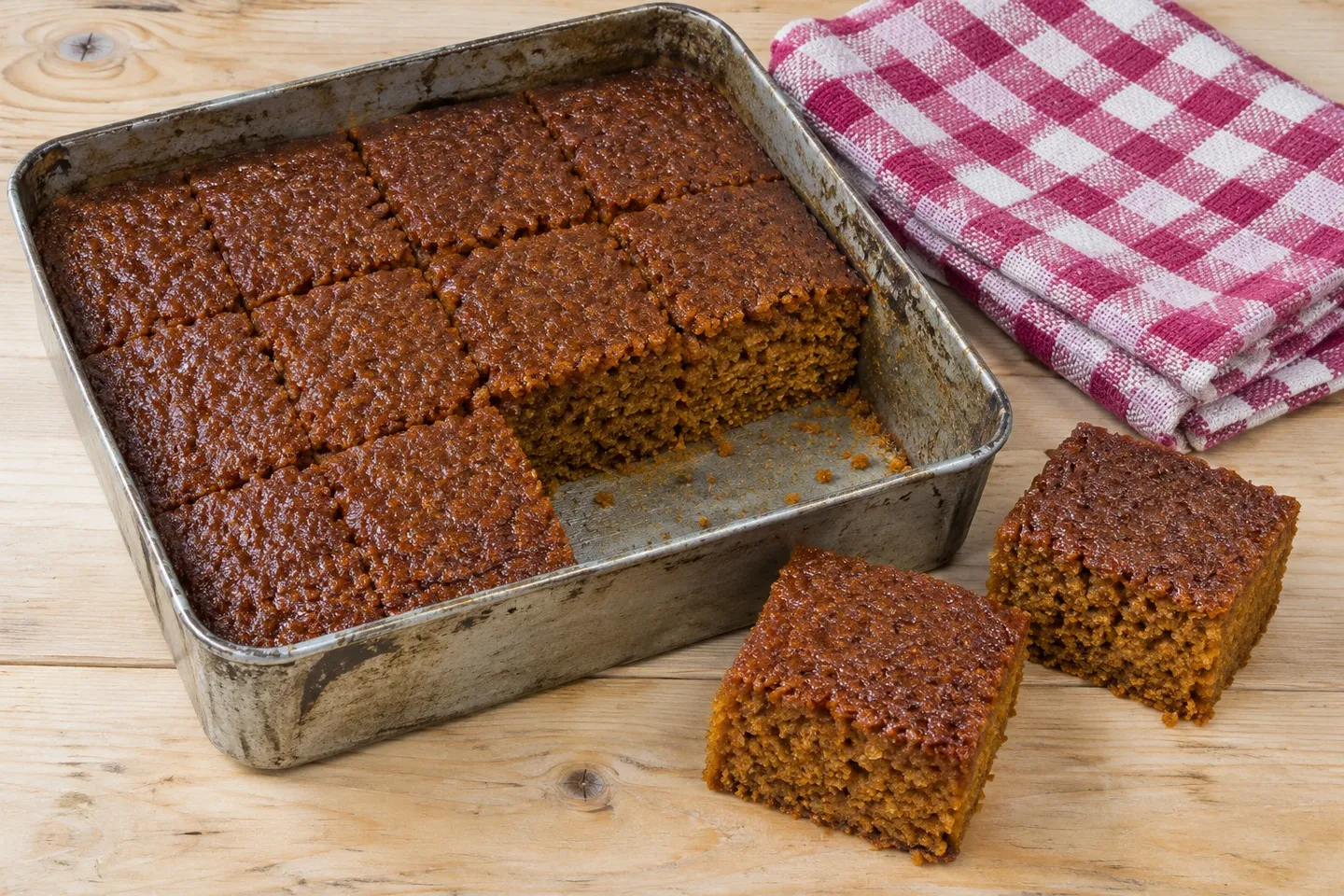
Parkin (1940s)
Reader ratingsYorkshire parkin from a wartime W.V.S. booklet printed in Mirfield: flour and oatmeal with syrup, butter and lard, ginger and allspice, baked slowly in a square tin.
- Recipe makes
- One 8-inch square tin, 16 squares
- Prep
- Cook
- Total
Parkin bakes slowly for about an hour. Kept in a tin, it softens over a few days, so bake it ahead of the night you want it.
Parkin cut into squares in its tin, with two pieces set out beside it.
The story behind the recipe
Parkin is the oatmeal gingerbread of the north of England, and in the West Riding of Yorkshire it is the cake of the fifth of November. This one comes from a small wartime booklet printed in Mirfield, in the West Riding, where members of the Women’s Voluntary Services gathered their recipes and put their names to them. The parkin is signed by Mrs. W. Jackson of Gregory Springs Road.
What goes into a parkin?
Hers is a plain pattern: more flour than oatmeal, a sweetening of syrup and sugar, butter and lard together, and ground ginger with allspice. Soda and baking powder lift it, and eggs and milk bind it. The booklet even prints its own table of measures, so her teacup can be read as the Mirfield cooks read it.
The syrup is the one ingredient that leaves a choice. The food historian Jennifer Stead traces treacle in northern oatmeal cakes back to the seventeenth century, when it took the place of honey, but the booklet says only “Syrup.” Its toffee recipes name golden syrup when they mean it, so we read hers as golden syrup too; black treacle makes a darker cake.
Read more about this recipe
A cake from the war years
Nothing in the booklet carries a date, but its first recipe is signed by William Mabane as parliamentary secretary to the Ministry of Food, a post he held from 1942 to 1945, and other recipes in it call for dried egg and National Bread. Sugar, butter and lard were all rationed then, so the sugar and the two fats in Mrs. Jackson’s tin came out of the household’s weekly allowance. There is no fruit and no peel.
Her whole method runs to two sentences: “Melt butter, beat sugar and eggs together, add other ingredients. Cook in a slow oven.” The size of the tin and the moment to take it out are left to the cook.
Making it today
We melt the lard with the butter and warm the syrup with them, so all three go into the dry mixture together, and beat the eggs and sugar first, as she says. Her “slow oven” becomes 300°F (150°C), and the tin is our choice. Treacle cakes were baked hard and softened as they kept, Stead notes, so it can be made a few days ahead.
How parkin came to belong to Bonfire Night, long after the Gunpowder Plot, is told in Why Is Parkin Eaten on Bonfire Night? Its partner at the bonfire is Treacle Toffee (1906), boiled from black treacle.
Melt butter, beat sugar and eggs together, add other ingredients. ...
Recipe makes: One 8-inch square tin, 16 squares
Ingredients
For One 8-inch square tin, 16 squares. Quantities are shown as written.
Quantities as written here, for One 8-inch square tin, 16 squares.
- Plain flour10 oz
- Medium oatmeal5 oz
- Ground ginger1 tsp
- Ground allspice1 tsp
- Bicarbonate of soda1 tsp
- Baking powder2 tsp
- Golden syrup4 oz
- Butter3 oz
- Lard3 oz
- Granulated sugar4 oz
- Large eggs2
- Milk (half a teacupful)2 1/2 fl oz
Measurement notes
Ingredients as written here
- 10 oz plain flour
- 5 oz medium oatmeal
- 1 tsp ground ginger
- 1 tsp ground allspice
- 1 tsp bicarbonate of soda
- 2 tsp baking powder
- 4 oz golden syrup
- 3 oz butter
- 3 oz lard
- 4 oz granulated sugar
- 2 large eggs
- 2.5 fl oz milk (half a teacupful)
Equipment
- 8-inch (20 cm) square cake tin
 Baking parchment
 Small saucepan
 Mixing bowl
 Whisk
 Instant-read thermometer
Instructions
Heat the oven to 300°F (150°C). Grease the square tin and line it with baking parchment.
Mix the flour, oatmeal, ginger, allspice, bicarbonate of soda and baking powder in the mixing bowl.
Put the golden syrup, butter and lard in the small saucepan and warm them gently until the fats have melted. Let the mixture cool for a few minutes.
Whisk the sugar and eggs together in a jug or bowl until pale and frothy.
Pour the melted syrup and fats into the dry mixture, add the egg mixture and the milk, and stir until smooth and evenly mixed.
Pour the mixture into the tin and level it.
Bake for 55 to 65 minutes, until the top is firm and springs back, a skewer in the middle comes out clean, and the center reads 200°F (93°C).
Cool in the tin for 20 minutes, then lift it out and leave it on a rack until cold. Cut into 16 squares.
Nutrition
210calories per serving
- Recipe makes
- One 8-inch square tin, 16 squares
- Servings
- 16
Estimated per square (16) from USDA FoodData Central values for flour, oatmeal, golden syrup, butter, lard, sugar, eggs and milk.
Recipe notes
When adjusting quantities
Mrs. Jackson’s quantities fill one 8-inch square tin. A larger batch needs a larger tin and a longer bake; test the middle.
Notes
Quantities mentioned in these notes don’t change when you adjust the servings.
The booklet gives no tin size, oven temperature or baking time; those are ours. It says “Syrup” without saying which; we use golden syrup, and black treacle can replace it. It calls for “Carbonate Soda,” which in wartime British recipes meant bicarbonate of soda. We melt the lard with the butter, which the method leaves unsaid, and give the half teacupful of milk by the booklet’s own table, which makes a teacupful a quarter of a pint. Medium oatmeal is our choice of grind.
Scaling changes the ingredients only; pan sizes and cooking times need their own judgment. To adapt this recipe further, try the recipe tool at TuneMyRecipe (opens in a new tab), our sister site.
Sources and attribution
After Mrs. W. Jackson, Parkin, in The Housewives’ Book of Recipes & Hints, W.V.S. Mirfield (Mirfield: A. Chadwick, 1942 to 1945), p. 10
See the original pages (scan at Internet Archive) (opens in a new tab)
Recipe details
- Course
- Bread & baking
- Dish family
- Breads & Cakes
- Region
- British
- Source decade
- 1940s
- Event
- Bonfire Night
- Main ingredient
- Grains & riceSpices
- Difficulty
- Easy
- Occasion
- Rationing
- Season
- Autumn