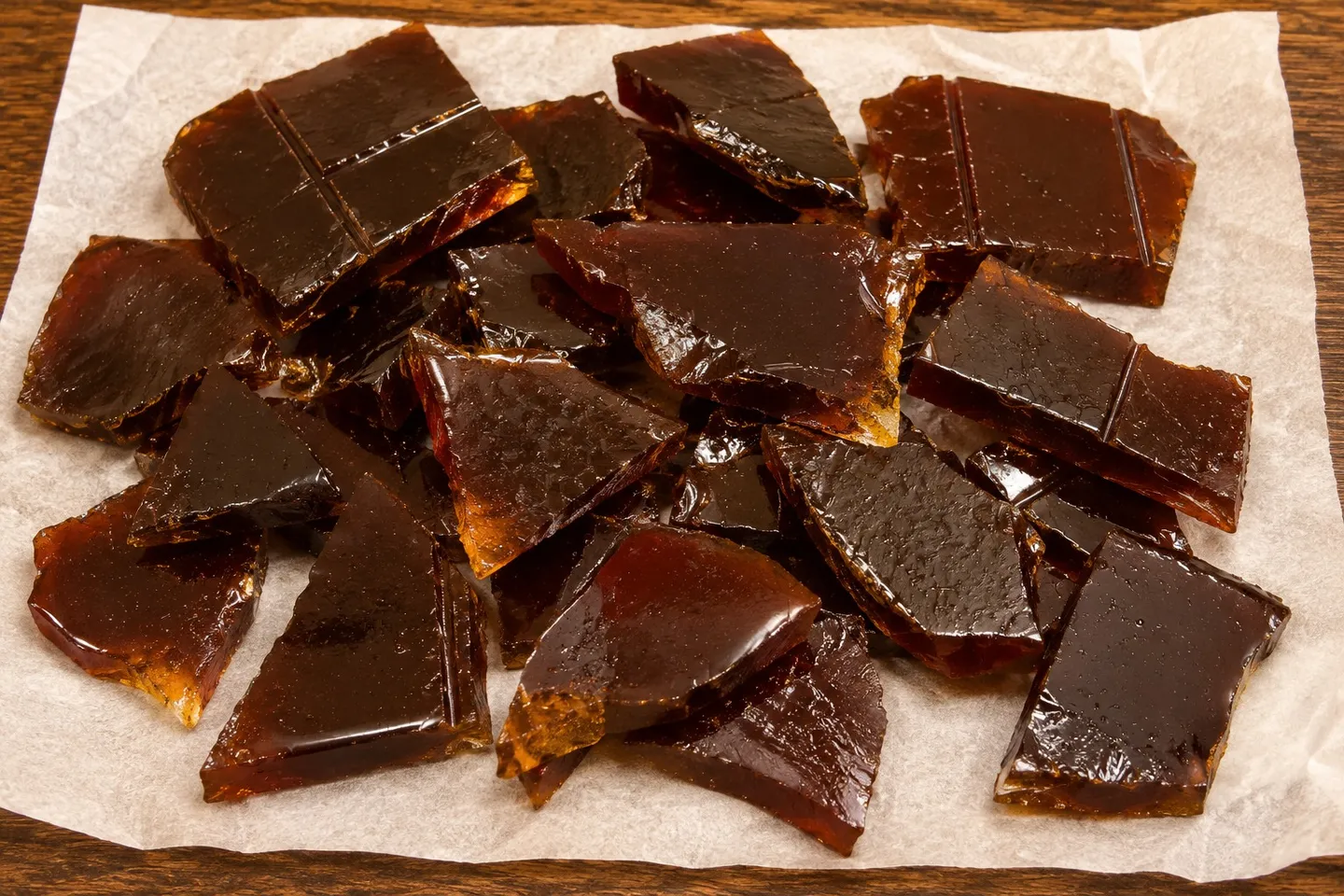
Treacle Toffee (1906)
Reader ratingsBlack treacle and brown sugar boiled with vinegar to the large ball, whitened with soda, enriched with butter and boiled on to the crack: treacle toffee from the 1906 Mrs. Beeton.
- Recipe makes
- About 1 lb 12 oz of toffee, 40 pieces
- Prep
- Cook
- Total
The boiling takes about 25 minutes with a sugar thermometer in the pan. The toffee then needs about 45 minutes to set before it can be broken.
Treacle toffee broken into pieces along its marked bars, on baking parchment.
The story behind the recipe
Treacle toffee, dark and brittle, is the sweet of Bonfire Night in the north of England. In Leeds in 1862 it went by the name of succour: a glossary of the town’s dialect printed that year makes it of treacle, sugar, vinegar and butter, and says it was widely boiled on the anniversary of the Gunpowder Plot. This version comes from the 1906 edition of Mrs. Beeton’s Book of Household Management, the London household book, revised long after Isabella Beeton’s death and by then printing more than a dozen toffees.
What makes it treacle toffee?
Beeton’s recipe is short, and treacle makes up nearly all of it, with a little brown sugar, butter, vinegar and soda, and almond essence to taste.
The book also says what the soda is for. Carbonate of soda, it explains, “serves to whiten the toffee,” and goes in off the heat, dissolved in a little hot water, once the treacle has reached the “large ball.” Then the butter and almond go in and it boils again, to the “little crack,” before it is poured into an oiled or buttered tin.
Read more about this recipe
Degrees of sugar
The 1906 book gives a table of temperatures for sugar boiling, from the small thread at 215°F (102°C) to caramel at 350°F (177°C), and for each a test by hand, with a skimmer or with a fingertip dipped in cold water. The large ball comes at 247°F (119°C), when the sugar on the finger can be formed into “a larger and harder ball.” The small crack is 290°F (143°C), when the sugar “breaks with a slight noise” and sticks to the teeth. The book’s recipe calls that stage the little crack, and we use its own figure for it.
Making it today
A sugar thermometer does the work of the finger test. We use black treacle for the book’s treacle and soft dark brown sugar for its “brown sugar.” Beeton wanted “essence of almonds” to taste; half a teaspoon of almond extract is our measure. The tin is ours too.
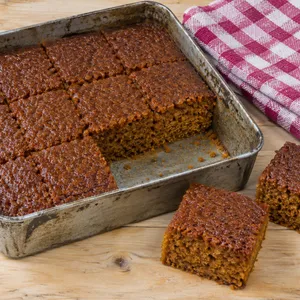
How treacle and oatmeal became the food of the fifth of November is told in Why Is Parkin Eaten on Bonfire Night? The cake that goes with it is the wartime Yorkshire Parkin (1940s).
Place the sugar in a sugar-boiler or stewpan, pour on the vinegar, and when dissolved add the treacle and boil to the “large ball” degree. ...
Recipe makes: About 1 lb 12 oz of toffee, 40 pieces
Ingredients
For about 1 lb 12 oz of toffee, 40 pieces. Quantities are shown as written.
Quantities as written here, for about 1 lb 12 oz of toffee, 40 pieces.
- Oil or butter for the tin
- Soft dark brown sugar2 oz
- Malt vinegar (half a gill)2 1/2 fl oz
- Black treacle28 oz
- Bicarbonate of soda1/2 tsp
- Hot water1 tbsp
- Butter1 oz
- Almond extract1/2 tsp
Measurement notes
Ingredients as written here
- oil or butter for the tin
- 2 oz soft dark brown sugar
- 2.5 fl oz malt vinegar (half a gill)
- 28 oz black treacle
- 1/2 tsp bicarbonate of soda
- 1 tbsp hot water
- 1 oz butter
- 1/2 tsp almond extract
Equipment
- Large heavy saucepan, at least 4 litres, since treacle boils up high
- Sugar thermometer
- Shallow tin, about 8 by 12 inches (20 by 30 cm)
- Small cup
 Wooden spoon
 Sharp knife
Instructions
Oil or butter the shallow tin with the oil or butter for the tin.
Put the brown sugar and vinegar in the large saucepan and stir over low heat until the sugar has dissolved.
Add the black treacle, clip the sugar thermometer to the side of the pan, and bring the mixture to the boil over medium heat. Boil, stirring now and then, until it reaches 247°F (119°C).
Dissolve the bicarbonate of soda in the hot water in the small cup.
Take the pan off the heat and stir in the dissolved soda. The mixture will foam up and lighten in color. Stir in the butter and the almond extract.
Return the pan to medium heat and boil, stirring gently, until it reaches 290°F (143°C).
Pour the toffee at once into the tin. Do not touch it: it is far hotter than boiling water.
When it is partly set, after about 15 minutes, mark it into bars with an oiled knife. Leave it for about 30 minutes more, until it is completely hard, then turn it out and break it along the marks.
Nutrition
85calories per serving
- Recipe makes
- About 1 lb 12 oz of toffee, 40 pieces
- Servings
- 40
Estimated per piece (40) from USDA FoodData Central values for molasses, brown sugar, butter and malt vinegar.
Recipe notes
When adjusting quantities
Make no more than this in one pan: treacle foams up when the soda goes in, and a deeper batch takes longer to reach temperature.
Notes
Quantities mentioned in these notes don’t change when you adjust the servings.
The 1906 recipe calls for a pint of treacle; we give it by weight, about 28 oz. Its “little crack” is boiled to 290°F (143°C), the book’s own figure for the small crack in its table of sugar degrees. The almond measure, the tin size and the setting times are ours. Store the pieces in an airtight tin, between sheets of parchment.
Scaling changes the ingredients only; pan sizes and cooking times need their own judgment. To adapt this recipe further, try the recipe tool at TuneMyRecipe (opens in a new tab), our sister site.
Sources and attribution
After Mrs. Beeton’s Book of Household Management, new edition (London, 1906), no. 2353
See the original pages (scan at Internet Archive) (opens in a new tab)
Recipe details
- Course
- Dessert
- Dish family
- Desserts & Sweets
- Region
- British
- Era
- Edwardian
- Source decade
- 1900s
- Event
- Bonfire Night
- Difficulty
- Intermediate
- Season
- Autumn