The first bonfires for the king’s escape from the Gunpowder Plot · London
Why Is Parkin Eaten on Bonfire Night?
Parkin and treacle toffee became the food of 5 November in the north of England long after 1605. A wartime Yorkshire parkin, and the toffee from Mrs Beeton.
Parkin, a dark, sticky oatmeal gingerbread, is eaten on Bonfire Night because the working people of the West Riding of Yorkshire made it the food of the fifth of November, and the firm evidence for that comes more than two centuries after the Gunpowder Plot. A glossary of the Leeds dialect printed in 1862 calls the fifth “the great Parkin day,” when the eating of it was “general amongst the working-classes.” The bonfires themselves go back to 1605. No record puts parkin beside them then.
Bonfires for the king
The plot to blow up King James I at the opening of Parliament was discovered in the night of 4 to 5 November 1605. When the news spread that he had survived, Londoners lit bonfires, and the king’s council allowed them, the historian Antonia Fraser records, so long as they were “without any danger or disorder.”
Parliament met again in January 1606 and passed the Thanksgiving Act, “An Act for a Public Thanksgiving to Almighty God every Year on the Fifth Day of November.” Its original is in the Parliamentary Archives. It made services and sermons on the plot a fixture of every 5 November. The bells and bonfires, UK Parliament’s history of the plot says, were a tradition that grew up around the day, and fireworks were part of some of the earliest celebrations. Food plays no part in that account.
An oatmeal cake from the West Riding
Parkin belongs to the oat country of the north, where oats, not wheat, were the staple grain of the poor. The oldest dated mention usually given is a West Riding Quarter Sessions record of 1728, in which a woman named Anne Whittaker was accused of stealing oatmeal to make parkin. Treacle, the syrup left over from refining sugar, took the place of honey in the oatmeal cakes called tharf cakes once sugar from Barbados began reaching England around 1650, as the food historian Jennifer Stead tells it. In her study of northern food she names the bonfire itself as the link between parkin and the fifth of November.
The London cookbooks took little notice. We found no parkin in Eliza Acton’s Modern Cookery of 1845 or in either the 1861 or the 1906 Book of Household Management. Toffee they did print. Acton gives an “Everton Toffie,” named for Everton, near Liverpool, and by 1906 the Beeton book had more than a dozen toffees, among them a treacle toffee boiled with brown sugar, butter and vinegar, then whitened with soda.
Parkin day in Leeds
The Leeds glossary, The Dialect of Leeds and its Neighbourhood, was published in London in 1862 and is credited to C. Clough Robinson. It gives bonfire night an entry of its own and says the town kept it “probably more generally and zealously than in any other part of the kingdom.” Children spent the day going from house to house begging “chumps,” wood for the fire, and coal, then went after branches, loose rails and fencing, hiding until dark whatever they could not carry off unseen. The night brought fireworks, small cannon and the guy, “and a parkin-cake to finish up with.” Under parkin the book describes cakes of treacle and oatmeal, a common food of children, and adds that on the fifth “enormous quantities” were sold by the bakers and confectioners.
The same glossary names the sweet. Its “succour” is treacle, sugar, vinegar and butter boiled together, spread in pudding tins until cool and broken up, and on the anniversary of the Gunpowder Plot, it says, the boiling of succour was very general, “even amongst the better class of tradespeople.” The Beeton treacle toffee is made from the same four, with soda and almond added.
Later collectors found the same custom across the West Riding. A note by the Rev. Sabine Baring-Gould, signed with his initials, in William Henderson’s Notes on the Folk-Lore of the Northern Counties of England and the Borders (1879) says that on the fifth, parkin “is found in every house in the West Riding.” Because it was eaten for several days beforehand, he had “no doubt” it had begun as part of the All Hallows’ feast, and he noted that the Sunday within the octave of All Saints was called Parkin Sunday. He offered no record for that origin. Joseph Wright’s English Dialect Dictionary ties parkin to about the fifth of November and quotes a Yorkshire dialect almanac of 1878, John Hartley’s Clock Almanack: “Th’ childer’s all lukkin’ forrad to th’ plot an’ parkin’.”
A parkin from wartime Mirfield
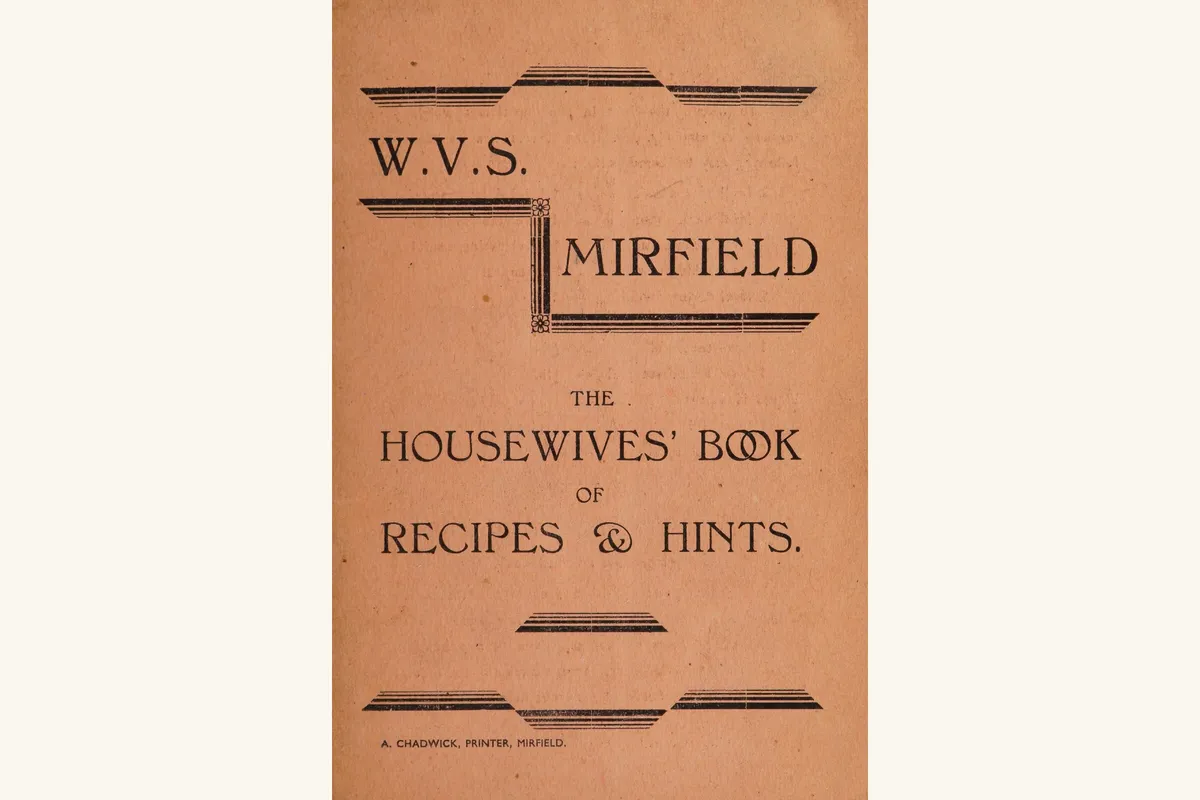
For a parkin in a cook’s own words, the source is a small orange booklet printed in Mirfield, a mill town on the River Calder in the West Riding. The Housewives’ Book of Recipes & Hints gathers recipes “collected by members of the W.V.S.,” the Women’s Voluntary Services, to help with “the problems of war-time housekeeping.” It carries no date, but its first recipe, a supper dish, comes “From Wm. Mabane, Esq., M.P., Parliamentary Secretary to the Ministry of Food,” a post he held from 1942 to 1945, and its recipes call for dried egg, reconstituted eggs and National Bread.
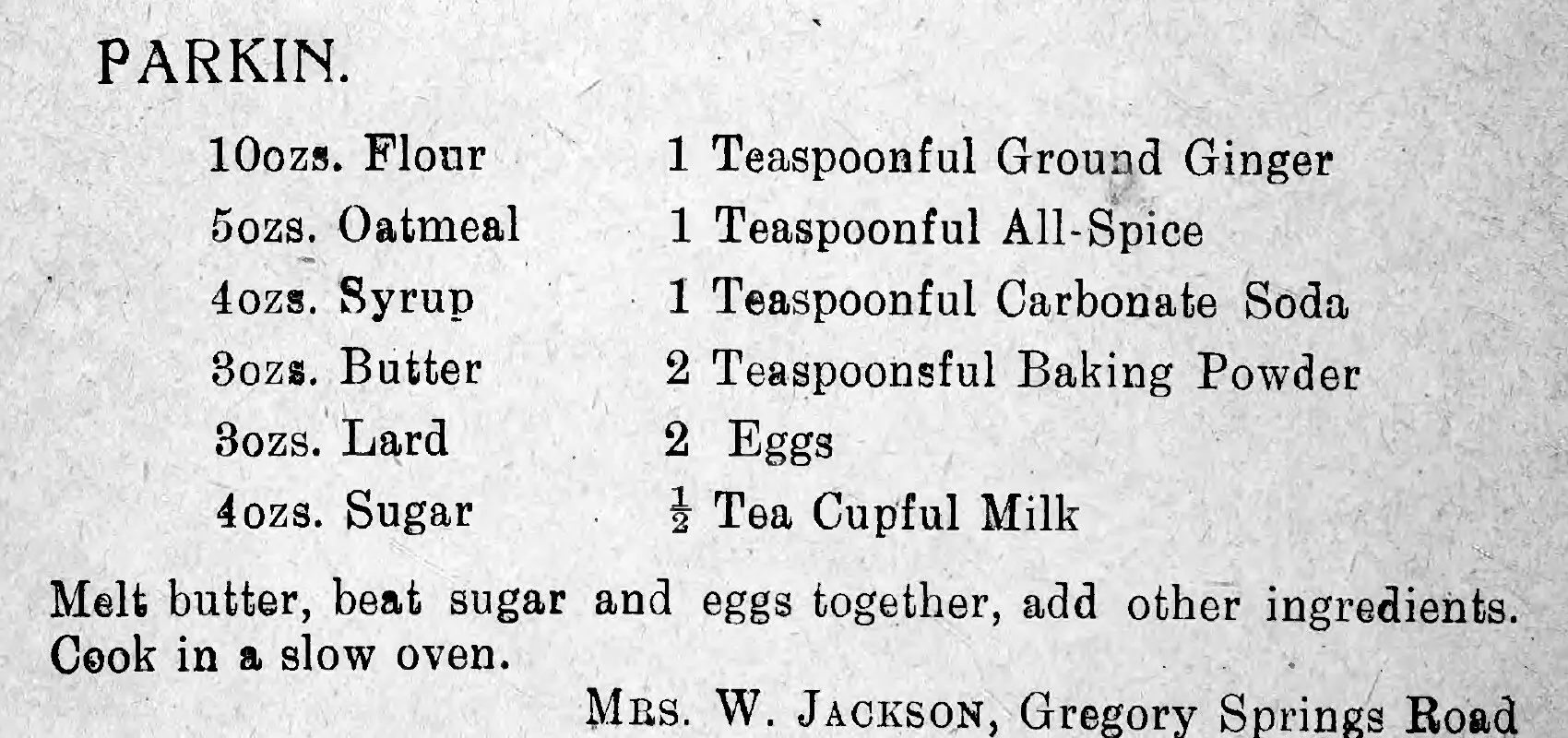
Each recipe carries its giver’s name, and often her street. The parkin is from Mrs. W. Jackson of Gregory Springs Road: ten ounces of flour to five of oatmeal, four ounces of syrup, butter and lard together, ginger and allspice, two eggs and half a teacupful of milk. She gives no tin, no heat and no time, only “Cook in a slow oven.”
Whether anyone in Mirfield baked it for a fifth of November in those years, the booklet doesn’t say. During the war the blackout meant children could have no bonfires or fireworks on 5 November, though, as the National Science and Media Museum has noted, they still collected money for the guy and some families kept the night with parties of toffee apples and parkin. A Daily Herald photograph of 5 November 1944, in the museum’s collection, shows London children at Waterloo with a guy labeled “Hitler’s Peace Envoy.”
The recipes
These two are the cake and the sweet of a northern Bonfire Night. Neither comes from 1605, and the recipe pages say how each one relates to the night.
- Parkin (1940s): Mrs. Jackson’s oatmeal and syrup gingerbread from the Mirfield W.V.S. booklet, baked slowly in a square tin.
- Treacle Toffee (1906): black treacle and brown sugar boiled to the crack with vinegar and butter, from the 1906 Book of Household Management.
Two years after the war, rationing still shaped a royal menu: the fish and game at Princess Elizabeth’s wedding breakfast in 1947 were both off the ration.
Cooking it
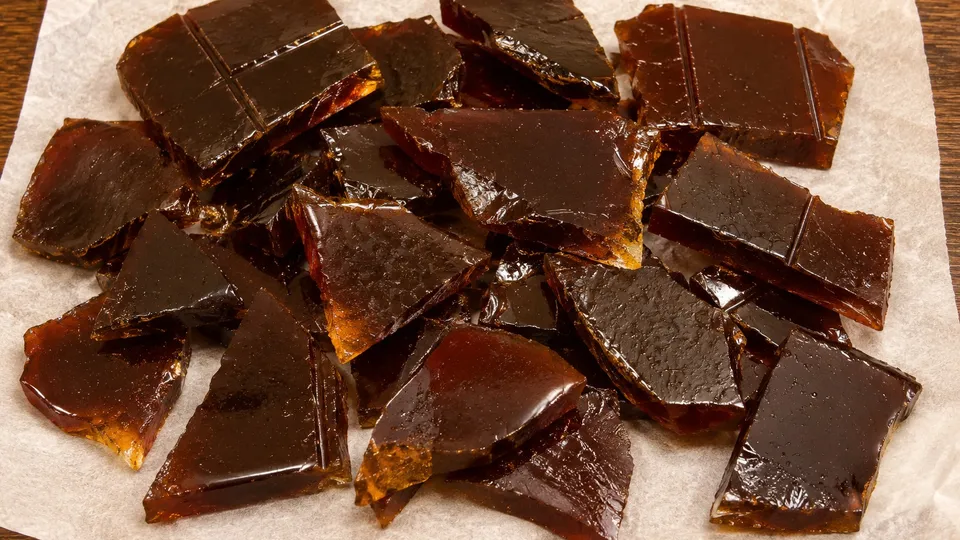
For a taste of Leeds in 1862, boil the Treacle Toffee (1906): it is the glossary’s treacle, sugar, vinegar and butter, taken to the crack with a sugar thermometer and lightened with Beeton’s soda.
 Cook it todayTreacle Toffee (1906)
Sources
- The Housewives’ Book of Recipes & Hints, collected by members of the W.V.S., Mirfield (Mirfield: A. Chadwick, printer, between 1942 and 1945), p. 10. Wellcome Collection copy, Internet Archive (opens in a new tab).
- “The Gunpowder Plot of 1605: Commemoration (opens in a new tab)” and “Thanksgiving Act (opens in a new tab),” UK Parliament, Living Heritage; Parliamentary Archives HL/PO/PU/1/1605/3J1n1.
- [C. Clough Robinson], The Dialect of Leeds and its Neighbourhood (London: John Russell Smith, 1862), glossary, s.v. Bonfire night, Parkin, Succour. Internet Archive (opens in a new tab).
- William Henderson, Notes on the Folk-Lore of the Northern Counties of England and the Borders (London: Folk-Lore Society, 1879), p. 97, note by S. Baring-Gould. Internet Archive (opens in a new tab).
- Joseph Wright, ed., The English Dialect Dictionary, vol. 4 (6 vols, 1898 to 1905), s.v. Parkin, quoting John Hartley, Clock Almanack (1878). Internet Archive (opens in a new tab).
- Antonia Fraser, The Gunpowder Plot: Terror and Faith in 1605 (London: Phoenix, 2005), p. 207, as cited in Wikipedia, “Guy Fawkes Night.”
- Jennifer Stead, in C. Anne Wilson, ed., Traditional Food East and West of the Pennines (Edinburgh: Edinburgh University Press, 1991), chapter 6.
- Emma Thom, “Bonfire Night in our collection (opens in a new tab),” National Science and Media Museum blog, 5 November 2012.
- Eliza Acton, Modern Cookery, in All Its Branches (London: Longman, 1845), Everton Toffie.
- Isabella Beeton, The Book of Household Management (London: S. O. Beeton, 1861), and Mrs. Beeton’s Book of Household Management, new edition (London: Ward, Lock, 1906), no. 2353, Treacle Toffee.