- French
- Second World War
- 1940s
- Sultan of Morocco’s visit, 1945
The Sultan of Morocco’s return train, Mauriac to Paris-Austerlitz · Mauriac, Cantal, to Paris
What Was on the Royal Train’s Menu in 1945?
A typed menu dated 1 July 1945 survives with the timetable of the Sultan of Morocco’s train from Mauriac to Paris: spring consommé, rolled sole, apricot ice.
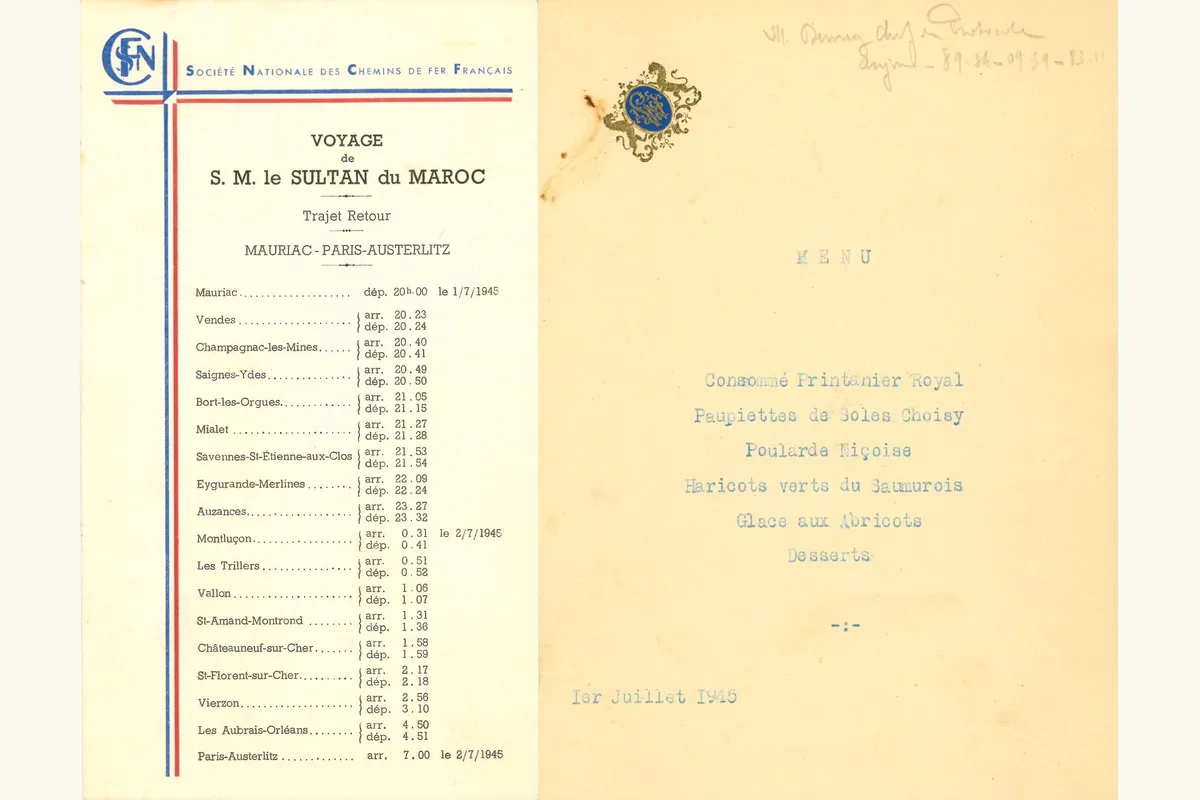
Spring consommé, rolled fillets of sole, a Niçoise poularde, green beans from the Saumur country, apricot ice and desserts: that is the typed menu dated 1 July 1945 that survives with the timetable of the Sultan of Morocco’s train from Mauriac to Paris. The two papers say what was planned; when the meal was served, who cooked it and who ate it is not on either of them.
A guest of the Liberation
Sultan Mohammed ben Youssef, later King Mohammed V of Morocco, came to France in June 1945 as a guest of the newly liberated capital. On 18 June, as the French presidency later recalled, he was made a Compagnon de la Libération, a member of de Gaulle’s Order of the Liberation, as the “seul homme d’Etat invité par Paris libéré,” the only statesman invited by liberated Paris.
Morocco was then a French protectorate, as it had been since 1912; in August 1953 the French government allowed him to be deposed, and the protectorate ended in March 1956, as the same statement recalls. In July 1945 he went with General de Gaulle to the Auvergne. Le Monde, on 3 July 1945, described the warm welcome the region gave them and the visit’s end at Mauriac, a small town in the Cantal, where the two boarded a train for Paris.
Two papers kept together
The left-hand paper is a printed SNCF timetable ruled in red and blue: “Voyage de S. M. le Sultan du Maroc, Trajet Retour, Mauriac-Paris-Austerlitz.” It gives a departure from Mauriac at 20:00 on 1 July and an arrival at Paris-Austerlitz at 07:00 on 2 July, with sixteen stops between. Most last a minute. Bort-les-Orgues gets ten, Eygurande-Merlines fifteen, from 22:09 to 22:24, Montluçon ten just after midnight, and Vierzon fourteen, from 02:56 to 03:10.
The right-hand paper is a cream card with a small gold and blue crest and a menu typed on it in blue: Consommé Printanier Royal, Paupiettes de Soles Choisy, Poularde Niçoise, Haricots verts du Saumurois, Glace aux Abricots, Desserts. Below the menu is the date, “1er Juillet 1945.” There is no hour beside any course, no price, no wine and no name of a cook.
The timetable doesn’t quite agree with the newspaper. Le Monde reported that the train left Mauriac at 21:10, seventy minutes after the printed time, and reached Paris at 07:00 as planned. The timetable is a plan and the newspaper a report, and neither is a log of the run.
The menu was typed in a rationed country. In July 1945 French sugar and coffee were still on ration tickets, and would stay there until December 1949; the bread card, dropped in May 1945, came back in December 1945.
The papers sit in the archive of the Compagnie internationale des wagons-lits, the company that ran Europe’s sleeping and dining cars, now held by the Archives nationales du monde du travail at Roubaix. That places the menu in the company’s files. It doesn’t say whether a Wagons-Lits dining car, a railway buffet or a kitchen in Mauriac prepared the meal.
What the names meant
Each line on the card is shorthand a professional cook of the time would have read at once, and Auguste Escoffier’s A Guide to Modern Cookery, published in English in London in 1907, spells most of them out.
Consommé Printanier is a clear chicken consommé with spring vegetables: tiny rods of carrot and turnip, peas, French beans, asparagus tips, little rounds of sorrel and lettuce, and chervil. Royal may mean the royale, Escoffier’s set custard of consommé and eggs, cut into shapes and floated in clear soups. The name was a stock one: Escoffier’s French Guide of 1903 lists “Printanier Royal” on a July dinner menu.
Paupiettes are fillets of sole spread with fish forcemeat and rolled “after the manner of a scroll,” stood upright in the pan and poached. Choisy is the garnish, and in Escoffier’s books it usually goes with lettuce: his Omelet à la Choisy is filled with braised lettuce, and his tournedos à la Choisy are ringed with braised half-lettuces. His 1903 French Guide also has little pastry boats of sole “à la Choisy” with mushrooms and truffles and no lettuce at all, so the name alone leaves the garnish open.
Poularde Niçoise is a fattened hen with the garnish of Nice. Escoffier’s tournedos à la Niçoise come with tomatoes tossed in butter with garlic and tarragon, French beans and small potatoes. The English Guide of 1907 has no Niçoise poularde, but his French Guide culinaire of 1903 gives one in two sentences: the bird pot-roasted, with a bunch of green beans at each end of the dish, chopped tomatoes around it and pitted olives in place of potatoes.
Haricots verts du Saumurois are green beans from around Saumur, on the Loire. Escoffier calls French beans “among the greatest vegetable delicacies” and wants them cooked so they “seem a little firm to the teeth.”
Glace aux Abricots is a fruit ice. Escoffier’s takes “one pint of fresh apricot purée, one pint of syrup, and the juice of two lemons,” frozen in a tin freezer packed around with broken ice and salt.
Desserts, on a French menu, means the fruit and small sweets that close the meal.
The recipes
These four come from Escoffier’s 1907 Guide; nothing survives from the train’s kitchen. Two are his recipes for dishes of the same name. Two are built from his parts, and the recipe pages say which. The poularde stays on the card: the 1907 Guide has no recipe for it, and the 1903 entry is a note on dressing the dish, with no method; our reconstruction is on the Poularde Niçoise (1903) page.
- Consommé Printanier Royal (1907): clear chicken consommé with spring vegetables and squares of royale custard, built from two of Escoffier’s recipes.
- Paupiettes of Sole Choisy (1907): rolled fillets of sole poached in fish stock, with braised lettuce for the Choisy garnish.
- French Beans (1907): Escoffier’s green beans, boiled just firm and finished with fresh butter.
- Apricot Ice (1907): apricot purée, syrup and lemon, frozen.
The same 1907 Guide supplies the recipes for an earlier French official meal, the Senate’s lunch for President Wilson, in What Did the Peacemakers Eat in Paris in 1919?
Cooking it
Escoffier wanted every ice “prepared in advance,” so make the Apricot Ice (1907) the evening before, and the night itself belongs to the soup, the sole and the beans. The apricot ice is one of our old-fashioned ice cream recipes.
 Cook it todayApricot Ice (1907)
Sources
- Timetable and menu, “Voyage de S. M. le Sultan du Maroc, Trajet Retour, Mauriac-Paris-Austerlitz,” 1 and 2 July 1945, Archives nationales du monde du travail, fonds CIWLT, 2022 9 1945.
- “Le chaleureux accueil de l’Auvergne au général de Gaulle et au sultan du Maroc (opens in a new tab),” Le Monde, July 3, 1945.
- A. Escoffier, A Guide to Modern Cookery (London: William Heinemann, 1907), nos. 206, 497, 601, 914, 1118, 2157, 2160, 2744, 2761.
- A. Escoffier, Le Guide culinaire (Paris, 1903), Barquettes de Soles à la Choisy, Tournedos à la Choisy, Poularde à la Niçoise, and a July dinner menu.
- “Déclaration de M. Jacques Chirac sur la vie et l’œuvre du roi du Maroc Mohammed V (opens in a new tab),” Élysée, December 20, 2002.
- “1er décembre 1949: fin du rationnement (opens in a new tab),” Hérodote.