The French Senate’s luncheon for President Wilson, Palais du Luxembourg · Paris, France
What Did the Peacemakers Eat in Paris in 1919?
Two days into the 1919 peace conference, the French Senate gave Wilson lunch for 250. The menu survives: bass, Pauillac lamb, artichokes. Three to make.
Sea bass in the Venetian style, a saddle of Pauillac lamb, young turkey roasted on the spit, artichoke bottoms in velouté, a fruit dessert with kirsch, then petits fours, fruit, cheese and coffee. That is what the French Senate served Woodrow Wilson and some 250 guests at lunch on January 20, 1919, two days after the Paris Peace Conference opened. The Senate kept the whole menu, and it shows what France put on the table for the peacemakers ten weeks after the Armistice of November 11, 1918, at the start of the five months of talks that led to the Treaty of Versailles.
Two days into the conference
The conference opened on January 18 at the French foreign ministry on the Quai d’Orsay, with delegates from 27 nations. On the Monday that followed, the Senate received the American president at the Palais du Luxembourg. The Senate’s history pages put the lunch in the Salle des Conférences and describe the guests as “deux cent cinquante des plus hautes personnalités de France, d’Europe et des Etats-Unis,” two hundred and fifty of the most prominent people of France, Europe and the United States.
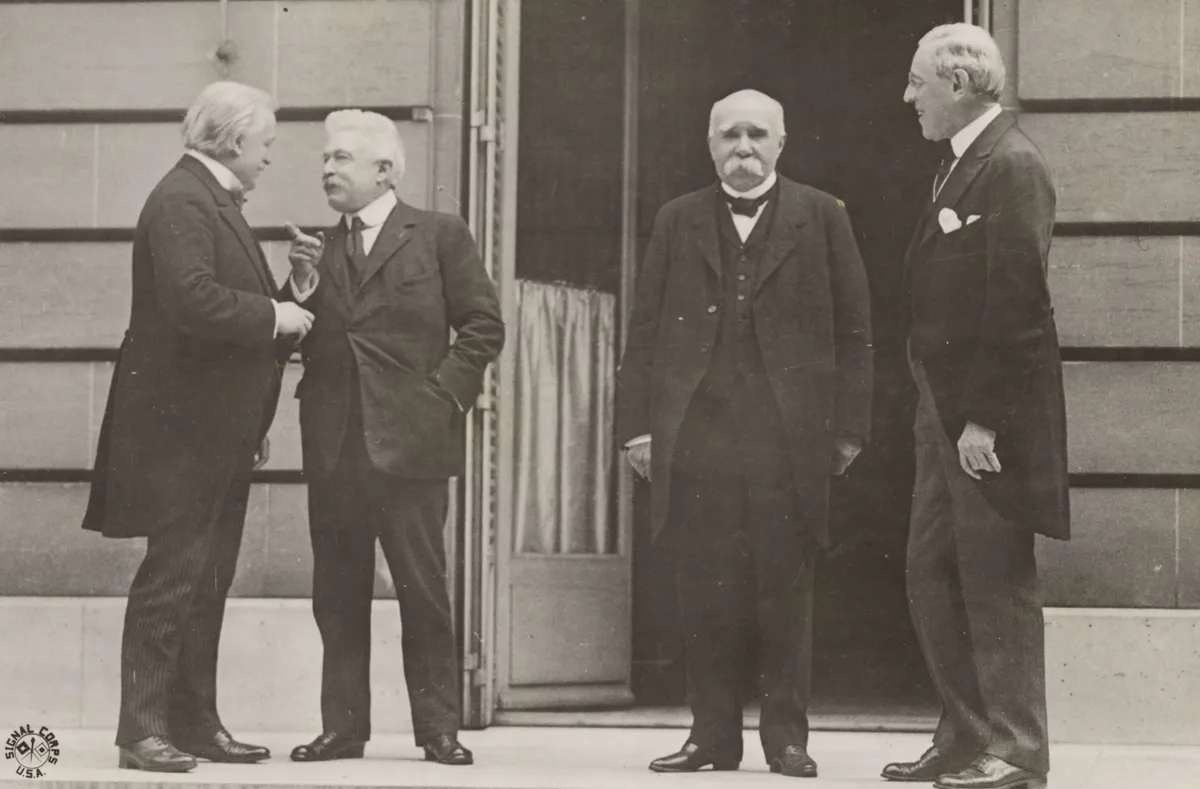
There were speeches. Antonin Dubost, the Senate’s president, welcomed Wilson to “un vieux Palais de France.” Wilson replied, and a caption in the Senate’s pages has him speaking about the League of Nations. The pages also reproduce pictures from L’Illustration captioned with Clemenceau watching him speak and Lloyd George talking about the devastated regions. Four months later the Signal Corps photographed those three men with Italy’s Vittorio Orlando, the four who came to run the conference; that picture heads this page. The band of the Garde Républicaine played a program that ran from an American march and a “Grand Fantasia on Dixie” to Coppélia and Samson et Dalila, and a singer from the Opéra, M. Noté, was to sing the Marseillaise.
Reading the bill
The Senate’s transcription of the card reads:
- Hors-d’oeuvre
- Bar glacé vénitienne
- Selle de Paulliac moissonneuse
- Dindonneau à la broche
- Fonds d’artichauts au velouté
- Mazarine de fruits au kirsch
- Petits fours variés, plateaux de fruits, café, fromage
The wines listed were Graves and Médoc in carafes, Volnay, Sauternes, and Théophile Roederer champagne served frappé, well chilled. Liqueurs followed.
It is the order of a French formal meal of the time: a fish, a large joint, a roast bird, a vegetable served as its own course, then the sweet. Most of the names can be read with Auguste Escoffier’s Guide to Modern Cookery, published in London in 1907 as the English version of his Guide culinaire.
Bar is sea bass, a fish Escoffier called “very little known” in England. In Escoffier’s book, vénitienne is Venetian sauce, a white wine fish sauce sharpened with a reduction of shallots, chervil and tarragon vinegar and turned green with the pressed juice of herbs. Glacé is the harder word. It can mean iced, as in a cold fish under aspic, or glazed, a hot fish coated with sauce and browned. The card doesn’t say which.
Dindonneau à la broche is a young turkey roasted on the spit. Fonds d’artichauts are artichoke bottoms, the fleshy base left when the leaves and choke are cut away, here served in velouté, a white stock thickened with a pale roux and one of the leading sauces in Escoffier’s book. Two names are still open. Moissonneuse, “harvester’s style,” is a garnish that doesn’t appear in Escoffier’s English edition, and neither does mazarine de fruits au kirsch, so how either was made for the Senate is unknown.
Lamb from Pauillac
The menu’s spelling is “Paulliac,” but the lamb is almost certainly from Pauillac, a wine town in the Médoc that gave its name to France’s best-known milk-fed lamb. Its official European specification today defines it as an unweaned lamb no more than 80 days old, “suckled and reared principally on its mother’s milk,” and notes that it was sold in Paris and served at grand tables, including President Émile Loubet’s dinner for the King of England in 1903.
Escoffier knew it as house lamb, “the sheep’s unweaned young that has not yet grazed,” and wrote in his London edition that “the ‘Pauillac’ lamb, which is imported from France, is the most excellent example.” For large joints of it he advised two methods, roasting or poêling, slow cooking in a covered pot on a bed of vegetables with plenty of butter, served with “their own stock, or a thickened, highly seasoned and clear gravy.”
A saddle is the whole back of the animal, both loins joined along the spine.
After four years of war
The lunch was laid in a country still coming out of the war. France gradually rationed bread, meat, milk and sugar, and brought in ration cards for sugar and bread only in 1917 and 1918. Restaurants had shorter opening hours and limits on the number of dishes they could list. The Senate’s menu doesn’t mention any of that, and it shouldn’t be read as a picture of how Paris ate in January 1919. It shows what the state could still set before its most important guests.
The day of the signing
The conference’s main business ended five months later in the Hall of Mirrors at Versailles, the room where the German Empire had been proclaimed in January 1871 while Paris was still under siege. On June 28, 1919, the German delegates signed the treaty in a session that, by the Château de Versailles’ own account, lasted fifty minutes and “was not celebrated with decorum or music.” No menu from that day appears in the Senate’s records or the Château’s account. The peacemakers’ lunch on the Luxembourg’s tables in January is the meal on record.
The recipes
These three follow the Senate’s menu in the order it was served. Each is a home version of the dish built from Escoffier’s 1907 Guide to Modern Cookery, which gives the methods but not the Senate’s own recipes.
- Bass with Venetian Sauce (1907): poached sea bass fillets coated with Escoffier’s green herb sauce, served hot.
- Pot-Roasted Saddle of Lamb (1907): a boned saddle cooked in butter on a bed of vegetables, with its own gravy.
- Artichoke Bottoms with Velouté (1907): artichoke bottoms simmered white, finished in butter and coated with velouté.
Cooking the Senate’s lunch
The Senate’s menu is long, but its three central courses make a dinner that fits a home kitchen: a fish, a joint and a vegetable, each with its own sauce.
Start with the Pot-Roasted Saddle of Lamb (1907). It is the one dish on the card named for where it came from, and Escoffier’s covered pot, with butter and vegetables underneath, gives you the gravy he wanted served with it. The lunch belongs with the margarine and wheatless-day cooking of the home front in our First World War recipes. What the bars of Paris and London poured in the years after the treaty is on Forgotten Drink, our sister site, in the cocktail books of the 1920s (opens in a new tab).
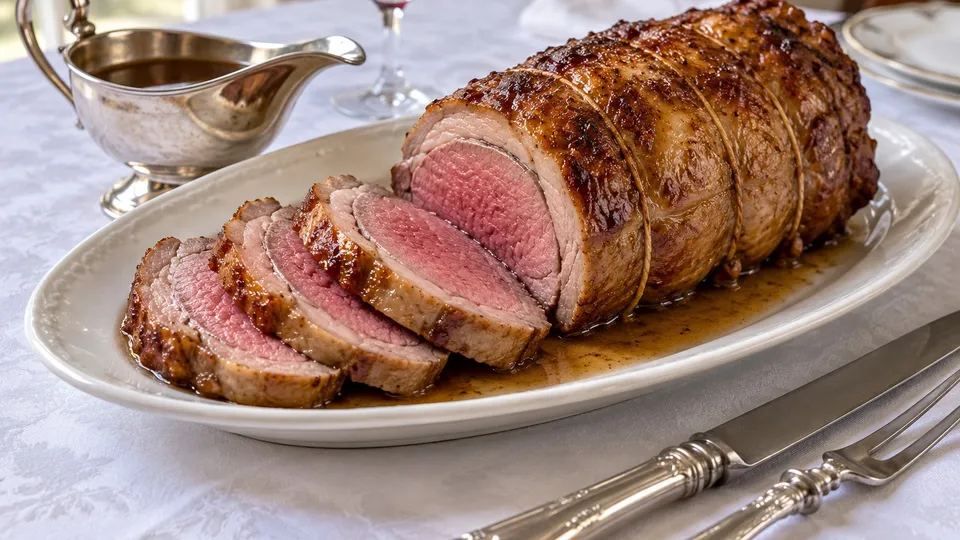 Cook it todayPot-Roasted Saddle of Lamb (1907)
Sources
- “20 janvier 1919, le banquet Wilson (opens in a new tab)” and “La réception comme si vous y étiez (opens in a new tab)” (speeches, menu and music), Sénat.
- Auguste Escoffier, A Guide to Modern Cookery (London: Heinemann, 1907).
- European Commission, publication of the amended specification for “Agneau de Pauillac,” Official Journal of the European Union, C/2025/606 (opens in a new tab).
- “The Treaty of Versailles, 1919 (opens in a new tab),” Château de Versailles.
- Emmanuelle Cronier and Stéphane Le Bras, “Food and Nutrition (France) (opens in a new tab),” 1914-1918-online: International Encyclopedia of the First World War.
- “Diplomatic Archives: The Peace Conference (Paris, 18 January 1919) (opens in a new tab),” French Ministry for Europe and Foreign Affairs.
- “The Armistice of 1918 (opens in a new tab),” Mémorial de l’Armistice, Compiègne.
- U.S. Army Signal Corps, Council of Four of the Peace Conference (opens in a new tab), May 27, 1919, National Archives.