Pot-Roasted Saddle of Lamb (1907)
Reader ratingsA pot-roasted saddle of lamb after Escoffier’s 1907 method for house lamb: boned, rolled and cooked in butter in a covered pot on a bed of vegetables, browned at the end and served with its own strained gravy.
- Recipe makes
- 6 servings
- Prep
- Cook
- Total
The lamb cooks for about an hour in the oven and rests for 10 minutes while you finish the gravy. Take it out of the refrigerator 30 minutes before cooking.
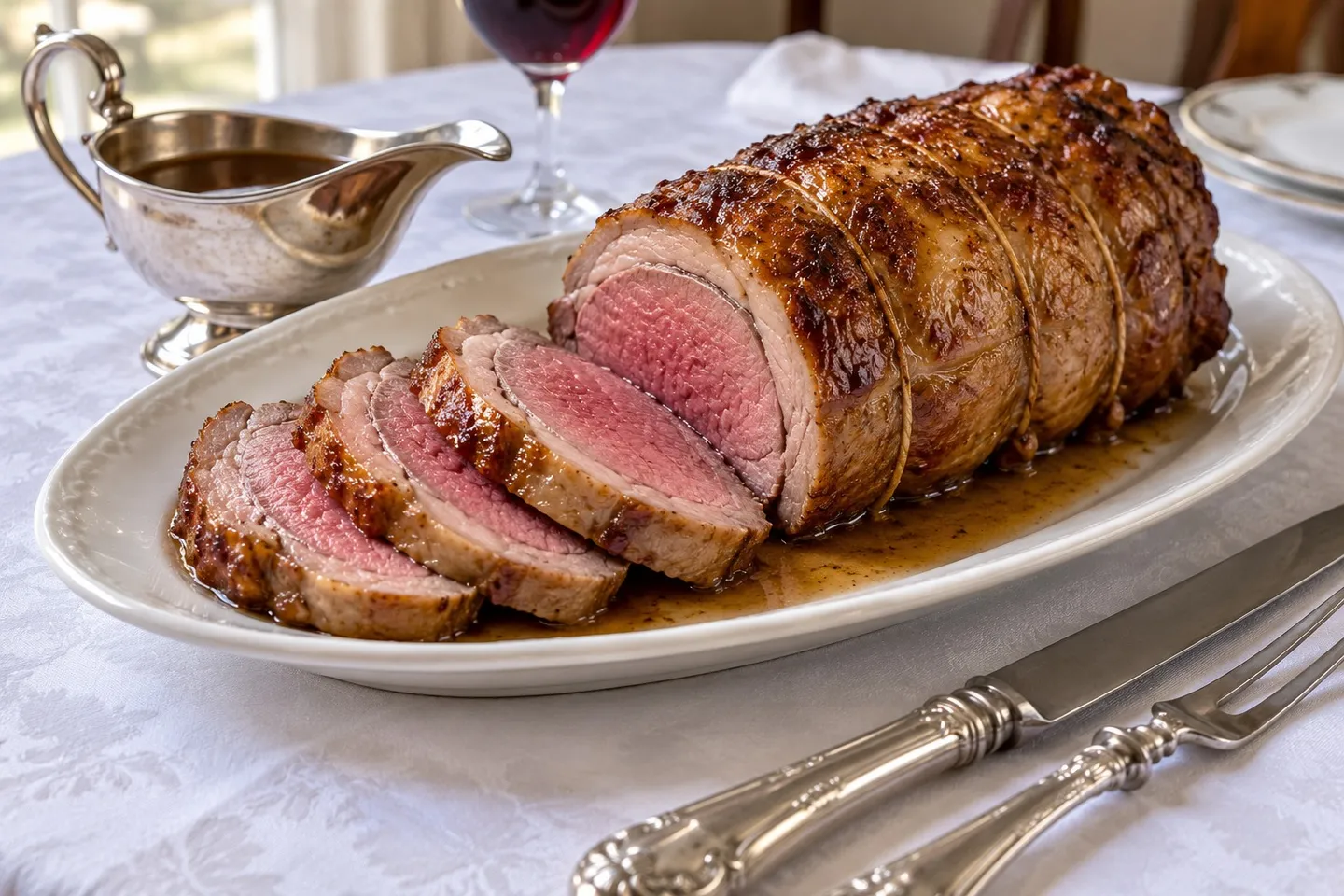
Pot-roasted saddle of lamb, sliced, with its gravy.
The story behind the recipe
The card’s “Paulliac” is almost certainly Pauillac lamb, which today’s rules define as unweaned and no more than 80 days old. At the French Senate’s lunch for Woodrow Wilson a saddle of it came after the fish, as “Selle de Paulliac moissonneuse.” One of Escoffier’s two ways with that young lamb was a covered pot and plenty of butter, and that is how this saddle is cooked.
House lamb and its gravy
Large joints of house lamb, Escoffier wrote, “should be poëled or roasted.” Poêling is a slow pot roast: the joint sits on a bed of raw sliced vegetables and ham, is “copiously sprinkled with melted butter,” and cooks covered, then uncovered at the end to take color, and the vegetables go into the gravy.
The Senate’s own recipe is lost, and moissonneuse isn’t in Escoffier’s 1907 English edition, A Guide to Modern Cookery. What follows rebuilds the dish from his method for the meat alone.
His book was written for London kitchens, and in it he wrote that roast mutton and lamb “are always accompanied by mint sauce.” The Senate’s menu, in Paris, names a garnish instead. Where the lamb itself came from is told in What Did the Peacemakers Eat in Paris in 1919?
Read more about this recipe
Making it today
Pauillac lamb is hard to buy outside France, so we use a boned and rolled saddle or double loin from a butcher. It is older lamb than the Senate’s, and a little larger. We cook it to the USDA’s 145°F (63°C), which leaves it slightly pink, and we leave the gravy unthickened unless you want it lightly bound, which Escoffier allows. Without a recipe for moissonneuse, we serve the lamb with no garnish at all.
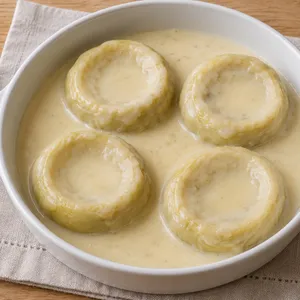
Escoffier wanted house lamb served with “early-season or new vegetables.” The Artichoke Bottoms with Velouté (1907) came two courses later on the same card and can be finished on the stove while the lamb rests.
Preparation of Poëled Meats.—Place in the bottom of a deep and thick receptacle, just large enough to hold the piece to be poëled, a layer of raw matignon (No. 227). ...
Recipe makes: 6 servings
Ingredients
For 6 servings. Quantities are shown as written.
Quantities as written here, for 6 servings.
Lamb
- Boneless lamb saddle or double loin roast, rolled and tied1Author measures: about 2 1/4 lb.
- Salt1 tsp
- Black pepper1/2 tsp
- Unsalted butter, melted4 tbsp
Matignon
- Medium carrots, thinly sliced2
- Medium onions, thinly sliced2
- Celery stalks from the heart, thinly sliced2
- Lean cooked ham, cut into small thin squares1 tbsp
- Fresh thyme1 sprig
- Bay leaf, crumbled1/2
- Unsalted butter2 tbsp
- Madeira2 tbsp
Gravy
- Brown veal or beef stock, low-sodium1 1/4 cups
- Arrowroot or cornstarch (optional)1 tbsp
- Cold water (optional)1 tbsp
Measurement notes
Ingredients as written here
- 1 boneless lamb saddle or double loin roast, rolled and tied (about 2¼ lb)
- 1 tsp salt
- ½ tsp black pepper
- 4 tbsp unsalted butter, melted
- 2 medium carrots, thinly sliced
- 2 medium onions, thinly sliced
- 2 celery stalks from the heart, thinly sliced
- 1 tbsp lean cooked ham, cut into small thin squares
- 1 sprig fresh thyme
- ½ bay leaf, crumbled
- 2 tbsp unsalted butter
- 2 tbsp Madeira
- 1¼ cups brown veal or beef stock, low-sodium
- 1 tbsp arrowroot or cornstarch (optional)
- 1 tbsp cold water (optional)
Equipment
- Heavy lidded casserole or Dutch oven just large enough to hold the lamb
 Instant-read thermometer
 Fine sieve
 Small saucepan
- Warm serving platter
Instructions
Heat the oven to 350°F (175°C), with a shelf in the lower third.
For the matignon, spread the raw carrots, onions, celery and ham over the bottom of the casserole, tuck in the thyme and bay leaf, and dot with the butter.
Pat the lamb dry and season it all over with the salt and pepper. Set it on the vegetables, fat side up, and spoon about half of the melted butter over it.
Cover and put it in the oven. Cook for 40 minutes, spooning a little more melted butter over the lamb every 15 minutes.
Uncover and raise the oven to 425°F (220°C). Check the temperature; if it already reads close to 145°F (63°C), brown it for only 5 minutes. Otherwise cook for 10 to 20 minutes more, spooning the butter in the pot over the meat once or twice, until it is browned and reads 145°F (63°C) in the center.
Move the lamb to the warm platter, cover loosely with foil and let it rest for 10 minutes.
Meanwhile, set the casserole over medium heat, add the Madeira and stock to the vegetables and simmer gently for 10 minutes, scraping up the browned bits. Don’t let the vegetables scorch.
Strain into the small saucepan, pressing lightly on the vegetables, and spoon off as much fat as you can. Bring the gravy back to a simmer and taste for salt.
For a lightly thickened gravy, stir the arrowroot into the cold water, whisk it into the simmering gravy and cook until it clears and thickens slightly.
Cut away the strings, slice the lamb and serve the gravy separately in a warm sauceboat.
Nutrition
560calories per serving
- Recipe makes
- 6 servings
- Servings
- 6
Estimated per serving from USDA FoodData Central values for the listed ingredients, less the fat skimmed from the gravy.
Recipe notes
When adjusting quantities
For a larger saddle, use a pot that fits it closely and expect a longer time in the oven; go by the thermometer.
Notes
Quantities mentioned in these notes don’t change when you adjust the servings.
A rolled joint has part of its outer surface rolled inside. The USDA counts lamb roasts safe at 145°F (63°C) with a 3-minute rest, but the UK Food Standards Agency advises that rolled joints should not be served rare; to follow the British advice, cook the lamb to 160°F (71°C), when it is no longer pink. A thinner single loin roast cooks faster; start checking it after 30 minutes. Escoffier made his gravy with brown veal stock; a low-sodium beef stock is the closest everyday swap. Contains milk and celery.
Scaling changes the ingredients only; pan sizes and cooking times need their own judgment. To adapt this recipe further, try the recipe tool at TuneMyRecipe (opens in a new tab), our sister site.
Sources and attribution
After Auguste Escoffier, A Guide to Modern Cookery (London: Heinemann, 1907), Nos. 41, 227, 250 and 1359
Recipe details
- Course
- Main course
- Dish family
- Meat & Poultry
- Region
- French
- Era
- Edwardian
- Source decade
- 1900s
- Main ingredient
- Lamb & mutton
- Difficulty
- Intermediate
- Occasion
- State banquet