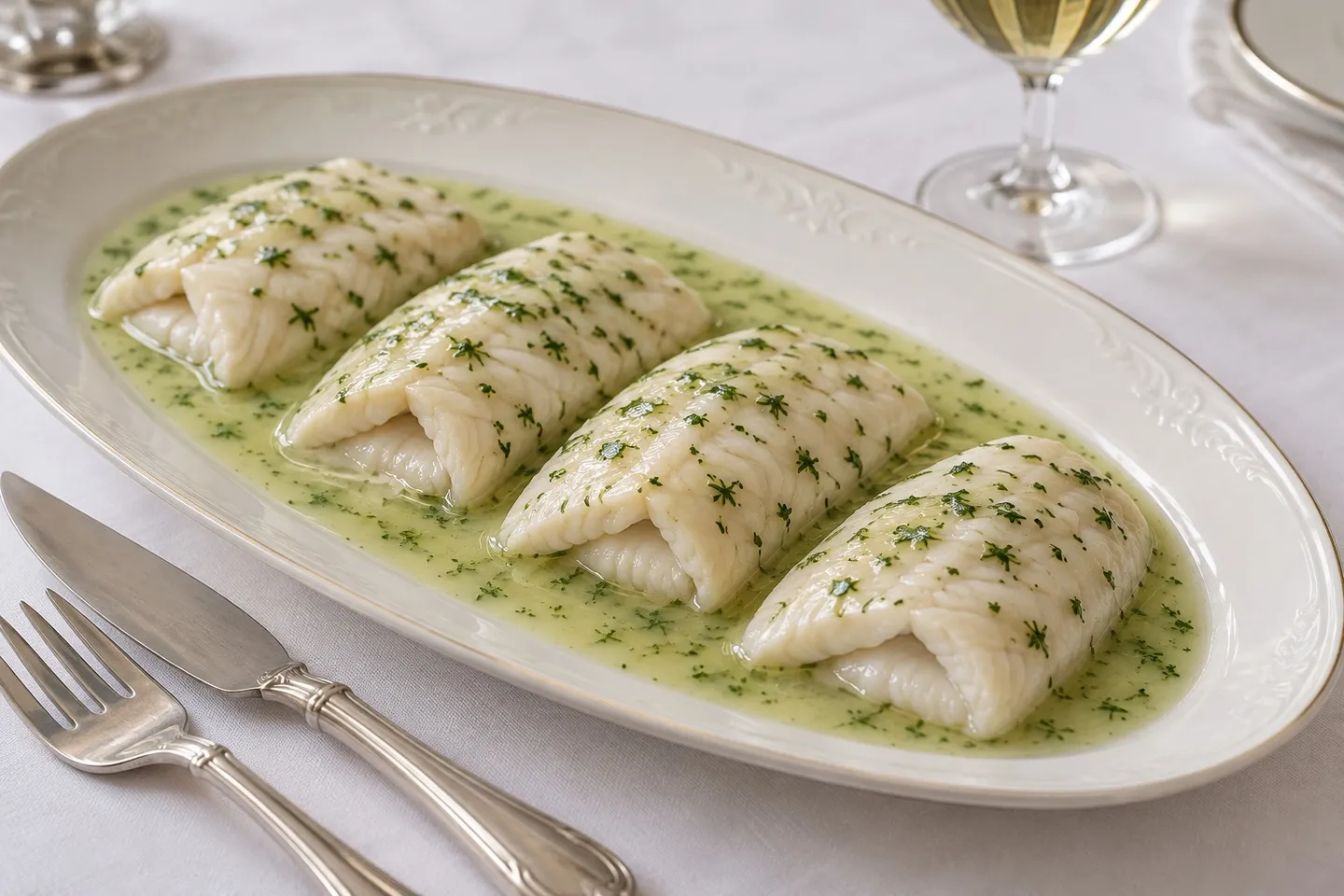
Bass with Venetian Sauce (1907)
Reader ratingsBass with Venetian sauce, after Escoffier: sea bass fillets poached in white wine and fish stock under a white wine fish sauce sharpened with tarragon vinegar and turned green with herb juice.
- Recipe makes
- 4 servings
- Prep
- Cook
- Total
The velouté simmers and reduces for about 35 minutes while you make the herb juice and the vinegar reduction. Poach the fish last, so it goes to the table as soon as the sauce is finished.
Sea bass fillets in Venetian sauce on a white platter.
The story behind the recipe
“Bar glacé vénitienne”: three words on a menu card are all that is left of the fish course the French Senate served Woodrow Wilson on January 20, 1919. It came after the hors d’oeuvre and before the lamb. This green-sauced version follows Escoffier.
Escoffier’s green sauce
The green in Escoffier’s Venetian sauce comes from herb juice: parsley, chervil, tarragon and chives, blanched, pounded and wrung out in a cloth. His No. 107 starts with white wine and tarragon vinegar boiled down with shallots and chervil, adds his white wine sauce, and is finished with “a sufficient quantity of Herb Juice.” “This sauce accompanies various fish,” he wrote, and his fillets of sole Vénitienne are poached in fish stock and coated with it, mixed with their reduced cooking liquor. For bass he had less to say. He served large bass boiled, with the sauces he used for turbot, and small ones à la meunière or fried.
No recipe from the Senate’s kitchen survives, so the dish here is a reconstruction from his London book of 1907, A Guide to Modern Cookery. Who sat at the Senate’s tables that day, and what else they ate, is in What Did the Peacemakers Eat in Paris in 1919?
Read more about this recipe
Making it today
Which of the two senses of glacé the Senate’s cooks meant, the card leaves open. Our reading is the one Escoffier’s own sole Vénitienne points to: the fish sent out hot and coated with its sauce, without browning. We also use less butter to finish the sauce than his white wine sauce calls for, and fillets in place of a whole fish, which a home kitchen can poach in one pan. The rest follows his order, including the reduction of the velouté by half that his white wine sauce asks for, which gives the sauce enough body to coat the fish.
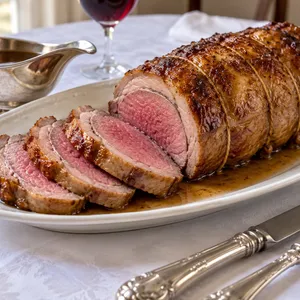
On the Senate’s menu the lamb came next. The Pot-Roasted Saddle of Lamb (1907) asks only for a spoonful of butter every 15 minutes once it is in the oven.
Put into a stewpan one tablespoonful of chopped shallots, one tablespoonful of chervil, and one-quarter pint of white wine and tarragon vinegar, mixed in equal quantities. ...
Recipe makes: 4 servings
Ingredients
For 4 servings. Quantities are shown as written.
Quantities as written here, for 4 servings.
Fish velouté
- Unsalted butter2 tbsp
- All-purpose flour2 tbsp
- Fish stock2 1/2 cups
Herb juice
- Lightly packed mixed parsley, chervil, tarragon and chive leaves1/2 cup
- Water1 tbsp
Venetian reduction
- Finely chopped shallot1 tbsp
- Chopped chervil or flat-leaf parsley1 tbsp
- Dry white wine5 tbsp
- Tarragon vinegar5 tbsp
Fish
- Skinless European sea bass (branzino) fillets (5 to 6 oz each)4
- Fish stock1/2 cup
- Dry white wine1/2 cup
- Salt and white pepper
To finish
- Cold unsalted butter, diced3 tbsp
- Chopped chervil1/2 tsp
- Chopped tarragon1/2 tsp
Measurement notes
Ingredients as written here
- 2 tbsp unsalted butter
- 2 tbsp all-purpose flour
- 2½ cups fish stock
- ½ cup lightly packed mixed parsley, chervil, tarragon and chive leaves
- 1 tbsp water
- 1 tbsp finely chopped shallot
- 1 tbsp chopped chervil or flat-leaf parsley
- 5 tbsp dry white wine
- 5 tbsp tarragon vinegar
- 4 skinless European sea bass (branzino) fillets (5 to 6 oz each)
- ½ cup fish stock
- ½ cup dry white wine
- Salt and white pepper
- 3 tbsp cold unsalted butter, diced
- ½ tsp chopped chervil
- ½ tsp chopped tarragon
Equipment
- Three small saucepans
- Wide skillet with a lid
 Fine sieve
- Blender or mortar and pestle
- Clean thin kitchen towel or cheesecloth
 Instant-read thermometer
- Warm serving platter
Instructions
For the velouté, melt the butter in a small saucepan over medium-low heat, stir in the flour and cook, stirring, for 2 to 3 minutes without letting it color.
Whisk in the fish stock a little at a time. Bring to a boil, stirring, then lower the heat and simmer gently for 20 minutes, skimming now and then. Raise the heat a little and let it boil gently, stirring often, until it has reduced by half and coats the back of a spoon thickly, 10 to 15 minutes more.
Meanwhile, make the herb juice. Drop the herb leaves into a small pan of boiling water for 2 minutes, drain, cool under cold water and squeeze dry. Purée them with the water in the blender or pound them in the mortar, then twist the purée hard in the towel over a small bowl to collect the green juice.
For the reduction, put the shallot, chervil, white wine and tarragon vinegar in the second saucepan and boil until reduced by two-thirds.
Pour the velouté into the reduction and boil gently for 2 to 3 minutes. Rub through the sieve and keep it warm.
Season the sea bass fillets with salt and white pepper and fold any thin tail ends under. Lay them in the skillet, add the fish stock and white wine, and bring to a bare simmer. Cover and poach for 6 to 8 minutes, until the fish is opaque and reads 145°F (63°C) in the thickest part.
Lift the fillets onto the warm platter, cover loosely and keep warm. Boil the poaching liquor hard until only a few spoonfuls are left, then strain it into the sauce.
Take the sauce off the heat and whisk in the cold butter a few pieces at a time. Stir in the herb juice a little at a time until the sauce is a clear pale green, then add the chervil and tarragon. Taste for salt.
Pour off any liquid from the platter, coat the fillets with the sauce and serve at once.
Nutrition
360calories per serving
- Recipe makes
- 4 servings
- Servings
- 4
Estimated per serving from USDA FoodData Central values for the listed ingredients.
Recipe notes
When adjusting quantities
The sauce is built in stages; when you double it, give the velouté and the poaching liquor longer to reduce.
Notes
Quantities mentioned in these notes don’t change when you adjust the servings.
For the other reading of glacé, run the coated platter under a very hot broiler for a minute or two, watching closely, until the sauce is flecked with gold. Chervil can be hard to find; flat-leaf parsley with a pinch more tarragon is the closest swap. Any leftover herb juice keeps for a day in the refrigerator. Striped bass or another firm white fish works if European sea bass isn’t available. Contains fish, milk and wheat.
Scaling changes the ingredients only; pan sizes and cooking times need their own judgment. To adapt this recipe further, try the recipe tool at TuneMyRecipe (opens in a new tab), our sister site.
Sources and attribution
After Auguste Escoffier, A Guide to Modern Cookery (London: Heinemann, 1907), Nos. 26a, 107, 111, 183, 900 and 987
Recipe details
- Course
- Fish course
- Dish family
- Fish & Seafood
- Region
- French
- Era
- Edwardian
- Source decade
- 1900s
- Main ingredient
- Fish
- Difficulty
- Advanced
- Occasion
- State banquet